On this page
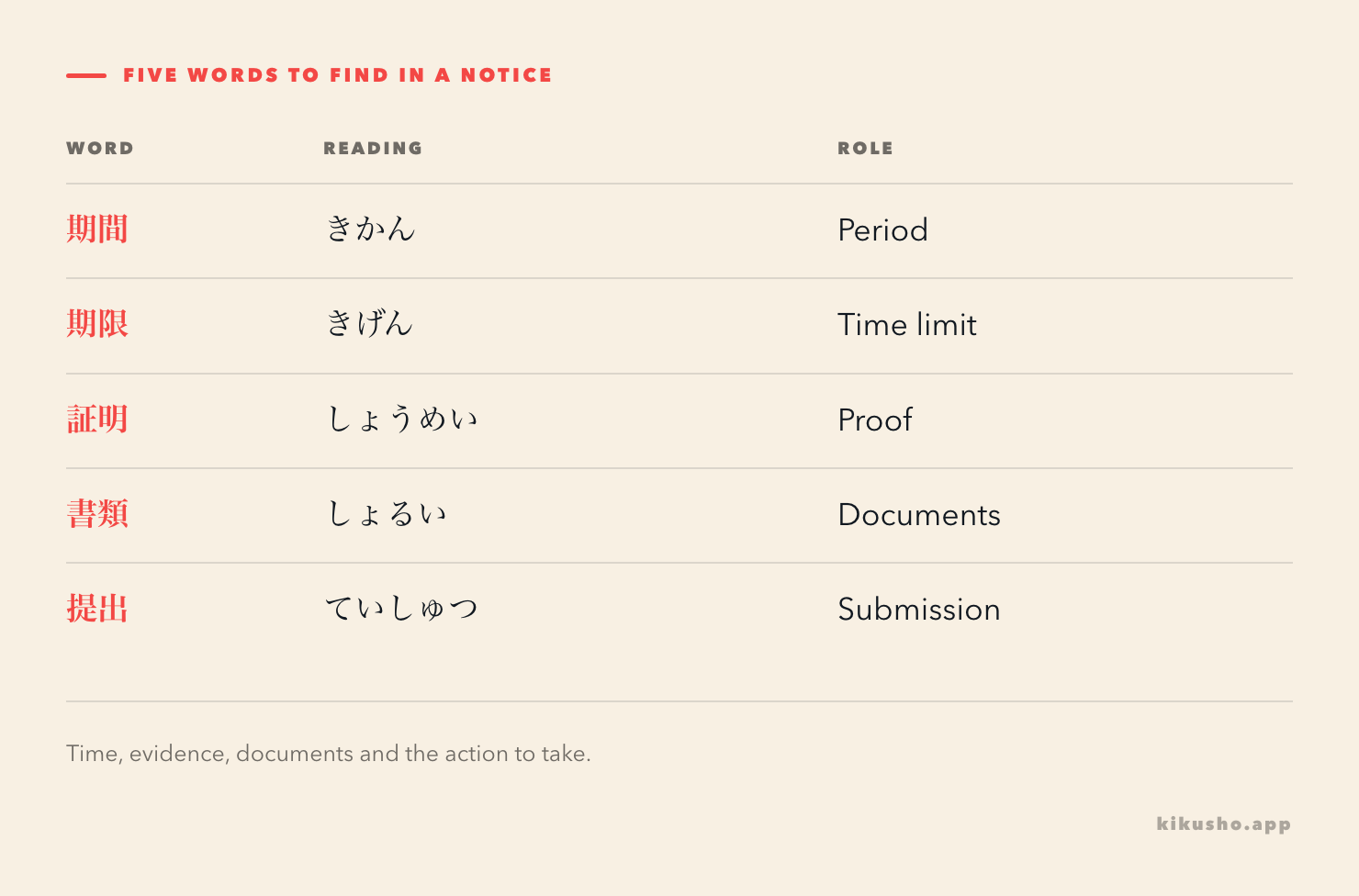
Five words help you read applications and public-service notices at N3: 期間 names a period, 期限 a set term or time limit, 証明 proof, 書類 documents, and 提出 submission. Together they let you find the available window, the limit, what must be established, what to prepare, and what action to take.
The difficult part is often a combination rather than an isolated kanji. 受付期間 and 提出期限 both concern time, but an application window and a submission cutoff answer different questions. Likewise, a document may provide proof, while submitting it is a separate action.
The five words cover time, evidence and an action
The noun and suru-verb uses below are the scope of this set. Read the full expression beside each headword; it supplies a job the English gloss alone can hide.
| Headword | Reading | Word class here | Selected meaning | Combination to recognise |
|---|---|---|---|---|
| 期間 | きかん | Noun | A span of time | 受付期間: reception or application period |
| 期限 | きげん | Noun | A fixed term; a time limit or deadline | 提出期限: submission time limit |
| 証明 | しょうめい | Noun / suru verb | Proof or verification; establish something as true | 住所を証明する: prove an address |
| 書類 | しょるい | Noun | Documents, especially records or administrative papers | 必要な書類: the required documents |
| 提出 | ていしゅつ | Noun / suru verb | Submission; hand something in | 書類を提出する: submit documents |
Here 受付 is read うけつけ. It can mean reception or the acceptance of applications, rather than the paper receipt from a shop. The N4 shopping-and-services lesson explains that prerequisite distinction. These five new headwords extend that setting into timing and paperwork.
期間 identifies a span, including a window for applications
受付期間は六月三日から六月十日までです。
The reception period is from June 3 to June 10.
準備期間は二週間程度です。
The preparation period is about two weeks.
Both are original illustrations. The first gives endpoints; the second describes an approximate length. 期間 itself names the span in either case. The approximation in the second comes from 程度, covered in the N3 amount-and-degree set, rather than from 期間.
The Shogakukan dictionary defines 期間 through the interval between times. Meshclass independently presents 期間 as a noun with an application-period example. A notice can specify dates, a duration, or both. The word does not supply opening hours that the notice has left unstated.
A single day written next to a heading is not automatically the whole window. Check whether the wording supplies a start, an end, or a length before deciding how that date functions.
期限 sets a limit, but its broader meaning includes a fixed term
提出期限は六月十日の午後五時です。
The submission deadline is 5 p.m. on June 10.
In this invented notice, 提出期限 identifies the cutoff for submission. Read the time as well as the date: 午後五時 means 5 p.m. The headword does not turn that explicit hour into midnight.
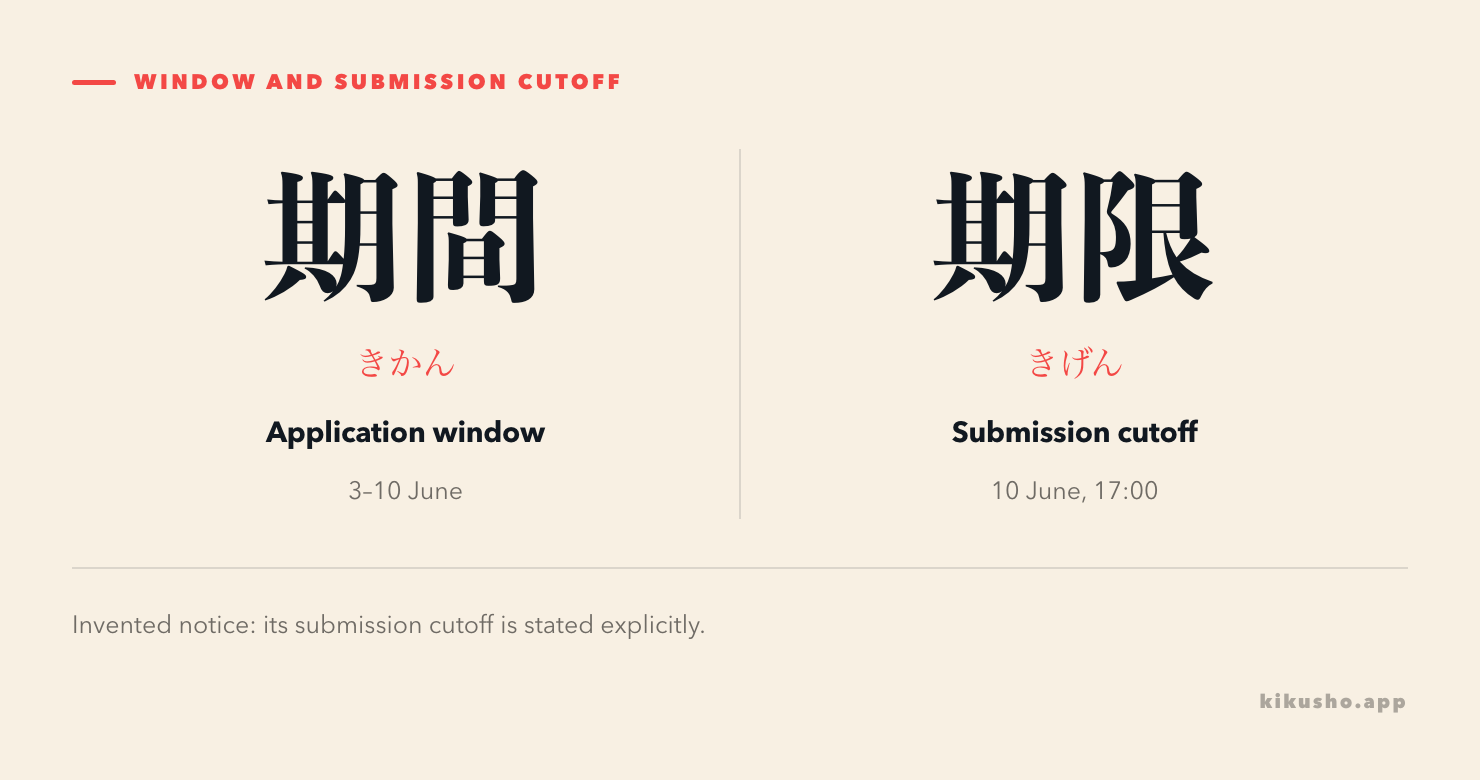
“期間 means a stretch, 期限 means a point” is useful for these two notice headings, but too narrow as a dictionary rule. Shogakukan's bilingual entry for 期限 separates a predetermined period or term from the point when it ends. Bunpro's 期限 page also records both groups of meanings. Let the expression and the stated details choose the interpretation.
With an action, までに expresses a deadline:
六月十日の午後五時までに提出してください。
Please submit it by 5 p.m. on June 10.
The action is to be completed by the stated limit, rather than performed continuously until it. This is a prerequisite time pattern, not another new N3 vocabulary item; Meshclass's までに explanation gives the deadline use.
証明 tells you what a document must establish
住所を証明する書類が必要です。
A document that proves your address is required.
証明する is the action of establishing something as true. Here 住所(じゅうしょ) is the fact to establish, marked by を. The clause 住所を証明する modifies 書類: it tells you what function the requested document must perform. The noun phrase 住所の証明 means “proof of the address.”
The dictionary entry for 証明 supports this ordinary proving sense and the suru verb. Bunpro's own summary and examples independently illustrate verification and proving identity. The word also appears in mathematics, but mathematical demonstration is outside this notice-reading set.
証明書(しょうめいしょ) names a document serving as evidence. The separate dictionary entry confirms that compound. It is a useful extension of 証明, rather than a reason to translate every 証明 as a physical certificate. You can prove a fact; a certificate is one possible object used for proof.
The address sentence does not name which document is acceptable. It gives a required function, not a complete checklist. Read the list attached to the actual notice to identify the requested items.
書類 names the paperwork; 提出 is what you do with it
必要な書類をそろえてください。
Please gather all the required documents.
書類を受付に提出しました。
I submitted the documents to reception.
書類 is the noun for the documents. そろえて comes from そろえる, to assemble or get a set together; 必要な(ひつような) identifies the documents as required. The first sentence asks for preparation, without reporting that anything has been handed in.
In the second, 書類 takes を as the object submitted and 受付 takes に as the recipient. 提出した is the plain past form; 提出しました is its polite counterpart. Meshclass's entries independently confirm 書類 as a noun and 提出 as a noun and suru verb for handing things in.
Submitting belongs in classrooms as well as offices: a report or homework can be submitted too. It is not a verb reserved for government procedures. In this set it reports handing something in, without asserting approval of an application or satisfaction of every requirement.
書類 does not specify the number or type of documents on its own. It also does not make all paperwork a 証明書. A form, a supporting certificate and another written record can have different functions within the same packet.
Two headwords take する; three remain nouns in these patterns
These endings belong to the ordinary する pattern. They make a notice's action visible even when no pronoun is written.
| Headword | Dictionary verb | Polite nonpast | て-form | Plain past |
|---|---|---|---|---|
| 証明 | 証明する | 証明します | 証明して | 証明した |
| 提出 | 提出する | 提出します | 提出して | 提出した |
期間, 期限 and 書類 are nouns in the uses taught here; adding する to each English gloss does not produce the corresponding Japanese action. By contrast, 書類の提出 uses 提出 as a noun: “submission of documents.”
提出してください combines the て-form with a polite request. If the ending is new, the N5 request lesson supplies the formation. A short instruction can ask you to submit without spelling out あなた.
For an unfamiliar notice, capture the expression that stopped you rather than a disconnected date. With Kikusho's photo capture, a heading such as 提出期限 can stay beside its original image. Review the reading and proposed example on the card before you keep it; the hour and the document requirement are details an invented generic example might lose.
Level labels differ most for 期限
The frozen curriculum brief assigns these five records to this N3 vocabulary lesson. 期間, 証明, 書類 and 提出 have N3 observations in the Waller-derived baseline, while 期限 has N3 and N2 observations even within that shared source family. Those descendants are not two independent level checks.
The Meshclass pages above explicitly place 期間, 書類 and 提出 at N3. Bunpro labels 証明 N3, but 期限 N4. The four inspected JapaneseTest4You pages identify 期間, 証明, 書類 and 提出 as N3 study words; their underlying list independence is unestablished.
This grouping teaches practical notice expressions at N3 while keeping 期限's N4/N3/N2 boundary visible. Dictionary definitions verify its meanings, not an exam assignment. Special legal senses of 期間 or 期限, historical readings, and mathematical proof are not covered by this lesson's exercises.
Practice
Work through all eight entries in order. The final correction block is below them, so you can keep a complete record of your decisions first.
Question 1
An organiser points to 期限 on a notice. Which reading matches that headword?
A. きかん
B. きがん
C. きけん
D. きげん
Question 2
The notice asks for しょるい, documents. Which spelling should appear in its checklist?
A. 書類
B. 書額
C. 署類
D. 諸類
Question 3
The paperwork is ready; the remaining action is to hand it in at reception. Select the headword for that action.
必要な書類を受付に( )してください。
A. 期間
B. 証明
C. 提出
D. 期限
Question 4
How would you interpret 受付期間は月曜日から木曜日までです。?
A. Documents are approved every Thursday.
B. Reception of applications runs from Monday to Thursday.
C. Submission happens only on Monday.
D. Every applicant must spend four days filling out a form.
Question 5
A notice states 提出期限は六月十日の午後五時です。 Which detail has it fixed?
A. The date when an application was approved.
B. The number of documents to prepare.
C. The beginning of the application window.
D. The submission cutoff, June 10 at 5 p.m.
Question 6
Which sentence correctly uses 証明する to describe establishing a fact, with that fact marked by を?
A. 来週の月曜日を証明して、書類を提出する。
B. この書類で住所を証明する。
C. 書類を机に証明する。
D. 受付期間を三日間から二週間に証明する。
Question 7
Someone reports 書類を受付に提出しました。 What has the sentence reported?
A. The documents were handed in to reception.
B. The application has been approved.
C. The documents were gathered but have not been handed in.
D. A certificate was issued by reception.
Question 8
Which sentence uses 期間 as a noun for the available window, without inventing a verb from it?
A. 受付を期間してください。
B. 期間する書類をそろえます。
C. 受付期間は一週間です。
D. 書類を受付に期間しました。
Use your finished list of eight letters to check both the meanings and the attachments that guided your choices.
Answers and explanations
Answer 1. D. 期限 is read きげん. A is the reading of the different assigned word 期間. B changes the vowel in the second part and C removes the voicing; neither gives the requested reading. Matching the initial き is not enough to identify the compound.
Answer 2. A. 書類 spells しょるい for documents. B replaces 類 with 額, C replaces 書 with 署, and D replaces it with 諸. The checklist needs the complete headword, rather than a character that merely resembles one half of it.
Answer 3. C. 提出してください asks the reader to submit. 証明する would concern establishing something as true, not the specified act of handing in the ready documents. 期間 and 期限 name time spans or limits and do not form the submission verb in this slot.
Answer 4. B. 月曜日から木曜日まで describes the reception window. A inserts approval, C discards most of that window, and D treats the window as time each individual must spend on an application. 受付期間 describes when reception is available, not the duration of every applicant's work.
Answer 5. D. 提出期限 supplies the submission limit and the sentence explicitly supplies 午後五時, 5 p.m. A changes submission into approval. B adds a document count, and C mistakes the limit for the opening of the window. None preserves both the function and the stated time.
Answer 6. B. 住所を証明する makes the address the fact established, using the document as evidence. A supplies an isolated weekday rather than a fact to demonstrate. C treats 証明する as though it meant put a document on a desk. D treats the verb as though it changed a period from three days to two weeks; 証明する does not mean extend a period. The selected ordinary proving use does not perform those other actions.
Answer 7. A. 提出しました reports the completed act of handing in the documents. B adds approval that this verb does not state; C denies the reported submission. D invents the issuing of a certificate, with reception as its issuer rather than the recipient of these documents.
Answer 8. C. 受付期間は一週間です uses 期間 as a noun and gives the window's length. A, B and D invent 期間する or its conjugated forms as the action of receiving or submitting documents. The noun needs a predicate such as です here; it does not borrow 提出する's verb behaviour.
Common questions
What is the difference between 期間 and 期限 on an application notice?
受付期間 names the application or reception window, while 提出期限 names the submission time limit. More broadly, 期限 can also mean a fixed term or period, so the distinction depends on the expression and its details.
Does 証明 mean the same thing as 証明書?
証明 means proof or verification and can form the verb 証明する, to prove. 証明書 is a document serving as evidence that something is true. The certificate is an object; proving is the function it can perform.
Does 提出した mean an application was approved?
提出した reports that something was submitted or handed in. It does not itself state that an application was approved or that the documents satisfied every requirement.