On this page
These fourteen N3 Japanese illness, symptoms and recovery vocabulary words let you describe a health problem from prevention to recovery. The key is to learn the relationships: a 傷 is a wound, 痛み is the pain you feel, a 検査 checks the condition, 治療 treats it, and 回復 describes improvement afterward.
This is a language lesson rather than a list of interchangeable medical labels. Each word has a distinct grammatical role and a typical partner that makes it sound natural.
Fourteen N3 words form one patient journey
| Word | Kana and rōmaji | Grammar role | Core meaning | Natural anchor |
|---|---|---|---|---|
| 痛み | いたみ, itami | noun | pain; ache | 痛みがある: have pain |
| 回復 | かいふく, kaifuku | noun; suru verb | recovery; restoration | 体力が回復する: strength returns |
| 患者 | かんじゃ, kanja | noun | patient | 患者を診察する: examine a patient |
| 傷 | きず, kizu | noun | wound; injury; scratch | 傷が治る: a wound heals |
| 苦痛 | くつう, kutsū | noun; na-adjective | physical or mental suffering | 苦痛を感じる: feel distress or pain |
| 苦しい | くるしい, kurushii | i-adjective | painful; hard to bear; difficult | 息が苦しい: breathing feels difficult |
| 検査 | けんさ, kensa | noun; suru verb | examination; inspection; test | 検査を受ける: undergo an examination |
| 症状 | しょうじょう, shōjō | noun | symptom; condition | 症状が出る: symptoms appear |
| 睡眠 | すいみん, suimin | noun | sleep | 睡眠をとる: get sleep |
| 頭痛 | ずつう, zutsū | noun | headache | 頭痛がする: have a headache |
| 治療 | ちりょう, chiryō | noun; suru verb | medical treatment | 治療を受ける: receive treatment |
| 疲れ | つかれ, tsukare | noun | tiredness; fatigue | 疲れが取れる: fatigue goes away |
| 吐く | はく, haku | transitive godan verb | vomit; exhale; utter | 息を吐く: breathe out |
| 予防 | よぼう, yobō | noun; suru verb | prevention | 病気を予防する: prevent illness |
Notice the long vowels in 苦痛(くつう), 症状(しょうじょう), 頭痛(ずつう), 治療(ちりょう) and 予防(よぼう). The spelling is part of the reading, even when the extra mora is subtle in fast speech.
傷, 痛み, 苦痛 and 苦しい describe different parts of an experience
English “pain” can point to an injury, a sensation, broad suffering or a difficult state. Japanese separates those jobs.
傷(きず) is damage to a body or an object. It can be visible even when it does not hurt.
転んだとき、腕に小さな傷ができました。
ころんだとき、うでにちいさなきずができました。
I got a small wound on my arm when I fell.
痛み(いたみ) is the sensation of pain or an ache. It may come from a visible 傷, but the words do not name the same thing.
傷は小さいですが、まだ痛みがあります。
きずはちいさいですが、まだいたみがあります。
The wound is small, but it still hurts.
The dictionary entry for 痛み includes bodily suffering caused by illness or injury and also emotional sorrow. Learn the noun with 痛みがある, 痛みを感じる and 痛みが治まる.
苦痛(くつう) widens the focus to physical or mental suffering. Its dictionary definition covers both. It can behave as a noun in 苦痛を感じる and as a na-adjective in 苦痛な時間.
同じ姿勢を続けることが、だんだん苦痛になりました。
おなじしせいをつづけることが、だんだんくつうになりました。
Staying in the same position gradually became painful.
苦しい(くるしい) is an i-adjective. It describes a state that feels hard to bear: bodily pain, difficult breathing, emotional pressure or even financial hardship.
階段を上ったあと、しばらく息が苦しかったです。
かいだんをのぼったあと、しばらくいきがくるしかったです。
After climbing the stairs, breathing was difficult for a while.
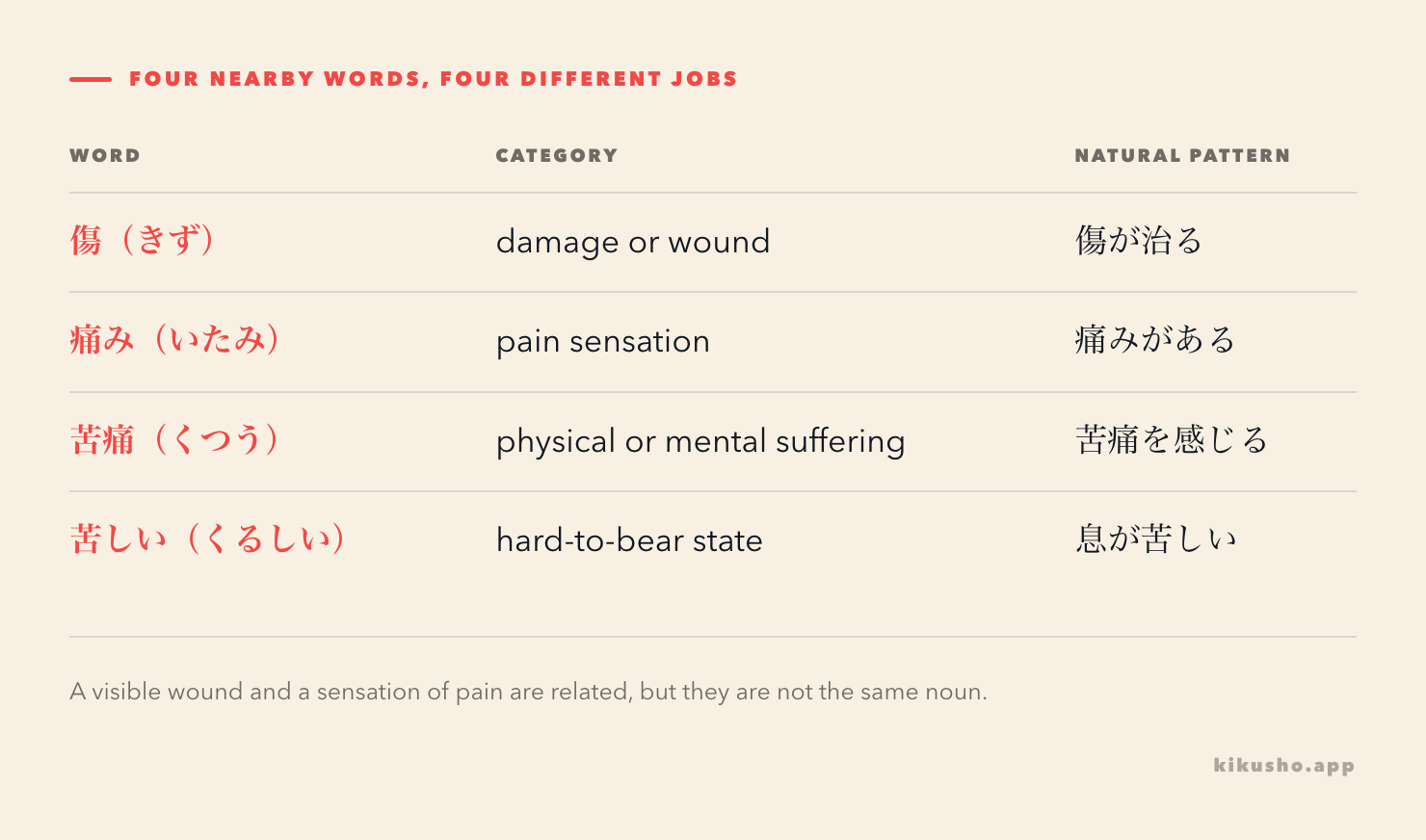
The quick test is grammatical as well as semantic: 傷 and 痛み are things you have, 苦痛 is suffering you experience, and 苦しい describes how the state feels.
症状 names what appears, while 患者 names a role
症状(しょうじょう) is a manifestation or condition associated with a health problem. A headache can be a 症状; the underlying 病気 is the illness itself.
頭痛はこの病気によく見られる症状の一つです。
ずつうはこのびょうきによくみられるしょうじょうのひとつです。
A headache is one of the symptoms often seen with this illness.
Common patterns show how the word behaves:
| Pattern | Meaning |
|---|---|
| 症状が出る | symptoms appear |
| 症状が続く | symptoms continue |
| 症状が軽い/重い | symptoms are mild / severe |
| 症状を伝える | describe the symptoms to someone |
| 症状が改善する | symptoms improve |
Japan's Ministry of Education materials for practical Japanese group expressions such as 喉が痛い, 鼻水が出る and 頭痛 as ways to communicate a condition. Those concrete observations are what a speaker can report as 症状.
患者(かんじゃ) identifies a person from the viewpoint of medical care: someone receiving an examination or treatment. The dictionary definition explicitly connects the person with treatment for illness or injury.
医師は患者の症状を詳しく聞きました。
いしはかんじゃのしょうじょうをくわしくききました。
The doctor asked the patient about the symptoms in detail.
Do not treat 患者 and 病人(びょうにん) as perfect synonyms. 病人 simply means a sick person. 患者 foregrounds the person's role in relation to a clinician or a healthcare setting. A 病人 resting at home may become a 患者 when examined at a clinic.
For simpler hospital words such as 病院, 医者, 薬 and 注射, review the N4 health and hospital vocabulary lesson.
疲れ, 睡眠 and 頭痛 describe common states
疲れ(つかれ) is the noun formed from 疲れる, “to become tired.” It names tiredness or fatigue rather than the action of resting.
昨日の疲れがまだ残っています。
きのうのつかれがまだのこっています。
Yesterday's fatigue is still lingering.
Two nearly opposite collocations are worth memorising:
- 疲れがたまる: fatigue builds up
- 疲れが取れる: fatigue goes away
睡眠(すいみん) is the noun for sleep. 睡眠をとる means to get sleep, while 睡眠不足(すいみんぶそく) means lack of sleep. The 睡眠 entry records both patterns.
十分な睡眠をとったら、疲れが少し取れました。
じゅうぶんなすいみんをとったら、つかれがすこしとれました。
After getting enough sleep, some of my fatigue went away.
頭痛(ずつう) joins 頭, head, with 痛, pain. The reading is ずつう, not とうつう. In everyday description, 頭痛がする reports the sensation and 頭痛が続く says it continues.
朝から頭痛がして、仕事に集中できません。
あさからずつうがして、しごとにしゅうちゅうできません。
I have had a headache since this morning and cannot concentrate on work.
頭痛 also has a figurative sense: a troublesome matter can be 頭痛の種, “a source of worry.” The dictionary entry records both the bodily symptom and that extended use.
吐く keeps the reading はく across three meanings
吐く(はく) is a transitive godan verb. The object before を tells you which meaning is active.
| Pattern | Meaning | Example |
|---|---|---|
| 食べた物を吐く | vomit what was eaten | 気分が悪くて、食べた物を吐いた。 |
| 息を吐く | breathe out; exhale | ゆっくり息を吐いてください。 |
| うそを吐く | tell a lie | 彼はうそを吐かなかった。 |
The dictionary entry for 吐く connects these senses through expelling something from inside: stomach contents, breath or words. In all three rows above, the reading is はく.
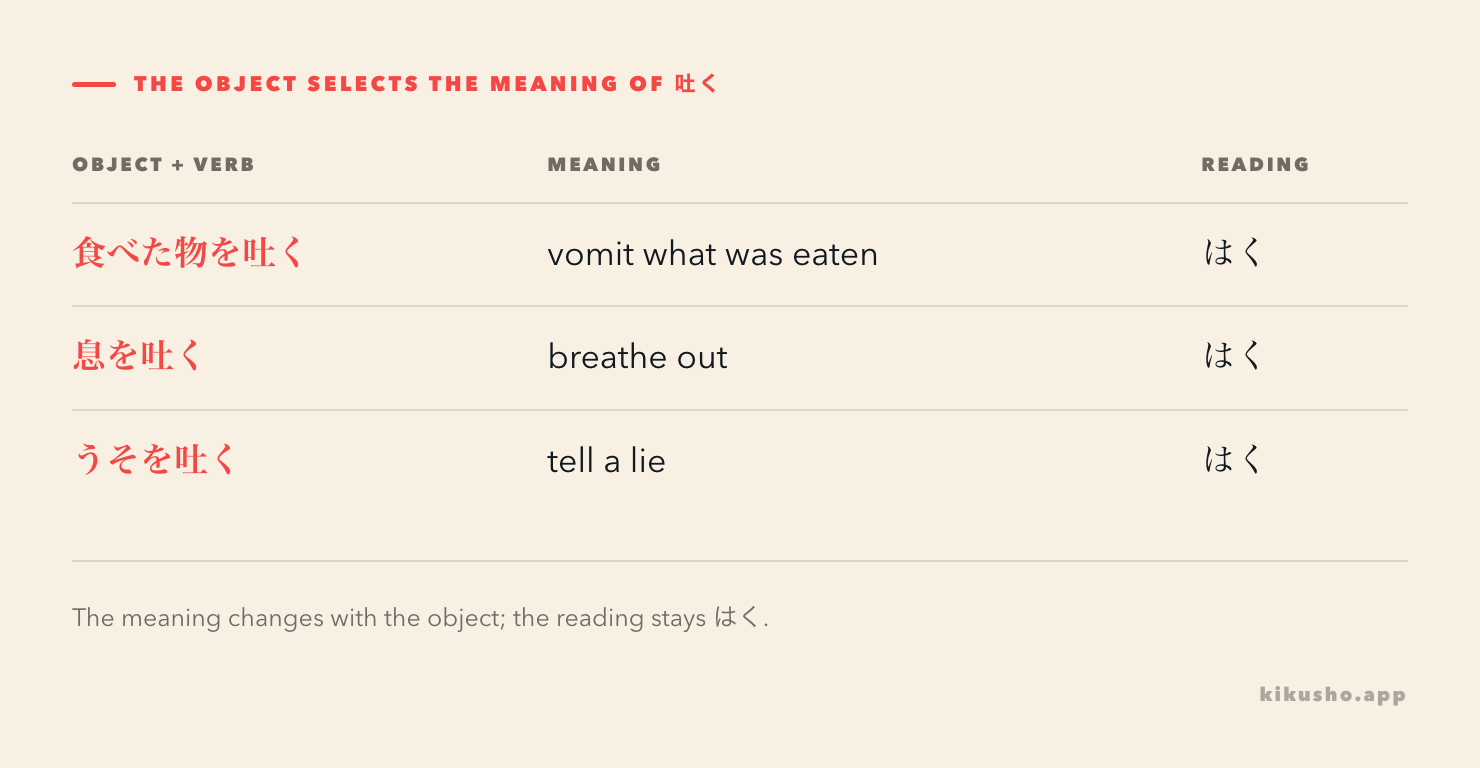
Context prevents confusion. 息を吐く cannot mean “vomit breath,” and うそを吐く is about speech rather than a bodily symptom.
検査 checks the condition; 治療 acts on it
検査(けんさ) means checking something against a standard or examining it for a condition. It is broader than medicine: products, vehicles and documents can also undergo 検査. The Digital Daijisen entry centres on examining for abnormalities or suitability.
患者は病院で血液検査を受けました。
かんじゃはびょういんでけつえきけんさをうけました。
The patient underwent a blood test at the hospital.
From the patient's viewpoint, use 検査を受ける, undergo an examination. From the examiner's viewpoint, 検査を行う or 検査する names carrying it out.
治療(ちりょう) is the medical action intended to cure or improve an illness, symptom or injury. The dictionary entry makes improvement the defining purpose.
検査のあと、すぐに治療が始まりました。
けんさのあと、すぐにちりょうがはじまりました。
Treatment began immediately after the examination.
Both words combine naturally with 受ける, but they still name separate stages:
| Patient-centred phrase | What happens |
|---|---|
| 検査を受ける | the condition is checked or information is gathered |
| 治療を受ける | care intended to improve the condition is provided |
An examination can guide treatment. It is not itself automatically a treatment.
The N2 illness and recovery lesson adds 診断, the medical judgment made from examination and test evidence, together with advanced symptom and recuperation vocabulary.
予防 comes before a problem; 回復 follows a poor state
予防(よぼう) means acting beforehand so an undesirable situation does not occur. The Digital Daijisen definition captures that timing directly.
病気を予防するために、手をよく洗います。
びょうきをよぼうするために、てをよくあらいます。
I wash my hands carefully to prevent illness.
The exact action varies with the problem. What stays constant is the time relation: 予防 is undertaken before the unwanted event.
回復(かいふく) means returning from a poor state toward the former state. In health language, 病気から回復する focuses on a person emerging from illness, while 体力が回復する makes physical strength the thing that returns.
治療を受けて、少しずつ体力が回復しました。
ちりょうをうけて、すこしずつたいりょくがかいふくしました。
After receiving treatment, my strength gradually returned.
The word is not limited to health. Weather, an economy, trust and performance can recover too. Its dictionary definition is the broader return from a bad condition to the previous one.
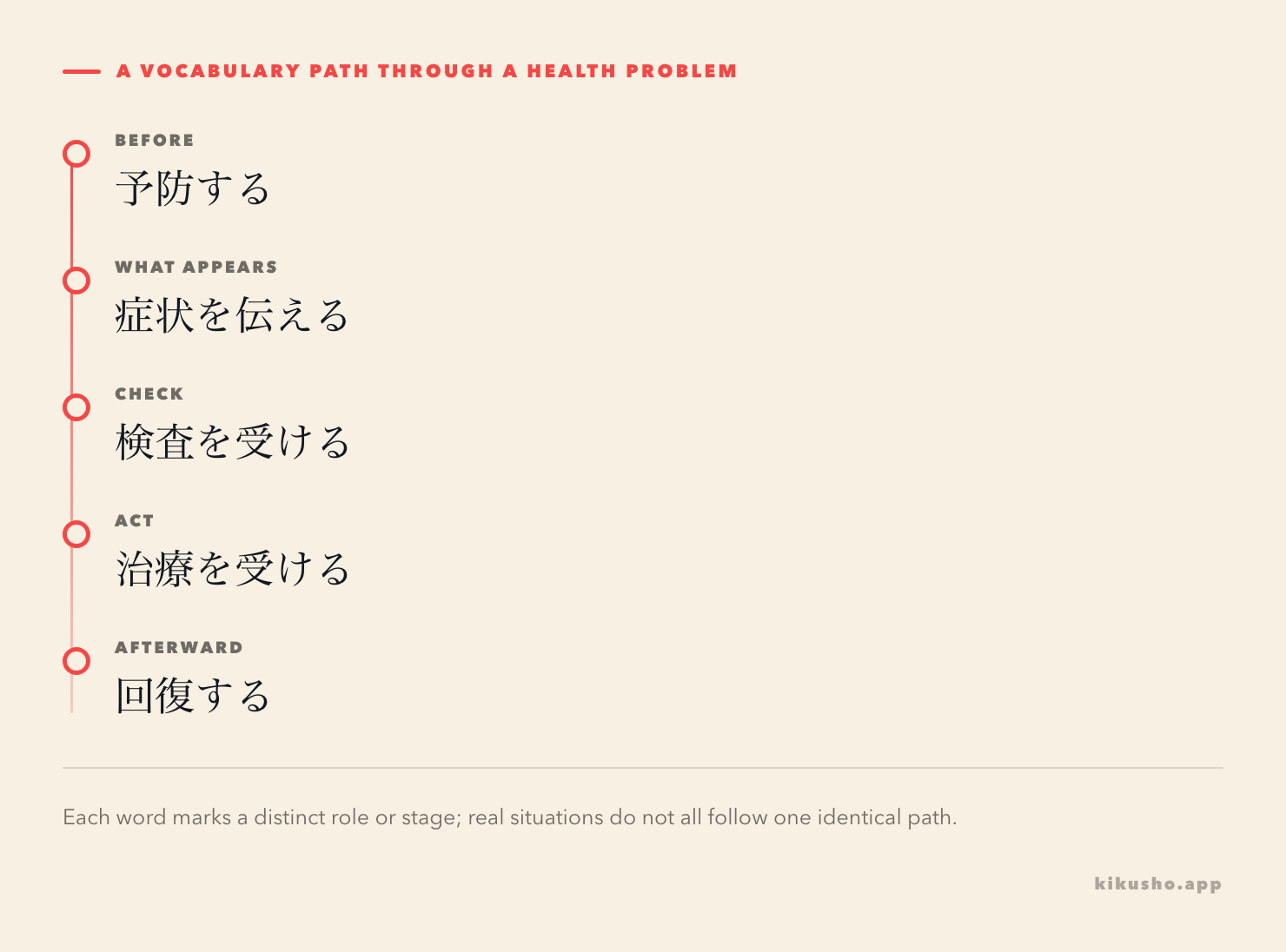
The sequence is a vocabulary map, not a promise that every real situation follows identical steps. Its value is that each term has a stable position:
- 予防する — act beforehand.
- 症状が出る/症状を伝える — a condition appears and is described.
- 検査を受ける — the condition is examined.
- 治療を受ける — care is provided.
- 回復する — the person or condition improves.
A connected scene uses all fourteen words
Read once for the situation, then again to find the stage and role of every highlighted item.
患者は昨日から頭痛と強い疲れがあり、十分な睡眠をとっても症状がよくなりませんでした。朝、食べた物を吐き、息も苦しくなったため、病院へ行きました。前の日に転んでできた腕の傷にも痛みがあり、同じ姿勢で待つことも苦痛でした。医師は症状を聞いてから検査を行い、治療を始めました。患者は少しずつ回復し、最後に病気の予防について説明を受けました。
かんじゃはきのうからずつうとつよいつかれがあり、じゅうぶんなすいみんをとってもしょうじょうがよくなりませんでした。あさ、たべたものをはき、いきもくるしくなったため、びょういんへいきました。まえのひにころんでできたうでのきずにもいたみがあり、おなじしせいでまつこともくつうでした。いしはしょうじょうをきいてからけんさをおこない、ちりょうをはじめました。かんじゃはすこしずつかいふくし、さいごにびょうきのよぼうについてせつめいをうけました。
The patient had had a headache and severe fatigue since the previous day, and the symptoms did not improve even after getting enough sleep. In the morning, the patient vomited food and began to have difficulty breathing, so they went to the hospital. A wound on the arm from a fall the previous day was also painful, and waiting in the same position was distressing. After asking about the symptoms, the doctor performed an examination and began treatment. The patient gradually recovered and finally received an explanation about illness prevention.
The passage does not use fourteen isolated translations. It connects nouns to their usual particles and verbs: 頭痛がする, 睡眠をとる, 検査を行う, 治療を始める and 病気から回復する.
N3 practice: readings, context and usage
1 · Reading at reception. A form contains 頭痛. Which pronunciation should the patient use?
A. とうつう
B. ずつう
C. あたまいた
D. ずうつ
2 · Writing a reported condition. Which spelling represents しょうじょう?
A. 症状
B. 病状
C. 症情
D. 病情
3 · Classifying a headache. Complete: 朝から頭痛がする。これは風邪の__かもしれない。
A. 患者
B. 症状
C. 睡眠
D. 予防
4 · Identifying a person in care. Only one sentence gives 患者 its natural role. Which one?
A. この患者を飲んでください。
B. 患者が病院で検査を受けました。
C. 頭痛を患者しました。
D. よく寝て患者が取れました。
5 · Separating damage from sensation. A cut is visible on your hand, but it does not hurt. Which sentence best describes the situation?
A. 手に傷がありますが、痛みはありません。
B. 手に苦しいがありますが、患者はありません。
C. 手に痛みがありますが、傷はありません。
D. 手に検査がありますが、治療はありません。
6 · Following a change in fatigue. Which sentence is closest to 疲れが取れました?
A. I became more tired.
B. My fatigue went away.
C. I prevented sleep.
D. My headache appeared.
7 · Letting the object choose the sense. What does 吐く mean in 窓を開けて、ゆっくり息を吐いた?
A. to vomit
B. to tell a lie
C. to breathe out
D. to receive treatment
8 · Reconstructing the journey. Which order best matches the vocabulary map in this lesson?
A. 回復 → 予防 → 治療 → 検査
B. 検査 → 症状 → 予防 → 回復
C. 予防 → 症状 → 検査 → 治療 → 回復
D. 治療 → 患者 → 痛み → 睡眠
9 · Dividing investigation from intervention. Complete both blanks: 医師は原因を調べるために__を行い、その結果を見て__を始めました。
A. 回復・予防
B. 治療・検査
C. 検査・治療
D. 睡眠・苦痛
10 · Reading a short report. Read: 昨日から頭痛と疲れが続いています。十分な睡眠をとりましたが、症状はよくなりませんでした。 Which statement is supported?
A. The person recovered after sleeping.
B. The symptoms continued despite sleep.
C. The person has a visible wound.
D. A medical examination prevented the headache.
Reveal the ten solutions
1 · B, ずつう. 頭 is voiced to ず in this compound. The second half 痛 is つう, producing ずつう.
2 · A, 症状. 症 refers to an illness or symptom and 状 to a state or condition. The distractors use real kanji but do not write this target word.
3 · B, 症状. A headache can be a symptom of an illness. 患者 is a person, 睡眠 is sleep, and 予防 is action taken beforehand.
4 · B. 患者 is a person receiving examination or treatment, so a patient can undergo an examination at a hospital. The other choices force a person noun into the roles of medicine, a verb or fatigue.
5 · A. 傷 names the visible wound, while 痛み names the sensation. Either can exist without the other.
6 · B. 疲れが取れる literally presents the fatigue as being removed or clearing, so the person feels less tired.
7 · C. The object 息, breath, selects the “breathe out” sense of 吐く. The same verb has other meanings with objects such as 食べた物 and うそ.
8 · C. 予防 belongs before the problem. 症状 can then be reported, 検査 gathers information, 治療 acts on the condition, and 回復 describes improvement afterward.
9 · C, 検査・治療. The first purpose is to investigate the cause, so 検査 fits. The result then informs an intervention, so 治療 fits the second blank.
10 · B. The text explicitly says that the headache and fatigue continued and the symptoms did not improve even after enough sleep. It mentions neither a wound nor an examination.
Keep these phrases: 症状が出る, 検査を受ける, 治療を受ける, 疲れが取れる and 病気から回復する. The N5 body parts and pain lesson supplies simpler location patterns, while the N3 body, senses and movement lesson adds internal organs, 息/呼吸 and 伸ばす/伸びる.
These records are placed at N3 in Kikusho's inventory and in current JLPT study lists, although 治療 appears at N1 in one older source family. Because the JLPT does not publish an official vocabulary list, level labels are study-guide mappings rather than an exam-issued syllabus. The word relationships and usage patterns remain useful regardless of that single placement disagreement.
Common questions
What is the difference between 痛み, 苦痛 and 苦しい?
痛み is a noun for pain or an ache. 苦痛 is the wider noun for physical or mental suffering and often sounds stronger. 苦しい is an i-adjective that describes a state that is painful, hard to bear or physically difficult, as in 息が苦しい.
What is the difference between 患者 and 病人?
患者 identifies someone in the role of receiving medical examination or treatment. 病人 simply identifies a sick person. Someone can therefore be a 病人 at home and become a 患者 when consulting a medical professional.
How are 検査 and 治療 different?
検査 checks a condition or gathers information, as in 検査を受ける. 治療 is an intervention intended to cure or improve an illness or injury, as in 治療を受ける. An examination may guide treatment, but the words name different stages.
How do 予防, 治療 and 回復 fit together?
予防 is action taken beforehand to prevent a problem. 治療 is care given after an illness or injury occurs. 回復 is the process or result of returning from a poor condition toward the former state.