On this page
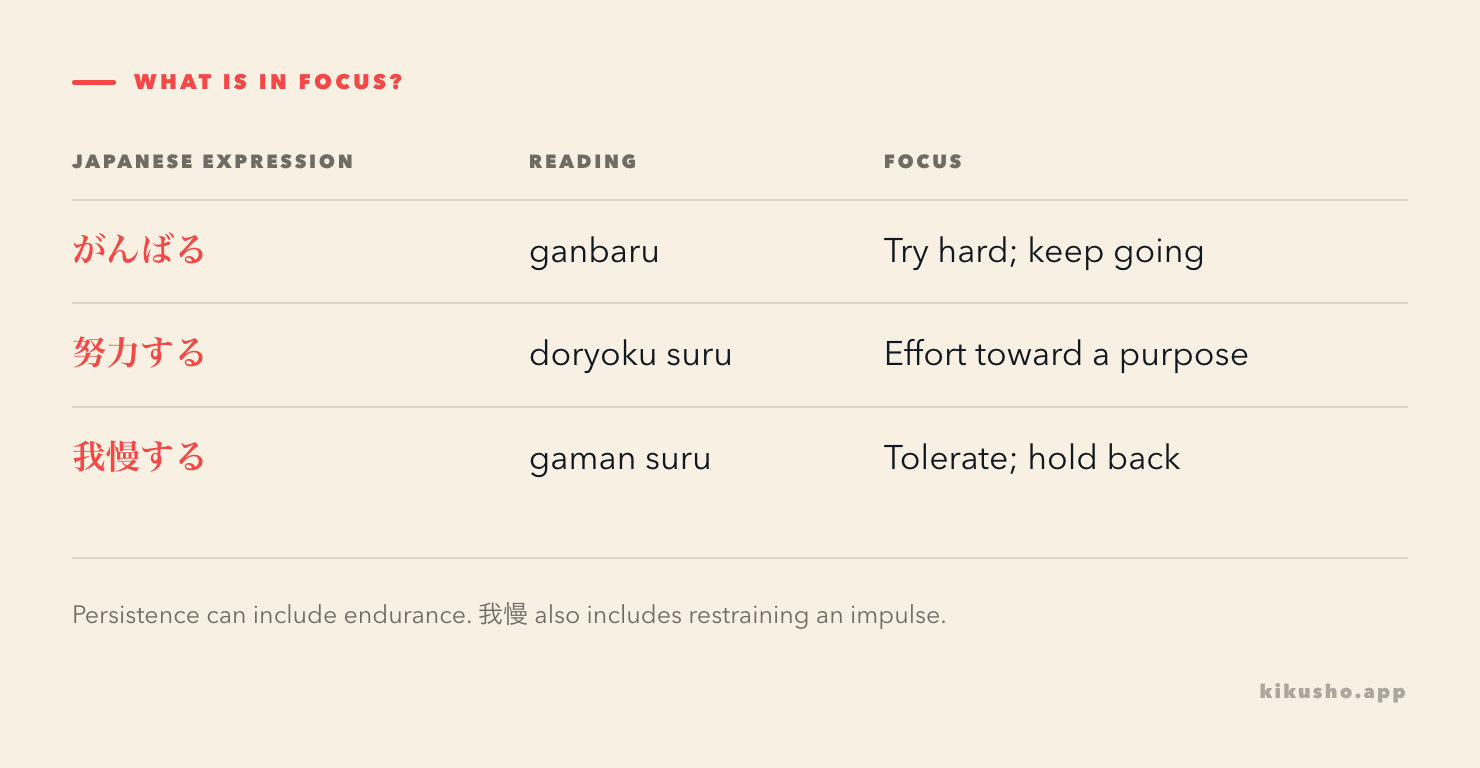
がんばる means to try hard or keep going; 努力(どりょく) names effort toward a purpose; 我慢(がまん) focuses on tolerating something or holding back an impulse. Choose by what you want to describe, while allowing that persistence, effort and endurance can happen together.
This N3 vocabulary lesson also teaches 苦労(くろう), hardship or difficulty experienced; 真剣(しんけん), serious or earnest; and 勇気(ゆうき), courage. Those three help you describe the trouble, attitude and nerve surrounding an effort without treating every word as another translation of “try.”
Ask what the sentence puts in focus
Before picking the Japanese word, ask what the sentence is about. Are you acknowledging someone who kept at a task? Naming the effort invested in it? Describing discomfort they bore, or something they resisted doing?
The grammatical shape matters too. Here are the six headwords and combinations worth keeping with them:
| Headword | Reading | Word class in this lesson | Focus and useful combination |
|---|---|---|---|
| 頑張る・がんばる | がんばる, ganbaru | Godan verb ending in る | Try hard, persist; 最後までがんばる(さいごまでがんばる), keep going to the end |
| 努力 | どりょく, doryoku | Noun; also 努力する | Effort toward a purpose; 努力を続ける(どりょくをつづける), continue making an effort |
| 我慢 | がまん, gaman | Noun; also 我慢する | Endurance or restraint; 音を我慢する(おとをがまんする), put up with a sound |
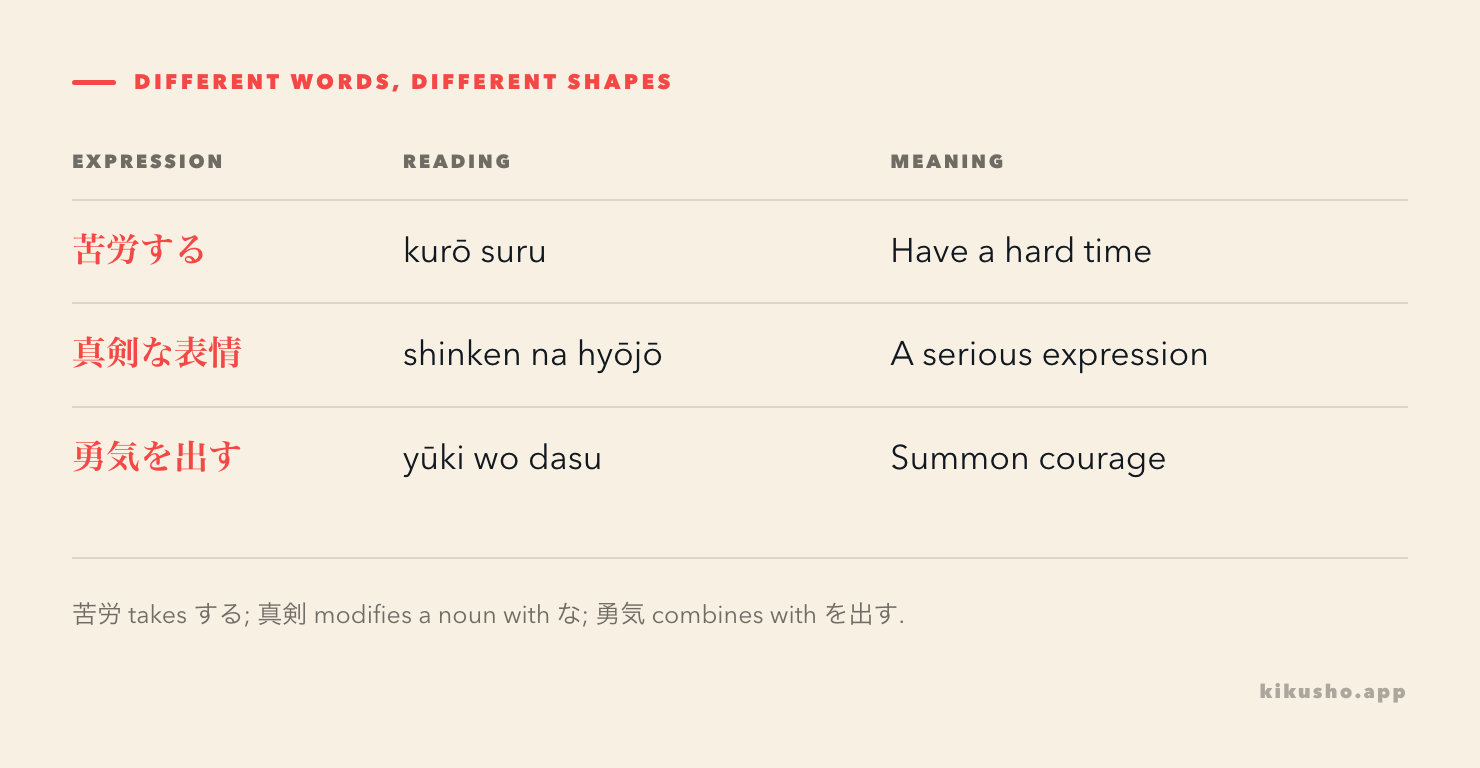
| 苦労 | くろう, kurō | Noun; also 苦労する | Hardship, trouble, difficult work; 仕事で苦労する(しごとでくろうする), have a hard time at work |
| 真剣 | しんけん, shinken | な-adjective in the earnestness sense | Serious engagement; 真剣に聞く(しんけんにきく), listen seriously |
| 勇気 | ゆうき, yūki | Noun | Courage; 勇気を出す(ゆうきをだす), summon courage |
The modern endurance meaning of 我慢 is the one used here. The dictionaries also record older or specialized senses. Likewise, the literal “real sword” sense of 真剣 is outside this comparison.
がんばる acknowledges trying hard and keeping going
You have spent the afternoon assembling a shelf. It is still unfinished, but someone has seen how much you did:
今日はよくがんばったね。
きょうはよくがんばったね。
“You worked really hard today.”
The praise can acknowledge effort without announcing success. “You did it” would add an outcome the Japanese sentence does not state.
Shogakukan’s Daijisen entry for 頑張る includes persevering despite difficulty. That makes a strict “がんばる is active, 我慢 is passive” division too narrow: keeping going can involve endurance. The entry also records stubborn insistence and staying planted in a place; those are separate senses, rather than reasons to translate every がんばる as friendly encouragement.
がんばる conjugates as a godan verb, despite ending in る:
| Use | Form | Reading |
|---|---|---|
| Polite | 頑張ります | がんばります |
| て-form | 頑張って | がんばって |
| Plain past | 頑張った | がんばった |
| Plain negative | 頑張らない | がんばらない |
The verb-group lesson explains the classification. You will meet the word in kanji and kana; neither spelling changes these endings.
がんばって is familiar encouragement. がんばれ has an imperative form and a more forceful sound, often heard in cheering. がんばってください adds a polite request ending, but politeness alone does not decide whether encouragement is welcome. Yukari Yokoyama’s FUN! JAPAN guide discusses these forms and cautions that urging an exhausted person to try harder can add pressure.
努力 names the effort, so it can become the subject
努力 is useful when you want to talk about the work invested in a goal:
毎日、発音を直すために努力しています。
まいにち、はつおんをなおすためにどりょくしています。
“I work at improving my pronunciation every day.”
Here 努力する supplies the verb. In 努力を続ける, “continue making an effort,” 努力 is instead the noun being continued. In 努力が実った(どりょくがみのった), “the effort bore fruit,” it is the subject.
Kanjipedia’s effort entry and Daijisen support exertion directed toward a purpose. Neither definition makes success part of the word: effort can fail, and a sentence about its result must tell you what happened.
努力 can sound more deliberate than the everyday encouragement がんばって. It is nevertheless available in ordinary conversation, not confined to reports. Nor does it require a grand project or a particular duration. The lesson on ~ために gives more detail on expressing the goal; you do not need ために in every sentence containing 努力.
我慢 describes what you bear or refrain from doing
Construction noise is audible through your wall:
工事の音を我慢しています。
こうじのおとをがまんしています。
“I’m putting up with the construction noise.”
The object marks what is being tolerated. The sentence does not say you are working to improve the noise or reach a goal.
我慢 also covers restraining yourself when you want to do something:
欲しいけれど、今は買うのを我慢します。
ほしいけれど、いまはかうのをがまんします。
“I want it, but I’ll hold off buying it for now.”
In 買うのを我慢する, の turns the action “buy” into what you hold back from doing. That restraint involves a choice; calling 我慢 purely passive would miss it. Both Daijisen’s usage discussion and Kanjipedia include restraint of a desire alongside endurance.
An instruction to 我慢して asks someone to bear something or restrain themselves. It does not automatically offer the encouragement of がんばって. The word itself does not tell you whether putting up with the situation is wise or necessary.
One task can involve both がんばる and 努力する
Both of these are ordinary ways to describe preparation:
| Sentence | Reading | Emphasis |
|---|---|---|
| 試験に向けてがんばっています。 | しけんにむけてがんばっています。 | “I’m working hard toward the exam”; persistence or commitment |
| 試験に向けて努力しています。 | しけんにむけてどりょくしています。 | “I’m making an effort toward the exam”; effort invested |
The second does not become correct by making the first incorrect. A quiz that asks for the only grammatical word in this pair would need more information.
The same person might also be putting up with a noisy study space. That discomfort could be described with 我慢 while the preparation is described with either of the other two. Changing the word changes what the sentence highlights, not necessarily what happened.
苦労 adds the difficulty experienced
苦労 focuses on having a hard time, including the strain of difficult work:
新しい仕事に慣れるのに苦労しました。
あたらしいしごとになれるのにくろうしました。
“I had a hard time getting used to the new job.”
慣れるのに identifies the task that was difficult. Another common pattern is 仕事で苦労する, having trouble in or through one’s work. Read 慣れる as なれる, “get used to.”
Daijisen and Kanjipedia connect 苦労 with mental or physical strain and effort. Do not reduce it to an external obstacle with no action involved. You can struggle while working toward a goal; 苦労 foregrounds the burden, whereas 努力 foregrounds exertion toward the purpose. Neither word, by itself, says whether the work succeeded.
真剣 gives the attitude; 勇気 gives the courage
You can describe someone taking an explanation seriously without making a claim about how difficult the explanation was:
真剣な表情で説明を聞いていました。
しんけんなひょうじょうでせつめいをきいていました。
“They listened to the explanation with a serious expression.”
For this earnestness sense, 真剣 behaves as a な-adjective: 真剣な表情, “a serious expression”; 真剣に聞く, “listen seriously”; 真剣です, “is serious.” The adjective describes engagement, not necessarily anger or a bad mood. The corresponding entries in Daijisen and Kanjipedia distinguish it from the literal sword noun.
勇気 is a noun, not another する verb:
勇気を出して、知らない人に道を聞きました。
ゆうきをだして、しらないひとにみちをききました。
“I plucked up my courage and asked a stranger for directions.”
勇気を出す is to summon courage. 勇気がある(ゆうきがある)means to have courage; 質問する勇気がない(しつもんするゆうきがない)means not to have the courage to ask a question. Daijisen and Kanjipedia identify the courage or strength of spirit. Do not replace 出す with する to form 勇気する.
The N3 placement includes an earlier verb
The five words 我慢, 苦労, 真剣, 努力 and 勇気 have N3 placements in the dated study inventory used for this series, also reflected on JapaneseTest4You’s individual vocabulary pages. The inventory places がんばる at N4, as does JapaneseTest4You’s 頑張る page. It is earlier vocabulary being compared more carefully here.
The inventory’s two Waller-derived lists share an ancestry, so their agreement is one source family. JapaneseTest4You is a separately published placement whose underlying list independence has not been established. The official JLPT FAQ explains why exhaustive vocabulary specifications are no longer published. These labels organize study; they are not official word boundaries.
When a message contains 勇気を出して質問した, paste the full expression into Kikusho. Check the drafted meaning and keep the example’s connection between courage and asking; every card field is editable before saving. A card headed only “try” would discard the distinction the sentence gave you. For other words that name an attitude or quality, the section’s abstract-noun lesson continues that work.
Try six questions before reading the solutions
These are original exercises in the vocabulary formats used at N3. Choose one answer per question. All solutions follow Question 6.
Question 1 — kanji reading. Read the bold word in 毎日の努力が実りました.
A. どろく
B. どりょく
C. どりゅく
D. とりょく
Question 2 — orthography. Choose the spelling of ゆうき in ゆうきを出して質問しました.
A. 勇汽
B. 勇記
C. 勇気
D. 勇期
Question 3 — meaning in context. Choose the word that fits the stated desire to laugh and the decision to hold it back. Read 会議 as かいぎ, “meeting,” and 笑う as わらう, “laugh.”
笑いたかったが、大事な会議なので、笑うのを( )した。
A. 努力
B. 苦労
C. 真剣
D. 我慢
Question 4 — paraphrase. Choose the closest meaning of 彼は説明を真剣に聞いていた. Read 説明 as せつめい, “explanation.”
A. 本気で話を聞いていた。
B. 話を聞くふりをしていた。
C. 話を聞きたくなかった。
D. 話の内容を忘れていた。
Question 5 — usage. Which sentence uses 苦労 naturally? 荷物(にもつ)means luggage or belongings; 階段(かいだん)means stairs.
A. 荷物が重くて、階段を上がるのに苦労した。
B. 入学のうれしさで、思わず苦労した。
C. 明日は晴れるという苦労がある。
D. 話す前に苦労を出して、質問した。
Question 6 — paraphrase. A person says 今日はがんばったけれど、仕事はまだ終わっていない. Which statement preserves what they said?
A. 今日は何もしなかった。
B. 力を尽くしたが、仕事はまだ終わっていない。
C. 仕事は全部終わった。
D. 今日は仕事をする必要がなかった。
Write down your six choices, then scroll to check them.
Answers and explanations
Answer 1. B: どりょく. “The daily effort bore fruit.” The small ょ belongs in りょ; A omits it, C changes it to ゅ, and D changes the voiced ど to と. 実りました(みのりました)reports a result. 努力 alone would not establish that the effort paid off.
Answer 2. C: 勇気. “I summoned my courage and asked a question.” The second character is 気. 汽, 記 and 期 produce incorrect spellings of the courage word in this sentence. Keep the reading ゆうき, including the long first vowel, and the phrase 勇気を出す together.
Answer 3. D: 我慢. “I wanted to laugh, but it was an important meeting, so I held back my laughter.” 我慢する describes the restraint. A names effort rather than the intended holding back, and 笑うのを努力する is not the way to express an effort to avoid laughing. B names difficulty experienced and does not fit this object pattern. C is an adjective and cannot supply this する verb.
Answer 4. A. “He was listening to the explanation seriously.” 本気で expresses the earnest attitude of 真剣に here; read 本気 as ほんき. B says he only pretended to listen, C that he did not want to listen, and D that he forgot the content. None preserves the stated engagement.
Answer 5. A. “The belongings were heavy, so I had a hard time going up the stairs.” 上がるのに苦労した identifies the difficult task. B tries to use 苦労 as a spontaneous expression of joy; that is not its meaning. C treats it as an expectation about the weather. D borrows the 勇気を出す pattern, but 苦労を出す does not mean to summon courage.
Answer 6. B. “I worked hard today, but the work still isn’t finished.” 力を尽くした(ちからをつくした)keeps the trying-hard meaning; the unfinished result remains explicit. A removes the effort, C changes the outcome to completion, and D changes the statement into one about whether work was necessary. A short English “I did it” would make the same outcome error as C.
Common questions
What is the difference between ganbaru, doryoku and gaman?
がんばる describes trying hard or keeping going. 努力(どりょく)names effort directed toward a purpose, and 努力する means to make that effort. 我慢(がまん) focuses on tolerating something or restraining an impulse. These meanings can overlap within one situation; がんばる can include endurance too.
Can I add suru to all these Japanese effort words?
努力する, 我慢する and 苦労する are standard combinations. がんばる is already a verb. 真剣(しんけん)uses な before a noun and に when describing an action. 勇気(ゆうき)is a noun: 勇気を出す means to summon courage. Do not form がんばるする, 真剣する or 勇気する for these meanings.
Is ganbaru N3 vocabulary?
This comparison is placed in the N3 study sequence, but JapaneseTest4You lists 頑張る(がんばる)at N4. The five other headwords 我慢, 苦労, 真剣, 努力 and 勇気 have N3 placements in the references used here. These are study-list estimates, not an exhaustive official JLPT vocabulary syllabus.