On this page
不 at the front of a word does not give you one English translation. In this N3 set, 不安 names unease, 不幸 misfortune, 不正 wrongdoing, and 不満 dissatisfaction; 未 helps build 未来, 的 makes 積極的 a modifier, and 化 appears in 変化, a word whose reading and meaning need checking.
These seven words let you use their visible pieces without treating every piece as a licence to coin a new word. A word built from two verbs has a different seam; here you are reading Sino-Japanese compounds and two suffix patterns.
Why these seven belong together
The first character in 不安, 不幸, 不正, and 不満 is read ふ in these words. It signals a negative or unsatisfactory state, but the second character determines what kind. 未 (み) means “not yet” in 未来. At the other end, 的 (てき) can form a na-adjectival modifier, while 化 (か) names a change or a process of becoming in many words. The dictionary entries for 的 and 化 identify their suffix uses; an academic comparison of negative Sino-Japanese prefixes explains why the prefixes cannot be treated as interchangeable.
These are editorially placed in N3 vocabulary by the Kikusho reference inventory, with matching headwords in a separately published N3 comparison list. The JLPT does not publish an exhaustive modern word list. A Japan Foundation pre-intermediate index includes 積極的 and 不安, while an intermediate index includes 不満 and 不幸な. Those textbook stages are useful prerequisites, not official JLPT placements.
Seven words, seven meanings
| Word | Reading | Word class | Sense taught here | Natural company |
|---|---|---|---|---|
| 積極的 | せっきょくてき | na-adjectival word | active, proactive | 積極的に参加する; 積極的な態度 |
| 不安 | ふあん | noun / na-adjectival word | unease, worry | 不安を感じる; 不安な気持ち |
| 不幸 | ふこう | noun / na-adjectival word | misfortune, unhappiness | 不幸な出来事; 身内に不幸があった |
| 不正 | ふせい | noun / na-adjectival word | wrongdoing, improper conduct | 不正を働く; 不正な取引 |
| 不満 | ふまん | noun / na-adjectival word | dissatisfaction | 不満を口にする; 不満な点 |
| 変化 | へんか | noun + する | change in state or condition | 気温が変化する; 変化が見られる |
| 未来 | みらい | noun | the future | 未来に向けて; 未来を考える |
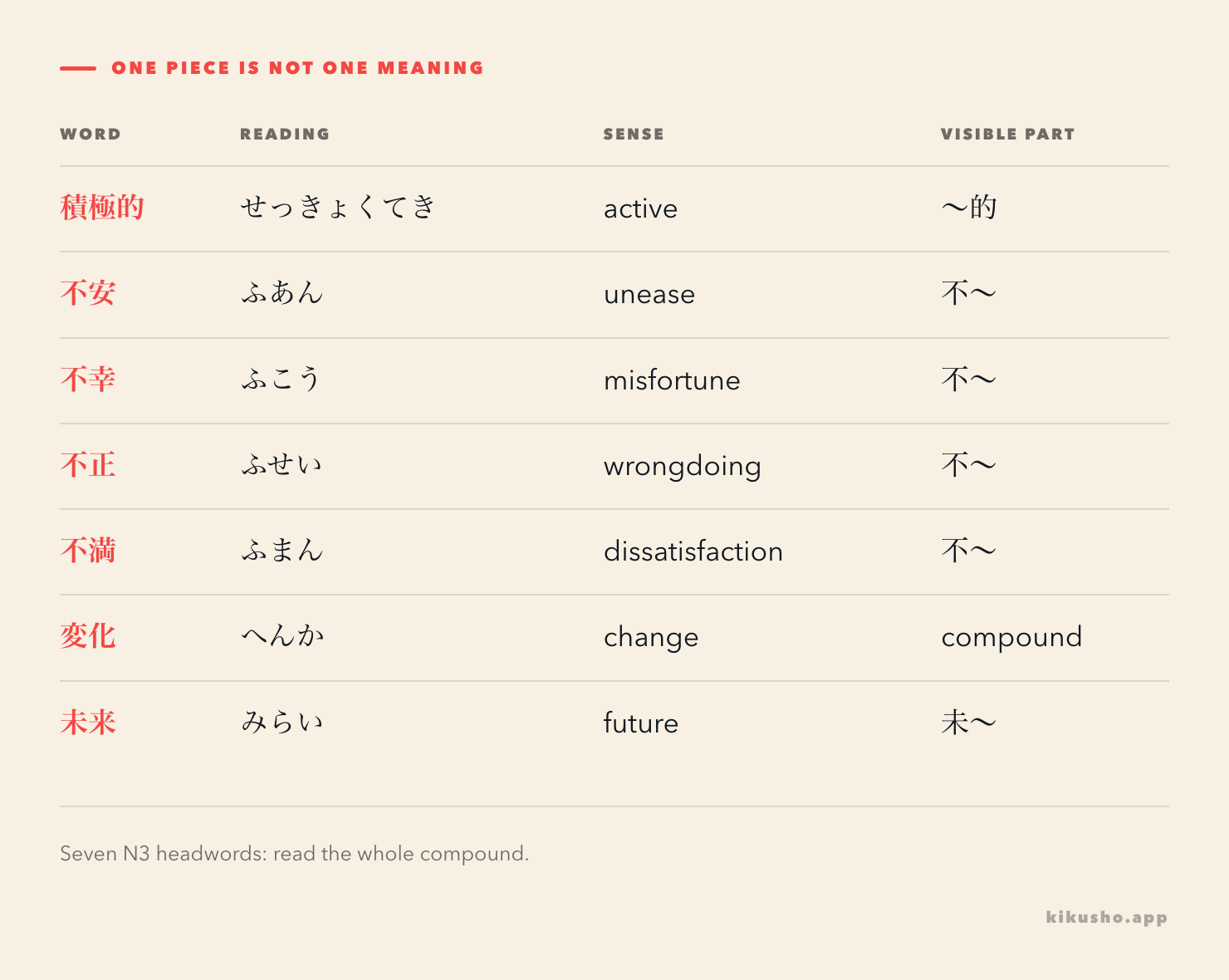
The table is a vocabulary set, not a rule for creating any combination you wish. Even when a piece is productive, check the resulting word in a dictionary and notice what it occurs beside.
不 points to four different concerns
不安 (ふあん) can be a feeling or a description. 明日の発表が不安です means “I'm worried about tomorrow's presentation.” 不安を感じる names the feeling; 不安な気持ち describes it. The Shogakukan entry gives both noun and na-adjectival uses.
不満 (ふまん) starts from something that fails to satisfy. この結果に不満があります means “I'm dissatisfied with this result.” You can 不満を口にする, voice a complaint, or refer to 不満な点, a point you find unsatisfactory. The dictionary entry records these uses. Someone can feel both 不安 and 不満, but one concerns what may go wrong, while the other judges what has already fallen short.
不正 (ふせい) points to something improper or dishonest. 不正な取引が見つかりました means “An improper transaction was discovered.” The Shogakukan definition also gives 不正を働く, to commit wrongdoing. A simple arithmetic mistake is 間違い, not automatically 不正: the latter makes a stronger claim about the conduct.
不幸 (ふこう) means misfortune or being unhappy: 不幸な出来事がありました, “An unfortunate event occurred.” It has a second, delicate use: 身内に不幸があった usually refers to a death in one's family. Kanjipedia records both senses. Do not read that phrase as a vague complaint about a bad day.
未, 的, and 化 do different jobs
未来 (みらい) is the future, literally what has not yet come. 未来に向けて準備する means “prepare for the future.” The dictionary entry lists the ordinary future sense and other specialized senses, including a future tense in descriptions of Western languages. Do not assume 未来 is the name of a Japanese verb tense. The kanji reading lesson contrasts 未 in 未来 with 末 in 週末.
In 積極的 (せっきょくてき), 的 turns the idea of proactive engagement into a modifier. 彼女は積極的に会議に参加しました means “She took an active part in the meeting.” Use 積極的な態度 before a noun and 積極的に参加する before the action. Shogakukan defines this as doing things willingly, and the Japan Foundation index confirms the reading and な form. The suffix is a pattern, but that does not make an arbitrary new noun + 的 an established word.
〜化 (か) is a suffix when a base becomes a new state: 国際化 (こくさいか) is internationalization, and グローバル化 (グローバルか) names globalization in the Japan Foundation's vocabulary index. The dictionary gives 映画化 and 近代化 as further established examples. 変化 (へんか) is itself a dictionary word, “change” or “variation”; 気温が急に変化しました means “The temperature changed suddenly.” Seeing 化 at its end explains the family resemblance, but does not establish that attaching 化 to any chosen word produces a natural new noun.
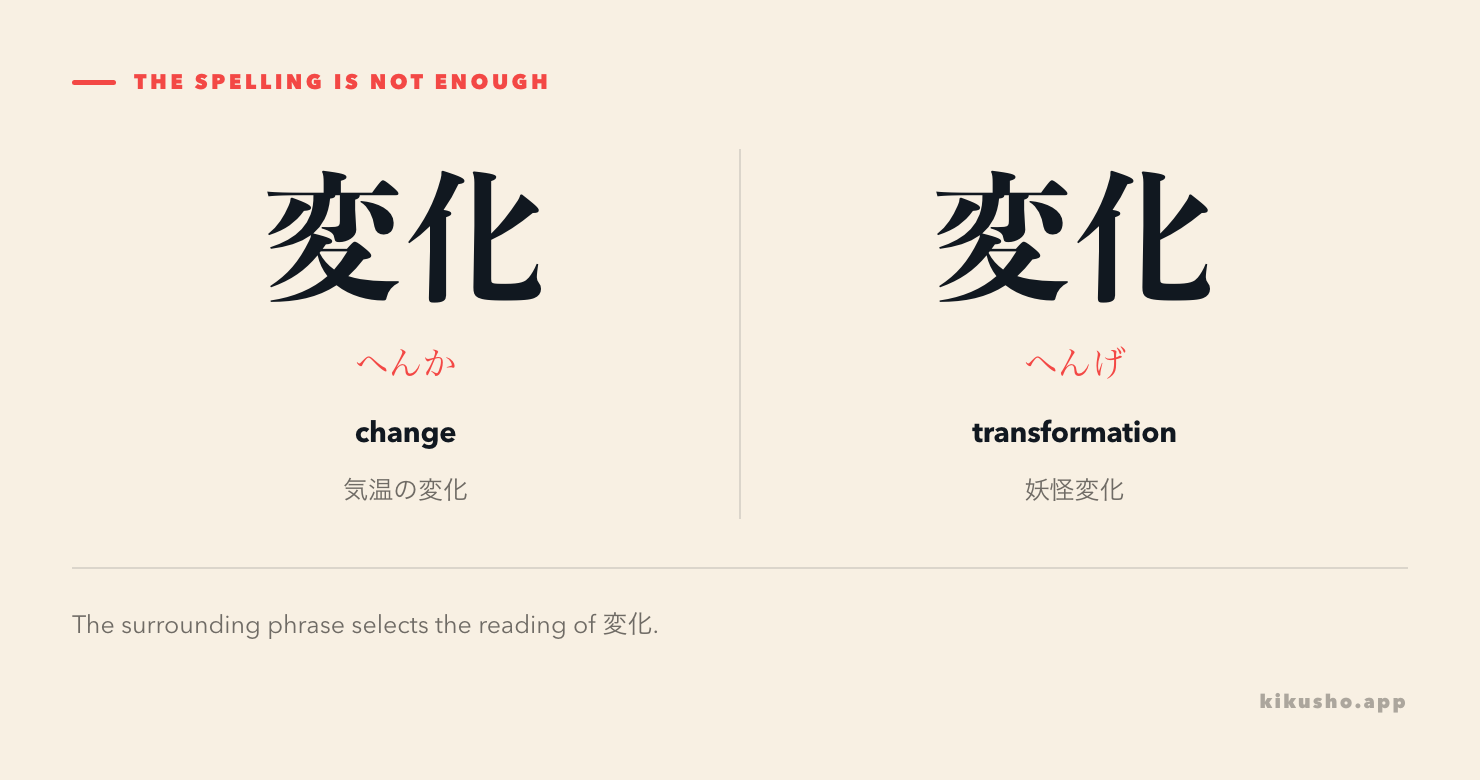
This last reading needs care. The Shogakukan dictionary entry and Kanjipedia's へんか entry distinguish 変化 (へんか, change) from 変化 (へんげ, transformation or an uncanny being). A source row in the Kikusho reference inventory gives a ghost gloss for the spelling; that is a different reading and sense from the assigned へんか here. 妖怪変化 is read ようかいへんげ. The two uses share characters, not this lesson's vocabulary sense.
Which words will you see in a real line?
A notice about a delayed service might say 対応に不満がある: the response was unsatisfactory. A friend awaiting an announcement might say 結果が不安だ: they feel uneasy about the outcome. A report of suspicious conduct might say 不正が見つかった. English could translate all three with some shade of “bad,” but the nouns point to different problems. 変化が見られる describes what changed without saying whether it was good or bad; 積極的に取り組む describes someone's willingness to act.
When one of these compounds turns up in a page you are reading, keep its reading and surrounding phrase together. A photo or text capture in Kikusho can become a card you check and edit before saving, then review offline. Keep 変化 beside its context: a bare spelling on a card would leave へんか and へんげ unresolved.
Try the words before checking the answers
Question 1
In 気温の変化, “a change in temperature,” how is 変化 read?
- a) へんげ
- b) へんか
- c) へんこう
- d) ふこう
Question 2
Find the characters for みらい, “the future.”
- a) 末来
- b) 未末
- c) 未来
- d) 末会
Question 3
The response has been slow, and the speaker is dissatisfied with it. Complete 対応の遅さに__があります.
- a) 不安
- b) 不幸
- c) 不正
- d) 不満
Question 4
Which sentence naturally uses 不正 to describe improper conduct?
- a) 不正な取引が見つかった。
- b) 明日の天気は不正だ。
- c) 不正に未来を考えた。
- d) 駅が不正に近い。
Question 5
Which word clearly illustrates a base + the suffix 化 to mean a process of becoming that kind of thing?
- a) 不安
- b) 未来
- c) 国際化
- d) 不満
Question 6
Fill both blanks with the natural forms of 積極的: __態度で、会議に__参加した.
- a) 積極的い / 積極的で
- b) 積極的な / 積極的に
- c) 積極的に / 積極的な
- d) 積極的の / 積極的を
Question 7
Which paraphrase best preserves 彼女は積極的に会議に参加した?
- a) She took an active part in the meeting.
- b) She was worried about attending the meeting.
- c) She committed wrongdoing at the meeting.
- d) She imagined a meeting in the future.
Question 8
Write a short Japanese sentence for “I'm worried about tomorrow's presentation,” using 不安. You may use 明日の発表 as the topic.
Answers and explanations
Answer 1
b) へんか. Temperature changes are changes of condition. a) へんげ is the separate transformation or supernatural-being reading; c) is the reading of 変更, a different word; d) belongs to 不幸.
Answer 2
c) 未来. 未 says “not yet” and 来 contributes “come.” The alternatives put 末, “end,” or other characters in the word and do not spell the taught noun.
Answer 3
d) 不満. The speaker judges the slow response unsatisfactory. a) 不安 would express worry about what may happen, not the dissatisfaction specified; b) 不幸 names misfortune, and c) 不正 would accuse the response of misconduct without evidence.
Answer 4
a) 不正な取引が見つかった. The transaction is improper. b) uses it for weather, c) turns thinking about the future into wrongdoing without context, and d) gives a station an unlikely moral property; none expresses the normal claim about conduct.
Answer 5
c) 国際化. 国際 plus the suffix 化 names a process of becoming international. a) and d) begin with 不, while b) begins with 未. 変化 is a related established word, but it is not an invitation to attach 化 freely to every base.
Answer 6
b) 積極的な / 積極的に. The na-adjectival word uses な before 態度 and に before 参加した. a) invents い and replaces the adverbial に; c) swaps the two attachments, and d) uses の and を where the modifier and adverb are needed.
Answer 7
a). 積極的に indicates willing, active participation. b) supplies 不安, c) supplies 不正, and d) supplies 未来; none is stated by the sentence.
Answer 8
One model answer is 明日の発表が不安です (あしたの はっぴょうが ふあんです). It expresses unease about the presentation. 明日の発表について不安があります also works. 不満 would say you are dissatisfied with it; 不幸 would describe misfortune, not anticipation.
Save the reading with the event
変化 on an isolated card leaves two readings open. In a sentence about temperature, it is へんか; in 妖怪変化, it is へんげ. The compound's surroundings settle what the characters alone cannot. That is the piece to keep when the word appears again.
Common questions
Does every word beginning with 不 mean the same kind of "not"?
No. 不安 is unease, 不満 is dissatisfaction, 不幸 is misfortune, and 不正 refers to wrongdoing or something improper. Learn the whole compound and its normal collocations, not a single English translation for 不.
Is 化 always a suffix in words that end with it?
No. The suffix in 国際化 expresses a change toward being international. 変化, read へんか when it means change, is an established compound and should be learned as a whole word. The same spelling can be read へんげ for a transformation or supernatural being in a different context.
How do I use the ending 的 in 積極的?
積極的 is a na-adjectival word: 積極的な態度 describes an active attitude, and 積極的に参加する describes participating actively. 的 is read てき here.