On this page
泣き出す, 食べ過ぎる, 話し続ける: three different verbs, and none of them started life as its own word. Each one welds a first verb's stem onto a second verb, and the second verb does all the conjugating from that point on. Learn five of those second verbs and you are not memorising five words. You are unlocking every verb you already know to combine with them.
Why these belong together
A Japanese compound verb, 複合動詞, takes the ます-stem of one verb (泣く becomes 泣き, drop the ます and stop there) and attaches a second verb directly to it. The result conjugates as one word, but only the second half changes shape: 泣き出す, 泣き出した, 泣き出さない. 泣き, the crying, never moves.
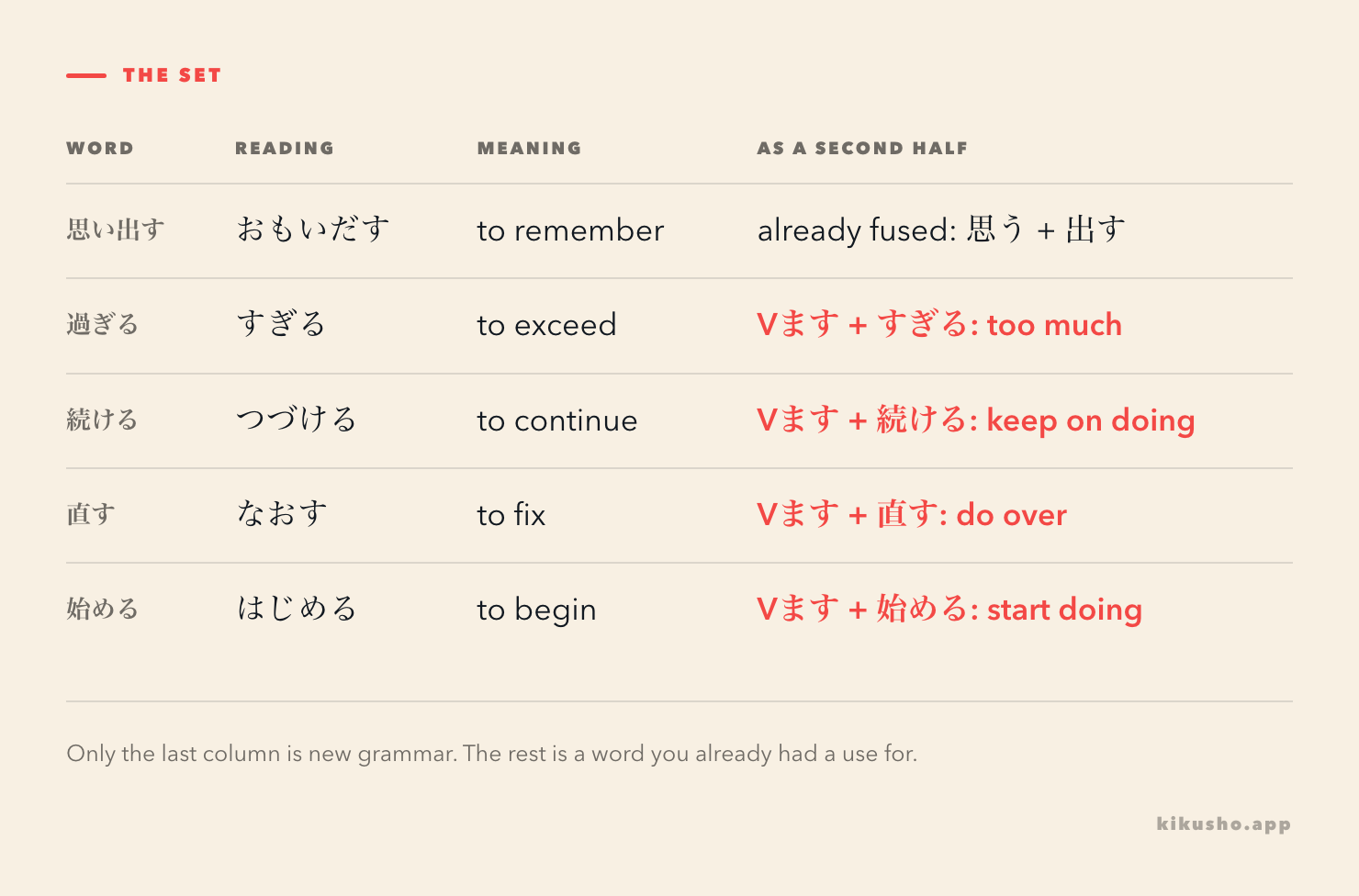
思い出す, おもいだす, "to remember," is this mechanism already finished for you. Split it and the pieces are visible: 思う, to think, plus 出す, to bring something out. A thought brought out into view is what remembering is, in Japanese as much as in English's own "recall." You do not build 思い出す yourself; it is one word in every dictionary already, but seeing the seam tells you what the other four are for.
過ぎる, 続ける, 直す and 始める are the productive half of the set: verbs you can already attach to a stem you already have, today, without waiting for a dictionary to have done it for you first. That is the whole reason a curriculum groups them together instead of scattering them across five unrelated vocabulary lists: the pattern is the lesson, not any one member of it.
The set itself
| Word | Reading | On its own | As a second half |
|---|---|---|---|
| 思い出す | おもいだす | to remember, recall | already fused: 思う + 出す |
| 過ぎる | すぎる | to pass, to exceed | Vます + すぎる: did too much |
| 続ける | つづける | to continue (something) | Vます + 続ける: keep on doing |
| 直す | なおす | to fix, repair | Vます + 直す: do over, correct |
| 始める | はじめる | to begin (something) | Vます + 始める: start doing |
One sentence per row: 昨日の約束を思い出した (I remembered yesterday's promise), 食べ過ぎた (I ate too much), 話し続けた (I kept talking), 書き直した (I rewrote it), 降り始めた (it started raining). The last four share one shape, because each second half is doing the exact job its own dictionary entry already told you: 過ぎる passes a limit, 続ける continues, 直す corrects, 始める begins. Attached to a stem, that meaning becomes what happens to the first verb's action rather than a fact about the second verb's own subject.
The pattern that runs through them
Take a verb you already have, 食べる, to eat, and drop ます to get its stem, 食べ. Attach any of the four productive endings directly, no particle, no connector:
食べ + 過ぎる → 食べ過ぎる, to eat too much 食べ + 続ける → 食べ続ける, to keep eating 食べ + 直す → 食べ直す, to eat again, differently, correcting the first attempt 食べ + 始める → 食べ始める, to start eating
From here the whole compound conjugates as a single word, and every change happens on the second half: 食べ過ぎる → 食べ過ぎた (past) → 食べ過ぎない (negative) → 食べ過ぎて (て-form). 食べ never moves again once it has handed its stem over. That single rule — first verb freezes, second verb carries every tense and every polarity — is what makes four endings into dozens of usable compounds rather than four more entries to separately conjugate.
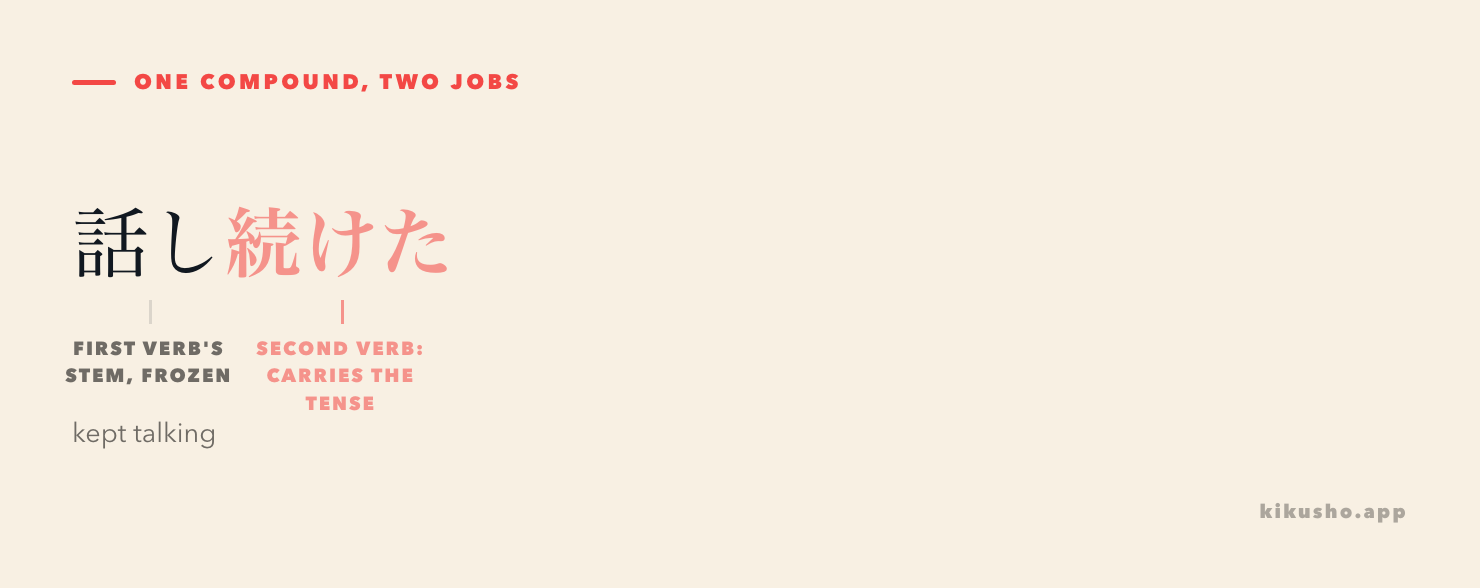
Nothing about the stem tells you which ending is coming — 食べ過ぎる and 食べ続ける share the identical first half and mean nearly opposite things about the eating. The ending is where the sentence's actual claim lives, which is exactly why it pays to know four of them cold rather than recognise one and guess at the rest.
The two or three that break it
Not all four productive endings carry the same weight of judgment, and mixing that up produces a sentence that is grammatical but says the wrong thing.
過ぎる is the one that almost never sounds neutral. 働き過ぎる is not a compliment about your work ethic; it is someone telling you to stop. Reach for it and you are claiming the amount was more than it should have been, which is a stronger statement than "a lot of."
直す carries a specific implication the other three do not: that the first attempt was wrong, incomplete, or broken, and this one corrects it. 書き直す is not "write it a second time" in the way 続ける extends an unbroken action — it is "the first draft failed, here is the fix." Confuse it with もう一度書く (write it one more time, no judgment implied) and you have told someone their first version had a problem you never meant to raise.
思い出す breaks the pattern in a different way: it does not generalise. You cannot lift 出す back out of 思い出す and attach it productively the way you can with 過ぎる or 始める without meeting a different, later grammar point — most guides that teach 〜出す as "to suddenly start" place it a level past this one, at N3, precisely because its range of use is wider and its nuance (abruptness) is sharper than 始める's plain, neutral beginning. Treat 思い出す as a finished word to keep, not a template to reuse yet.
None of the four attach the way 〜てしまう does, either. てしまう needs the て-form and welds onto a verb that is already finished conjugating; 過ぎる, 続ける, 直す and 始める need the bare stem, before ます or て ever entered the picture. The two can stack, but only in that order: 食べ過ぎる forms first, stem plus すぎる, and only then does the whole new verb take a て-form of its own for てしまう to attach to — 食べ過ぎてしまった, I went and ate too much. Reverse the order and there is no stem left for すぎる to attach to.
Which ones you will actually meet this month
食べ過ぎた comes up the day after any meal worth mentioning. 話し続けた and 話し始めた show up in exactly the retellings you would expect — someone describing a conversation that ran long, or one that finally got going. 書き直す arrives with every email you draft twice. None of these wait for a textbook; they arrive first in something a friend says out loud, a line in a manga panel, a caption under a video, already built and already past the point where you could look up "過ぎる" alone and land on the sentence's real meaning.
That is the moment worth capturing rather than reconstructing later from memory: the whole compound, in the sentence it actually appeared in, not the two separate dictionary entries you would otherwise have to recombine yourself. Say it into Kikusho, or point the camera at the caption, and the card that comes back keeps 食べ過ぎた together — the base verb, the ending, and the reading — rather than splitting it into two flashcards that each look complete and are not.
Four questions the set earns you
Question 1. Which compound verb best completes this sentence? 「レポートに間違いがあったので、___。」(There was a mistake in the report, so ___.)
a) 書き直した b) 書き続けた c) 書き過ぎた d) 書き始めた
Answer 1: 書き直した. The sentence states a mistake existed, which is exactly the situation 直す responds to: correcting something that was wrong. (b) implies uninterrupted writing with no mention of a fix. (c) implies writing too much, unrelated to an error. (d) implies starting to write, which contradicts a report that already existed and had a mistake in it.
Question 2. Choose the reading for the underlined word: 「疲れているのに、彼は_働き過ぎる_。」
a) はたらきすぎる b) はたらきつづける c) はたらきなおす d) はたらきはじめる
Answer 2: はたらきすぎる. (b) is 働き続ける, "keeps working," a different claim about duration rather than excess. (c) 働き直す is not natural — 直す needs something broken to correct, and simply working again is not that. (d) 働き始める, "starts working," does not fit "despite being tired," which signals an amount already in progress.
Question 3. Which sentence means almost the same as 「彼女は10年間、日本語を勉強し続けている」?
a) 彼女は10年間、ずっと日本語を勉強している。 b) 彼女は10年前に日本語の勉強を始めた。 c) 彼女は日本語を勉強し過ぎている。 d) 彼女は日本語の勉強をやり直している。
Answer 3: (a), "she has been studying Japanese continuously for 10 years," restates the same unbroken duration without 続ける. (b) only states when she started, not that it continued. (c) claims excess, not duration. (d) claims she is redoing her studying, which nothing in the original implies.
Question 4. Which underlined part is used incorrectly? 「今朝、_①思い出した_ことを_②忘れないように_、すぐに_③書き過ぎた_。あとで_④読み直す_つもりだ。」
a) ① b) ② c) ③ d) ④
Answer 4: ③. 書き過ぎた claims the writing was excessive, which does not fit "so as not to forget" — the intended meaning is simply that the writer wrote it down promptly, which is 書いた or 書き留めた, not 書き過ぎた. ① correctly uses 思い出した for "the thing I remembered." ② is a standard purpose clause. ④ 読み直す, "to read over again" (to check what was written), fits the plan described in the last sentence.
Learn these five with the seam between the two verbs visible, and the next compound you meet — 遊び疲れる, 見上げる, 泣き止む — will already look like something you can take apart rather than a new word to memorise whole.
Common questions
思い出す is built from 出す (だす). Why isn't 出す one of the five words here?
出す is productive the same way: 泣き出す, to burst into crying; 走り出す, to take off running. Most grammar guides file that pattern one level later, at N3, even though 出す on its own is far more basic. 思い出す still shows you the mechanism fully assembled: 思う (to think) plus 出す (to bring out) is a thought brought out where you can see it, which is what remembering is.
Does 〜過ぎる always mean something went wrong?
Almost always, and it's worth trusting that instinct. 食べ過ぎる, 飲み過ぎる, 働き過ぎる all describe a degree the speaker did not want. A compliment like きれいすぎる (too beautiful) borrows the same form for effect, but it is doing so precisely because すぎる's default reading is "more than was called for," not neutral surprise.
Is there a compound verb for stopping, to go with 始める?
Yes: 終わる is not one of this set's five, but it belongs to the same family: 食べ終わる, to finish eating; 話し終わる, to finish speaking. You will meet it the first time someone asks 宿題、もう終わった?, and the ます-stem-plus-verb shape will already be familiar.