On this page
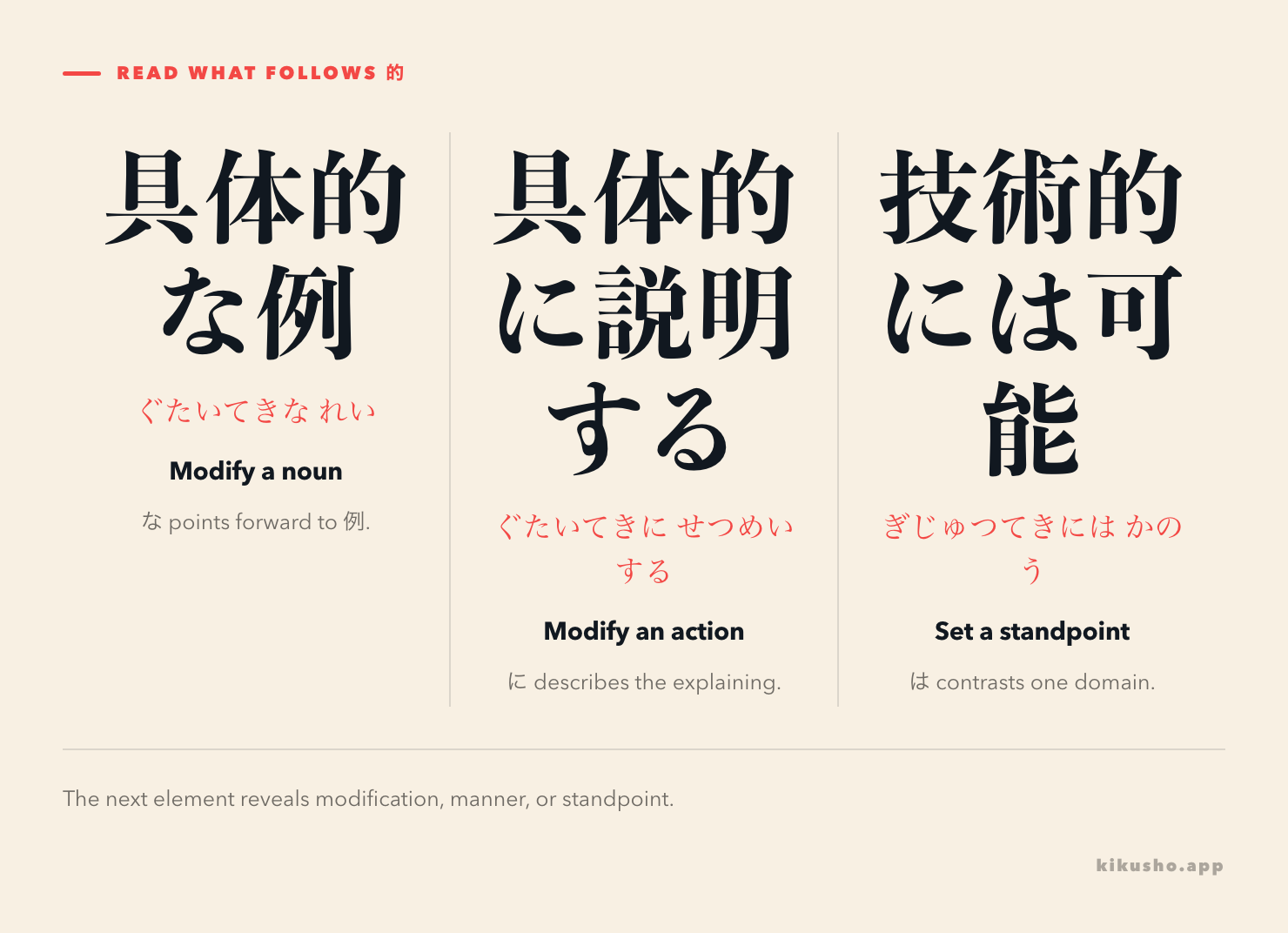
具体的な例 describes a noun; 具体的に説明する describes how someone explains. In both, 的 (てき) turns the established noun base 具体 into a descriptive stem, while な or に gives that stem its job in the sentence.
The suffix is productive, but it is not a machine that converts every noun into a natural adjective. Learn the attachment rule and the complete word together.
的 builds the stem; the next ending places it
This lesson teaches inventory item g-45047c53d703, 的(てき). Start with an established base plus 的, then treat the result like a na-adjectival word.
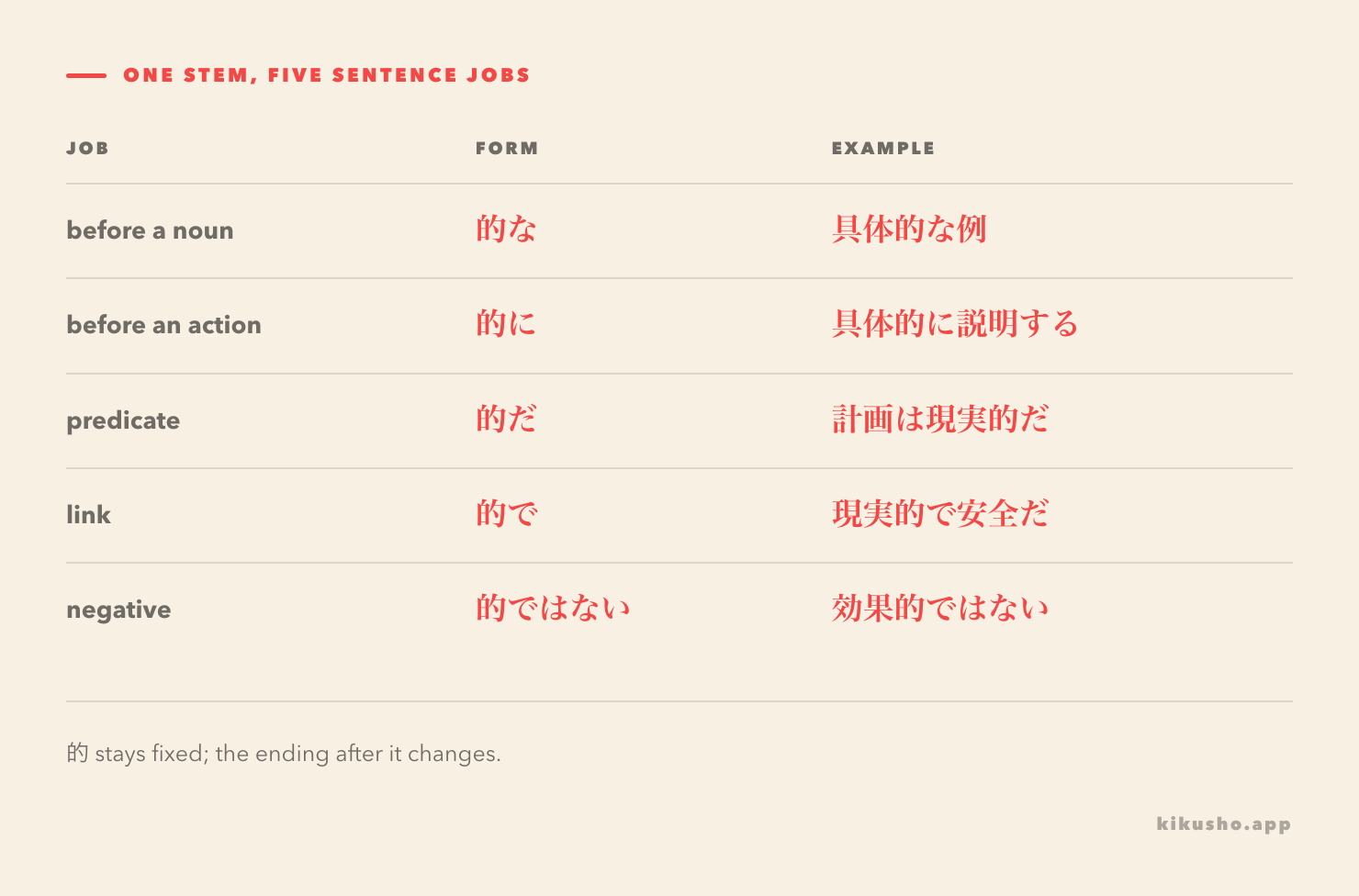
| Job in the sentence | Form | Example | Meaning |
|---|---|---|---|
| Modify a noun | N + 的な + noun | 具体的な例 | a concrete example |
| Modify an action | N + 的に + verb | 具体的に説明する | explain concretely |
| Finish a statement | N + 的だ/です | この案は現実的だ | this plan is realistic |
| Join another description | N + 的で | 現実的で安全な案 | a realistic and safe plan |
| Negate the description | N + 的ではない | その方法は効果的ではない | that method is not effective |
JLPT Sensei and Bunpro both place the pattern at N3 and document 的な before nouns and 的に in adverbial use. The dictionary account in Shogakukan's Digital Daijisen classifies 的 as a suffix that forms a na-adjectival stem from a noun.
Do not add な before a sentence ending. 具体的な例です is correct because な links to 例. If the description itself is the predicate, say 説明は具体的です, without な.
The complete word decides which shade of meaning appears
English suffixes such as -al, -ic, -ive and -ly often translate 的, but no single English ending covers the family. The dictionary records several relationships.
| Relationship | Japanese | What the completed word says |
|---|---|---|
| related to a field | 政治的な問題 | a political problem |
| having a quality | 効果的な方法 | an effective method |
| typical or representative | 典型的な例 | a typical example |
| viewed in one respect | 経済的に難しい | difficult financially or economically |
| an attitude or tendency | 積極的に参加する | participate actively |
この問題には、技術的な知識が必要です。
この もんだいには、ぎじゅつてきな ちしきが ひつようです。
This problem requires technical knowledge.
新しい仕組みを具体的に説明してください。
あたらしい しくみを ぐたいてきに せつめいしてください。
Please explain the new system concretely.
The base contributes a domain or concept, but the finished word may develop a conventional meaning. 具体的 means concrete or specific; 積極的 means proactive or willing to act; 一般的 can mean general or common. Translating the base first and mechanically adding “-al” will not reliably recover those meanings.
的な points to a noun; 的に frames an action or judgment
The most useful test is syntactic. Look at what follows.
これは効果的な練習方法です。
これは こうかてきな れんしゅうほうほうです。
This is an effective practice method.
効果的な modifies the noun 練習方法. Remove な and the ordinary teaching form is incomplete: 効果的練習方法 may resemble compressed technical writing, but it is not the safest default for a learner producing a normal sentence.
毎週、定期的にデータを確認します。
まいしゅう、ていきてきに データを かくにんします。
We check the data regularly every week.
定期的に modifies 確認します. It tells you how or on what schedule the checking happens. The に is the adverbial ending of the resulting na-adjectival word; it is not the destination particle attached to データ.
費用の面では、この計画は現実的ではありません。
ひようの めんでは、この けいかくは げんじつてきでは ありません。
In terms of cost, this plan is not realistic.
Here 現実的 is the predicate and takes the polite negative ではありません. The stem stays intact through tense, politeness and negation: 現実的だった, 現実的ではない, 現実的でしょう.
的に can mark a particular respect rather than manner
Not every 的に answers “How was the action performed?” Sometimes it limits the viewpoint from which a judgment holds.
技術的には可能ですが、時間的には難しいです。
ぎじゅつてきには かのうですが、じかんてきには むずかしいです。
Technically it is possible, but in terms of time it is difficult.
The added は contrasts two frames: technology and time. 技術的に可能 does not describe the manner of being possible; it says that the assessment “possible” holds from a technical standpoint.
The same distinction appears without an explicit contrast:
- 精神的に疲れた: mentally tired, with 精神 as the respect.
- 論理的に説明した: explained logically, with 論理 as the manner.
- 一般的に知られている: generally known, with 一般的に setting the scope of the claim.
Translation can hide these different roles under English -ly. Keep the larger predicate on your card.
的な and の do not simply replace each other
A noun plus の identifies possession, category, content or another noun-to-noun relationship. A word in 的な attributes a quality or relation through an established descriptor.
日本の文化を研究しています。
にほんの ぶんかを けんきゅうしています。
I study the culture of Japan.
文化的な活動に参加しました。
ぶんかてきな かつどうに さんかしました。
I took part in cultural activities.
日本の names whose or which culture. 文化的な classifies the activity as cultural. You cannot decide between の and 的な by translating both as English “of” or an adjective; the intended relationship differs.
Some formal compounds omit な, as in 政治的判断 or 経済的問題. Research on native and learner writing notes both ~的なN and compressed ~的N forms. For active use at N3, keep 的な + noun as the dependable pattern unless you have met the shorter compound as an established expression. Do not erase な everywhere to make a sentence look formal.
Productive does not mean unlimited
的 attaches very often to Sino-Japanese and abstract bases. That frequency makes unfamiliar words easier to analyze, but it does not authorize every possible combination.
An academic learner-corpus study by Mochizuki documents overuse of 的 and errors in choosing な, の, に and で. It also notes the suffix's strong history in academic, expository and newspaper prose. The practical lesson is simple: recognize a possible seam, then verify the complete word and its ordinary company.
For example, 科学的, 客観的, 社会的 and 個人的 are established. 簡単 already works as a na-adjectival word, so inventing 簡単的 is not standard Japanese. A plausible base and a visible suffix do not guarantee a natural result.
The existing N3 word-building set teaches how 的 appears inside 積極的 beside other prefixes and suffixes. The 消極的 vocabulary lesson follows one complete N2 word through its meaning and collocations. This page owns the sentence grammar shared by those words.
Keep the whole descriptor when you capture it
If a report contains 経済的に難しい, saving only 経済 loses the judgment and saving only 難しい loses the respect in which it applies. Keep the complete phrase. In Kikusho, you can check and edit the reading, meaning, register note and example before the card is saved, then review it offline.
A compact note can name the job you saw: “的な + noun,” “的に + action,” or “的には + contrasted standpoint.” That is enough to reconstruct the sentence without pretending every 的 word has the same English suffix.
Practice: follow the ending after 的
Work through the six items in order, then open the explanations below.
Question 1 — grammar choice. Choose the natural phrase for “a concrete example.”
- A. 具体的に例
- B. 具体的な例
- C. 具体的の例
- D. 具体的い例
Question 2 — grammar choice. Complete 新しい仕組みを__説明してください, “Please explain the new system concretely.”
- A. 具体的な
- B. 具体的だ
- C. 具体的に
- D. 具体的の
Question 3 — sentence composition. Arrange the chunks to say “This plan is realistic and safe.”
- この計画は
- 現実的で
- 安全です
Question 4 — interpretation. In 技術的には可能ですが、時間的には難しいです, what does the repeated 的には do?
Question 5 — grammar choice. Which sentence uses a verified ordinary form rather than attaching 的 mechanically to a word that already works without it?
- A. この方法は効果的です。
- B. この方法は簡単的です。
- C. この方法は便利的です。
- D. この方法は静か的です。
Question 6 — text grammar. Fill both gaps with the forms that fit their jobs.
これは( )な提案です。担当者が内容を( )に説明しました。
- A. 具体的/具体的
- B. 具体的に/具体的な
- C. 具体的だ/具体的で
- D. 具体的の/具体的を
Keep your choices fixed before reading the explanations.
Answers and explanations
Answer 1. B, 具体的な例. The completed 的 word modifies the noun 例, so it takes な. A uses the adverbial ending, C substitutes the noun linker の, and D treats the stem as an い-adjective.
Answer 2. C, 具体的に. The descriptor modifies the action 説明してください, so に supplies the adverbial form. A would need a following noun; B ends a statement, and D does not form the taught modifier.
Answer 3. この計画は現実的で安全です。 (この けいかくは げんじつてきで あんぜんです). 現実的で links the first na-adjectival description to 安全です. The suffix itself does not change.
Answer 4. It sets two contrasted respects for the judgments: the plan is possible from a technical standpoint but difficult in terms of time. The に does not describe a physical manner, and は marks the contrast between the two frames.
Answer 5. A, この方法は効果的です. 効果的 is an established descriptor. 簡単, 便利 and 静か already function as na-adjectival words in the intended meanings; adding 的 creates nonstandard forms here.
Answer 6. A, 具体的/具体的. The printed な after the first blank creates 具体的な提案. The printed に after the second creates 具体的に説明しました. The option supplies the same stable stem to two different endings.
The suffix exposes how a judgment is framed
The most revealing 的 phrases are not always the ones before nouns. In 技術的には可能だが、時間的には難しい, the speaker divides one decision into two standards and reaches a different answer under each. Once you notice that framing work, 的 becomes more than a vocabulary ending: it tells you which domain a claim belongs to and where that claim stops.
OpenAI Codex carried out this lesson's AI editorial check. It compared the attachments, meanings, register limits, examples, readings and six exercises with the cited teaching and research sources. This is not human or native-speaker certification.
Common questions
What does the suffix 的 mean in Japanese?
的, read てき, attaches to established noun bases to form descriptive words. Depending on the complete word, it can mean related to, having the qualities of, typical of, or viewed in a particular respect.
When should I use 的な and 的に?
Use 的な before a noun, as in 具体的な例, and 的に when the completed word modifies an action or evaluation, as in 具体的に説明する. Use 的だ or 的です when the description ends the sentence.
Can I add 的 to any Japanese noun?
No. The suffix is productive, especially with Sino-Japanese and abstract bases, but many possible combinations are not established or sound vague. Learn the whole 的 word and its usual collocations.
Is Japanese 的 the same as Chinese 的?
No. They share a historical connection, but Japanese 的 is a suffix read てき that forms descriptive stems. It is not the general possessive or attributive particle used in modern Chinese.