On this page
Use 語る for connected content or a story, 叫ぶ for a shout, 主張する for a position being asserted, 述べる for a formal statement, and 報告する for information delivered as a report. All five can involve words leaving someone's mouth, but each tells the reader what kind of speech act is happening.
言う remains the broad default. These five verbs become useful when “say” hides the most important fact: the content has a narrative shape, the voice is loud, the speaker is defending a claim, the wording belongs to a formal statement, or the information is owed to a recipient.
Five verbs, five shapes of speech
| Word | Reading | Word class | What it foregrounds | Anchor phrase |
|---|---|---|---|---|
| 語る | かたる | godan verb | a connected account, experience, or story | 経験を語る |
| 叫ぶ | さけぶ | godan verb | a loud cry or forceful appeal | 大声で叫ぶ |
| 主張 | しゅちょう | noun + する | a position advanced for acceptance | 自分の意見を主張する |
| 述べる | のべる | ichidan verb | a formally expressed view or statement | 理由を述べる |
| 報告 | ほうこく | noun + する | facts, progress, or results passed to someone | 上司に結果を報告する |
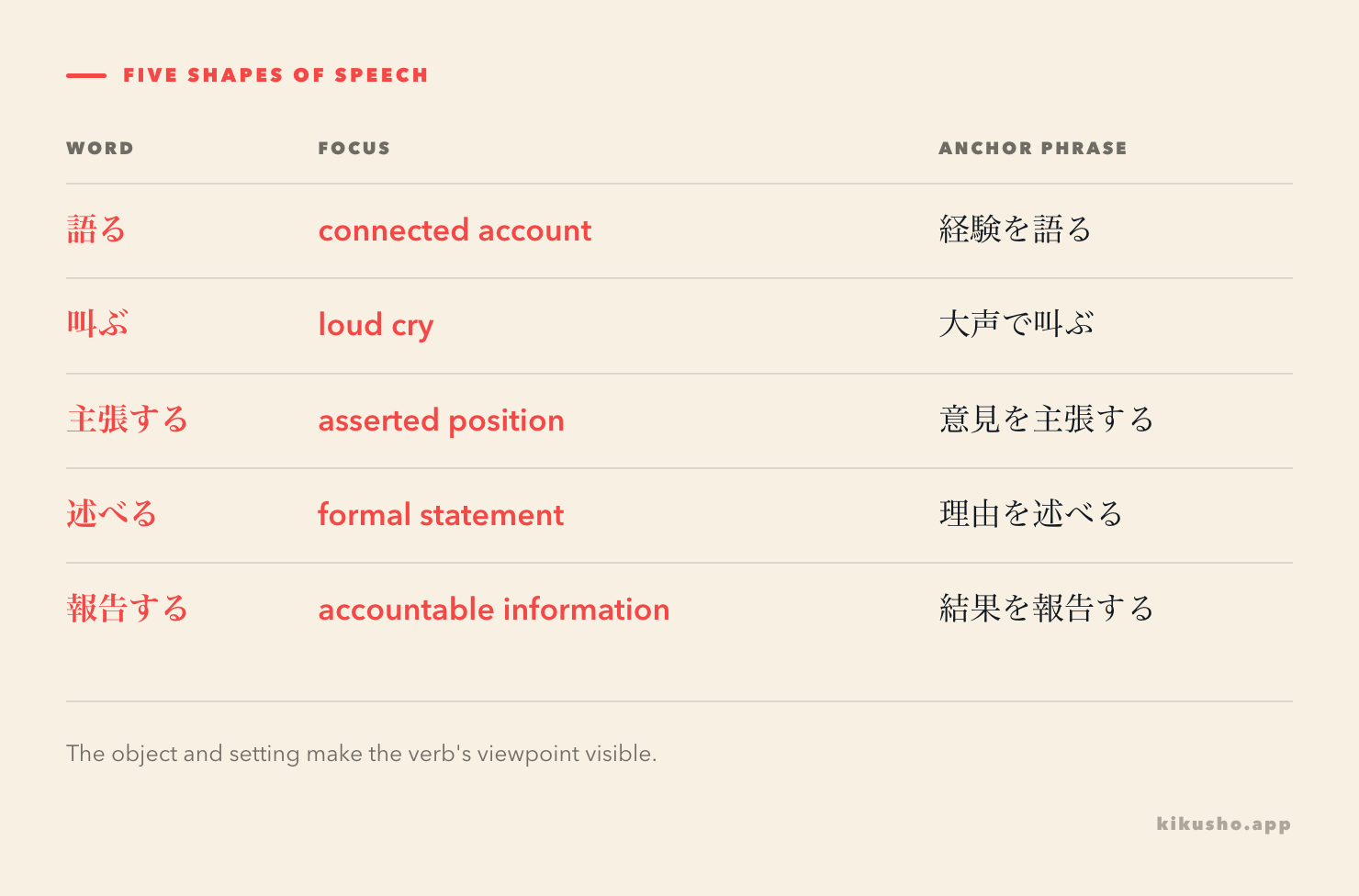
The two verbal nouns can stand alone as nouns: 主張が正しい means “the claim is correct,” and 報告を読む means “read the report.” Add する when they name the action. 語る and 叫ぶ are godan verbs; 述べる is an ichidan verb.
語る gives the content a narrative shape
語る is read かたる. It presents a connected body of content to a listener or reader, often a memory, experience, dream, history, or story.
祖父は若いころの経験を語りました。
My grandfather recounted his experiences from when he was young.
選手は将来の夢を熱く語った。
The athlete spoke passionately about a future dream.
The object marked by を is the subject matter being related: 経験を語る, 夢を語る, 思い出を語る. A topic can also take について:
作家が新しい小説について語っています。
The author is talking about the new novel.
The Goo synonym dictionary's comparison of 言う, 話す, 語る, and 述べる describes 語る as letting an attentive listener hear organized, connected content. That is why 自分の過去を語る sounds natural while a single reflexive “Ow!” does not need it.
語る can also be figurative. 表情がすべてを語っている means “the expression says it all.” No mouth is speaking; the evidence reveals the story by itself. Shogakukan's dictionary entry records both the ordered-account sense and this “show or reveal” extension.
叫ぶ tells you about force and volume
叫ぶ is read さけぶ. Its central image is a raised voice.
子供が「助けて!」と叫びました。
The child shouted, “Help!”
駅で友達の名前を叫んだ。
I shouted my friend's name at the station.
A quotation takes と. A name or short content can take を. 大声で叫ぶ uses で to describe the manner, and 助けを求めて叫ぶ explains why the person cries out.
The verb does not itself mean “angrily.” Someone can shout from fear, joy, urgency, pain, or across a long distance. It can also be extended to a public appeal. The dictionary entry for 叫ぶ records both a loud voice and the figurative sense of strongly appealing to society, as in calling for reform.
主張する advances a position
主張 is read しゅちょう. As 主張する, it means to assert, maintain, or insist on a view. The essential feature is commitment to a position, not loudness.
彼はその計画が必要だと主張しました。
He argued that the plan was necessary.
労働者たちは自分たちの権利を主張した。
The workers asserted their rights.
A proposition commonly takes と: 必要だと主張する. A claim, opinion, right, or theory can take を: 自説を主張する, 権利を主張する. The Shogakukan entry for 主張 defines it as strongly maintaining an opinion or theory so that others recognize it.
That does not require a quarrel. An academic paper can 主張する something in print, and a calm speaker can state a claim firmly. Conversely, shouting a train time does not become 主張 just because the voice is loud.
述べる puts a view into formal words
述べる is read のべる. It commonly appears in presentations, interviews, essays, reports, and instructions.
面接で志望理由を述べてください。
Please state your reason for applying in the interview.
市長は式典で感謝の言葉を述べました。
The mayor expressed words of thanks at the ceremony.
詳細は次の章で述べます。
The details will be set out in the next chapter.
The object is often 意見, 理由, 考え, 感想, or お礼. A quoted proposition can take と: 問題は解決したと述べた. Unlike 話す, 述べる can directly name written expression. The dictionary entry for 述べる explicitly records both saying a thought or opinion aloud and expressing it in writing.
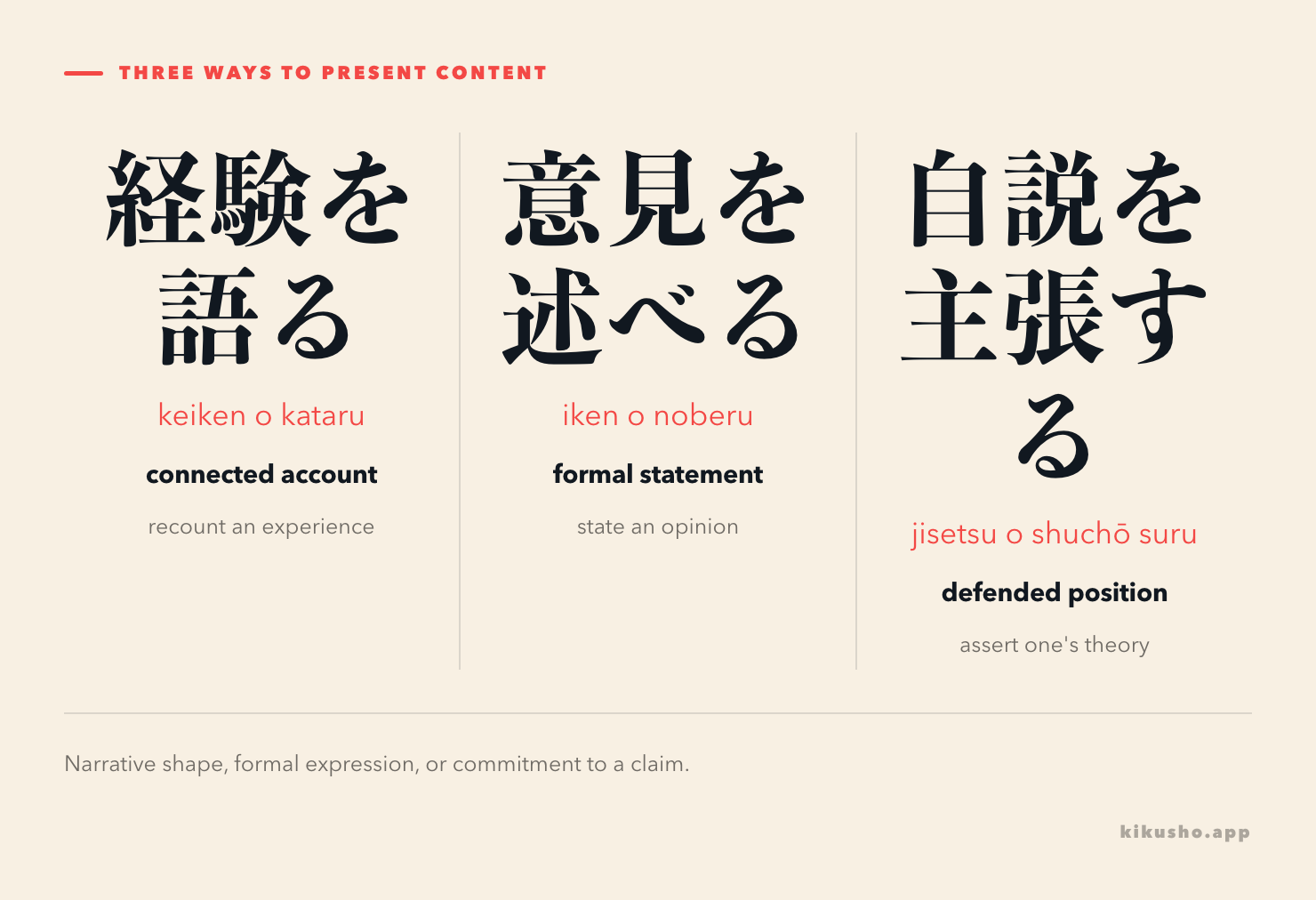
This separates three verbs that can all translate as “talk about”:
- 経験を語る: give the experience as a connected account
- 意見を述べる: formulate an opinion in a formal setting
- 自説を主張する: put forward one's own theory for acceptance
語る can sound reflective or narrative. 述べる is formal and descriptive. 主張する adds the stance that the proposition should be recognized.
報告する delivers information that is due
報告 is read ほうこく. A report transfers facts, progress, or results to a person or organization that needs them.
調査の結果を上司に報告しました。
I reported the survey results to my manager.
担当者は問題が解決したと報告した。
The person in charge reported that the problem had been resolved.
The content takes を or a quotation with と. The recipient commonly takes に: 先生に結果を報告する, 会社に状況を報告する. This recipient structure is much more central here than with 語る or 述べる.
The dictionary entry for 報告 emphasizes communicating the progress or result of an assigned duty. A friend can tell you what happened with 言う or 話す; an employee gives the manager an expected update with 報告する.
報告する also differs from the N2 newsroom verb 報道する. 事故を報道する is what a media outlet does for the public. 事故について上司に報告する is what a responsible person does for a recipient. The lesson on newspaper workflow vocabulary follows that distinction through 取材, 発表, 記事, and 報道.
Quotations do not erase the verb's viewpoint
All five can occur near quoted content, but と only packages the words or proposition. The verb still tells the reader how to interpret the event.
| Sentence | What the verb adds |
|---|---|
| 「危ない」と叫んだ | the words were shouted |
| 必要だと主張した | the proposition was asserted |
| 問題はないと述べた | the proposition was formally stated |
| 終了したと報告した | the fact was delivered as a report |
| 当時の様子を語った | the content was related as an account |
This is also why replacing everything with 言った removes useful information. 必要だと言った only says the words were said. 必要だと主張した tells us the speaker was advancing a position.
If the content is an opinion rather than a speech event, the related lesson on 思う, 考える, and 気がする distinguishes belief, active thought, and impression before any of those ideas are spoken aloud.
Practice: choose all ten before reviewing
Question 1. How is 語る read?
- Choice A: さとる
- Choice B: ごたる
- Choice C: かたる
- Choice D: のべる
Question 2. Choose the verb for a grandfather recounting a long childhood memory. 祖父は子供のころの思い出を__。
- Choice A: 叫んだ
- Choice B: 語った
- Choice C: 報告した
- Choice D: 主張した
Question 3. Complete the emergency scene. 彼女は「火事だ!」と大声で__。
- Choice A: 述べた
- Choice B: 語った
- Choice C: 叫んだ
- Choice D: 報告した
Question 4. Which expression most naturally asks an interview candidate to state a reason formally?
- Choice A: 志望理由を叫んでください
- Choice B: 志望理由を報告してください
- Choice C: 志望理由を語り合ってください
- Choice D: 志望理由を述べてください
Question 5. A researcher firmly maintains that the data support a new theory. Choose the best verb. 研究者は、新しい説が正しいと__。
- Choice A: 主張した
- Choice B: 叫んだ
- Choice C: 報告した
- Choice D: 語り合った
Question 6. Choose the particle marking the recipient. 調査結果を部長__報告しました。
- Choice A: を
- Choice B: と
- Choice C: に
- Choice D: で
Question 7. Which paraphrase preserves the stance in 必要だと主張した?
- Choice A: He whispered that it might be needed.
- Choice B: He maintained that it was necessary.
- Choice C: He reported the schedule to his manager.
- Choice D: He narrated how it had been made.
Question 8. Which pair is matched correctly?
- Choice A: 大声で叫ぶ — speak in writing
- Choice B: 経験を語る — recount an experience
- Choice C: 理由を述べる — shout a reason
- Choice D: 結果を報告する — defend a personal theory
Question 9. Which sentence uses 述べる incorrectly for its context?
- Choice A: 面接で志望理由を述べた。
- Choice B: 論文で調査方法を述べた。
- Choice C: 子供が痛くて「わあ!」と述べた。
- Choice D: 市長が式典で感謝を述べた。
Question 10. Complete both speech events in this meeting report.
会議で、田中さんは新しい制度が必要だと( A )。その後、担当者は調査の結果を部長に( B )。
- Choice A: A 叫んだ / B 語った
- Choice B: A 報告した / B 主張した
- Choice C: A 主張した / B 報告した
- Choice D: A 述べた / B 叫んだ
Make every choice before moving on. The explanations below are kept together so none gives away the next question.
Review the ten choices
Answer 1: c) かたる. 語る is read かたる. のべる is the reading of 述べる.
Answer 2: b) 語った. A connected childhood memory is content someone recounts. 叫ぶ describes volume, while 報告する and 主張する impose the wrong institutional or argumentative relationship.
Answer 3: c) 叫んだ. The quotation and 大声で create an urgent loud cry. 叫ぶ does not specify whether the emotion is fear, anger, or excitement; the fire context supplies the urgency.
Answer 4: d) 志望理由を述べてください. An interview calls for a formally expressed reason. 報告する would imply an assigned update, and 叫ぶ would make the candidate shout.
Answer 5: a) 主張した. The researcher advances the theory as a position supported by evidence. The sentence does not describe volume or an institutional report to a recipient.
Answer 6: c) に. In XをYに報告する, X is the information reported and Y is its recipient: 調査結果を部長に報告する.
Answer 7: b) He maintained that it was necessary. 主張する adds commitment to a proposition that the speaker wants recognized. A bare “said” would lose that stance.
Answer 8: b) 経験を語る — recount an experience. The other glosses cross the verbs: 叫ぶ is a shout, 述べる a formal statement, and 報告する the delivery of reportable information.
Answer 9: c) 子供が痛くて「わあ!」と述べた. A reflexive cry of pain calls for 叫んだ or 言った. 述べる suits the interview, academic, and ceremonial statements in the other options.
Answer 10: c) A 主張した / B 報告した. Tanaka advances a position about the system, so 主張した fits. The person in charge then delivers survey results to the department head, which gives 報告した its content and recipient.
Keep one anchor phrase for each word: 経験を語る, 大声で叫ぶ, 意見を主張する, 理由を述べる, 結果を報告する. Those objects and particles preserve what a one-word translation such as “say” leaves out.
Common questions
What is the difference between 語る and 述べる?
語る presents connected content as a story, experience, memory, or account. 述べる formally puts an opinion, reason, view, or explanation into words and can refer to writing as well as speech.
What is the difference between 主張する and 述べる?
主張する asserts a position that the speaker wants others to accept. 述べる states or expresses content without itself saying that the speaker is defending it strongly.
Does 叫ぶ always take a quotation with と?
No. A quoted cry can take と, as in 「危ない」と叫ぶ. You can also say 大声で叫ぶ, 名前を叫ぶ, or 助けを求めて叫ぶ without quoting a complete utterance.