On this page
The four Japanese seasons are 春(はる), spring; 夏(なつ), summer; 秋(あき), autumn or fall; and 冬(ふゆ), winter. They are short nouns, but learning them in a fixed cycle and in complete time phrases makes the four readings far easier to retrieve than memorising isolated kanji.
The four-word cycle
| Order | Season | Reading | Meaning | A phrase to keep |
|---|---|---|---|---|
| 1 | 春 | はる | spring | 春になる, spring arrives |
| 2 | 夏 | なつ | summer | 夏は暑い, summer is hot |
| 3 | 秋 | あき | autumn; fall | 秋が好き, like autumn |
| 4 | 冬 | ふゆ | winter | 冬に雪が降る, snow falls in winter |
Each word is a noun. You can put it before です, attach a particle, or let it modify another noun with の:
今は春です。
いまは はるです。
It is spring now.
冬の朝は寒いです。
ふゆの あさは さむいです。
Winter mornings are cold.
The Japan Foundation's Irodori kanji material prints all four readings together and uses them in beginner sentences about flowers, heat, fruit and cold weather. Its Marugoto course outline likewise groups 春, 夏, 秋 and 冬 in a unit on seasons and weather.
Learn the order before the shapes
Say the cycle aloud as one rhythm: はる・なつ・あき・ふゆ. Then reverse the task. Look at 春・夏・秋・冬 and supply those four readings without translating first.
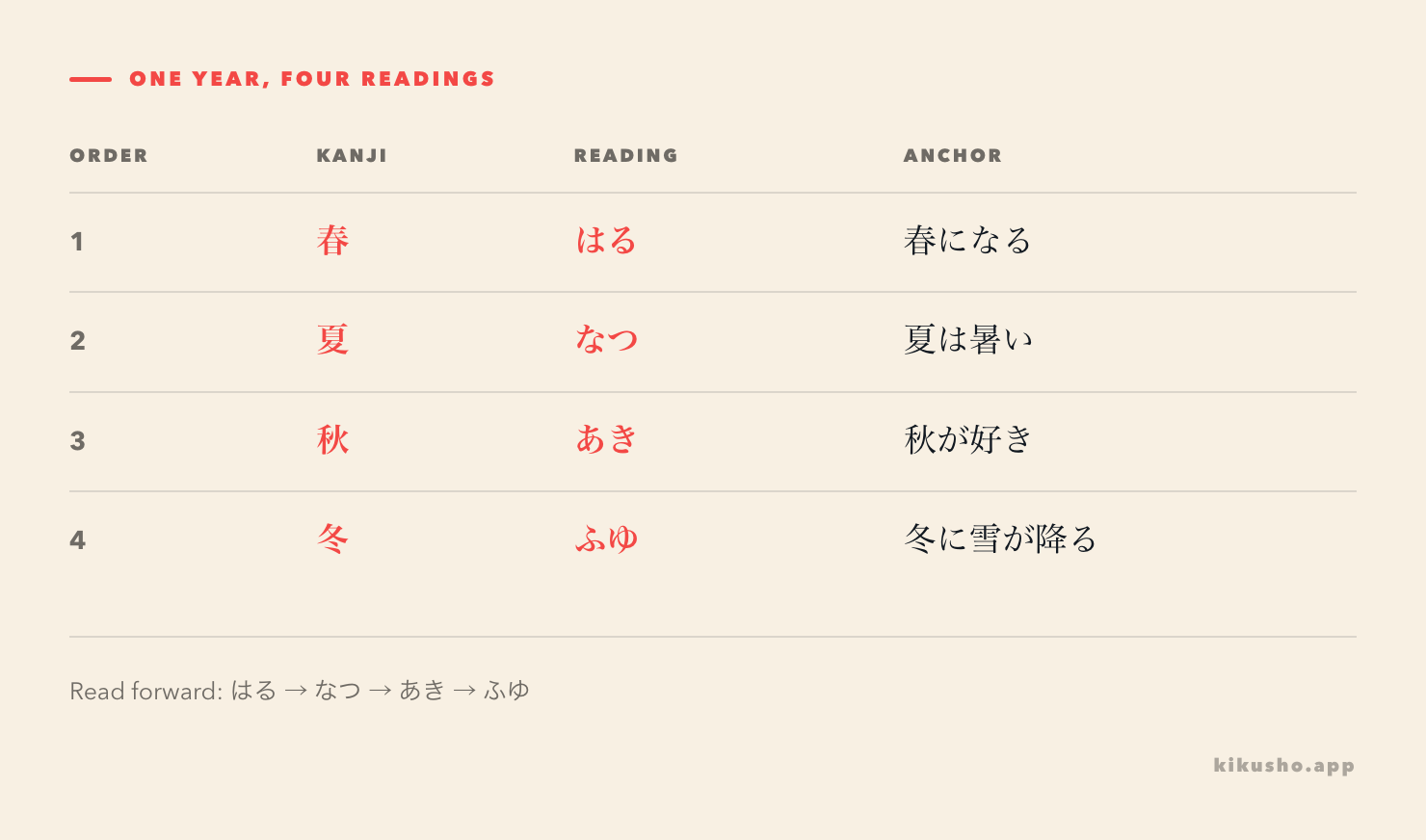
The kanji do not share a useful visual rule, so a single invented story for all four would be fragile. The order supplies the missing structure. If 夏 appears after 春, you know the answer is なつ; if 冬 closes the cycle, it is ふゆ.
The dictionary readings also confirm that these familiar standalone words use native Japanese readings. Kotobank lists 春 as はる, 夏 as なつ, 秋 as あき, and 冬 as ふゆ. The characters have other readings inside advanced compounds, but an N5 sentence such as 夏が好きです needs なつ.
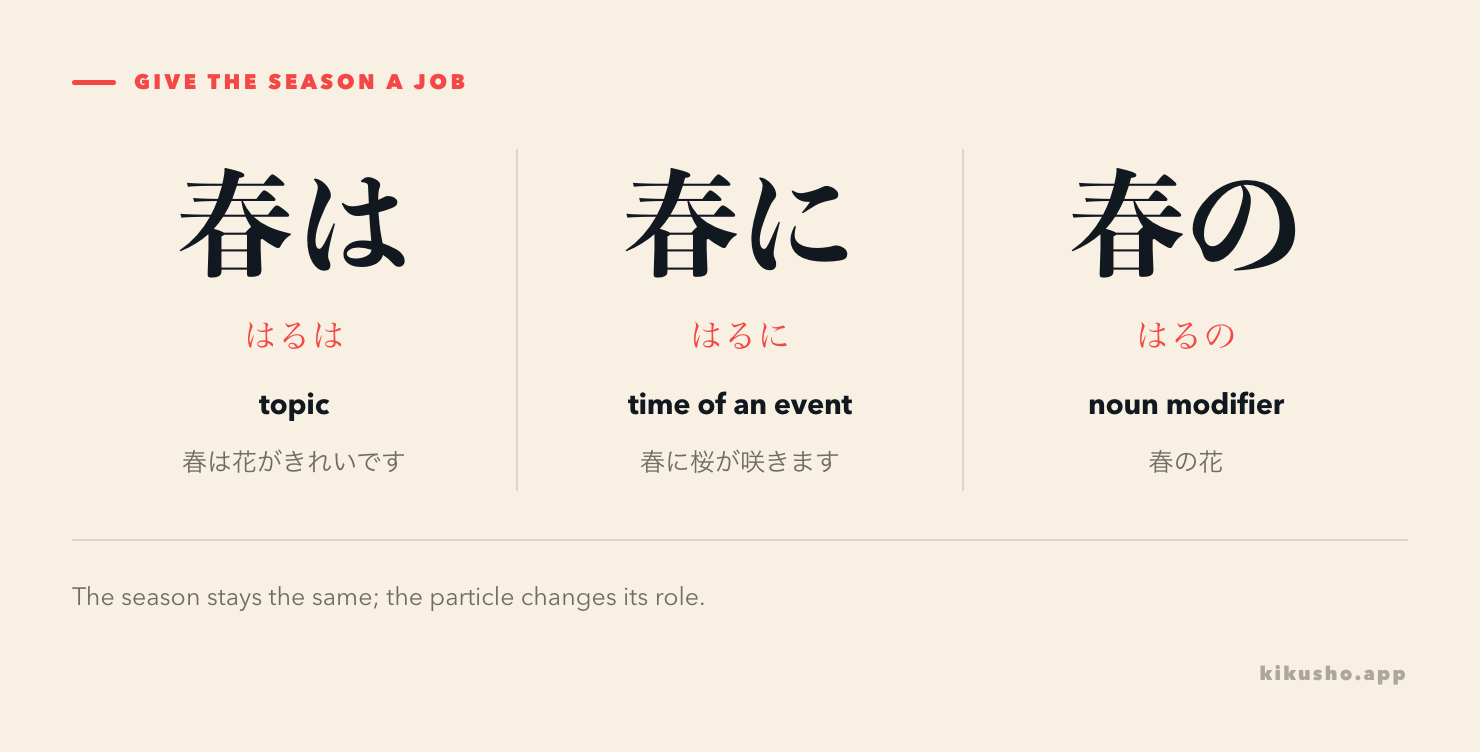
は makes a season the topic
Use は when the sentence says what a season is like or contrasts it with another one:
夏は暑いです。冬は寒いです。
なつは あついです。ふゆは さむいです。
Summer is hot. Winter is cold.
春は花がきれいです。
はるは はなが きれいです。
In spring, the flowers are beautiful.
Here the season frames the whole comment. The first pair contrasts summer with winter. The second sentence establishes spring as the setting, then describes the flowers inside that setting.
You can answer a preference question with が:
どの季節が一番好きですか。
どの きせつが いちばん すきですか。
Which season do you like best?
秋が一番好きです。
あきが いちばん すきです。
I like autumn best.
季節(きせつ), season, is supporting vocabulary rather than one of the four assigned headwords. In the answer, 秋 fills the item selected by 好き. The same frame works with every season: 春が好き, 夏が好き, 冬が好き.
に marks when an event happens
Use に when the season answers “when?” for a particular event:
春に桜が咲きます。
はるに さくらが さきます。
Cherry blossoms bloom in spring.
冬に雪が降ります。
ふゆに ゆきが ふります。
Snow falls in winter.
The season is a broad period, but it still locates the event in time. Compare 春は桜がきれいです, which makes spring the topic, with 春に桜が咲きます, which places the blooming in spring. The N5 time-particle lesson explains the wider choice between に, no particle, and either option for different kinds of time expressions.
Use の when the season directly modifies a noun:
- 春の花 — spring flowers
- 夏の休み — a summer break
- 秋の空 — the autumn sky
- 冬の朝 — a winter morning
The phrase names a thing associated with the season. It does not state that an event happens then, so に has no role inside the noun phrase.
になる marks the turn into a new season
Attach に to a season before なる to say that the year enters that season:
もう春になりました。
もう はるに なりました。
It has already become spring.
秋になると、涼しくなります。
あきに なると、すずしく なります。
When autumn comes, it gets cooler.
The first sentence reports a completed change. The second states what normally happens when autumn arrives. Notice that 秋 itself does not conjugate. The verb なる carries the tense: 春になる, will become spring; 春になりました, has become spring.
This frame is especially useful because a calendar date and someone's felt season do not always match. A warm day may prompt もう春ですね, while another region remains cold. The season noun can describe the period as the speaker experiences or discusses it.
から and まで draw a seasonal range
Use から, from, and まで, until, to mark endpoints:
春から夏まで、この公園は花が多いです。
はるから なつまで、この こうえんは はなが おおいです。
From spring through summer, this park has many flowers.
秋から冬にかけて、日が短くなります。
あきから ふゆに かけて、ひが みじかく なります。
From autumn into winter, the days become shorter.
The first line gives a clear range with two endpoints. The second uses the common から~にかけて frame for a change spread across a period. For N5 production, 春から夏まで is the simpler model to own; recognising にかけて in a seasonal sentence is an added reading aid.
Do not force the seasons into fixed dates in every context. The Japan Foundation's teaching text 日本の一年 presents a useful beginner model: spring around March to May, summer June to August, autumn September to November, and winter after that. Dictionary entries distinguish meteorological, astronomical and traditional-calendar boundaries. The word 春 remains “spring” across those systems; the intended dates come from the context.
One year in four short sentences
A beginner description can reuse one reliable pattern per season:
春に花が咲きます。夏は暑いです。秋になると涼しくなります。冬に雪が降ります。
はるに はなが さきます。なつは あついです。あきに なると すずしく なります。ふゆに ゆきが ふります。
Flowers bloom in spring. Summer is hot. When autumn comes, it gets cooler. Snow falls in winter.
The N5 weather lesson supplies the condition words and change verbs behind this miniature year. The N5 nature lesson adds the places that often appear in seasonal descriptions.
If you capture a sentence in Kikusho, keep the season together with its particle and predicate. 秋 alone tests one translation. 秋になると涼しくなります tests the reading, the transition and the seasonal relationship in a line you can use again. Check the drafted card before saving it; the surrounding phrase is what makes the four short nouns distinct during review.
A note about the N5 placement
Kikusho's September 2026 reference inventory assigns all four exact spelling-reading records to N5 without a recorded disagreement. Its two baseline snapshots both descend from the Tanos/Waller list, so they count as one source family. A separately published MLC Japanese N5 seasons page also lists 春(はる), 夏(なつ), 秋(あき) and 冬(ふゆ) at N5.
The JLPT does not publish an exhaustive current vocabulary list. The level label therefore describes a well-supported beginner study placement, not an official promise about which word will appear on a particular test. The official Japan Foundation course material verifies the readings and beginner uses; the dictionaries verify the words' meanings and the fact that season boundaries can be defined in more than one way.
Practice: complete the year before revealing the key
Season 1 · read the first season
How do you read 春?
A. あき
B. なつ
C. はる
D. ふゆ
Season 2 · identify autumn
Which kanji means “autumn” or “fall” and is read あき?
A. 夏
B. 秋
C. 冬
D. 春
Season 3 · choose the yearly order
Which sequence follows the ordinary yearly cycle taught in this lesson?
A. 春 → 夏 → 秋 → 冬
B. 夏 → 春 → 冬 → 秋
C. 秋 → 春 → 夏 → 冬
D. 冬 → 秋 → 春 → 夏
Season 4 · mark when flowers bloom
Complete 春__桜が咲きます to say “Cherry blossoms bloom in spring.”
A. を
B. に
C. が
D. の
Season 5 · make the season a topic
Which sentence naturally means “Summer is hot”?
A. 夏に暑いです。
B. 夏を暑いです。
C. 夏は暑いです。
D. 夏の暑いです。
Season 6 · report the transition
Which sentence means “It has already become spring”?
A. もう春になりました。
B. もう春をしました。
C. もう春が降りました。
D. もう春のなりました。
Season 7 · understand the range
What period does 春から夏まで describe?
A. Only one day in spring
B. From spring through summer
C. Every winter after autumn
D. Summer before spring
Answers and explanations
1 · Spring reading: C, はる. 春 is the standalone noun for spring. The other three readings belong to 秋, 夏 and 冬.
2 · Autumn kanji: B, 秋. 秋 is read あき and means autumn or fall. 夏 is summer, 冬 winter, and 春 spring.
3 · Yearly order: A. The cycle is 春(はる), 夏(なつ), 秋(あき), 冬(ふゆ). Keeping the words in this order gives each reading a stable neighbour.
4 · Time particle: B, に. 春に locates the blooming in spring. の would require a following noun inside one noun phrase, while を and が do not mark the time here.
5 · Topic particle: C. 夏は暑いです establishes summer as the topic and comments that it is hot. A season with に can locate an event, but 夏に暑いです is not the basic topic sentence requested.
6 · Seasonal transition: A. 春になる means “become spring,” and なりました makes the change polite past. The season takes に before なる; the other particles and verbs do not express that transition.
7 · Range: B. から marks the starting point, 春, and まで marks the endpoint, 夏. Together they describe a span from spring through summer.
The useful unit is now larger than a translation: 春は, 夏に, 秋になる, 冬の朝. Each particle gives the season a different job, so the four readings return inside a sentence rather than as a bare list.
Common questions
What are the four seasons in Japanese?
Spring is 春(はる), summer is 夏(なつ), autumn or fall is 秋(あき), and winter is 冬(ふゆ). All four are nouns and usually appear in that order.
How do you ask which season someone likes in Japanese?
Ask どの季節が一番好きですか, “Which season do you like best?” A simple answer is 秋が一番好きです, “I like autumn best.”
Do Japanese season names take the particle に?
Use に when a season is the time when an event happens, as in 春に桜が咲きます. Use は when the season is the topic, の before another noun, and から or まで for the endpoints of a range.
Are 春, 夏, 秋 and 冬 officially N5 vocabulary?
No exhaustive official vocabulary list exists for the revised JLPT. Kikusho's dated inventory and an independent Japanese-language-school list place all four words at N5, so the label is a supported study estimate.