On this page
山(やま), 川(かわ), 海(うみ) and 池(いけ) name four different parts of an outdoor scene: a mountain, a river, the sea and a pond. The readings are short; the useful work is keeping each noun with a phrase that shows whether it is a destination, a route, an activity place or the location of something.
Four nature words, four physical shapes
All four assigned items are nouns. Read them here as standalone words, rather than trying to reuse the reading in every compound or place name.
| Word | Reading | Core meaning | Phrase to keep |
|---|---|---|---|
| 山 | やま | mountain | 山へ行きます, go to the mountain |
| 川 | かわ | river; stream | 川を渡ります, cross the river |
| 海 | うみ | sea; ocean | 海で泳ぎます, swim in the sea |
| 池 | いけ | pond | 池に魚がいます, there are fish in the pond |
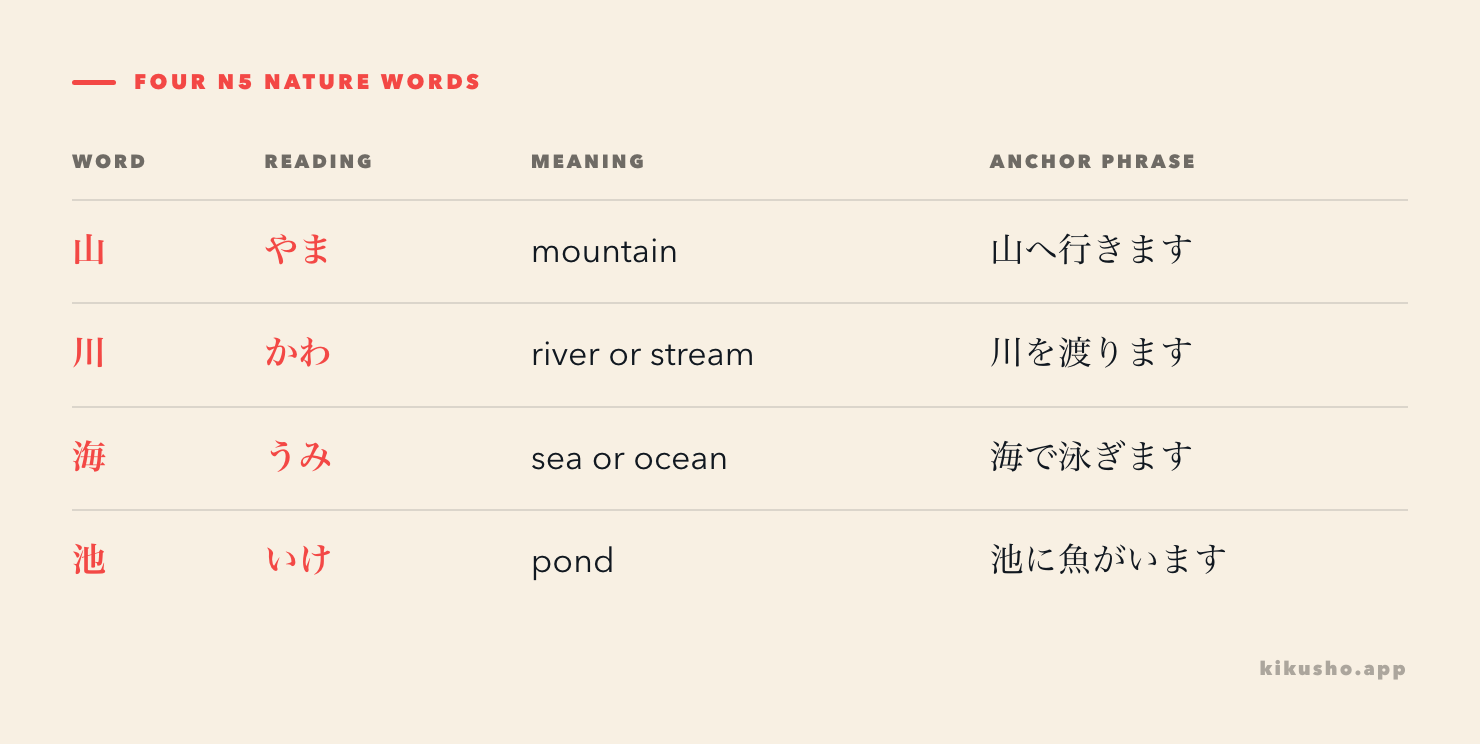
The shapes separate the words before translation does. A 山 rises above the surrounding land. Water moves along a 川. Water gathers in an 池, naturally or in a basin people have made. The 海 is the much larger body of salt water beyond the land.
Kotobank's dictionary entries verify 山(やま) as raised land, 川(かわ) as water flowing through a channel, and 池(いけ) as water collected in a hollow or constructed place. The definitions support the basic boundaries without turning an N5 lesson into a geography textbook.
川 flows; 池 holds water
The cleanest contrast is movement. A river has a direction:
山の近くに川があります。 やまの ちかくに かわが あります。 There is a river near the mountain.
橋で川を渡ります。 はしで かわを わたります。 I cross the river by the bridge.
An 池 is bounded water. In a park, it may be small enough to walk around:
公園の池に魚がいます。 こうえんの いけに さかなが います。 There are fish in the park pond.
This does not mean every 川 is large or every 池 is artificial. The distinction is the kind of water feature, not a fixed measurement. Kanjipedia independently defines 池(いけ) as a natural pool or a place dug to hold water.
海 means sea, even when the outing means beach
海 is the sea or ocean. Tokyo University of Foreign Studies gives the reading and sense in 海のそばに住んでいます, “I live near the sea.”
夏に海へ行きます。 なつに うみへ いきます。 I go to the seaside in summer.
The English translation may naturally say “the beach” because people understand the destination of a summer outing. The Japanese noun still names the sea. Use a more precise word such as 海辺(うみべ) for the seaside or 浜(はま) for a beach or shore when that physical strip of land matters. Those two are context here, not extra items credited to this four-word lesson.
The Japan Foundation's Irodori materials place the words in natural beginner descriptions: 海の近くにあります and 山や川がとてもきれいです. A separate Irodori lesson uses 海 and 山 as representative outdoor destinations. These examples confirm ordinary use without claiming that the JLPT publishes an official exhaustive word list.
The verb chooses the particle
The four anchor phrases use four different relationships. The noun alone does not choose a particle.
| Phrase | Role of the nature word | Particle |
|---|---|---|
| 山へ行きます | destination | へ |
| 川を渡ります | place crossed | を |
| 海で泳ぎます | place where an action happens | で |
| 池に魚がいます | place where something exists | に |
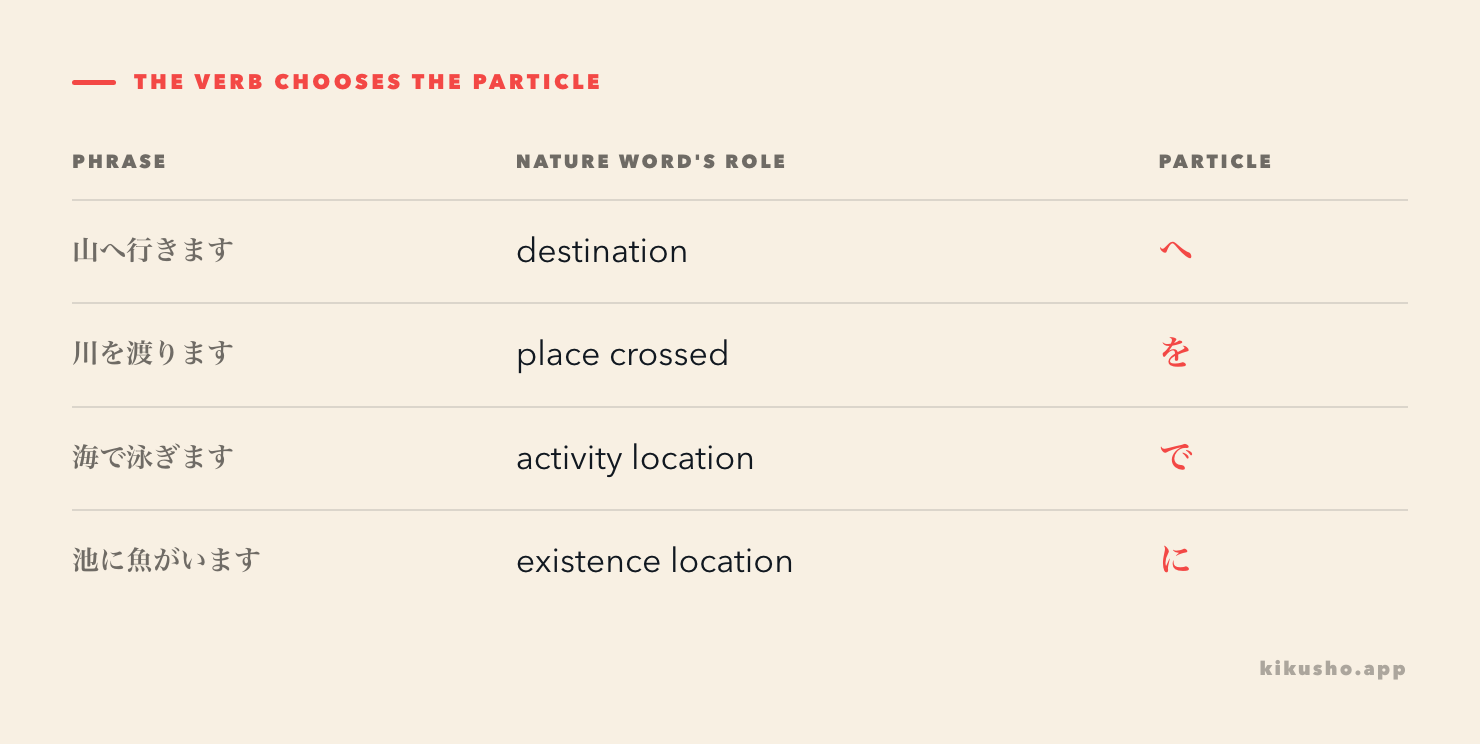
山に登ります is also natural: に marks the mountain as the goal of climbing. You can encounter 山を登ります when the mountain or route is presented as the space traversed. At N5, keep one secure phrase first and avoid turning one example into a ban on the other pattern.
The location-word lesson develops place relationships such as 駅の前. The place-particle lesson gives the wider rule behind destination に・へ and action-location で.
Standalone readings do not predict every name
In this table, 山 is やま and 川 is かわ. Inside compounds and names, the reading can change. 富士山 is ふじさん, while a river name may turn 川 into がわ, as in 隅田川(すみだがわ).
That does not make the beginner readings unreliable. It shows that a reading belongs to a word. Learn 山(やま) as the common standalone noun, then learn 富士山(ふじさん) as a complete name when you meet it. The same approach keeps 川(かわ) separate from the voiced ending in a particular river name.
If a trail sign, map or travel message contains one of these nouns, save the full phrase in Kikusho and check the drafted reading before keeping it. 海で泳ぐ preserves an activity place; 池に魚がいる preserves an existence place. The card then returns the relationship you met rather than a bare English label.
Practice the four-word map
Question 1 · sign reading
A trail map shows 池. Which pronunciation is correct for this standalone noun?
- A. うみ
- B. いけ
- C. かわ
- D. やま
Question 2 · spelling
Select the kanji for かわ, “river”.
- A. 池
- B. 山
- C. 川
- D. 海
Question 3 · water shape
Which word names water that flows along a channel?
- A. 川
- B. 池
- C. 山
- D. 海辺
Question 4 · activity place
Complete “I swim in the sea”: 海( )泳ぎます。
- A. に
- B. を
- C. の
- D. で
Question 5 · existence place
Complete “There are fish in the pond”: 池( )魚がいます。
- A. に
- B. へ
- C. を
- D. で
Question 6 · short passage
Read: 山の近くに川があります。川を渡って、海へ行きます。公園の池には魚がいます。 Which statement matches it?
- A. The sea is inside the pond.
- B. The speaker swims across a mountain.
- C. A river is near the mountain, the route continues to the sea, and fish are in a park pond.
- D. The passage uses one word for every kind of water.
Answers and explanations
Answer 1
B. いけ. 池 is read いけ as the standalone noun “pond”. The other choices are the readings of 海, 川 and 山.
Answer 2
C. 川. 川 is かわ, a river or stream. 池 is いけ, 山 is やま and 海 is うみ.
Answer 3
A. 川. A 川 carries flowing water along a channel. An 池 holds water in a bounded hollow or basin. 山 is raised land, and 海辺 means the seaside rather than a river.
Answer 4
D. で. 海で泳ぎます marks the sea as the place where swimming happens. に or へ can mark a destination with 行く, but the verb here describes an activity at that place.
Answer 5
A. に. 池に魚がいます uses に for the place where the fish exist. で would suit an action performed at the pond, such as 池で写真を撮ります, but います uses the existence-location pattern.
Answer 6
C. The passage keeps all four nouns distinct. 山 locates the nearby river, 川 is crossed, 海 is the destination, and 池 is the pond where fish exist. No line says that the sea is inside the pond or that the mountain is crossed by swimming.
Common questions
How do you read 山, 川, 海 and 池?
As standalone N5 nature words, 山 is やま, 川 is かわ, 海 is うみ and 池 is いけ. These kanji can take other readings inside compounds and place names, so keep each reading with the whole word in which you meet it.
What is the difference between 川 and 池?
川(かわ)is a river or stream, where water flows along a channel. 池(いけ)is a pond, where water collects in a hollow or constructed basin. A fish can be in either, but the type of water feature is different.
Does 海 mean sea or beach?
海(うみ)means the sea or ocean. In conversation, 海に行く can imply going to the seaside or beach because the destination is understood, but the noun itself does not become the precise word for a sandy beach.
Which particles are useful with these nature words?
Use a destination particle in 山へ行く, を for the river crossed in 川を渡る, で for the activity location in 海で泳ぐ, and に for the place where a fish exists in 池に魚がいる. The verb determines the noun's role.