On this page
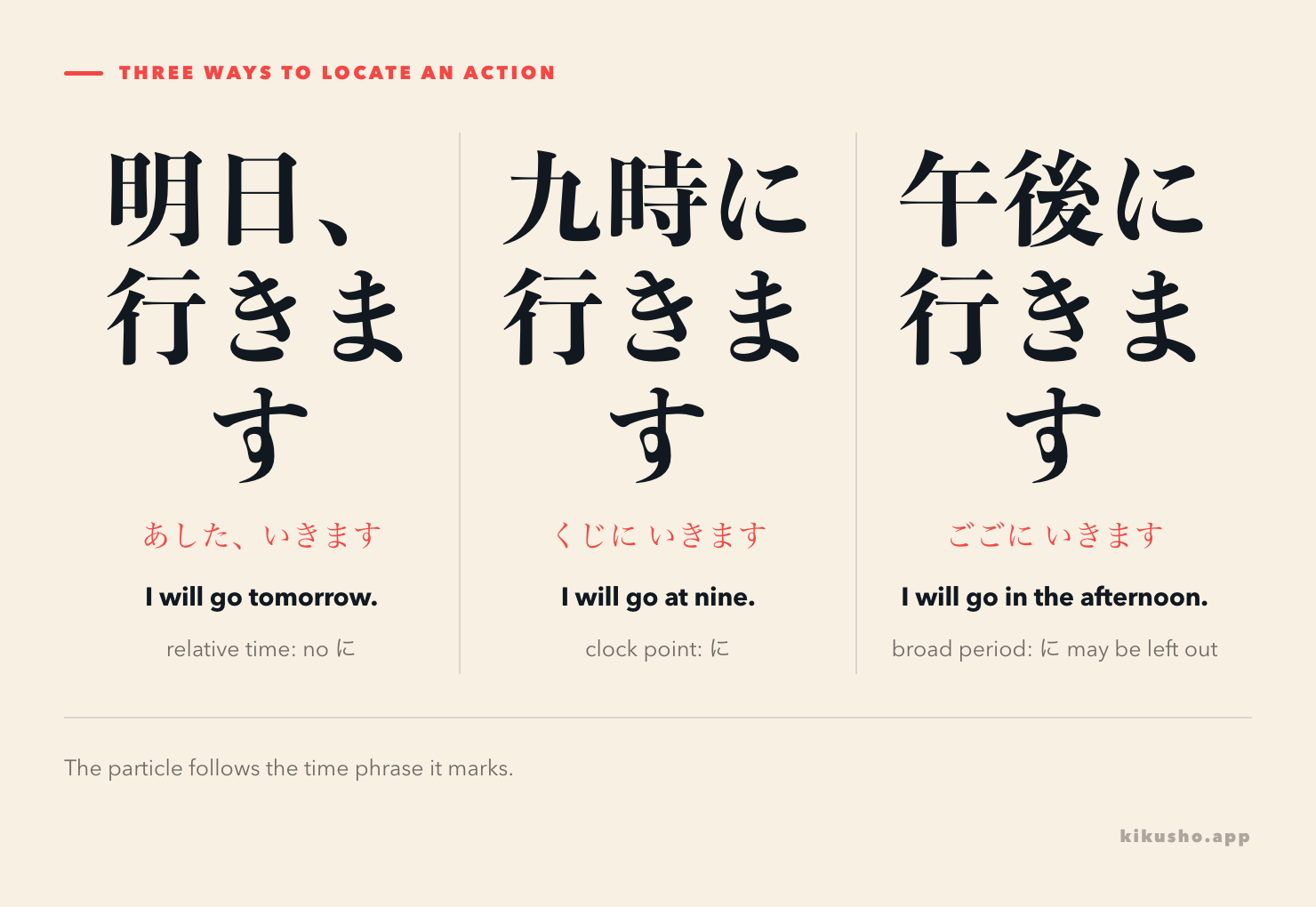
Most time words measured from now, such as 今日 and 来週, stand before the verb without the time particle に. Exact clock times commonly take に; the broad periods 午前 and 午後 are more flexible, so a rule that divides every time word into “always に” and “never に” will mislead you. The nineteen N5 words below are easier to remember in their usual sentences than as a particle checklist.
These nineteen words locate a day, week, month, year or routine
They belong together because English often adds on, in or at before a time phrase, while Japanese distributes that job differently. In the tables, time noun / adverbial means a word that can name a time and can also locate an action in a sentence. The short phrases show that adverbial use. Readings are in parentheses; each phrase is a collocation you can say, not a second definition.
| Word and reading | Sense | Class | Usual phrase |
|---|---|---|---|
| 今日(きょう) | today | time noun / adverbial | 今日、勉強します: study today |
| 昨日(きのう) | yesterday | time noun / adverbial | 昨日、帰りました: went home yesterday |
| 明日(あした) | tomorrow | time noun / adverbial | 明日、行きます: go tomorrow |
| 今朝(けさ) | this morning | time noun / adverbial | 今朝、起きました: woke up this morning |
| 今晩(こんばん) | this evening; tonight | time noun / adverbial | 今晩、勉強します: study tonight |
| 今週(こんしゅう) | this week | time noun / adverbial | 今週、テストがあります: have a test this week |
| 先週(せんしゅう) | last week | time noun / adverbial | 先週、休みました: took a break last week |
| 来週(らいしゅう) | next week | time noun / adverbial | 来週、会います: meet next week |
| 今月(こんげつ) | this month | time noun / adverbial | 今月、旅行します: travel this month |
| 先月(せんげつ) | last month | time noun / adverbial | 先月、買いました: bought it last month |
| 来月(らいげつ) | next month | time noun / adverbial | 来月、出発します: depart next month |
| 今年(ことし) | this year | time noun / adverbial | 今年、卒業します: graduate this year |
| 去年(きょねん) | last year | time noun / adverbial | 去年、日本に行きました: went to Japan last year |
| 来年(らいねん) | next year | time noun / adverbial | 来年、入学します: enter school next year |
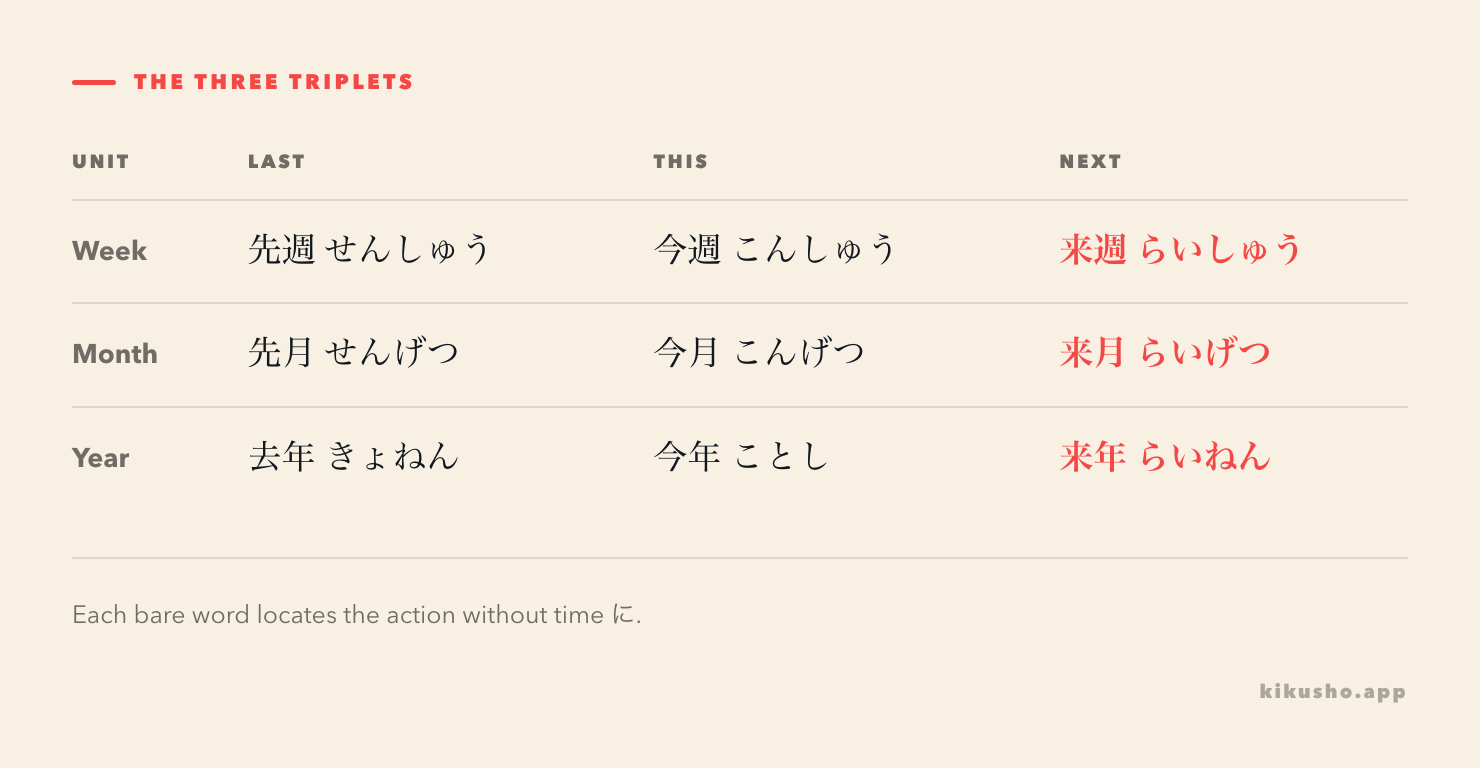
The week, month and year words form three useful triplets: 今 is this, 先 is last, and 来 is next. The readings are not built by simply sounding out the first kanji: 来週 is らいしゅう, 来月 is らいげつ, and 来年 is らいねん. 今日, 昨日, 明日 and 今朝 deserve their own word cards because their readings are less predictable. A Japanese introductory textbook's time-reference list gives several of these readings and models the no-particle pattern; this independent time-expression guide lists the day, week, month and year series.
毎朝, 毎日 and 毎晩 locate a repeated action
The three 毎 words name a routine rather than a date. They ordinarily stand without time に, like the relative words above.
| Word and reading | Sense | Class | Usual phrase |
|---|---|---|---|
| 毎朝(まいあさ) | every morning | time noun / adverbial | 毎朝、七時に起きます: get up at seven every morning |
| 毎日(まいにち) | every day | time noun / adverbial | 毎日、日本語を勉強します: study Japanese every day |
| 毎晩(まいばん) | every night | time noun / adverbial | 毎晩、本を読みます: read a book every night |
In 毎朝、七時に起きます, there are two time expressions. 毎朝 states the recurrence and has no time に. 七時 specifies a clock point and takes に. Attaching に to 毎朝 because another time expression in the sentence has it would assign the particle to the wrong word. The introductory textbook's lesson on time に uses 毎朝 this way and includes 毎晩 among relative or general time references.
午前 and 午後 can be a period or part of a clock time
These two words name the sides of noon. 午前 is before noon, or A.M.; 午後 is after noon, or P.M. As stand-alone broad periods, they can appear with or without に in ordinary time expressions. When placed before an exact clock time, they qualify the clock phrase rather than taking their own particle.
| Word and reading | Sense | Class | Usual phrase |
|---|---|---|---|
| 午前(ごぜん) | before noon; A.M. | time noun / adverbial | 午前九時に会います: meet at 9 A.M. |
| 午後(ごご) | after noon; P.M. | time noun / adverbial | 午後、図書館へ行きます: go to the library in the afternoon |
Compare 明日の午後、図書館へ行きます with 午後に図書館へ行きます. The first locates the afternoon inside tomorrow and leaves に out; the second uses 午後に as a broad time phrase. Neither licenses a blanket claim that 午後 always requires に. 午前九時に会います puts に after the whole “9 A.M.” clock time. Tokyo University of Foreign Studies' time lesson verifies the 午前/午後 readings and order before a clock time. A Japanese teacher's examples explicitly show 午後 with and without に; a linguistic study of temporal に describes why broad time-of-day periods allow variation.
The phrase after a relative word can still take に
Use the simplest safe pattern first: 明日、図書館へ行きます for “I will go to the library tomorrow,” and 九時に図書館へ行きます for “I will go at nine.” If you combine them, 明日の九時に図書館へ行きます, the に follows 九時, not 明日. The relative word uses の to narrow an exact time. Named weekdays and calendar dates also commonly use に in ordinary speech, as in 月曜日に行きます, though context and written style can allow omission. The linguistic study distinguishes a point named relative to the speaker from an absolute calendar point and records those contextual exceptions.
This lesson concerns time に. The same particle marks a destination in 日本に行きました in the table, so seeing に elsewhere in a sentence does not mean its time word took it. If you need the number and clock readings, the N5 number lesson is the useful prerequisite. Another time-word set starts with intervals such as 間 and うち, which answer a different “when?” question.
Learn the word inside the sentence where its particle belongs
A card that says only “tomorrow = 明日” cannot tell you whether the に in a later sentence belongs to tomorrow, a clock time, or a destination. Keep 明日、九時に行きます together long enough to see that split, then practice retrieving 明日, 九時 and the whole phrase separately. Kikusho lets you save a sentence you meet, check the reading with native audio, and review its words in that context. The point is to retain the boundary after the time expression, where the grammar is visible.
Check yourself
Question 1: kanji reading. How is 今朝 read in 今朝、早く起きました?
- A. けさ
- B. こんあさ
- C. きょうあさ
- D. いまあさ
Question 2: orthography. Which written word means “next month” and is read らいげつ?
- A. 来週
- B. 先月
- C. 来月
- D. 今月
Question 3: meaning in context. Someone says 毎晩、本を読みます. Which English meaning fits 毎晩 here?
- A. tonight
- B. every night
- C. last night
- D. tomorrow night
Question 4: paraphrase. Replace 今週 in 今週、会います with the word meaning “next week,” keeping the same simple sentence pattern. Write the Japanese sentence.
Question 5: sentence composition. Write “I get up at seven every morning” in Japanese, using 毎朝, 七時 and 起きます. Place に only where it marks the exact time.
Answers and explanations
Answer 1. A, けさ. 今朝 is an established word reading; the choices that pronounce 今 or 朝 separately do not give its ordinary reading.
Answer 2. C, 来月. 来 marks next and 月 marks month. 来週 is next week; 先月 is last month; 今月 is this month.
Answer 3. B, every night. 毎 marks recurrence and 晩 names the evening/night. 今晩, without 毎, is the word in this set for tonight.
Answer 4. 来週、会います。 来週 is next week. It replaces 今週 directly as a relative time adverbial, so no time に is added.
Answer 5. 毎朝、七時に起きます。 毎朝 gives the routine without time に; 七時 is the specified clock time and receives に. A に after 毎朝 would mark the routine rather than the clock point; を after 七時 would not mark when one wakes.
When you meet a new sentence, locate each time expression before deciding where に belongs. The nineteen words here supply the day, week, month, year and routine; the clock phrase can still set a precise point inside any one of them.
Common questions
Does 明日 take に when it means tomorrow?
As an ordinary time adverbial, say 明日、行きます, without time に. A relative word such as 明日 names tomorrow from the speaker's present.
Why does 毎朝、七時に起きます have に?
毎朝 means every morning and stands without time に. The に belongs to the exact time 七時, seven o'clock. Read the two time expressions separately.
Can 午後 appear without に?
Yes. 午後、図書館へ行きます and 午後に図書館へ行きます can both work. A specified period such as 明日の午後 also commonly stands without に. In 午後三時に, the particle follows the complete three-P.M. clock expression.