On this page
Japanese sorts how often onto a single line, from いつも at the always end down to ぜんぜん at the never end, and a word's place on that line is only half of what you need to know about it. The other half is grammar: the four words at the low-frequency end, あまり, めったに, ほとんど and ぜんぜん, refuse to appear unless the verb after them is negative, and ときどき and たまに, both handed to you as "sometimes," sit at different heights and are not interchangeable.
A frequency list files them together, then trips you
A beginner glossary gives each word a gloss and moves on: いつも, "always"; よく, "often"; ときどき, "sometimes"; たまに, "sometimes"; あまり, "not much"; ぜんぜん, "not at all." Two of those glosses are identical, which is the first problem. None of them records the rule welded to the word, which is the larger one. あまり does not simply mean "not often." It means "not often" and forces the rest of the clause negative, so it cannot stand in front of a plain verb at all. That is a piece of grammar wearing the costume of a vocabulary item, and no flat list will ever put it on the page.
These words belong together because the thing worth learning is the relationship between them, not any single member. Seen as one scale, you can ask the two questions that matter: how often does this word place the action, and does it need a negative to do its job. Met one at a time on separate cards, both questions stay invisible, and you keep six glosses while losing the shape they make. This is the same reason keeping a word inside the sentence you met it in beats keeping the gloss on its own.
The set, from every day to almost never
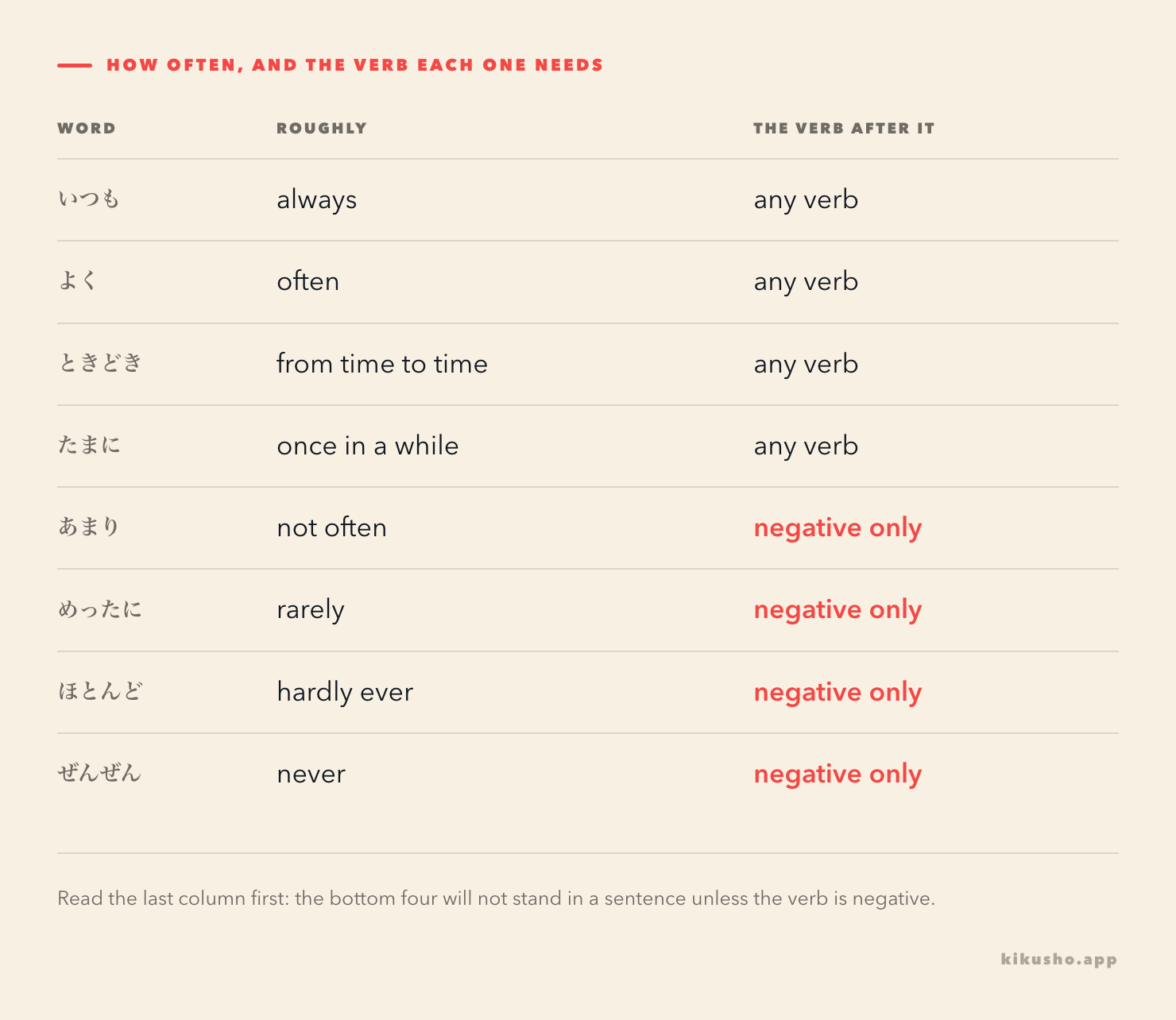
| Word | Roughly | Verb it needs | Example |
|---|---|---|---|
| いつも | always | any | いつもコーヒーを飲む |
| よく | often | any | よく映画を見る |
| ときどき | from time to time | any | ときどき料理をする |
| たまに | once in a while | any | たまに旅行する |
| あまり | not often | negative | あまり肉を食べない |
| めったに | rarely | negative | 彼はめったに来ない |
| ほとんど | hardly ever | negative | ほとんどテレビを見ない |
| ぜんぜん | never | negative | ぜんぜんお酒を飲まない |
Read the last column before the glosses and the set falls into two halves. The top four attach to any verb, positive or negative, and simply mark a point on the frequency scale. The bottom four demand a negative and refuse a plain verb outright. That split is the lesson; the individual meanings are the easy part.
One note on level. These land around N5 in most beginner courses, though the low-frequency members drift upward: めったに and ほとんど often turn up a stage later, and the lists disagree because the JLPT publishes no official vocabulary syllabus. Treat the level as a study stage rather than a fixed label.
ときどき and たまに are two different "sometimes"
The pair that sends people to a search box is ときどき and たまに, because the glossary gives both as "sometimes" and stops there. They are not the same point on the scale. ときどき is the more frequent of the two and carries a sense of rhythm: something you do from time to time, on a loose but real cycle. ときどき散歩する describes a walk that recurs, even if not on a fixed day. たまに is rarer and has no rhythm to it: it happens once in a while, as an exception rather than a habit. たまに散歩する is the same walk taken only now and then, when the mood or the weather allows.
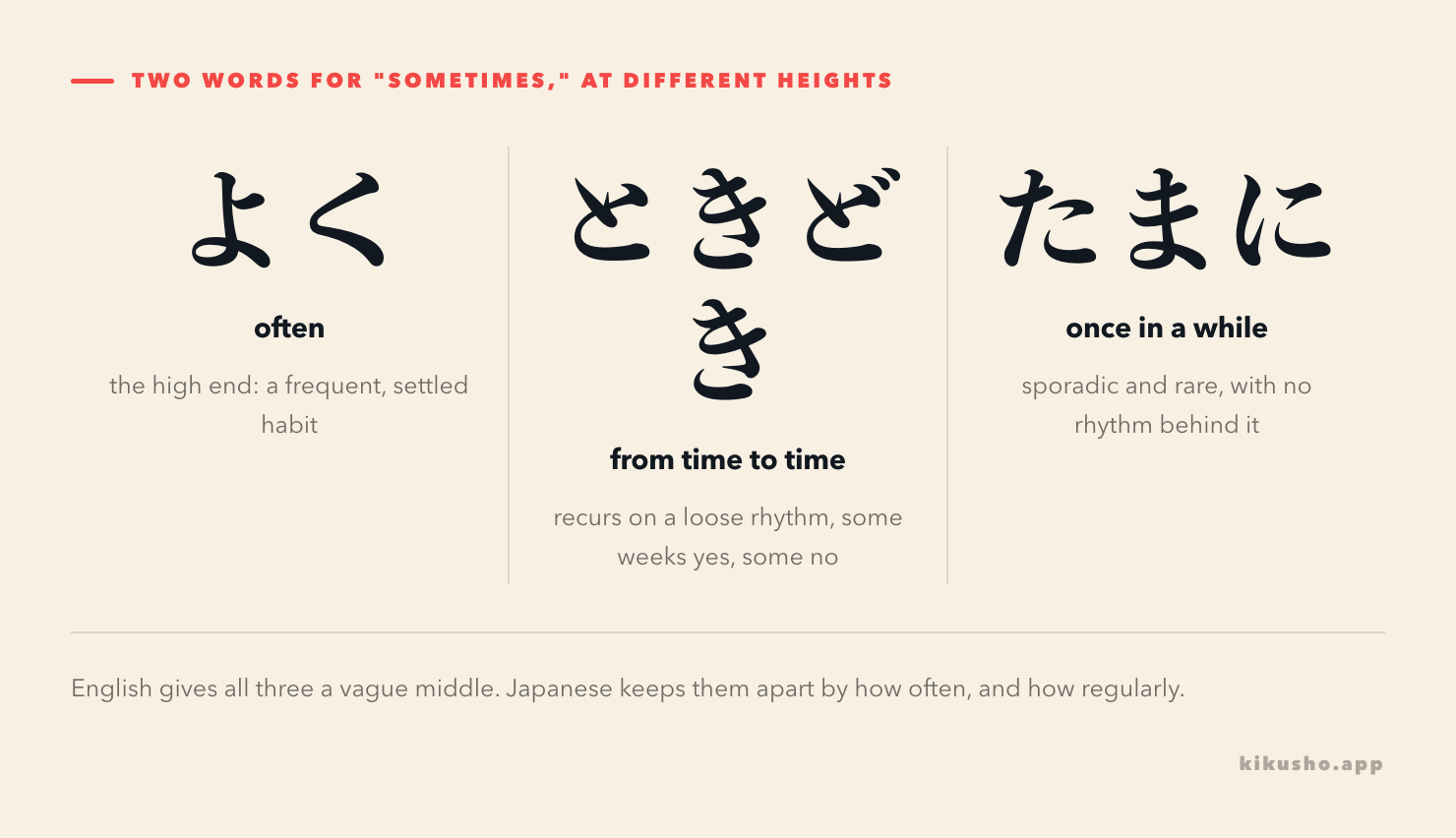
Put them beside よく and the three sort cleanly by frequency. よく is the high end, a settled habit. ときどき sits in the middle, regular but sparse. たまに is down near the floor, just above the words that need a negative. Swap ときどき for たまに and you have not made a small slip of degree. You have told your listener the thing almost never happens when you meant it happens fairly often, or the reverse.
Four of them refuse a positive verb
あまり, めったに, ほとんど and ぜんぜん share a rule the glosses hide: each one needs the clause to end in a negative. They are negative-polarity items, which means the adverb opens an expectation and the verb has to close it. めったに映画を見ない is correct. めったに映画を見る is broken, stranded the way English "I have ever been there" is broken as a plain statement, with the adverb left hanging and nothing to attach to.
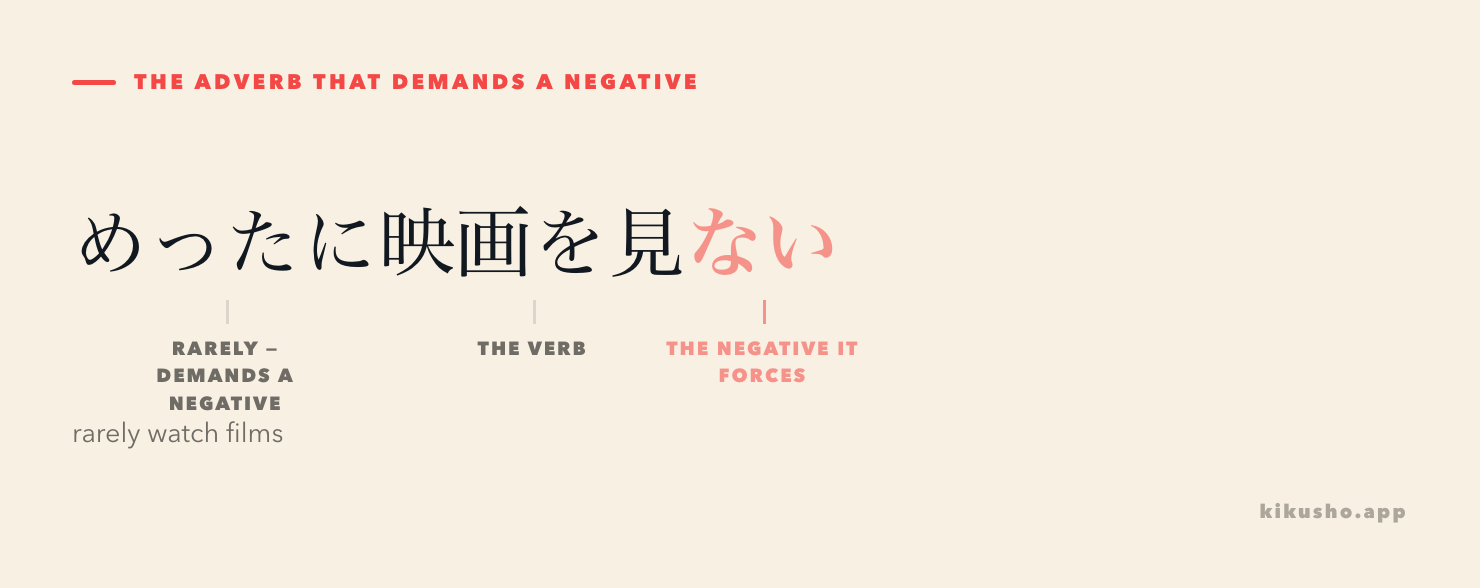
You build that negative the ordinary way, with ない, ません or the past negative; the adverb changes nothing about how the negative is formed, it only insists that one is present. It is the same rule that governs the low end of the degree adverbs, where 全然 and ちっとも require a negative for the same reason. Some Japanese adverbs are grammatical only inside a negative frame, whether they are measuring how much or how often.
Two of the four carry a wrinkle. あまり does double duty: あまり食べない can mean "I don't eat much" as a matter of degree, or "I don't eat often" as a matter of frequency, and only the sentence around it tells you which. ほとんど is a trap of the opposite kind. With a negative it means "hardly ever": ほとんど電話しない, "hardly ever calls." On its own, in front of an affirmative, it means "almost" or "most": ほとんど終わった, "almost finished"; ほとんどの人, "most people." The negative is what pins ほとんど to the frequency scale rather than the amount scale.
The formal and the casual ends of the same scale
The eight words above are the neutral, everyday set. Two more sit off to the sides, and knowing them is what keeps your frequency vocabulary from sounding flat. At the always end, 常に (つねに) is the formal, written twin of いつも: 常に確認する belongs in a manual or a notice, where いつも確認する would read as too casual. The N5 lesson on 一緒に and いつも shows how that frequency word can share one predicate with a companion phrase, as in いつも友達と一緒に勉強します. Toward the often end, しょっちゅう is the opposite register, thoroughly colloquial, and it usually carries a faint note of too often for comfort: しょっちゅう遅刻する is less a neutral report than a small complaint. Reaching for one of these is a decision about how formal the sentence should sound, not about frequency alone.
Which of the whole group you meet first depends on where you meet Japanese. In conversation, よく, ときどき and the negative-forced ぜんぜん arrive early, usually welded to a specific verb. In signs and instructions, 常に and めったに show up more than they do in speech. None of them waits for the lesson that introduces it, and each lands already carrying the verb that makes it legal.
That verb is the part worth catching, and the part a bare word card drops. The rule that あまり or めったに carries lives in the sentence, in the ない at the end, so a card holding only the adverb and a one-word gloss has thrown the useful half away. What you want to keep is the clause you actually heard: しょっちゅう電車が遅れる from a coworker, あまりテレビを見ない from a friend describing their evenings. Kikusho builds a card from a line you say, photograph or paste, so the adverb stays attached to the verb it forced and to the register it belongs in. You can lift a single word out to drill later, once the frame around it is already recorded.
Questions to fix the scale
Question 1. Which word completes 「私は___肉を食べない」so it means "I hardly ever eat meat"?
a) よく b) ときどき c) ほとんど d) いつも
Answer 1: (c) ほとんど. With the negative 食べない, ほとんど means "hardly ever." (a) よく, (b) ときどき and (d) いつも all describe frequent or regular action, and none of them sets up the negative the sentence already has; よく肉を食べない is not how anyone says "rarely."
Question 2. A friend cooks dinner most weeks, on no fixed day. Which is the natural way to say it?
a) たまに料理する b) めったに料理しない c) ときどき料理する d) ぜんぜん料理しない
Answer 2: (c) ときどき料理する. A loose but real rhythm, "from time to time," is ときどき. (a) たまに would drop it to "once in a while," rarer than described. (b) and (d) require a negative and say the opposite, that it seldom or never happens.
Question 3. Which sentence is grammatical?
a) 私はめったに映画を見る。 b) 私はめったに映画を見ない。 c) 私はあまり本を読む。 d) 私はぜんぜん寝た。
Answer 3: (b). めったに requires a negative, so めったに映画を見ない, "I rarely watch films," is correct and めったに映画を見る is not. (c) あまり also needs a negative: あまり本を読まない. (d) ぜんぜん needs one too; ぜんぜん寝た is broken, though ぜんぜん寝ていない would be fine.
Question 4. ほとんど appears in all four sentences. Where does it mean "hardly ever"?
a) 仕事はほとんど終わった。 b) ほとんどの人が知っている。 c) 彼はほとんど電話しない。 d) ご飯をほとんど食べた。
Answer 4: (c). Only (c) pairs ほとんど with a negative, 電話しない, to give the "hardly ever" frequency reading. (a) and (d) are affirmative and mean "almost" — "almost finished," "ate almost all of it." (b) is the noun use, ほとんどの, "most people."
None of this is extra memorisation. It is one question you ask once and then stop noticing: does the word I want sit above the negative line or below it. Above, and any verb will do. Below, and the sentence has to end in ない before the word is allowed in at all.
Common questions
What is the difference between ときどき and たまに?
Both translate as "sometimes," but they sit at different heights. ときどき is the more frequent of the two and implies a loose rhythm, "from time to time"; たまに is rarer and more sporadic, "once in a while." Choosing たまに tells your listener the action is an occasional exception; ときどき says it recurs on some cycle, even an irregular one.
Which Japanese frequency adverbs need a negative verb?
あまり, めったに, ほとんど and ぜんぜん. Each is a negative-polarity item: the clause has to end in a negative — ない, ません or the past negative — for the adverb to be grammatical. So it is あまり食べない, "I don't eat much," and めったに行かない, "I rarely go," never あまり食べる or めったに行く.
Does あまり mean "not much" or "not often"?
Both. あまり covers degree, "not much" or "not very," and frequency, "not often," and the surrounding sentence decides which: あまり難しくない is "not very hard", あまり行かない is "don't go often". Either way it requires a negative predicate to complete it.
Is ぜんぜん always negative?
As a frequency word, yes: ぜんぜん運動しない means "I never exercise." The casual 全然大丈夫 or 全然いい you hear in conversation is a separate, intensifying use in front of an adjective, still treated as nonstandard in writing and on the JLPT, and it is not part of the frequency scale.