On this page
いくつ, いくら, 少し, あまり and 全部 let you ask for a quantity, report a small amount, limit a claim or include the whole set. The central choices are simple: use いくつ for a count, いくら for a price, 少し for a positive small amount, あまり with a negative for “not much,” and 全部 for all of it.
Five N5 words form one practical quantity system
| Word | Reading | Job in a sentence | Phrase to remember |
|---|---|---|---|
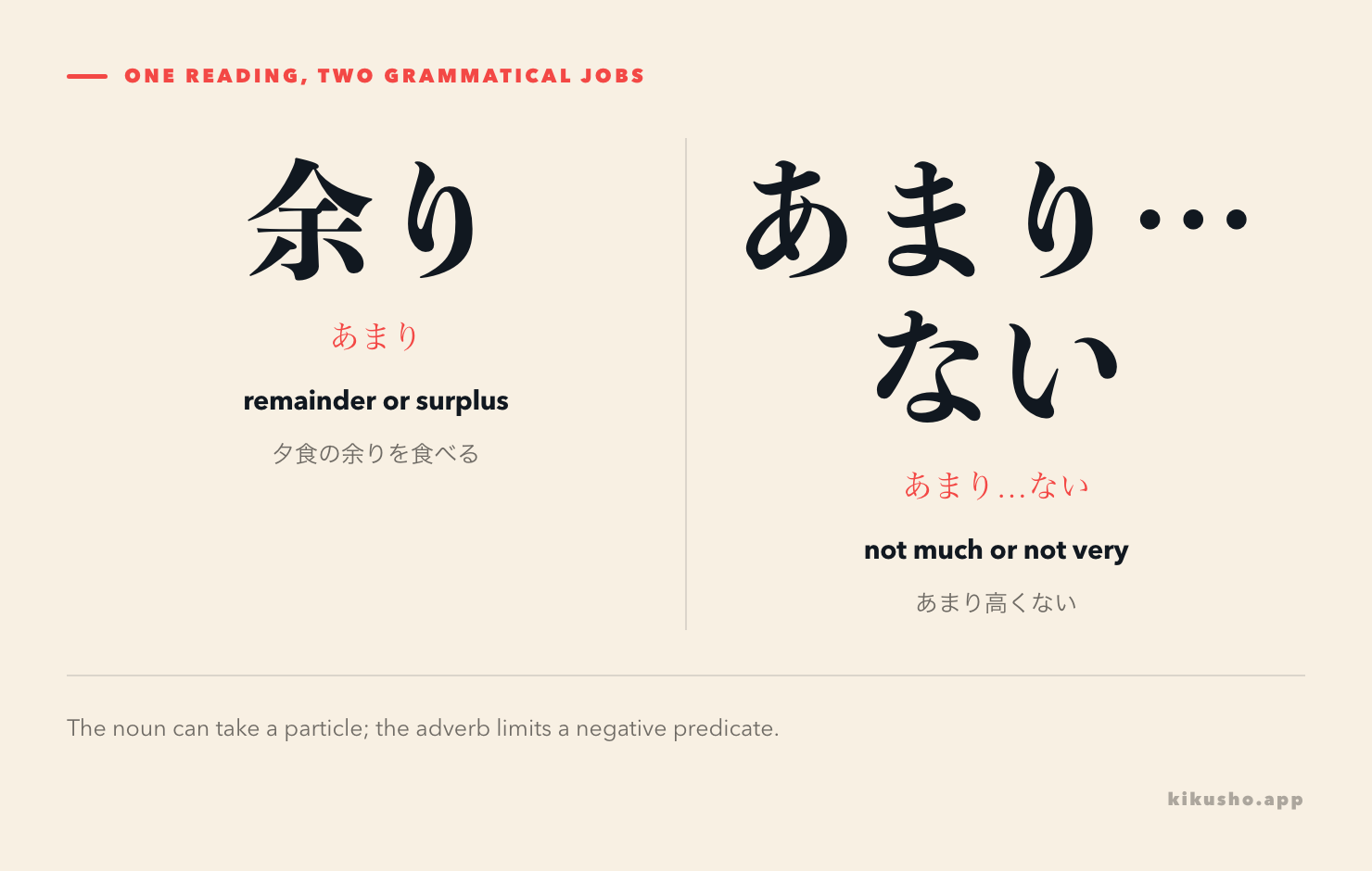
| 余り/あまり | あまり, amari | noun: remainder or surplus; adverb with a negative: not much, not very | あまり高くない: not very expensive |
| いくつ | いくつ, ikutsu | asks how many general objects; also asks age | りんごはいくつありますか: how many apples are there? |
| いくら | いくら, ikura | asks a price or amount of money | これはいくらですか: how much is this? |
| 少し | すこし, sukoshi | marks a small positive amount or degree | 水が少しあります: there is a little water |
| 全部 | ぜんぶ, zenbu | includes every relevant item or gives the total | 全部で五つです: there are five in all |
In ordinary beginner writing, いくつ, いくら and the negative adverb あまり usually appear in hiragana. 少し and 全部 commonly appear in kanji. The noun meaning “remainder” may be written 余り or あまり; the sentence tells you which sense is active.
These are useful beginner placements rather than entries in an official syllabus. The retained reference sources place all five at N5, although one older source places 余り at N3. Independently, Bunpro labels 幾つ and 余り N5, while the MLC N5 vocabulary list includes あまり, 少し and 全部. The JLPT organizers do not publish an exhaustive vocabulary list, so the level remains an editorial study guide.
The N5 numbers lesson teaches the answers ひとつ, ふたつ and the readings used with 円. This page teaches the questions and quantity words that make those numbers useful in a conversation.
いくつ asks for a count, and sometimes an age
Use いくつ when the unknown answer is a number of general objects. It contains the same つ used in ひとつ, ふたつ and みっつ, so the answer often comes from that native counting series.
りんごはいくつありますか。 How many apples are there?
四つあります。 There are four.
The dictionary entry for 幾つ gives both unknown object count and unknown age. In normal beginner writing, keep the question in kana even though 幾つ exists.
For age, おいくつですか adds the polite prefix お:
お子さんはおいくつですか。 How old is your child?
The direct form 何歳ですか also asks age. Age can be personal, so use either question only when the situation makes it appropriate.
Do not use いくつ when a specific counter is expected and known. A restaurant may ask 何人ですか, “how many people?”, and a bookstore may ask 何冊ですか, “how many books?” The guide to Japanese counters develops those noun-specific questions. いくつ remains a safe general question for ordinary objects.
いくら asks for a price or an amount of money
At N5, the most useful meaning of いくら is “how much does it cost?”
このかばんはいくらですか。 How much is this bag?
三千円です。 It is 3,000 yen.
The Japan Foundation's shopping lesson pairs いくら with prices and いくつ with the number of items. That split is the reliable beginner default:
| Expected answer | Question | Example answer |
|---|---|---|
| number of general objects | いくつ | 三つです |
| price or money amount | いくら | 五百円です |
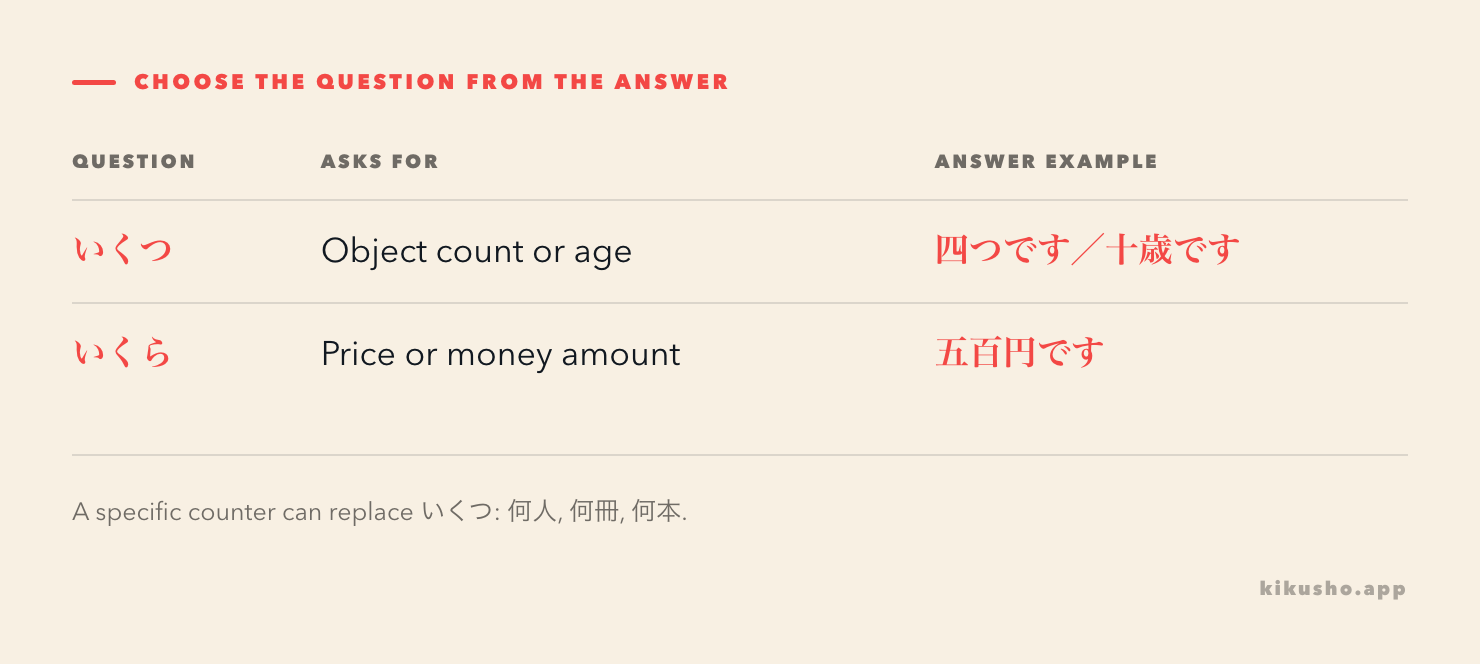
The broader dictionary entry for 幾ら includes unknown quantity, degree and price. Everyday Japanese often uses a counter or どのくらい/どれくらい for weight, time and other kinds of amount. For clear N5 production, let いくら lead first to a money answer.
少し presents a small amount as present
少し(すこし) means “a little,” “a few” or “slightly.” It can modify an action, an adjective or an amount that exists.
水を少し飲みます。 I will drink a little water.
このかばんは少し重いです。 This bag is a little heavy.
時間が少しあります。 I have a little time.
The dictionary definition of 少し covers a small quantity or degree and also records noun-like patterns such as 少しの時間. The examples above all leave a positive claim in place: some water is drunk, the bag has some heaviness, and some time exists.
This positive viewpoint separates 少し from 少ない(すくない). 少し modifies another expression; 少ない is an い-adjective that describes the number or amount itself:
| Form | Structure | Meaning |
|---|---|---|
| 少し時間があります | 少し + positive clause | there is a little time |
| 時間が少ないです | noun + が + 少ない | the amount of time is small |
Both can fit the same situation, but they build it differently. The first notices the small amount that is available; the second judges the amount as low.
あまり pairs with a negative to limit quantity or degree
In the beginner adverb pattern, あまり waits for a negative ending. It can lower quantity, frequency or the degree of an adjective:
お金があまりありません。 I do not have much money.
テレビはあまり見ません。 I do not watch television much or often.
この店はあまり高くないです。 This shop is not very expensive.
The negative ending carries the “not.” あまり by itself does not mean the complete English phrase “not much.” Tofugu's formation guide verifies the noun-existence, verb and adjective patterns. A later lesson compares あまり~ない with the stronger 全然~ない; here, keep the basic contrast with 少し:
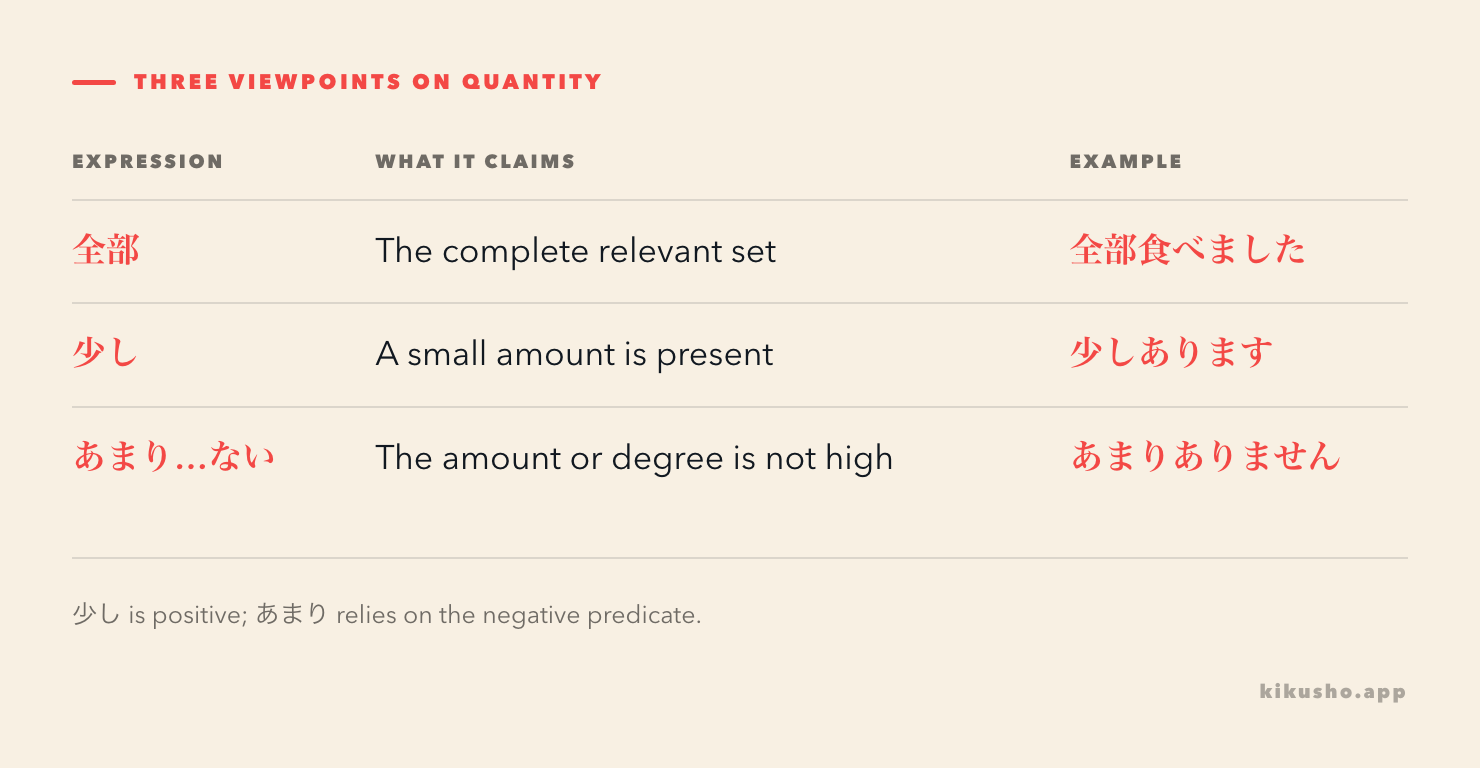
- 水が少しあります: some water is available.
- 水があまりありません: there is not much water.
These sentences may describe similar amounts. Their viewpoints differ: 少し affirms what exists, while あまりありません says the amount falls below “much.”
余り as a noun means what remains
The same reading has a separate noun use. 余り(あまり) can mean a remainder, surplus or leftover portion:
夕食の余りを冷蔵庫に入れました。 I put the dinner leftovers in the refrigerator.
Here 余り is an object marked by を. It does not predict a negative ending. In arithmetic, 七を二で割ると、三余り一です means “Seven divided by two is three, remainder one.” You do not need that calculation pattern to shop, but it makes the noun sense unmistakable.
Everyday 残り(のこり) also means what remains. 余り often presents something as extra or unused, while 残り neutrally points to the remaining part. At this level, recognize both and learn 余り through a complete phrase such as 夕食の余り.
全部 includes every relevant item and 全部で gives the total
全部(ぜんぶ) means all, the whole amount or every relevant part. The dictionary entry defines it against 一部, “one part.”
りんごを全部食べました。 I ate all the apples.
宿題は全部終わりました。 All the homework is finished.
Add で when you combine items or costs and state the total:
りんごは全部でいくつありますか。 How many apples are there in all?
全部で六百円です。 The total is 600 yen.
全部 does not mean “many.” A box can contain only two cookies and still be eaten 全部 if both are eaten. The word describes completeness within the relevant set, not the size of that set.
A shop exchange gives every word a distinct job
客:すみません。このりんごは一ついくらですか。 Customer: Excuse me, how much is one of these apples?
店員:百五十円です。 Clerk: It is 150 yen.
客:大きいりんごはいくつありますか。 Customer: How many large apples are there?
店員:四つです。小さいのも少しあります。 Clerk: Four. There are also a few small ones.
客:小さいのはあまり買いません。大きいのを全部ください。 Customer: I do not usually buy many small ones. Please give me all the large ones.
店員:はい。全部で六百円です。 Clerk: Certainly. The total is 600 yen.
いくら asks for the unit price, いくつ asks for the count, 少し confirms that a small quantity exists, and あまり買いません limits the customer's usual quantity or frequency. The first 全部 selects every large apple; 全部で then introduces their combined price.
Check the quantity choice before revealing the explanations
1 · Kanji reading. What is the reading of 少し?
- A. すくし
- B. すこし
- C. しょうし
- D. すこい
2 · Orthography. Which spelling matches ぜんぶ, “all”?
- A. 全部
- B. 少部
- C. 余部
- D. 全分
3 · Context. You want to know the number of apples in a basket. Which question fits?
- A. りんごはいくらありますか。
- B. りんごはいくつありますか。
- C. りんごは全部円ですか。
- D. りんごは少しですか。
4 · Context. You point to a bag in a shop and want its price. What do you ask?
- A. これはいくつですか。
- B. これはあまりですか。
- C. これはいくらですか。
- D. これは全部ですか。
5 · Paraphrase. What does 水が少しあります say most directly?
- A. There is a little water.
- B. There is no water.
- C. All of it is water.
- D. The water is expensive.
6 · Orthography. Which form clearly presents あまり as the noun “remainder” in 夕食の__?
- A. 全部
- B. 幾つ
- C. 少し
- D. 余り
7 · Context. Three items cost 200 yen each. Which sentence gives the combined price?
- A. 少しで六百円です。
- B. 全部で六百円です。
- C. あまり六百円です。
- D. いくつで六百円です。
8 · Paraphrase. Which meaning matches この店はあまり高くないです?
- A. This shop is not very expensive.
- B. This shop is a little expensive.
- C. Everything in this shop is expensive.
- D. How much is this shop?
9 · Context. Which polite question asks someone's age?
- A. おいくらですか。
- B. お全部ですか。
- C. おいくつですか。
- D. お少しですか。
10 · Shop sequence. Choose the only set that fits all five blanks: このりんごは__ですか。大きいのは__ありますか。小さいのも__あります。でも、小さいのは__買いません。大きいのを__ください。
- A. いくら・いくつ・少し・あまり・全部
- B. いくつ・いくら・全部・少し・あまり
- C. 少し・全部・いくら・いくつ・あまり
- D. 全部・あまり・いくつ・いくら・少し
Decide how every blank controls the expected answer or predicate before opening the key.
Answers and explanations
1 · B, すこし. 少 is read すこ in this word, followed by し. すく appears in the related adjective 少ない, but the target word is not read すくし.
2 · A, 全部. 全 contributes the idea of the whole, and 部 can mark a part or section. Together, 全部 means the whole set or all of it.
3 · B. いくつ asks for a general object count, so an answer such as 四つ fits. いくら normally invites a price or money amount at this level.
4 · C. これはいくらですか is the standard beginner price question. いくつ would ask a count or age, while あまり and 全部 are not price question words.
5 · A. 少し with the positive あります confirms that a small amount exists. It neither denies the water nor includes a complete set.
6 · D, 余り. 夕食の余り means the leftover portion of dinner. The noun follows の and can later take a particle such as を; it does not require a negative predicate.
7 · B. 全部で introduces a combined total. Three items at 200 yen each make 全部で六百円です.
8 · A. あまり pairs with 高くない to lower the degree: “not very expensive.” The negative belongs to the adjective and does not mean that the price is zero.
9 · C, おいくつですか. いくつ can ask age, and お makes the question more courteous. おいくらですか would ask a price or money amount.
10 · A, いくら・いくつ・少し・あまり・全部. いくら asks the price; いくつ asks the count. 少し works with positive あります, あまり works with negative 買いません, and 全部 selects all the large apples.
Common questions
What is the difference between いくつ and いくら?
いくつ asks how many general objects there are and can also ask someone's age. いくら asks how much something costs or what an amount of money is.
Does あまり need a negative ending?
In the beginner pattern meaning not very, not much or not often, yes: あまり高くない, あまり食べません and あまりありません all end negatively. The noun 余り, meaning a remainder or surplus, does not follow that rule.
What is the difference between 少し and 少ない?
少し is an adverb or quantity expression meaning a little, as in 少し食べます. 少ない is an adjective meaning that the number or amount is small, as in 時間が少ないです.
What does 全部で mean?
全部で introduces the total after items or amounts are combined. 全部で三つです means there are three in all, and 全部で千円です means the total is 1,000 yen.