On this page
Japanese counts with two different sets of numbers, and a beginner needs both in the first week. One set — いち, に, さん — runs on without limit and reads prices, clocks, dates and phone numbers. The other — ひとつ, ふたつ, みっつ — stops at ten and counts plain objects when you have no counter to reach for. Knowing which set a moment wants is most of what "learning to count in Japanese" turns out to mean.
Two sets, and when each one is yours
The first set is borrowed. いち, に, さん and the rest are 音読み, readings that came into Japanese from Chinese, and they behave like the digits you already think in: they never run out, they combine into 百, 千 and 万, and they sit in front of a counter whenever you name what you are counting — 三人 for three people, 五分 for five minutes. Money, calendars, measurements and telephone numbers are all theirs.
The second set is native. ひとつ, ふたつ and their siblings carry a general counter inside them, so nothing is added: point at an object, say 二つ, and you have counted two of it. This is the set you want when you are holding something and either do not know its counter or do not need one. It has one hard limit, which is that it ends at とお and hands the work back to the 音 numbers above ten. Which specific counter each noun prefers, and why about six of them carry an ordinary week in Japanese, is a separate question from the numbers themselves — as is the way one kanji ends up with both a borrowed and a native reading in the first place.
The 音 numbers are the spine that never runs out
These are the workhorses. Learn them first, in order, until they arrive without thought.
| Numeral | Rōmaji | Value |
|---|---|---|
| 一(いち) | ichi | 1 |
| 二(に) | ni | 2 |
| 三(さん) | san | 3 |
| 四(し・よん) | shi / yon | 4 |
| 五(ご) | go | 5 |
| 六(ろく) | roku | 6 |
| 七(しち・なな) | shichi / nana | 7 |
| 八(はち) | hachi | 8 |
| 九(きゅう・く) | kyū / ku | 9 |
| 十(じゅう) | jū | 10 |
| 百(ひゃく) | hyaku | 100 |
| 千(せん) | sen | 1,000 |
| 万(まん) | man | 10,000 |
| 半(はん) | han | half |
Everything between the milestones is built by joining them: 二十 is にじゅう (two tens), 三百 is a three in front of 百, 四千 a four in front of 千. Only three joints make a noise of their own worth naming now — 三百(さんびゃく), 六百(ろっぴゃく), 八百(はっぴゃく), and in the thousands 三千(さんぜん)and 八千(はっせん) — and you meet them so often that they wear in by themselves. The one genuinely foreign move waits at 万: past ten thousand the language regroups digits by fours rather than threes, which is why a written price can stall you even when every digit is one you know.
半(はん)is the odd entry in the table because it is not a digit at all. It means half, and it rides along with the numbers rather than counting on its own — you meet it most on a clock, where 二時半(にじはん)is half past two.
The native set stops at ten
The native numbers are a closed list of ten, and they are irregular enough that you learn them as words, not as a pattern.
| Numeral | Rōmaji | Counts |
|---|---|---|
| 一つ(ひとつ) | hitotsu | one thing |
| 二つ(ふたつ) | futatsu | two things |
| 三つ(みっつ) | mittsu | three things |
| 四つ(よっつ) | yottsu | four things |
| 五つ(いつつ) | itsutsu | five things |
| 六つ(むっつ) | muttsu | six things |
| 七つ(ななつ) | nanatsu | seven things |
| 八つ(やっつ) | yattsu | eight things |
| 九つ(ここのつ) | kokonotsu | nine things |
| 十(とお) | tō | ten things |
Two things about the shape of the list are worth fixing early. Nine of the ten end in つ, and that つ is the counter — it is why 三つ needs no extra word to mean "three things". The tenth breaks the mould: ten is 十(とお)with no つ, and it is written with the same kanji as じゅう but read differently. Above ten the series simply stops. There is no 十一つ; you switch back to the 音 numbers and add a counter, so eleven items is 十一個(じゅういっこ).
Four, seven and nine each answer to two readings
Three numbers carry a second reading, and the table above shows both because both are real. The split is a scar left by borrowing: Japanese took し, しち and く from Chinese, then came to prefer よん, なな and きゅう when saying a number on its own, partly because they are harder to mishear and partly because し coincides with 死, the word for death. So the default when you count aloud is よん, なな, きゅう — reach for those and you will rarely be wrong.
The older readings did not disappear. They survive inside fixed words, and clock times and months are where you meet them first.
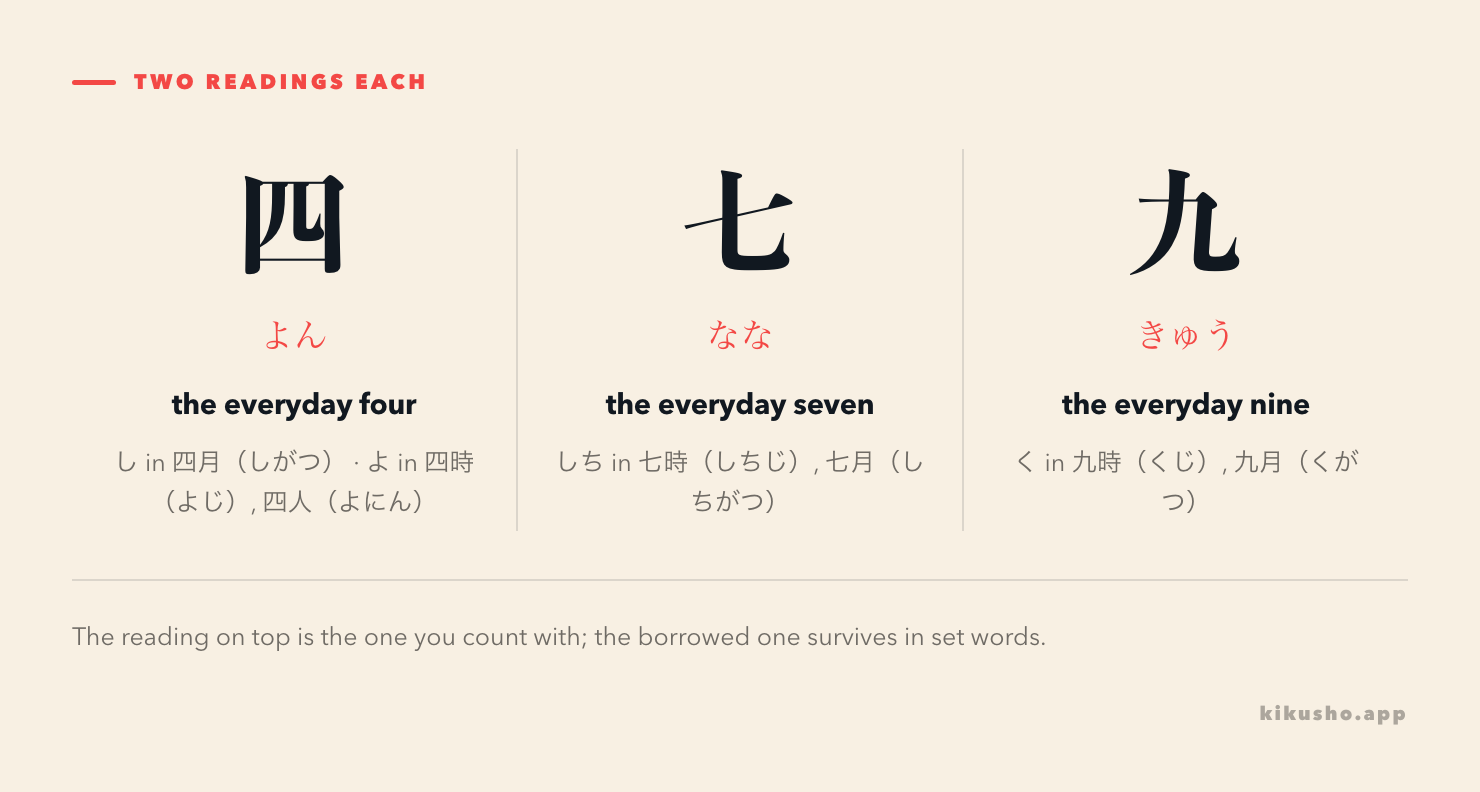
Four is the busiest of the three, because it has a third face as well: よ appears before some counters, giving 四時(よじ)for four o'clock and 四人(よにん)for four people, where neither し nor よん would sound right. There is no rule that predicts which set word takes which reading; you learn the reading with the word, the same way you learned that 四月 is しがつ and not よんがつ.
Prices: read the number, then add 円
Money is where you use the 音 numbers hardest, and it is easier than it looks, because the counter does nothing. 円(えん)begins with a vowel, so it never reshapes the number in front of it: prices run いちえん, にえん, さんえん straight down, with 六円 staying ろくえん and 八円 staying はちえん. All the work is in the number, and below ten thousand yen the only surprises are the ones the number makes anyway.
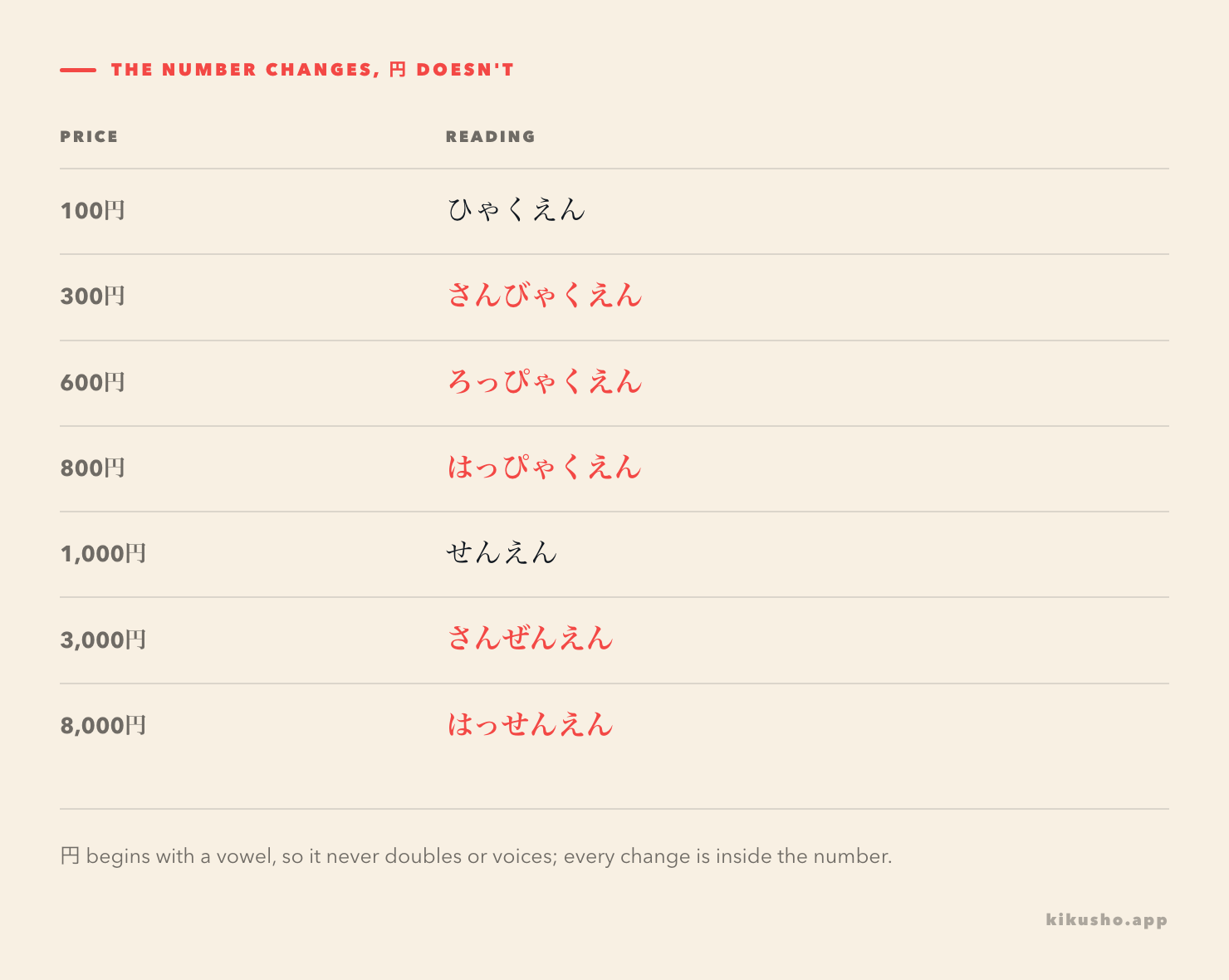
One small wobble is worth naming so it does not surprise you at a till: 4円 is usually said よえん, though よんえん is heard too — the four hesitating between its readings one more time. Past ten thousand, prices lean on 万 and regroup in fours; on a menu, though, the figures stay in the hundreds and low thousands, so reading a Japanese menu rarely pushes you past 千.
A number can change shape when a counter joins it
The prices above are the easy case, where the counter leaves the number alone. Most counters do not. When a 音 number is welded to a counter, the same sound change that reshapes a kanji reading inside a compound applies: 一, 六, 八 and 十 often clip into a small っ, and an は-row counter hardens with it. So the counter 本, for long thin things, gives 一本(いっぽん), 六本(ろっぽん), 八本(はっぽん)and 十本(じゅっぽん), beside plain 二本(にほん)and 三本(さんぼん). And people bend two numbers out of shape entirely: 一人(ひとり)and 二人(ふたり), where いちにん and ににん are what the pattern would have predicted.
That is as far as the numbers themselves reach. How the readings run across 本, 個, 枚 and the rest of the counters, and which counter a given noun expects, belong to the counter rather than the number.
This is also the reason a flashcard that says 九 = きゅう is teaching you the reading you will use least. The nine that lands on a clock face is くじ; the four on a table for four is よにん; the one that turns a bottle into いっぽん was reshaped by the counter next to it. The reading worth keeping is the one in the phrase you actually met, and that is the form a photograph of a price tag or a spoken line hands you whole. Kikusho takes that capture and files the number inside its phrase — the reading and native audio attached — and lets you lift any single word out into a card of its own, so a number arrives wearing the shape it takes in the world rather than the citation shape you would then have to unlearn.
Check yourself
Question 1. How is 四人 read, in 「テーブルを四人ぶんお願いします」(a table for four, please)?
a) よにん b) よんにん c) しにん d) よっつにん
Answer 1: よにん. This is the third reading of four, よ, that some counters demand. (b) よんにん regularises it to the everyday よん, which sounds off here. (c) しにん uses the borrowed し and lands on 死人, "a dead person" — the exact overlap that pushed Japanese toward よん in the first place. (d) よっつにん fuses the native counter つ onto 人, which no counter allows.
Question 2. You see 300円 on a price tag. How is it read?
a) さんびゃくえん b) さんひゃくえん c) さんぴゃくえん d) みっつえん
Answer 2: さんびゃくえん. Three voices 百 from ひゃく to びゃく. (b) さんひゃくえん leaves the sound unchanged, which is the mistake this reading exists to catch. (c) さんぴゃくえん hardens it to ぴ instead of voicing it to び — ぴゃく is what six and eight produce (六百 ろっぴゃく), not three. (d) みっつえん reaches for the native number, which never takes 円.
Question 3. Which word completes 「りんごを__ください」(two apples, please)?
a) ふたつ b) に c) にほん d) ふたり
Answer 3: ふたつ, the native number that counts plain objects with no counter added. (b) に is the bare 音 number and cannot stand alone in front of a noun like this; it needs a counter. (c) にほん uses 本, the counter for long thin things, which an apple is not. (d) ふたり counts people, not fruit.
Question 4. Which kanji writes はん, the "half" in 「二時_です」(it's half past two)?
a) 半 b) 分 c) 本 d) 万
Answer 4: 半. (b) 分 is read ふん or ぷん and means minutes, so 二時分 would be trying to say an amount of minutes, not a half hour. (c) 本 is the counter ほん from the previous section, unrelated in sound and sense. (d) 万 is まん, ten thousand — a real number, but not this one.
Drill the 音 spine and the native ten until they surface on their own, and the rest of Japanese counting stops being a table to memorise. What is left is a short list of adjustments to a number you already know: a hundred that voices to びゃく, a nine that keeps its old く inside a clock, a one that doubles into いっぽん before a counter. The digit underneath never moves. Only the company it keeps rewrites how it sounds.
Common questions
Do I count with ひとつ or いち?
Use the native ひとつ, ふたつ, みっつ for plain objects when you have no counter to hand — りんごを三つ, three apples, is natural and correct. Switch to the 音 numbers いち, に, さん in front of a counter (三人, three people), for money, dates and times, and for anything above ten, where the native series stops at とお.
Why do 4, 7 and 9 have two readings each?
Japanese borrowed one set of number readings from Chinese — し, しち, く — and kept its own alongside them. When counting aloud it now prefers よん, なな, きゅう, which are clearer and keep し from overlapping with the word for death. The older readings survive in fixed words such as 四月 (しがつ), 七時 (しちじ) and 九月 (くがつ).
How do you read a price like 800 yen?
800円 is はっぴゃくえん. The counter 円 (えん) never changes shape, because it begins with a vowel, so every sound change sits inside the number instead: 八百 becomes はっぴゃく, and えん is simply added after it.
Is 半 a number?
半 (はん) means "half" and is not a digit, but it travels with the numbers, most often in telling time: 二時半 (にじはん) is half past two. It attaches after a number and its unit rather than counting anything on its own.