On this page
奥さん、兄弟、子供、誕生日 are four N5 nouns for talking about a household and the events around it. Read them おくさん、きょうだい、こども、たんじょうび; the main work is learning whose relationship each word names and what context leaves unstated.
Four nouns connect a family snapshot to a birthday
The earlier guide to Japanese family words names individual relatives such as 兄, 姉, 弟 and 妹. This lesson adds one collective relationship, one respectful reference to a wife, a word whose number depends on context, and the event that supplies a date.
| Headword | Reading | Word type and core sense | Useful phrase |
|---|---|---|---|
| 奥さん | おくさん | noun; another person's wife, respectfully | 田中さんの奥さん (Mr Tanaka's wife) |
| 兄弟 | きょうだい | noun; siblings, or brothers when context narrows it | 兄弟はいますか (do you have any siblings?) |
| 子供 | こども | noun; a child or children | 子供のころ (when I was a child) |
| 誕生日 | たんじょうび | noun; birthday | 誕生日はいつですか (when is your birthday?) |
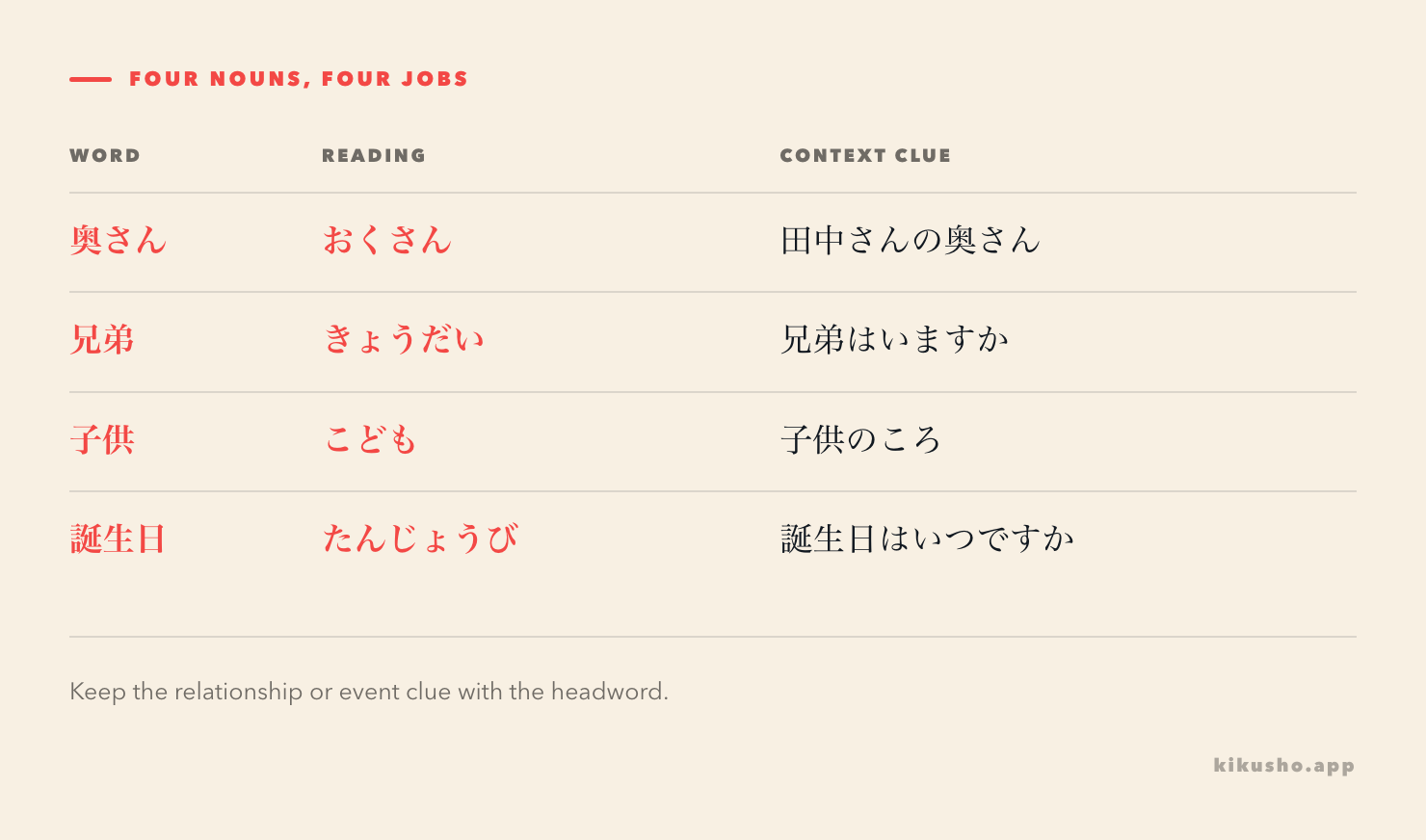
These are practical N5 placements from study lists rather than an official syllabus. The JLPT organizers explain that they do not publish an exhaustive vocabulary list. Independent beginner material from MLC Japanese Language School places 奥さん and 子供 in basic family vocabulary, while separate Japanesetest4you entries record 兄弟, 子供 and 誕生日 in its N5 material.
奥さん safely refers to another person's wife
In 田中さんの奥さんは先生です, 奥さん refers respectfully to Mr Tanaka's wife. Kotobank's dictionary entry gives this other-person sense and distinguishes 奥さん from the more formal 奥様. The さん is part of the ordinary headword here; removing it does not create a neutral beginner word for your own wife.
When speaking to someone outside your family, 妻(つま) is the dependable word for your own wife: 妻は先生です. You may hear speakers use 奥さん for their own wife in casual speech, so this is a safe production rule rather than a claim that actual usage has only one form. The contrast follows the same attention to relationship and listener that chooses 父 or お父さん.
兄弟 can include sisters as well as brothers
The characters in 兄弟 literally show “older brother” and “younger brother,” but the standard noun is broader. Kotobank defines 兄弟 both as children of the same parents and as brothers specifically, depending on context. In the everyday question 兄弟はいますか, the natural meaning is “Do you have any siblings?” A courteous version may use ご兄弟.
If the answer needs detail, switch from the group word to the specific relationships: 姉と弟がいます, “I have an older sister and a younger brother.” English “brothers” can still be the right translation when the conversation has established that everyone in the group is male. The word itself does not require that reading every time.
子供 leaves singular and plural to context
子供 can mean one child or children as a group. 姉には子供が二人います clearly means “My older sister has two children” because 二人 supplies the number. In あの子供は六歳です, the demonstrative and singular child in view make “that child” the natural reading. Add 子供たち when you want to make a group explicit.
You will also see 子ども, with ども in hiragana. Both spellings represent こども. Kotobank records 子供 for a child in relation to parents and for a young person as opposed to an adult; its 子ども entry reflects the mixed spelling. A sign, school notice or article may prefer 子ども, while a vocabulary list may print 子供. Treat the spelling change as style, not a different word.
The phrase 子供のころ means “when I was a child.” It names a period of life rather than someone's son or daughter: 子供のころ、北海道にいました, “When I was a child, I was in Hokkaido.”
誕生日 works as a date and as an occasion
誕生日 is the day on which someone was born. Kotobank verifies the reading たんじょうび. Ask 誕生日はいつですか, then answer with a date: 妹の誕生日は七月十日です, “My younger sister's birthday is July 10.” The irregular date readings in that answer belong to the guide to Japanese days of the month.
With に, the birthday becomes the time or occasion for an action: 誕生日に家族でケーキを食べます, “We eat cake as a family on the birthday.” In the greeting お誕生日おめでとうございます, the initial お adds courtesy. The core noun remains 誕生日.
One short scene shows what each word contributes
田中さんにはお兄さんがいます。お兄さんと奥さんには子供が二人います。今日は下の子の誕生日です。家族でケーキを食べます。 Mr Tanaka has an older brother. His older brother and his wife have two children. Today is the younger child's birthday. The family will eat cake together.
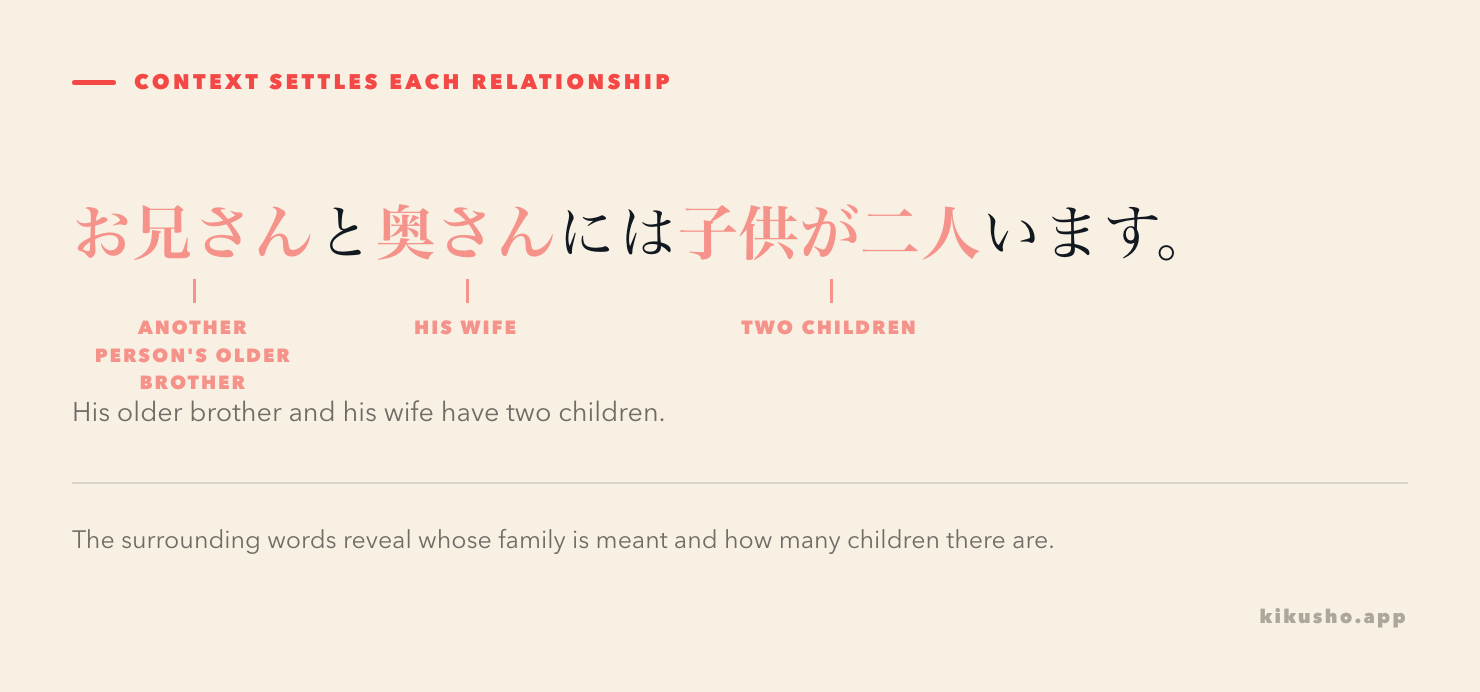
The scene first names the relationship, then lets context carry it. 奥さん belongs to the older brother, 子供が二人 establishes two children, and 下の子 selects the younger one. A flashcard containing only 子供 cannot preserve those connections. In Kikusho, capture the whole sentence that settles number or relationship, then trim the card only if the clue still survives.
Practice without revealing the answers
Question 1 · reading
What is the hiragana reading of 奥さん?
Question 2 · orthography
Which spelling matches たんじょうび?
- A. 兄弟
- B. 誕生日
- C. 子供
- D. 奥さん
Question 3 · relationship context
Complete the sentence about someone else's wife: 山田さんの___は会社員です。
- A. 兄弟
- B. 子供
- C. 奥さん
- D. 誕生日
Question 4 · the collective word
A speaker says 姉と弟がいます. Which word can refer to those two people together?
- A. 兄弟
- B. 奥さん
- C. 子供
- D. 誕生日
Question 5 · childhood
Which English sentence best matches 子供のころ、北海道にいました?
- A. My child is in Hokkaido.
- B. My siblings were born in Hokkaido.
- C. When I was a child, I was in Hokkaido.
- D. My birthday is in Hokkaido.
Question 6 · spelling
Which statement about 子供 and 子ども is accurate?
- A. Only 子供 can mean a child.
- B. 子ども is always plural.
- C. They are common spellings of the same word, こども.
- D. They have different readings.
Question 7 · date and relationship
What does 妹の誕生日は七月十日です mean?
- A. My younger sister has ten children.
- B. My younger sister's birthday is July 10.
- C. My siblings arrive on July 10.
- D. My wife's birthday is July 7.
Question 8 · connected context
Read the short scene above. Why will the family eat cake today?
- A. It is Mr Tanaka's birthday.
- B. It is the older brother's wedding.
- C. It is the younger child's birthday.
- D. The two children are siblings.
Answers and explanations
Solution 1
おくさん. In the core use taught here, 奥さん respectfully refers to another person's wife.
Solution 2
B. 誕生日. 誕生日 is read たんじょうび and means birthday. The other choices read きょうだい, こども and おくさん.
Solution 3
C. 奥さん. 山田さんの奥さん means “Mr or Ms Yamada's wife.” The named person is someone other than the speaker, which fits the safe beginner use.
Solution 4
A. 兄弟. The word can cover siblings of any gender. 姉 and 弟 then give the exact relationships.
Solution 5
C. When I was a child, I was in Hokkaido. Here 子供のころ names the speaker's childhood, not a particular son or daughter.
Solution 6
C. They are common spellings of the same word, こども. The choice between full kanji and the mixed spelling is often editorial or stylistic; it does not change singular into plural.
Solution 7
B. My younger sister's birthday is July 10. 妹 marks the person whose birthday is named, and 七月十日 supplies the date.
Solution 8
C. It is the younger child's birthday. 今日は下の子の誕生日です gives the reason. The final sentence states what the family does for that occasion.
Once these four words are stored with their relationships intact, a single family conversation can move from who people are to when they celebrate.
Common questions
Does 兄弟 mean brothers or siblings?
兄弟(きょうだい)often means siblings of any gender. Context can narrow it to brothers, so name 姉, 妹, 兄 or 弟 when the exact relationship matters.
Should I write 子供 or 子ども?
Both are common spellings of こども. 子ども is frequent in public and educational writing, while 子供 remains standard and widely understood.
Can I call my own wife 奥さん?
Some speakers do in casual conversation, but the reliable beginner choice is 妻(つま)for your own wife when speaking to someone else and 奥さん for another person's wife.
Why does お appear in お誕生日おめでとうございます?
お makes 誕生日 more courteous in the greeting. The basic noun is 誕生日 (たんじょうび), and both 誕生日 and お誕生日 occur according to tone.