On this page
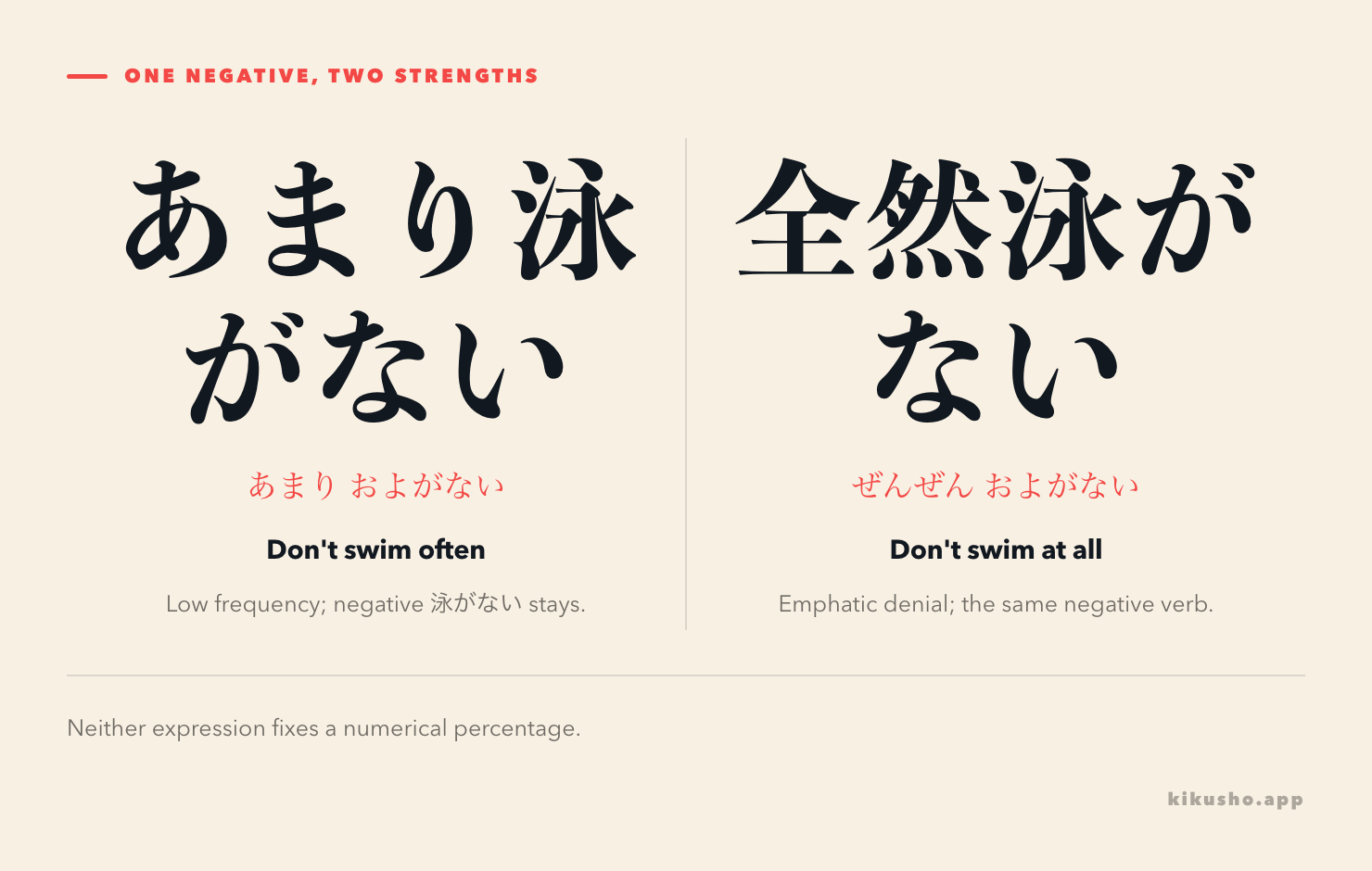
あまり~ない describes a low degree, quantity or frequency: “not very,” “not much” or “not often.” 全然~ない, read ぜんぜん~ない, emphasizes the negative: “not at all.”
Someone who says あまり泳がない may swim occasionally. Someone who says 全然泳がない is presenting swimming as something they do not do at all. Both sentences end in the same negative verb, 泳がない (およがない). The adverb changes how strongly you should read that negative.
The test is how much of the positive claim remains
Ask what you want to deny. Is something merely low on a scale, or are you rejecting it altogether?
| Same predicate | あまり~ない | 全然~ない |
|---|---|---|
| 泳がない | あまり泳がない: don't swim often | 全然泳がない: don't swim at all |
| 重くない | あまり重くない: not very heavy | 全然重くない: not heavy at all |
| 好きじゃない | あまり好きじゃない: don't like it much | 全然好きじゃない: don't like it at all |
These are judgments in a situation, not percentages. A bag described as 全然重くない still has weight; the speaker finds no heaviness worth mentioning. あまり好きじゃない may leave room for limited enjoyment, but it can also be a tactful way of expressing dislike. You cannot calculate a person's preference from the adverb alone.
This is an N4 grammar comparison of two negative constructions. Bunpro's あまり~ない and JLPT Sensei's 全然~ない use that study level. Basic negatives are prerequisites, and you may have met these words earlier. No official exhaustive JLPT grammar list fixes the boundary.
あまり~ない leaves the degree below “much” or “very”
The negative ending and あまり work together. Adding あまり to a negative can turn a categorical denial into a statement about limited extent.
今週はあまり歩かなかった。
こんしゅうは あまり あるかなかった。
I didn't walk much this week.
The sentence need not mean that you took no steps. It can describe a week with less walking than usual. A frequency reading becomes clearer when the surrounding conversation concerns habits:
あの公園にはあまり行きません。
あのこうえんには あまり いきません。
I don't go to that park often.
With an adjective, the relevant scale is the quality itself:
このかばんはあまり重くないです。
このかばんは あまり おもくないです。
This bag isn't very heavy.
The bag may be somewhat heavy. With a different adjective, the same construction can carry criticism: あまり便利じゃない (あまりべんりじゃない), “not very convenient,” falls short of praise.
Tofugu's formation guide distinguishes adjective degree, verb quantity or frequency, and limited existence. The surrounding words determine which sense you need. Avoid translating every あまり as “rarely”; a heavy bag is not heavy less often.
The conversational variant あんまり has the same basic negative meaning. あんまり行かない is a casual alternative to あまり行かない. It does not supply the missing negative by itself.
全然~ない makes the denial emphatic
全然 can be written ぜんぜん without changing this construction. With a negative predicate it rules out the action, state or degree under discussion:
昨日は全然歩かなかった。
きのうは ぜんぜん あるかなかった。
I didn't walk at all yesterday.
A listener takes this as a stronger denial than あまり歩かなかった. Everyday speech can exaggerate, but the grammatical meaning you are practising is “not at all,” rather than “not much.”
このかばんは全然重くないです。
このかばんは ぜんぜん おもくないです。
This bag isn't heavy at all.
That can be reassuring when someone offers to carry it for you. Strong negation need not express anger. Tone and the thing being denied decide whether 全然 sounds reassuring, disappointed or dismissive. Bunpro's ぜんぜん lesson covers both negative expressions and the conversational affirmative uses discussed below. At N3, the 別に~ない and 決して~ない comparison separates a dismissive “not particularly” from a categorical “by no means.”
With ability, keep the distinction between doing and being able to do. 全然泳がない says you do not swim; 全然泳げない (ぜんぜんおよげない) says you cannot swim at all. The potential-form lesson explains how 泳ぐ becomes 泳げる before you negate it.
Build the negative from the predicate, not the adverb
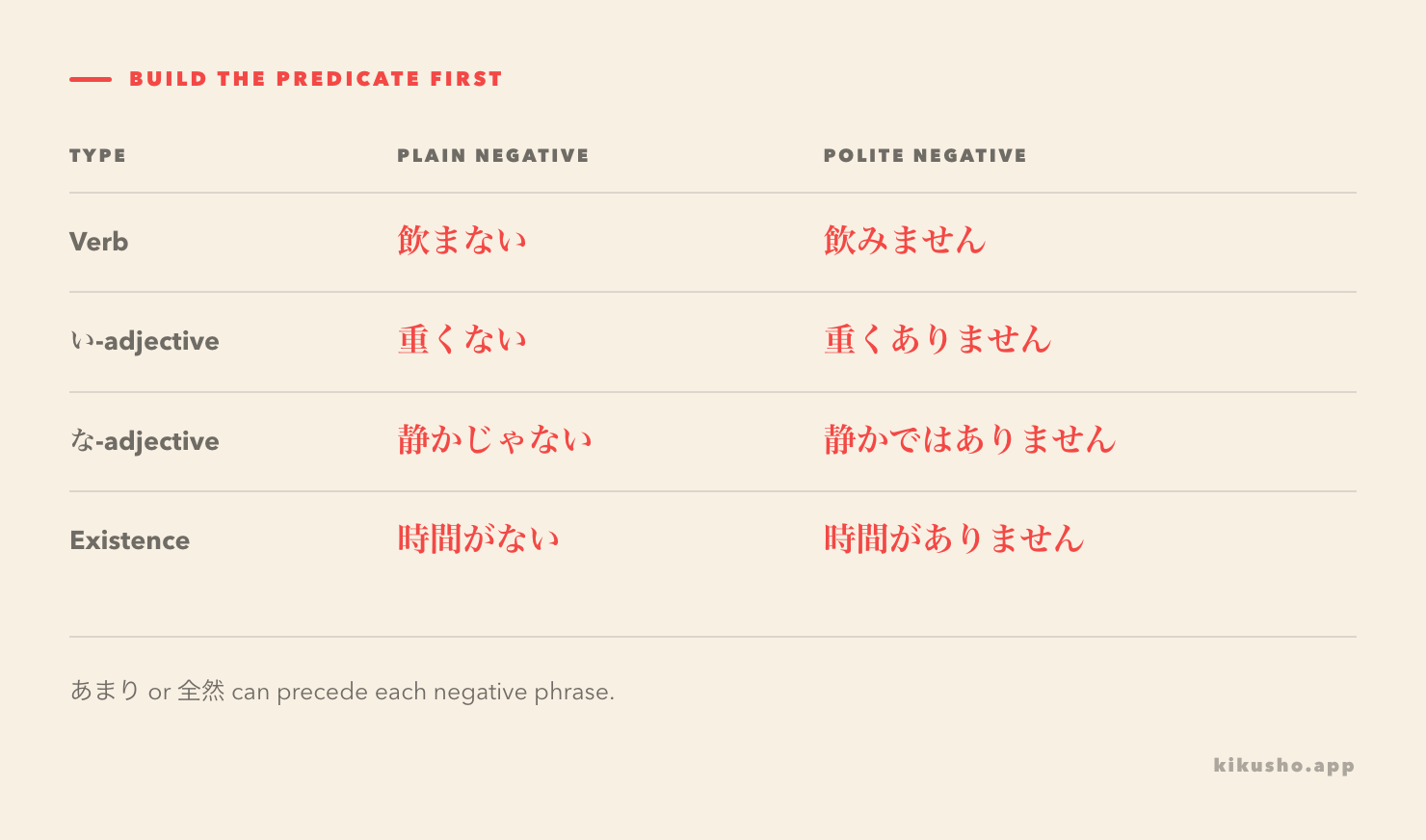
Neither adverb conjugates the word after it. Construct the ordinary negative first, as in the ない and ません lesson, then place あまり or 全然 in the clause.
| Predicate type | Base | With あまり | With 全然 |
|---|---|---|---|
| Verb | 飲む (のむ) | あまり飲まない | 全然飲まない |
| い-adjective | 重い (おもい) | あまり重くない | 全然重くない |
| な-adjective | 静か (しずか) | あまり静かじゃない | 全然静かじゃない |
| Existence | 時間がある (じかんがある) | あまり時間がない | 全然時間がない |
好き follows the な-adjective pattern even though English uses the verb “like”: あまり好きじゃない and 全然好きじゃない. Do not build 好きない. For 重い, remove the final い before adding くない; 重いじゃない is not the ordinary adjective negative.
The existence row contrasts “not much time” with “no time at all.” Here ある becomes ない. It does not become あるない.
Polite speech retains the same contrast:
- あまり飲みません / 全然飲みません: don't drink much or often / don't drink at all.
- あまり重くありません / 全然重くありません: not very heavy / not heavy at all.
- あまり静かではありません / 全然静かではありません: not very quiet / not quiet at all.
Conversational 重くないです and 静かじゃないです are polite alternatives too. A past report changes the ending, not the choice of adverb: あまり飲まなかった or 全然飲まなかった; politely, あまり飲みませんでした or 全然飲みませんでした. JLPT Sensei's あまり lesson likewise includes past and polite negatives.
Where both fit, and where the conversation changes the reading
You can use either adverb with the same negative predicate, but you need to mean its degree of denial. After a short explanation, あまり分からない can mean “I don't understand very well.” 全然分からない (ぜんぜんわからない) is “I don't understand at all.” Replacing one with the other changes the report of your understanding, even though both sentences are grammatical.
A polite ending does not make that difference disappear. 全然好きではありません is addressed politely but still says you do not like it at all. あまり好きではありません can soften the rejection. This is separate from the forms that make speech polite.
Do not extend the negative pattern into a ban on every other use of the words. あまり also has excessive-degree and causal uses; this lesson teaches its negative construction. 全然大丈夫 (ぜんぜんだいじょうぶ), “completely fine,” is a familiar conversational reassurance, often overturning an expectation that something might be wrong.
Sadao Yamada's NINJAL explanation traces affirmative uses as well as discussing modern emphasis and reassurance. Their existence is broader than a new grammatical error made by young speakers. Acceptance varies with wording, audience and writing conventions. In a formal message you can choose 大丈夫です without 全然; in these exercises, follow the meaning and register given by the context.
If you save a phrase in Kikusho, keep the predicate in the example field and edit its translation to match the situation. A text capture of 全然泳げない should retain the inability to swim, rather than reducing the card to “swimming.” A register note is useful for 全然大丈夫: the reassurance is part of what you heard.
Questions
Question 1
A friend says you swim once or twice a year. Choose the reply that describes this low frequency without claiming that you never swim.
私は__泳がない。
A. あまり
B. 全然
C. いつも
D. よく
Question 2
Choose the ordinary negative meaning “This bag is not heavy at all.”
A. このかばんは全然重いないです。
B. このかばんはあまり重くないです。
C. このかばんは全然重くないです。
D. このかばんは全然重いです。
Question 3
Arrange the pieces after この部屋は to say “This room is not very quiet.” Begin with the adverb and use every piece once.
- では\
- あまり\
- 静か\
- ありません
この部屋は____。
Question 4
Arrange the pieces after 昨日は to say “I couldn't sleep at all yesterday.” Begin with the adverb and use every piece once. 眠れる (ねむれる) means “can sleep.”
- 眠れ\
- 全然\
- ません\
- でした
昨日は____。
Question 5
Read this short account and select the sentence that preserves the stated habit.
駅の近くに新しい映画館ができました。でも、仕事が忙しくて、月に一回ぐらいしか行けません。
A. その映画館には全然行きません。
B. その映画館にはあまり行きません。
C. その映画館には毎日行きます。
D. その映画館にはよく行きます。
Question 6
A friend worries that the chair they offered is uncomfortable. You sit down and find it perfectly fine. In casual conversation you reply:
友だち:「その椅子、大丈夫?」
あなた:「全然大丈夫だよ。」
Which reading fits this exchange?
A. You cannot sit down at all.
B. You find the chair only slightly uncomfortable and are stating that amount.
C. You mean the chair is fine only on rare occasions.
D. You reassure your friend that the chair is completely fine.
Answers and explanations
Answer 1
A, あまり. Once or twice a year is a low frequency, so あまり泳がない matches the account. B presents a complete denial. C and D do not express the required low frequency; adding them to a negative does not turn “always” or “often” into “not often.”
Answer 2
C. 重い becomes 重くない, and 全然 makes it “not heavy at all.” A adds ない without conjugating the adjective. B is grammatical but gives the weaker “not very heavy.” D lacks the negative and does not express the requested denial; it should not be labelled impossible solely because 全然 has affirmative uses.
Answer 3
2–3–1–4: この部屋はあまり静かではありません。\
このへやは あまり しずかではありません。
静か is a な-adjective. ではありません follows its stem; the attributive な is absent here. あまり lowers the degree of quietness. The room might be somewhat quiet, or the speaker might be tactfully criticizing the noise.
Answer 4
2–1–3–4: 昨日は全然眠れませんでした。\
きのうは ぜんぜん ねむれませんでした。
The potential verb 眠れる takes the polite negative 眠れません, then the past ending でした. 全然 emphasizes the lack of ability to sleep during that period. あまり would instead describe not being able to sleep much.
Answer 5
B. The account says a new cinema opened near the station, but work keeps the writer's visits to roughly once a month. あまり行きません summarizes that limited frequency. A conflicts with the stated visits by denying them altogether; C and D present regular or frequent attendance instead. The Japanese context supplies the scale: no universal number of visits defines あまり.
Answer 6
D. This is affirmative reassurance: “It's completely fine.” It answers the friend's concern, with 大丈夫 stating that there is no problem. A reads an inability that the reply never expresses. B invents a small amount of discomfort. C treats 全然 as a frequency expression despite the conversational predicate. If you collect the sentence, collect the worried question with it: that question explains why the reassurance carries emphasis.
Common questions
What is the difference between あまり~ない and 全然~ない?
あまり~ない means not very, not much or not often: it describes a low degree, quantity or frequency. 全然~ない, read ぜんぜん~ない, means not at all and emphasizes negation. Neither gives a numerical percentage. あまり can also soften a reply, so context matters when deciding whether any amount remains.
Can these expressions use ません instead of ない?
Yes. With verbs, build the usual polite negative: あまり飲みません or 全然飲みません. With an い-adjective, use forms such as あまり寒くないです or 全然寒くありません. With a な-adjective, use じゃないです or ではありません after its stem. The adverb does not replace the negative ending.
Is 全然大丈夫 a mistake?
全然大丈夫 is an established conversational expression meaning completely fine, often reassuring someone against an expected problem. 全然 also occurs with other affirmative expressions. Some listeners and formal writing conventions prefer more conservative wording. Learn the negative construction separately rather than declaring every affirmative use ungrammatical.
Why is this an N4 comparison if I learned あまり earlier?
Bunpro and JLPT Sensei place the negative constructions in their N4 grammar lessons, though beginner courses introduce these adverbs earlier. Level labels are study estimates. The JLPT does not publish an exhaustive official grammar syllabus; this lesson assumes basic negative verbs and adjectives.