On this page
までに places an action on or before a deadline: 金曜日までにレポートを出します means “I will submit the report by Friday.” It does not describe the action continuing until Friday; that time span belongs to まで.
Use までに when the boundary waits for a result
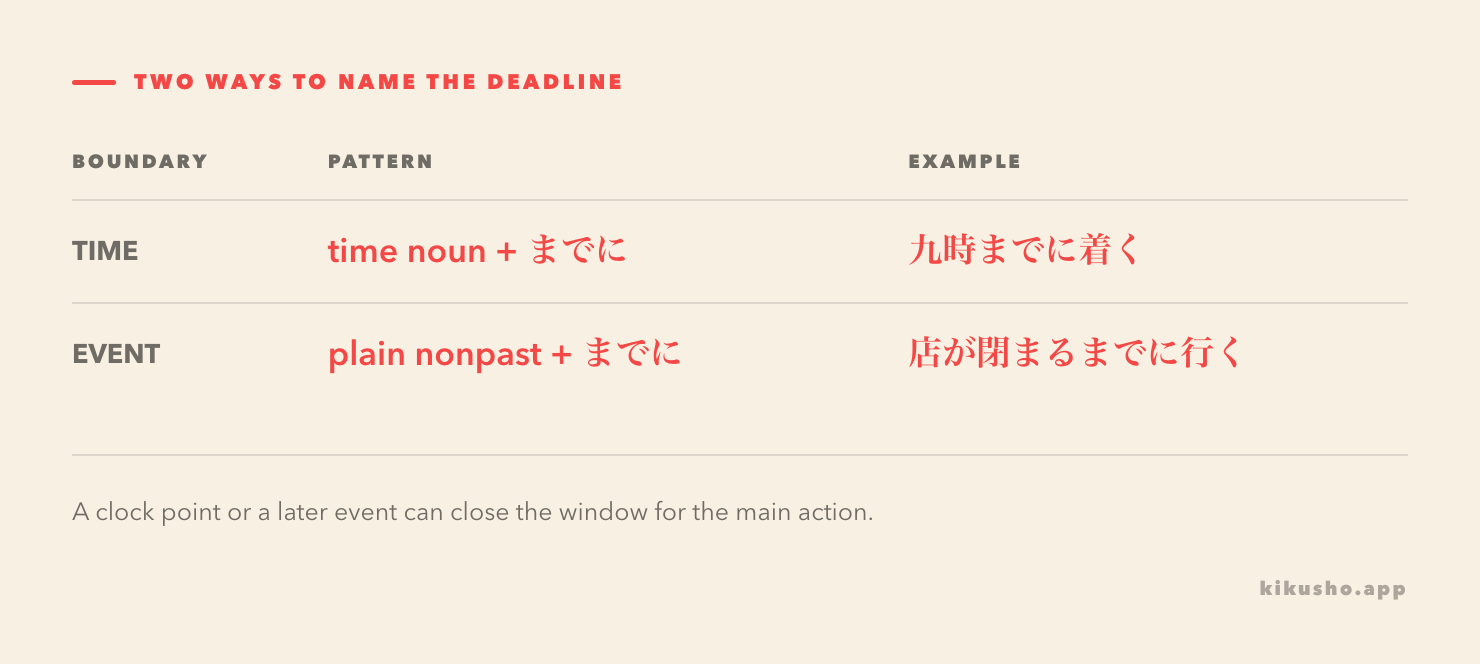
A deadline sentence contains two parts: a boundary and an action that must occur no later than that boundary.
| Boundary | Pattern | Example | Meaning |
|---|---|---|---|
| Time or date | time noun + までに | 九時までに着く | arrive by nine |
| Named event | plain nonpast clause + までに | 店が閉まるまでに行く | go before the shop closes |
明日の午後三時までに、申込書を送ってください。
あしたの ごごさんじまでに、もうしこみしょを おくってください。
Please send the application form by 3 p.m. tomorrow.
The sending can happen at noon, at two, or just before three. までに sets the latest acceptable point; it does not fill the whole interval with sending.
JLPT Sensei lists noun and dictionary-form verb attachments and places the construction at N4. Bunpro independently gives the same two attachments, the meanings “by,” “by the time” and “before,” and an N4 placement. These are teaching-site estimates: the JLPT does not publish an exhaustive grammar syllabus.
まで measures extent; までに sets a cutoff
The extra に changes the relationship between the action and the boundary.
| Sentence | What reaches five o'clock? | Translation |
|---|---|---|
| 五時まで働きます。 | the activity of working | I will work until five. |
| 五時までに仕事を終えます。 | the deadline for finishing | I will finish the work by five. |
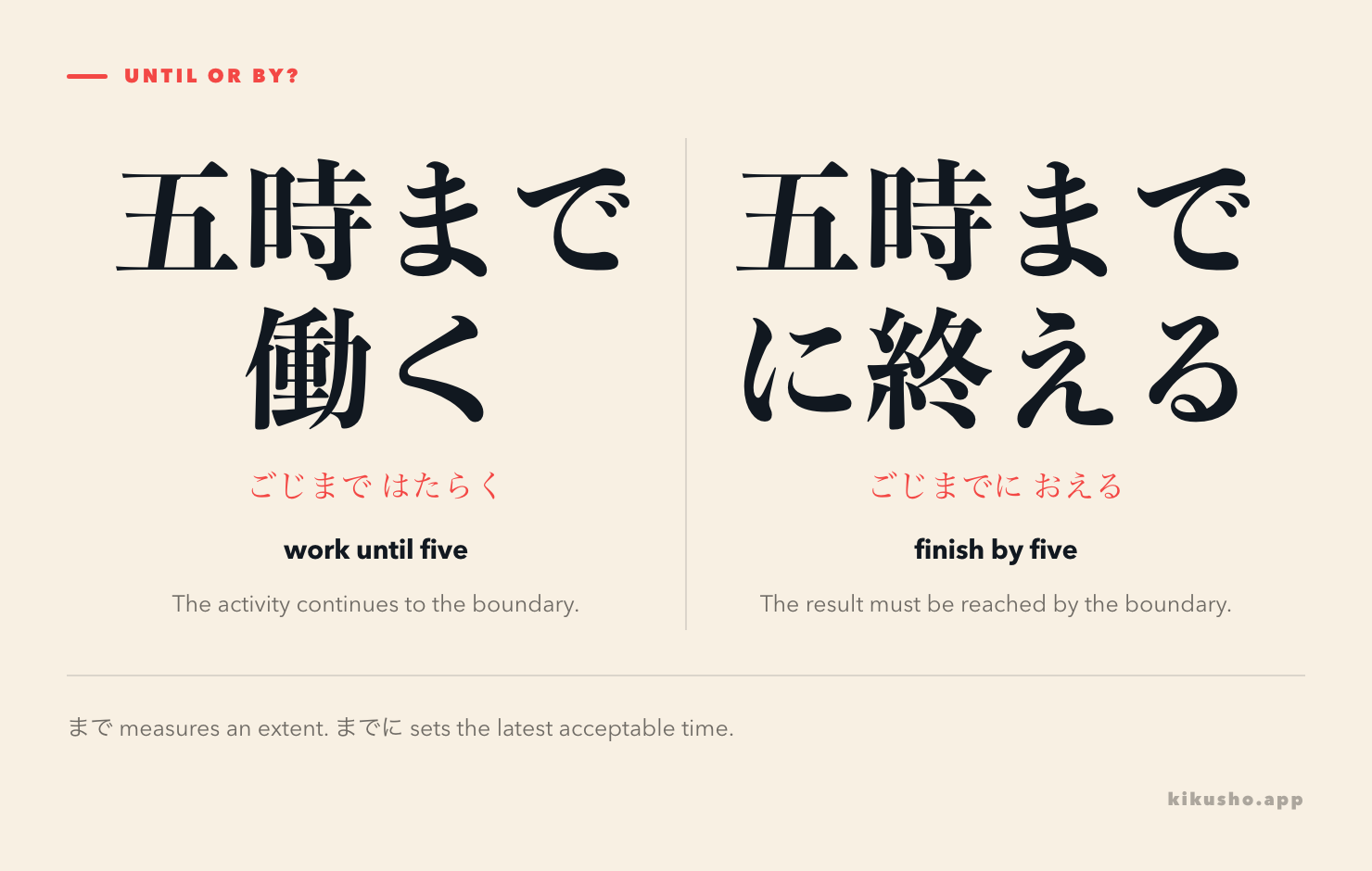
This is more reliable than memorising “long action” versus “short action.” Writing a report may take hours, but 金曜日までにレポートを書き終えます still uses までに because the sentence sets a deadline for the completed result. Arriving takes little time, yet 九時まで駅で待ちます uses まで because the waiting continues until nine.
The から and まで lesson teaches the underlying endpoint particle. Its 五時まで待つ describes the extent of waiting. Add に only when the intended relationship is a latest time for another action: 五時までに来る, “come by five.”
A verb before までに names the event that closes the window
Use a plain nonpast event clause before までに. The event is future relative to the action in the main clause, even when the whole account is in the past.
先生が来るまでに、教室を掃除しました。
せんせいが くるまでに、きょうしつを そうじしました。
We cleaned the classroom before the teacher came.
来る remains in the nonpast form. 掃除しました places the completed cleaning in the past. Changing the boundary clause to 先生が来たまでに does not form this ordinary “before the teacher came” construction.
The subject inside the event clause normally takes が: 友達が来るまでに. The main clause can have a different subject, often left unstated. In 友達が来るまでに料理を作ります, the friend is the one arriving; the speaker is understood as the person cooking.
Coto Academy's explanation contrasts duration まで with deadline までに and gives the event-clause pattern 友達がうちに来るまでに. The Japan Foundation's Irodori beginner materials also use real workplace deadlines such as 明日までに and 休みの前の日までに in its grammar worksheets. The form is standard in instructions, plans and promises; politeness comes from the sentence ending, not from までに itself.
Choose a boundary precise enough for the promise
Clock times give a clear point: 九月二十日の午後五時までに. Broad expressions may depend on context.
| Expression | Likely use | Possible problem |
|---|---|---|
| 今日の五時までに | by five today | precise cutoff |
| 月曜日までに | by Monday | start or end of Monday may be unclear |
| 来週までに | by next week | which day may be unclear |
| 店が閉まるまでに | before the shop closes | event supplies the boundary |
Bunpro notes that a broad expression such as 夏までに can be understood differently by different listeners. If the full day is allowed, 月曜日中に means “during Monday / by the end of Monday.” If the work must be ready when the office opens, say 月曜日の午前九時までに.
Do not use a bare duration as though it were a calendar point. English “within three days” is naturally 三日以内に, with 以内 marking the allowed span. 三日までに lacks an anchor in many contexts and is not a safe automatic translation.
までには puts contrast on the deadline
The form can take topic は:
来週までには終わります。
らいしゅうまでには おわります。
I will have it finished by next week, at least.
The deadline relationship still comes from までに. は adds contrast or emphasis, often implying that an earlier finish is uncertain but the named limit should be met. It does not create a different conjugation or make an imprecise date precise.
In ordinary modern writing, use hiragana までに. The kanji 迄に occurs, especially in older or formal material, but a learner does not need it to write a notice or message naturally.
When a real notice gives you a deadline, keep its object and time together. A Kikusho card for 金曜日までに申込書を提出する preserves what must be submitted and when. Check the drafted reading and meaning before saving; a card containing only までに loses the decision the phrase is meant to carry.
Check yourself
Complete all seven questions before opening the shared correction block.
Question 1: grammar choice. The library asks you to return a book no later than Friday. Choose the natural sentence.
- A. 金曜日まで本を返してください。
- B. 金曜日までに本を返してください。
- C. 金曜日から本を返してください。
- D. 金曜日にまで本を返してください。
Question 2: duration or deadline. Interpret 午後六時まで店で働きます.
- A. I will start working at six.
- B. I will finish one task before six.
- C. I will work at the shop until six.
- D. I will arrive at the shop by six.
Question 3: attachment. Complete “I will prepare dinner before my family comes home”: 家族が__までに、夕食を準備します。
- A. 帰ります
- B. 帰った
- C. 帰る
- D. 帰って
Question 4: sentence composition. Use 九時, 駅, 着く, and までに to write “I will arrive at the station by nine.”
Question 5: repair the deadline. A colleague writes 三時まで会議の資料を完成します but means “I will complete the meeting materials by three.” Rewrite the sentence so the time is a deadline.
Question 6: precision. A form may be submitted at any time on Monday, including Monday afternoon. Which wording states that permission most clearly?
- A. 月曜日まで
- B. 月曜日中に
- C. 月曜日から
- D. 月曜日の前まで
Question 7: notice reading. Consider this account: 店は十時に閉まります。私は店が閉まるまでに買い物を終えて、十時まで駐車場で友達を待ちました。 Choose the faithful timeline.
- A. The speaker shopped continuously until ten and left before the friend arrived.
- B. The speaker finished shopping before closing, then waited in the car park until ten.
- C. The shop closed after ten, so the speaker began shopping at ten.
- D. Both actions had to be completed before an unspecified Monday.
Answers and explanations
Answer 1. B, 金曜日までに本を返してください. Returning the book is the result required by the Friday deadline. A instead presents an extent up to Friday and does not cleanly express “no later than Friday.” C marks a starting point, and D puts に before まで in the wrong order.
Answer 2. C. まで marks the endpoint of the working activity, so the work continues until six. Nothing in the sentence says the speaker arrives at six or completes one separate task before then.
Answer 3. C, 帰る. A plain nonpast event clause precedes までに: 家族が帰るまでに. The polite ending belongs in the main clause; 帰った and 帰って do not supply the target attachment here.
Answer 4. 九時までに駅に着きます。 九時までに is the deadline, 駅に marks the arrival point, and 着きます is the polite nonpast predicate. 九時まで駅にいます would instead mean remaining at the station until nine.
Answer 5. 三時までに会議の資料を完成させます。 Adding に turns three o'clock into the latest point for completion. 完成させます treats the materials as the object brought to completion.
Answer 6. B, 月曜日中に. It explicitly allows the action during Monday and therefore includes Monday afternoon. A gives an endpoint phrase without the requested full-day reading, C means “from Monday,” and D is not the ordinary way to grant the whole day.
Answer 7. B. 店が閉まるまでに sets the closing event as the deadline for finishing the shopping. 十時まで then marks the extent of the separate waiting activity. The same short passage uses に to distinguish a result deadline from an activity continuing to its endpoint.
The final predicate tells you what relationship the sentence needs. If an activity extends to the boundary, choose まで. If a result must exist by that boundary, choose までに and state the cutoff as precisely as the promise requires.
Common questions
What is the difference between まで and までに?
まで marks the endpoint of a range or an activity that continues until a boundary. までに sets the latest time by which an action should occur or be completed. 五時まで働く is work until five; 五時までに提出する is submit by five.
Can までに follow a verb?
Yes. Put it after a plain nonpast event clause, as in 先生が来るまでに, by the time the teacher comes. The action in the main clause must happen before that event supplies the boundary.
Does 月曜日までに always mean before Monday begins?
A broad expression such as 月曜日までに can depend on context and may leave the exact cutoff unclear. State 月曜日の午前九時までに or 月曜日中に when the start, hour or whole day matters.