On this page
A deck becomes a chore when cards only ever arrive in it. Adding a word is a button; being finished with one is not, so the queue you meet on a Tuesday morning is the sum of every word you have ever added, including the ones you have known cold since spring.
The usual diagnosis is motivation, and the usual prescription is a streak. Both miss what actually changed. If most of a session is now spent confirming things you already know, the session has genuinely become low-value work, and your reluctance is an accurate reading of it. The deck stopped paying you before you stopped enjoying it.
Every deck has an intake, and almost none has an exit
Every review app teaches you how to put cards in on the first day. None of them sets aside a moment for taking cards out, and no card ever announces that it is done.
What the scheduler does instead is stretch. Answer correctly enough times and the card comes back in a month, then a season, then the better part of a year. That is real relief and it is not an exit. The card is still in the deck, still on its way back, and a few hundred of them on long intervals eventually land on the same morning. A quiet week is followed by a Tuesday with sixty cards in it and no explanation for why.
So the queue has an inlet and no outlet. The number of new words you add each day sets the floor under how large it can get. Whether the thing is still bearable a year from now is decided by the other side of the ledger, and most decks have never had one.
Most of a stale session is spent on cards you finished with months ago
Open the deck that has started to feel like rent and look at what it actually hands you. Three kinds of card tend to be doing the damage, and they are not failing in the same way.
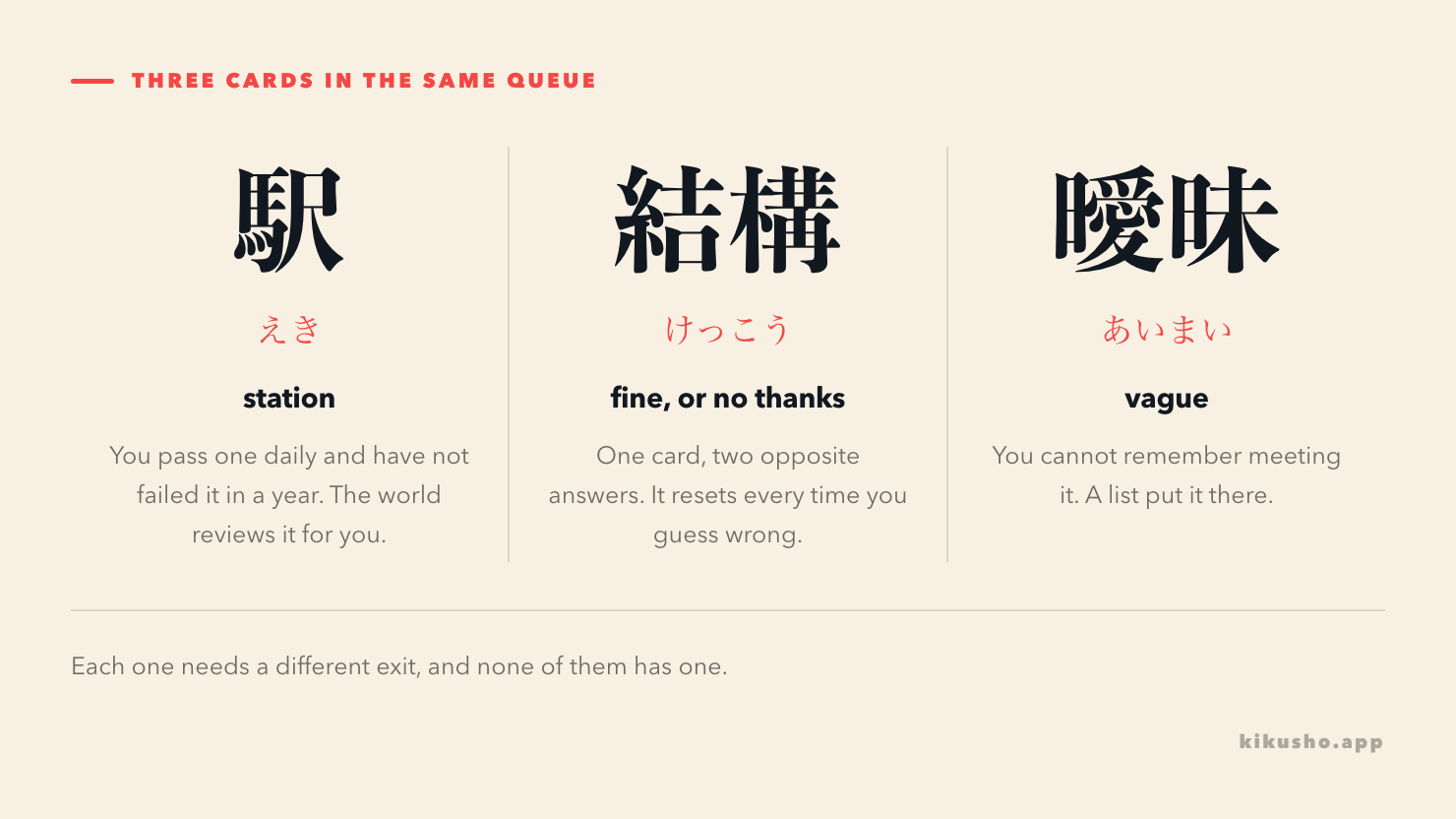
The first kind is the one that survives every cleanup, because reviewing it feels good. It is a free win in a session that mostly costs effort, and the small pleasure of getting it right is precisely what stops you noticing that it has taught you nothing since March. A deck accumulates these the way a desk accumulates paper: each one arrived for a reason, and none of them ever had a reason to leave.
The second kind is worse than it looks. A card you get wrong resets to a short interval and comes back almost immediately, so a handful of coin-flip cards can generate more daily reviews than a week of new words. They are not a discipline problem. They are usually one card carrying two things that need separating.
The third kind is the one to be honest about. If you cannot remember where a word came from, it came from a list, and it arrived with no scene, no sentence and no reason you cared. It will keep failing for exactly that reason.
Knowing it this morning is not the same as being done with it
The obvious objection to all this is that if you delete everything that feels easy, you will delete a pile of words you were about to forget. That is right, and it is why retirement needs a test better than a feeling.
Ease at a three-day interval proves almost nothing. It proves you saw the card on Saturday. The same confident answer after four months proves something different: the word survived a gap long enough to have lost it in, which is the only evidence that a memory has actually consolidated rather than merely been refreshed.
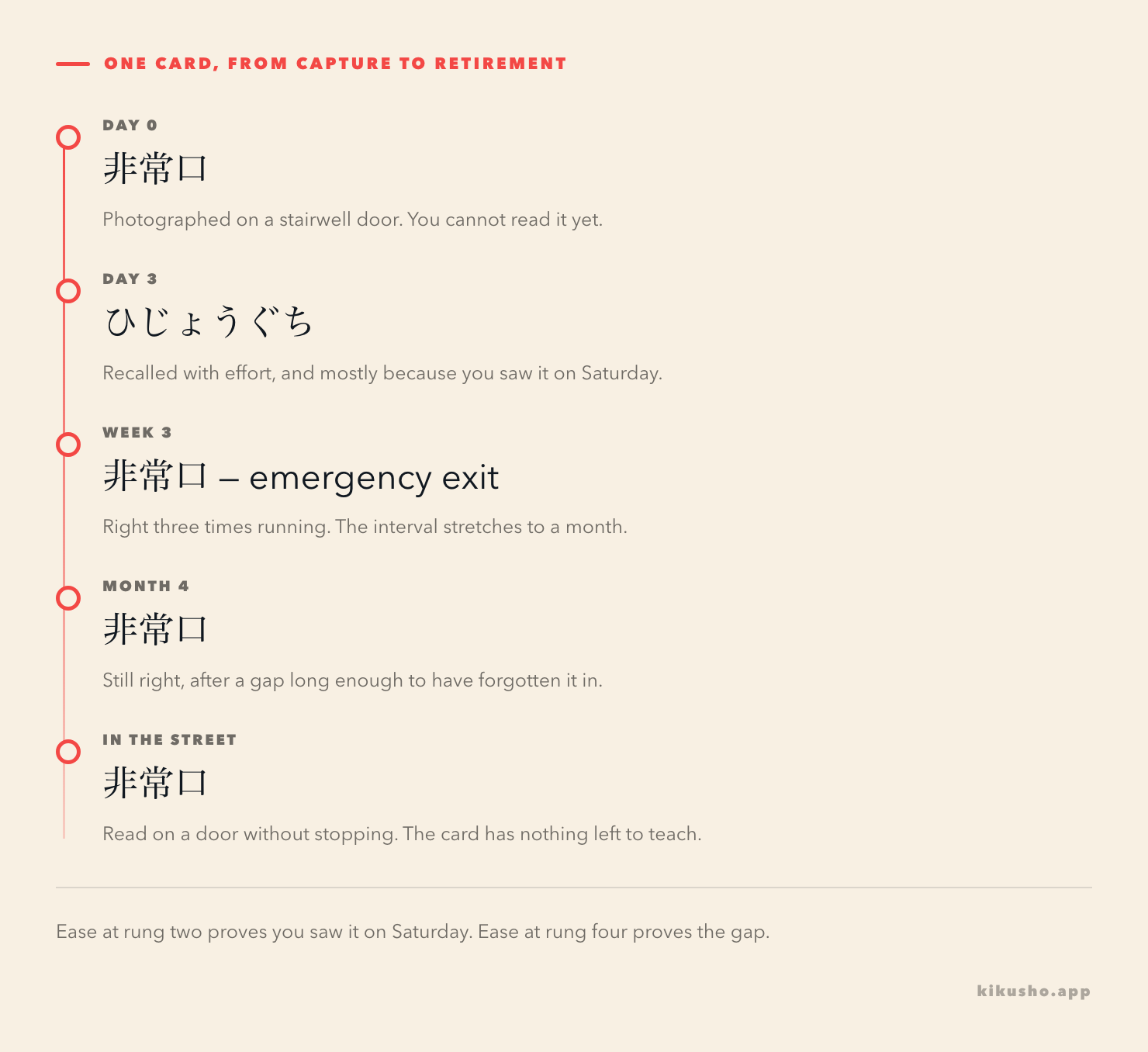
There is a second test, and it is better than the interval, because it costs nothing to check. Does the word appear in your life? A word on the door of every stairwell, on every menu, in every other message from a friend is being reviewed whether or not you keep a card for it. Retiring 駅 does not mean you stop seeing 駅. It means you stop paying twice for it.
Words you met yourself are the ones most likely to pass both tests at once, which is one more reason the vocabulary worth collecting is the vocabulary you keep running into.
Deleting a card does not delete the word
The real reason decks never shrink is that removing a card feels like undoing work. Every one of them cost you something to make, and the count going down looks like progress running backwards.
It isn't. The work you did was the recalling, and that is already spent — it is in your head, not in the card. What the card holds now is not your past effort but a claim on your future mornings. Keeping it does not preserve anything you have earned. It only schedules the collection.
And if you get it wrong, the world corrects you. A word worth keeping is a word you will meet again, because meeting it is what made it worth keeping in the first place. When it turns up and you draw a blank, you will notice, and capturing it again takes seconds.
That is what Kikusho is built around. Point the camera at the sign, say the phrase while it is still in your head, or paste the text, and a complete card comes back: the word, its reading, the meaning, the register note, an example sentence and audio, which you check on screen before anything is saved. One photo can carry up to five highlights and give you five separate cards from a single capture. The free plan limits creating cards to five a day and never limits reviewing, so nothing you have already collected is ever behind a meter.
When re-adding a word is that cheap, deleting stops being a decision you have to be sure about.
A retirement pass, in four questions
The pass itself is short. It is not an audit of the whole deck, and it works best on the queue in front of you rather than on a card list, because the cards that deserve attention are the ones already annoying you.
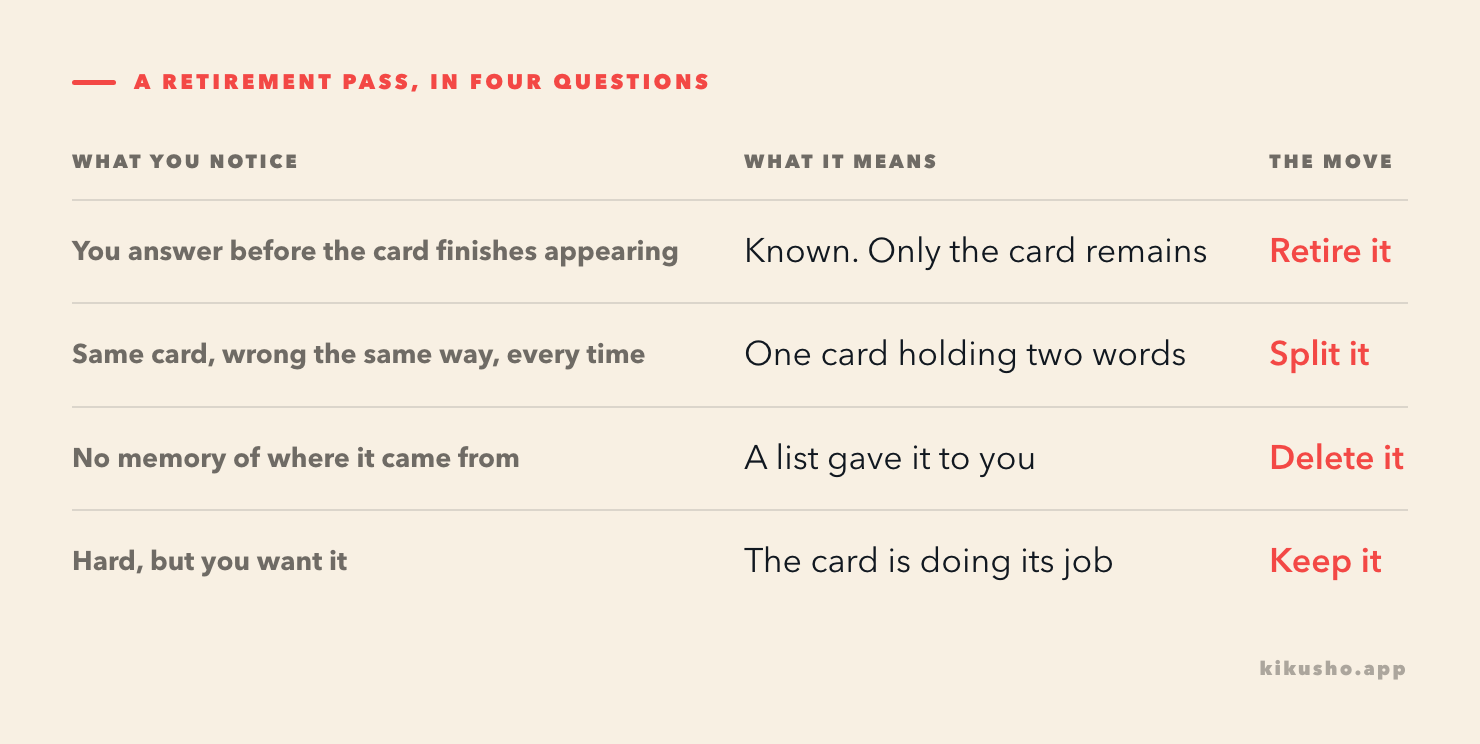
Retiring does not need to be a feature, either. Suspending the card, moving it to a deck you never open, or deleting it outright all do the same job: they take it out of tomorrow's queue. Deleting is the cleanest of the three, and the only one that also stops the deck growing.
Run the pass once a season, or the next time a session starts feeling like an obligation, and give it ten minutes rather than an evening. A deck that gets a short pass regularly never needs the dramatic clear-out that people usually reach for instead.
One guard, because the pass can overshoot. Difficulty is not a reason to retire anything. A card that is hard and that you want is the deck doing precisely what you built it for, and a deck pruned down to only comfortable cards is a deck that has stopped teaching you. What you are removing is not the effort. It is the cards that no longer cause any.
If the deck is already a wall
A backlog and a bloated deck usually arrive together, and they are treated in the same pass. Set new cards to zero, then clear the queue with the four questions running the whole time. The queue drains faster than you expect, partly because most of a backlog is cards you still know, and partly because a good number of them should not have been there at all.
Resist the move that feels most decisive. Deleting the deck and starting fresh throws out the cards that are still working alongside the ones that are not, and it costs you the intervals that took months to earn. Retirement gives you the same relief without the loss, and it leaves you with the part of the deck that was always the point: a small set of words you actually met, that you do not yet know, and that you will be glad to have kept.
Common questions
How do I know when a flashcard is safe to delete?
When it has been answered correctly after a gap of several months, and the word also turns up in your life without the card. Ease at a three-day interval only proves you saw it a few days ago; surviving a long gap is the evidence that the memory holds on its own.
Should I delete cards I keep getting wrong?
Usually rewrite them first. A card failed repeatedly is normally one card carrying two things — two meanings, two readings, a word and its opposite — and splitting it fixes what deleting only hides. Delete it if you cannot remember why you added it.
Does deleting cards lose the progress I made on them?
No. The work was the recalling, and that already happened; it is in your memory, not stored in the card. What a card holds is a claim on future review sessions, so removing one costs you nothing you have earned.
How often should I clear out a deck?
Once a season, or whenever a session starts feeling like an obligation, and inside the review itself rather than as a separate task. Ten minutes spent on the cards that are already annoying you does more than an evening spent scrolling a card list.