
On this page
Highlighting a word marks it; it does almost nothing to teach it. A memory is built by pulling the word back out of your head later, from nothing — and a highlight quietly guarantees you never have to, because the answer stays on the page exactly where you left it.
That is the whole problem in a line, and it is worth sitting with, because highlighting feels like the opposite of wasted effort. You read closely, you caught the word, you did something about it. Weeks later the page is striped with yellow, you recognise every stripe, and you still cannot produce one of the words without looking. The marking and the learning turned out to be two different acts, and only one of them happened.
Highlighting feels like work because it leaves a mark
The reason the habit is so hard to drop is that it pays out immediately. You draw the line, a word is now flagged, and you get a small sense of closure — handled. It costs almost nothing: no reaching, no risk of being wrong, no pause. You keep reading.
But that feeling of progress is manufactured by the marking, not by any change in what you can recall. Real learning tends to feel worse in the moment. Trying to remember a word and half-failing is uncomfortable; drawing a clean line over it is pleasant. So the pleasant act and the useful act point in opposite directions, and the pleasant one wins, session after session — which is how you end up with a beautifully annotated book and an empty memory. The tidier the page looks, the more finished the work feels, and the further you are from the one thing that would have made it stick.
Say you are reading and hit 頑張る. You look it up — to do your best, to hang in there — highlight it, and move on, satisfied. Nothing about that sequence asked your memory to do anything. You met the word, and you filed the meeting under done.
A word is learned by retrieval, not by re-exposure
Seeing a word a second time does surprisingly little. What strengthens a memory is the effort of reconstructing it — being handed a partial cue and having to produce the rest. Recognising a word is cheap and shallow; recalling it is expensive and deep, and the expense is the entire point. We went through the mechanism in how many times you need to see a word to remember it: the count of sightings barely matters, because re-seeing is not what installs the word. Retrieval is.
A highlight is pure re-exposure. It is the least effortful thing you can do to a word and the one that leaves the answer most visible. When your eye lands on the mark again, the word arrives for free, and your memory never has to reach.
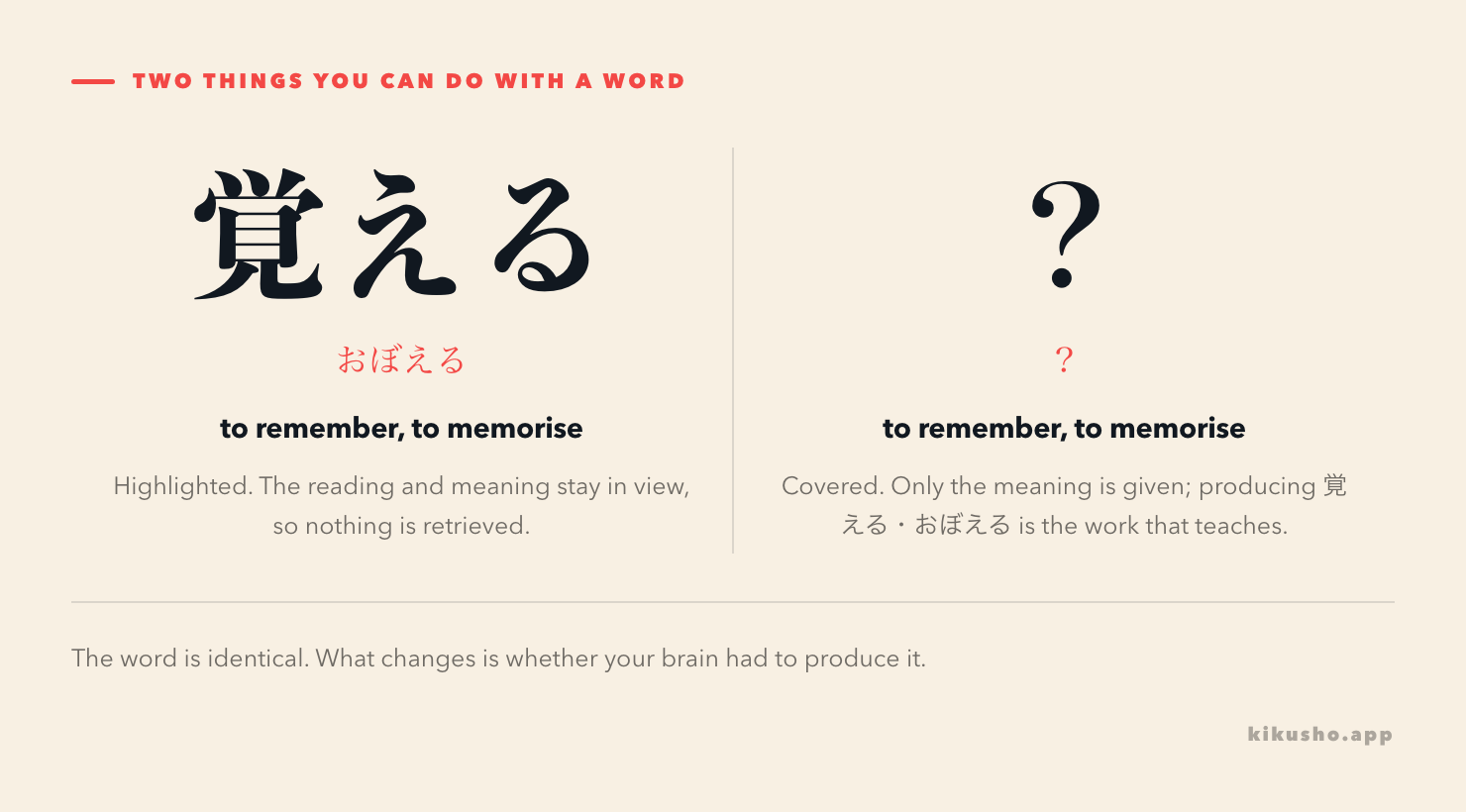
The difference in that picture is the difference between a striped page and a word you actually own.
Re-reading your highlights is the fluency trap
The natural next move is to "review" by going back over your highlights, and it feels productive because every word is instantly familiar. That familiarity is the trap. You are recognising a mark you made yourself, in a context you already know, with the answer sitting right beside it. Ease of seeing is being read as strength of knowing — the fluency illusion.
The test that would puncture it is exactly the one a highlight lets you skip: cover the word, give yourself only the meaning, and try to produce it. Most of the words you were sure of will not come. The highlight had been doing the remembering for you, and re-reading only confirms that the highlight is still there — not that the word is.
But I remember plenty of things I highlighted
The obvious objection is that you clearly do remember some of what you marked — the exam material, the passages you underlined and then argued about for weeks. That is real, and it is worth being precise about why. In nearly every case the highlight was followed by retrieval you are not crediting: an exam that made you produce the material cold, an essay that made you use it, a conversation where you had to pull the word up with nothing prompting you. The recall did the teaching; the highlight merely happened to be nearby, and took the credit.
Strip the later retrieval away — mark a word and then genuinely never test yourself on it again — and the memory does not survive on the stripe alone. The highlights that seemed to work are the ones that were later made to earn their keep. Which is the good news hiding in all of this: you do not have to stop marking words, you only have to add back the step that was quietly doing the work.
A highlight removes the effort — and strips the word from its sentence
Two things go wrong at once. The first is that a highlight is an anti-retrieval device by design: its whole function is to make the word easy to find again, which is the same as making it easy to never rebuild. Every time you lean on it, you skip the one action that would have taught you.
The second is quieter. A lone highlighted word loses everything around it — the particle it took, the politeness level it sat in, the words it habitually travels with. You mark 頑張る and lose whether you met it as 頑張って (hang in there, said to someone) or 頑張ります (I'll do my best, said about yourself). The mark says this word and keeps none of what made it usable, which is the case for learning words inside their sentences rather than as isolated hits. A highlight is the most isolated a word can get.
Turn the mark into a question you have to answer later
The fix is not to stop highlighting. It is to stop letting the highlight be the last step. Treat it as step one — noticing — and add the step that does the teaching: turn the word into a question you answer at a delay.
Concretely: cover the word, give yourself only the meaning or the sentence with a gap in it, and rebuild the word from nothing. Do it later, not in the same breath — the gap between meeting the word and reaching for it is not a flaw in the method, it is the method. Memory decays on a schedule, and a recall bites hardest just as the word is starting to slip, which is the whole logic behind why you forget vocabulary and what stops it.
Take the 頑張る from earlier. Instead of leaving it striped, the next day you give yourself only to do your best, to hang in there and try to produce the Japanese. If がんばる comes back, with the kanji, good — push the next recall further out. If you get the meaning but not the reading, or nothing at all, that failure is information: the word was never as learned as the highlight made it look, and it earns another pass. Either way you have finally done the thing the highlighter could not.
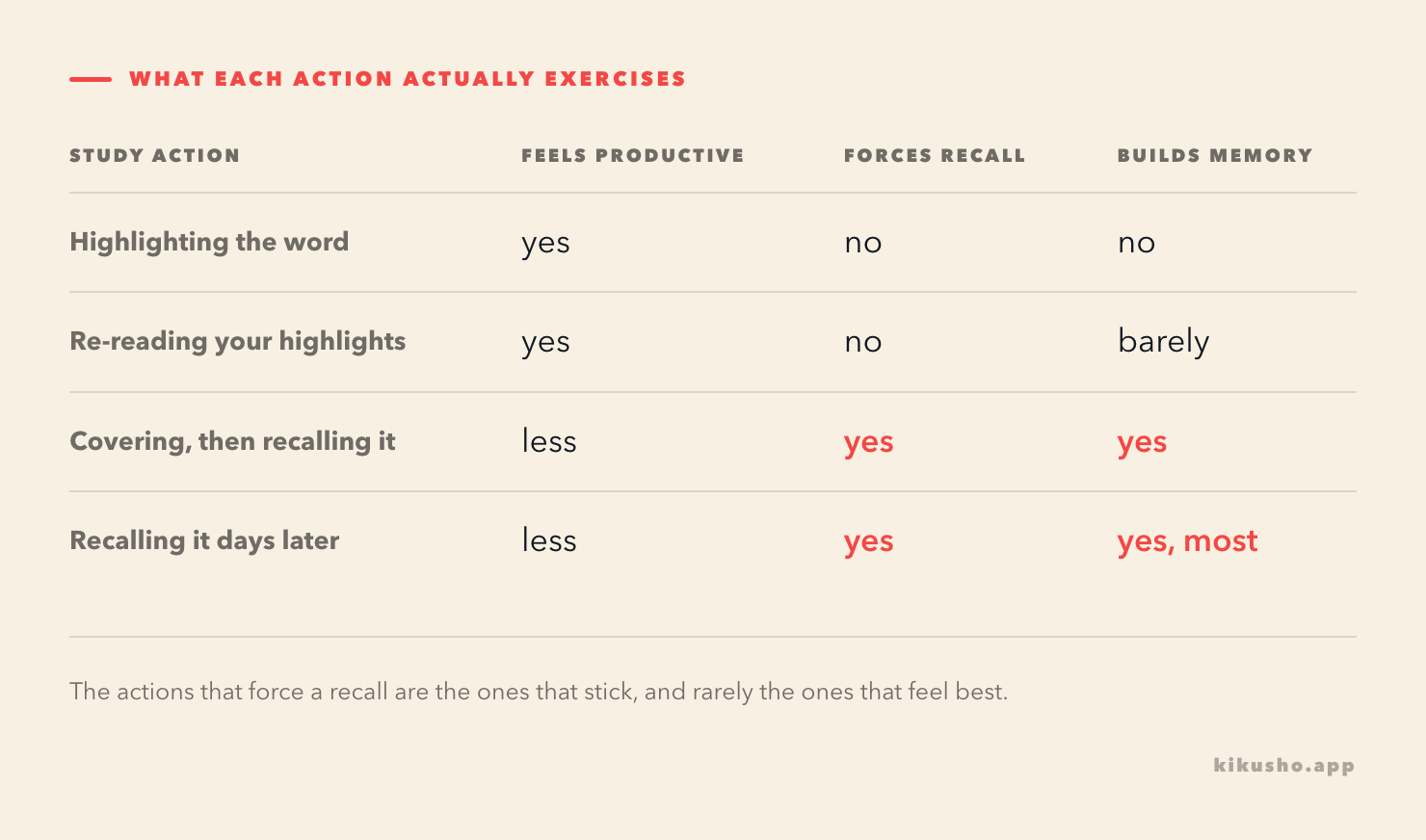
Notice the pattern: the actions that build memory are the uncomfortable ones, and the comfortable ones do nothing. If a study step never once makes you produce the word from memory, it is not teaching you the word, however tidy it leaves the page.
When highlighting earns its place
None of this makes highlighting worthless. As a capture gesture it is genuinely good — a fast, low-friction way to flag come back to this without breaking your reading. The failure is only when the flag is the end of the process instead of the start of it.
So the question for any highlight is a single one: what turns it into a recall? If the answer is nothing, the mark is just where the word goes to be forgotten in a nicer colour. If the answer is a later step that hides the word and asks you to produce it, the highlight has done its real job — pointing at something worth keeping.
That second half is the part a highlighter cannot do, and it has to live somewhere. It is also exactly what Kikusho is for: you highlight what you notice — up to five things on a single photo of a menu, a page of manga, a sign — and each highlight becomes its own card, drafted for you, then scheduled back with FSRS so that when it returns you have to recall the word, not just recognise your own mark. The noticing stays instant; the retrieval gets done on its own timetable.
Keep highlighting if it helps you notice. Just don't mistake the stripe for the memory. The memory is made later — in the small, uncomfortable moment when you have only the meaning in front of you, and have to find the word yourself.
Common questions
Is highlighting completely useless for learning vocabulary?
No. As a way to notice a word and flag it for later, highlighting is fine — even useful. It just isn't the step that forms the memory. That step is the delayed recall you do afterwards, when you cover the word and rebuild it from its meaning. A highlight on its own teaches almost nothing.
Why do my highlights feel familiar but I still can't recall the words?
Because recognising a mark you made is not the same as producing the word from memory. Going back over highlights makes every word feel easy, but that ease is the fluency illusion — the comfort of seeing mistaken for the strength of knowing. The only test that measures the difference is covering the word and trying to say it.
What should I do instead of highlighting?
Turn each word you would highlight into a question you answer later: cover the word, give yourself only the meaning or a sentence with a gap in it, and reconstruct the word from nothing. Then space those recalls over days rather than doing them all at once, so each one lands as the word starts to fade.