On this page
Every review ends on the same four buttons — Again, Hard, Good, Easy — and the choice you make there is not a grade on the card and not a grade on you. It is the one piece of information the scheduler gets about the state of your memory, and it uses that single reading to estimate how fast the word is fading and to pick the day it will test you again.
Which is why the instinct almost everyone follows is the wrong one. You press Easy when you feel pleased, Hard when the recall stung, Again when a word has annoyed you one too many times. But the algorithm underneath — FSRS, the scheduler Kikusho runs on and the one modern Anki adopted — has no interest in how you feel about the card. It is tracking one hidden quantity per card, roughly how durable this memory is right now, and your button is the only evidence it ever gets. Choose the wrong one and you have not been modest or generous. You have handed it bad data, and it books your next review on the strength of it.
The buttons answer a question about your memory, not about the card
It helps to know what the scheduler is keeping track of, because the buttons make more sense once you do. FSRS carries a few numbers for every card. The important one is stability: loosely, how many days can pass before your chance of recalling the word falls to a set threshold. A stable memory decays slowly and earns a long interval; a fragile one decays fast and comes back soon. Beside it sits a difficulty value — how stubborn this card is about becoming stable — and, worked out from the time since you last saw it, your retrievability: the odds you could produce the answer at this exact moment.
You never see these numbers, and you do not need to. What matters is that pressing a button, together with how long it has been since the last review, is what updates them. The scheduler had a prediction about how likely you were to remember; your answer either confirms it or corrects it. That is the whole transaction. The four buttons are not a difficulty dial running from mild to brutal. They are four different messages about how a memory is holding up.
Again is the only button that means you failed
Start with the split that does the most work, because getting it wrong costs the most. Again means one thing: you could not produce the answer, or you produced the wrong one. Hard, Good and Easy all mean the same thing as each other — you got it — and differ only in how the getting felt.
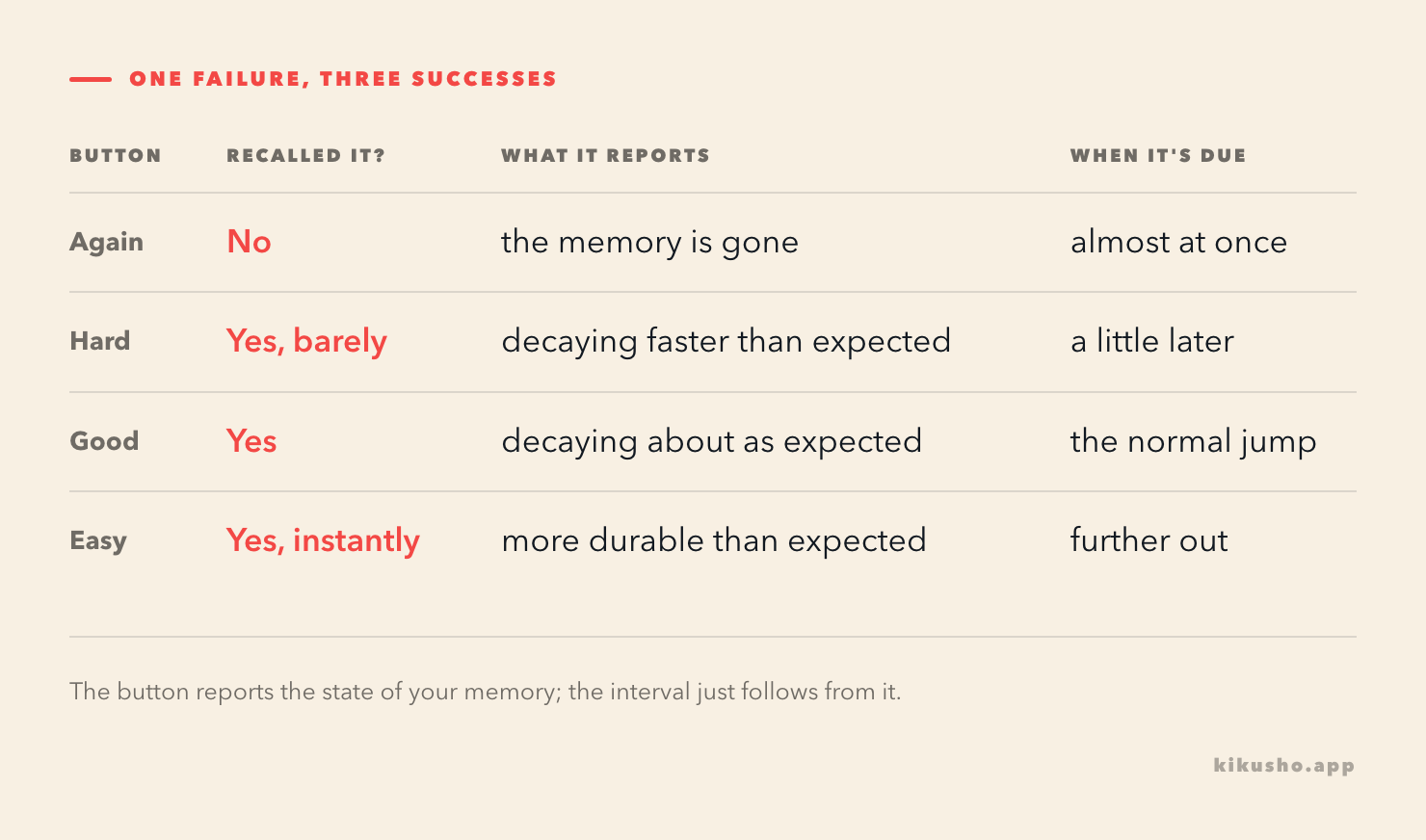
Read down the second column and the four buttons stop looking like a row of difficulty settings and start looking like what they are: one failure and three flavours of success. Everything downstream follows from that line. A card you press Again on is treated as a lapse — its stability is cut and it is thrown back into the near future, sometimes the same session. A card you press any of the other three on keeps its progress and moves further out. So the most consequential decision at the bottom of a review is not how hard was that but did I actually recall it.
Hard, Good and Easy grade the effort of a success, not the success itself
Once you have recalled the word, the remaining three buttons report how much it cost you. Good is the honest default: you produced the answer at about the effort the scheduler expected, and the interval grows by the normal amount. Hard says you got there, but it was a slog — you hesitated, half-lost it, dredged it up at the last second — and the interval grows less, because a memory that was already wobbling should not be trusted as far. Easy says the answer arrived instantly, with room to spare, so the scheduler stretches the interval further and marks the card a little less demanding from then on.
The thing to notice is that all three describe the same word on the same card. Nothing about 曖昧 changes between a Tuesday when it comes to you at once and a Friday when you nearly blank. What changed is your memory of it, and that is exactly what the button is there to report.
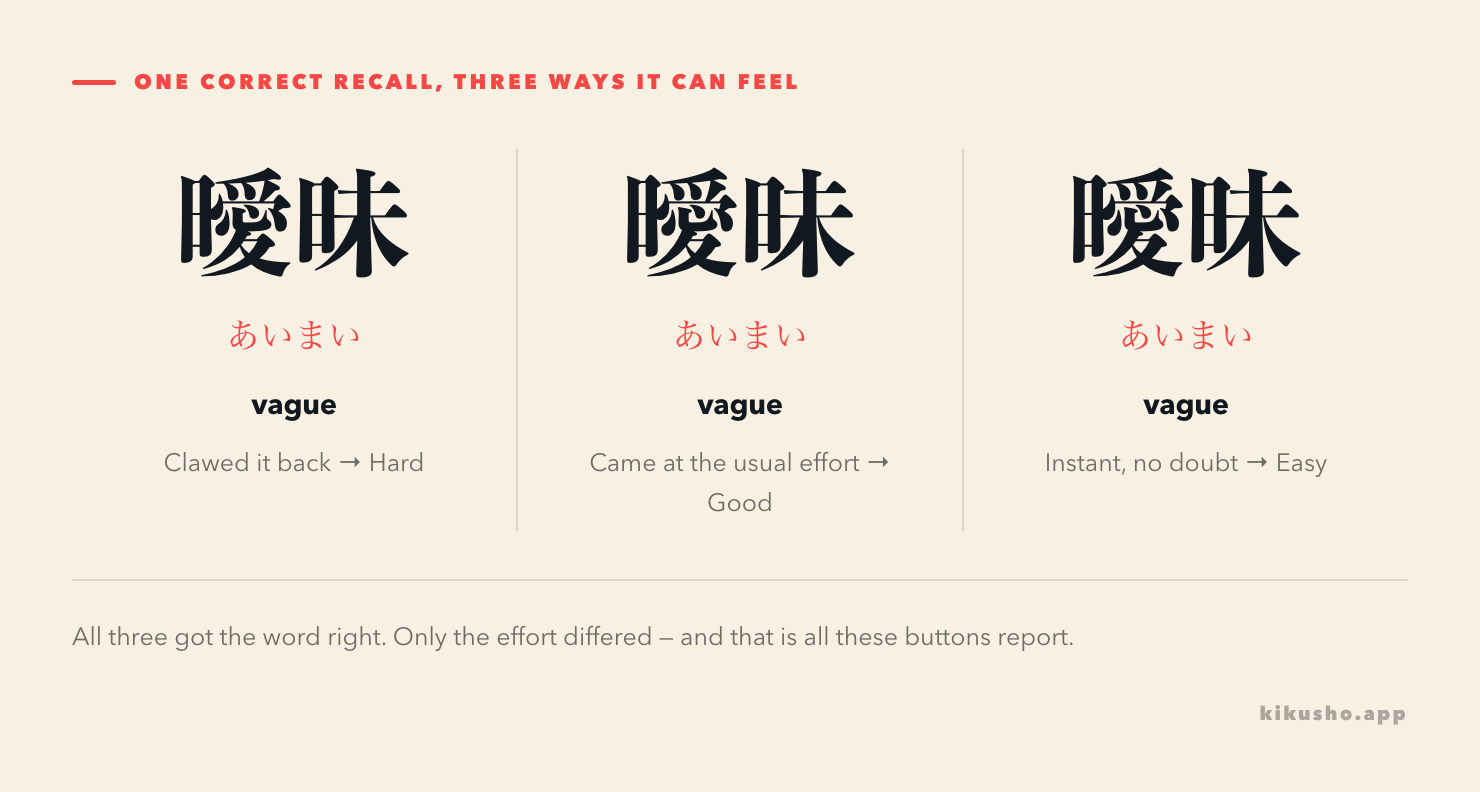
This is the reframe that fixes most bad grading. You are not rating the card's inherent hardness; the scheduler tracks that itself, across all your reviews. You are reporting the one thing only you can see: how close you just came to losing the word.
What actually changes when you press each one
Concretely, each button sends the card to a different day. Again collapses the interval and records a lapse against the card. Hard grows the interval, but by the least of the three. Good grows it by the amount the model was aiming for. Easy grows it the most and eases the card's difficulty, so its intervals stretch faster afterwards.
Underneath all four, the scheduler is solving the same small problem: when should this come back so that, on the day it does, your chance of recalling it has fallen to your target — 90% by default in FSRS. That figure is what the intervals are built around. A word you keep pressing Easy on is being scheduled for a future in which you will still, nine times in ten, remember it. A word you keep failing has its interval pulled back in until the odds recover. The whole point of the schedule is to catch each word just as it is about to slip, and the buttons are how it learns where that moment falls for you.
The two miskeys that quietly wreck a deck
Two habits do most of the damage, and both come from reading the buttons as a report card.
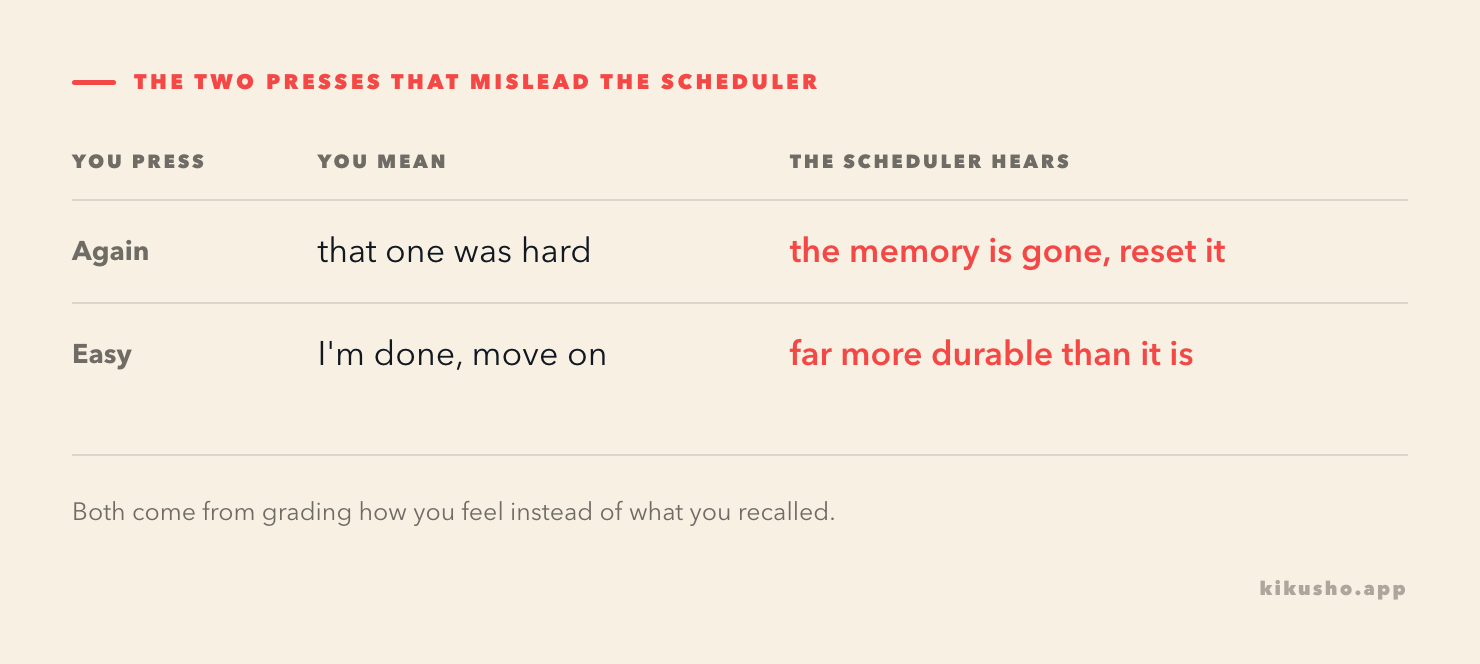
The first is pressing Again because a recall was hard, not because it failed. It feels honest — the word fought you, so you punish it. But Again is a lapse: it tells the scheduler the memory is gone, cuts the card's stability, and drops it to a short interval. Do this to words you actually knew and you manufacture a deck full of cards resetting to a few minutes, and a handful of those coin-flip cards can generate more daily reviews than a week of genuinely new words. If you produced the answer at all, the button is Hard.
The second is pressing Easy to move faster, or as a small reward for a card you are fond of. Easy is not a quicker Good; it tells the scheduler the memory is stronger than a Good would imply, so it launches the interval further out. Lean on it and you build a deck scheduled for a confidence you do not actually have, and the cards come due weeks later as fresh failures. Easy is for the recall that was genuinely instant, not the one you are pleased with.
There is some history behind why this matters less than it once did. For years Anki ran on an older algorithm, SM-2, in which every card carried an "ease" percentage that Again and Hard chipped away at permanently. A card you kept finding hard could spiral into ever-shorter intervals it never climbed out of — the notorious "ease hell". FSRS did away with that. It fits its model to your whole review history rather than docking one number per miskey, so a single Hard no longer trails a card around forever. The buttons are more forgiving now — but forgiving is not the same as ignored, and the Again-for-Hard swap still does real damage, because it changes the one thing the model cannot second-guess: whether you got it right.
So how should you actually press them?
The rule that survives all of this is short. Ask two questions and nothing else: did I recall it, and how did that feel?
If you could not produce the answer, press Again — however familiar the word looked the instant you flipped the card. If you did produce it, choose among the other three by the effort, not the outcome: Hard for a recall you clawed back, Good for one that came at the expected cost, Easy for one that was instant and effortless. Do not agonise over Hard versus Good on a given card; FSRS averages across many reviews, so rough consistency matters far more than getting any single press exactly right. The one line to hold firmly is the one between Again and everything else, because that is the line the scheduler trusts you to draw.
This is also why the buttons work the same way with no setup. In Kikusho the scheduler is FSRS with sensible defaults and nothing to configure: you capture a word — point the camera, say it, paste it — and it comes back as a finished card on a schedule, with the same four buttons under every review. Reviewing is never metered, so pressing them honestly costs you nothing; the free plan limits only how many new cards you make in a day, never how many you revise. All you are ever doing at the bottom of a card is telling the truth about your memory, and letting the schedule do the arithmetic.
Common questions
If I got the answer right but it was really hard, should I press Again or Hard?
Hard. Again means you failed to recall the word at all; it is treated as a lapse, cutting the card's stability and bringing it back almost immediately. If you produced the answer — even slowly, even at the last second — that counts as a success, and Hard is the button that records a success that cost you effort. Keep Again for the cards you genuinely could not answer.
Does it really matter whether I press Hard or Good?
A little, not a lot. FSRS learns from your whole history with a card, so one press rarely makes or breaks it, and being roughly consistent matters more than agonising over any single button. The distinction that does matter is Again versus the other three, because only you can tell the scheduler whether you actually recalled the word.
Is Easy just a faster way to press Good?
No. Easy tells the scheduler the memory is stronger than a Good would imply, so it stretches the next interval further out and marks the card less difficult from then on. Use it for a recall that was genuinely instant and correct. Used as a shortcut to clear cards quickly, it schedules words for a confidence you do not have and they return later as failures.
What is the actual difference between Again and Hard in FSRS?
Again is a lapse — a failed recall that cuts the card's stability and returns it to a very short interval. Hard is a success that still moves the card forward, just less than Good does. The line between them is simply whether you recalled the answer at all, which is why it is the one call worth getting right every time.