On this page
If the manga you are holding prints furigana — the small kana above the characters — you need almost no kanji to start, because the reading of every character is already on the page. If it does not, you are reading ordinary Japanese prose that happens to sit in speech bubbles, and the working floor is the 常用漢字 set of 2,136 characters.
So the number depends on a property of the book, not of you. And in both cases the count is the wrong unit: what decides whether a panel makes sense is how many words you know, and manga is written in the register textbooks put off until last.
Check the top edge of the characters before you count anything
Manga divides along a line that vanishes in translation. Titles serialised for younger readers — the weekly shōnen magazines, most shōjo — print furigana over essentially every kanji, a convention called 総ルビ (sō-rubi, "all ruby"). The publisher assumes a twelve-year-old has not finished learning the characters, and that assumption happens to describe you too.
Manga for adults — the seinen and josei magazines — usually reserves furigana for names and unusual readings, and plenty of titles carry none at all. Same medium, entirely different entry cost. One volume asks you for zero characters and the next asks you for two thousand.
This is checkable in about four seconds, and it is worth more than any number anyone can give you. Open the volume, look at the top edge of a line of dialogue, and see whether there is kana sitting above the kanji. That single observation answers the question you came with, for the book actually in your hands.
Furigana gives you the sound, and the sound was never the hard part
Here is the trap inside the question. Furigana solves pronunciation and nothing else. You can read かくご off the top of 覚悟 with complete confidence, say it out loud correctly, and have no idea what was just said. The kana hand you the sound of a word you do not know.
That inverts what most kanji study is built for. Drilling characters is largely training to produce readings, and a reading only resolves inside the word it belongs to anyway. Manga has already done that part for you, on every page, for free. What it has not done is tell you what the word means — which was the part you were always going to have to learn.
Which is why "how many kanji" both overcounts and undercounts. It overcounts because a furigana'd volume needs none of them up front. It undercounts because the number of distinct words in a volume of dialogue is far larger than the number of characters in it, and words are what you will be looking up.
The wall is that manga is written in speech, not in prose
Textbooks teach a register almost nobody prints in a speech bubble. They are not wrong to: you have to learn 〜ています before you can recognise what it collapses into. But the collapse is not an advanced topic that arrives later. It is on page one of volume one.
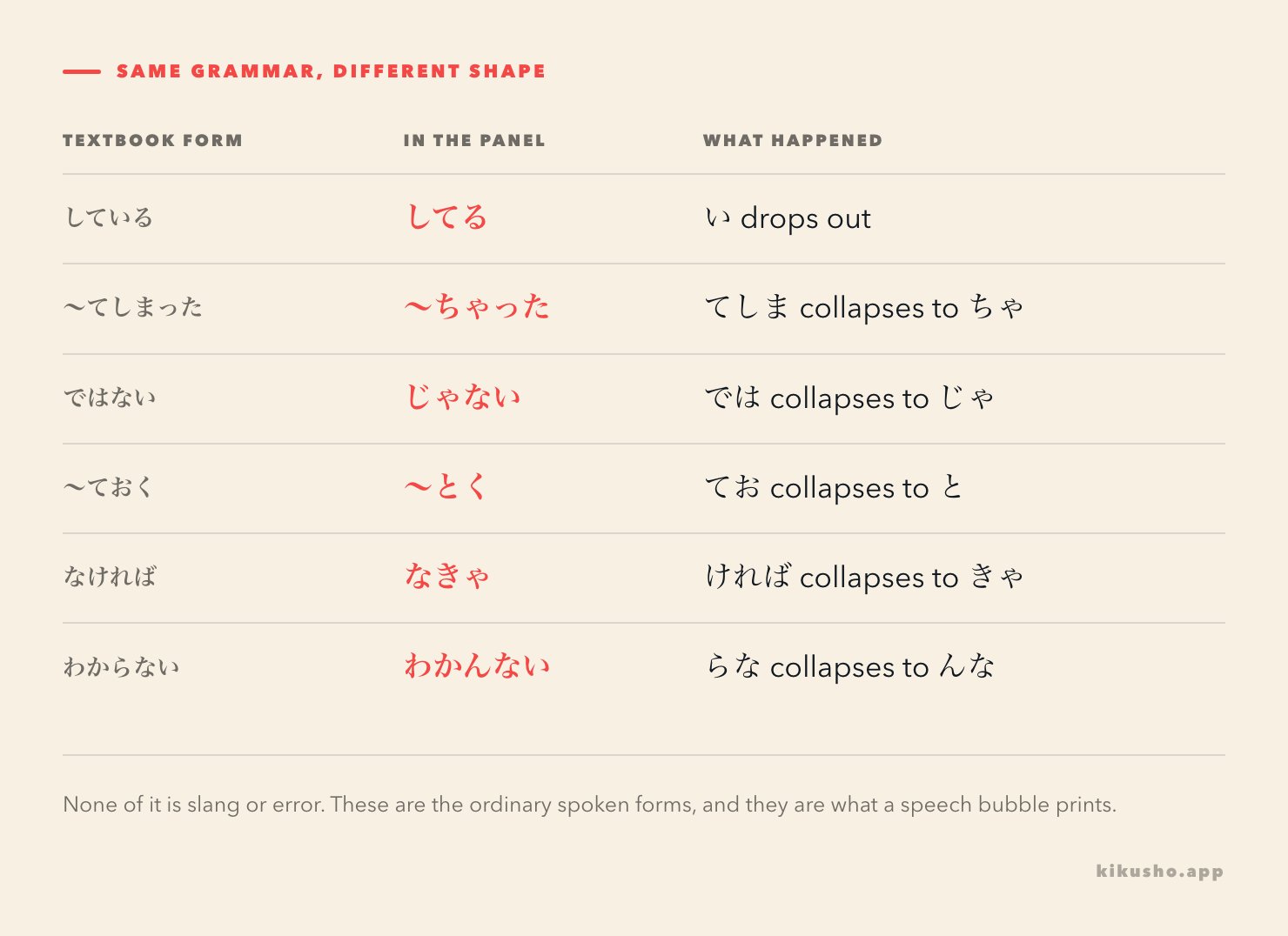
None of these is slang, and none is an error. They are the ordinary spoken forms of things you already know, and they are what gets printed. If you learned 〜てしまう as "do something completely, often regrettably" and then meet 食べちゃった, the grammar is not new. The shape is. A reader who has never been shown the shape experiences a sentence they have technically studied as a sentence they have never seen.
The same applies to particles you were taught to drop and never taught to hear back. Spoken Japanese leaves out は and を constantly, so a bubble reading 飯食う? contains a verb, an object and a question, with two of the four grammatical signposts missing.
One line, and everything difficult in it is kana
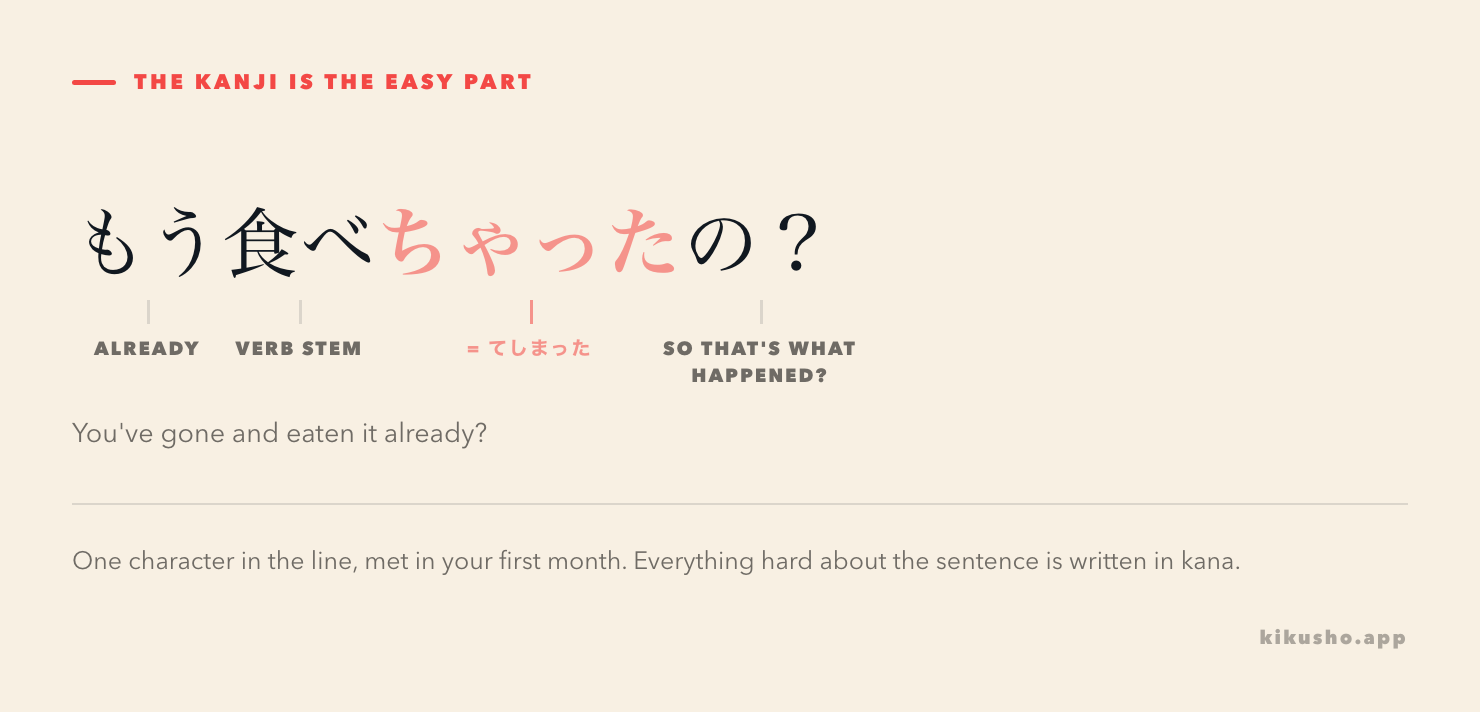
The single character here is 食, which most learners meet in their first month. Everything that makes the line hard to parse is written in kana: a contraction of てしまった, and a sentence-final の doing work that has no clean English equivalent.
Count characters and this sentence scores as trivial. Read it cold at N5 and it stops you. That gap is the whole subject of the question people are actually asking when they ask how many kanji they need.
Commands and rough speech arrive far earlier than they do in a course
Manga dialogue also sits low on the politeness scale, and courses climb that scale from the top down. You are taught the form you can safely say to a stranger first, and the forms characters actually shout at each other much later, if at all.
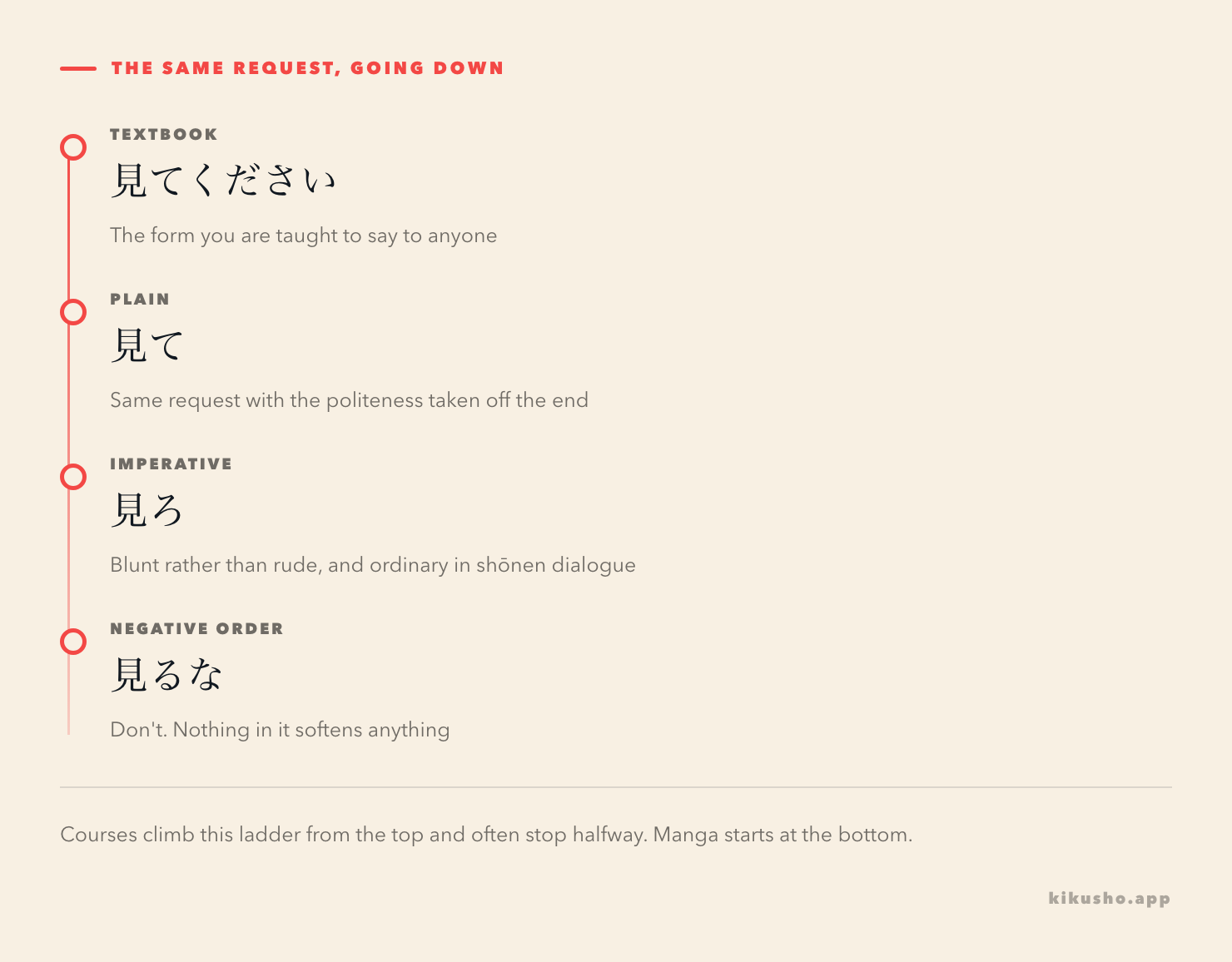
Nothing at the bottom of that ladder is exotic. 見ろ is not rude by nature, it is blunt, and it is everywhere in shōnen dialogue. What makes it hard is only that you were introduced to the polite end and left there. Politeness in Japanese is a set of substitutions layered onto a sentence you can already build, so learning to read downward costs far less than the size of the gap suggests — but it does have to be learned deliberately, because manga will not walk you up from ください.
Sound effects are drawings, and no dictionary will help you much
A large share of the text on a manga page is not text at all. Onomatopoeia is hand-lettered into the artwork, sized and warped to fit the panel, so there is nothing to select, copy or paste. It has no furigana, because it is not kanji. It frequently has no dictionary entry, because the artist made it up for that panel.
Japanese splits these into 擬音語 (giongo), words for actual sounds, and 擬態語 (gitaigo), words for states and manners that make no sound at all. ドキドキ is a heart going; ざわざわ is a crowd murmuring, or a room going uneasy. しーん is the standard rendering of total silence, which is to say Japanese has a sound effect for the absence of sound and prints it in large letters.
Everyone speaks like a character, and that is a deliberate system
The other thing that surprises readers arriving from a textbook is how strongly manga marks who is speaking through how they speak. Japanese linguistics has a name for it: 役割語, role language.
An elderly professor says わし and ends sentences with じゃ. A rough young man says おれ and may attach 〜やがる to a verb to show contempt for the action. A girl written as sheltered and wealthy ends sentences with ですわ. A period-drama swordsman says 拙者. Almost none of these people exist. The speech patterns are a shorthand between artist and reader, understood instantly and used by essentially nobody in daily life.
For a learner this cuts both ways. You will meet first-person pronouns and sentence endings that no course teaches, and you should not copy them. You will also get, free, a very fast lesson in the fact that Japanese encodes age, gender, era and social position in the grammar of a sentence rather than only in its content.
The JLPT figures people quote at you are not official
If someone tells you manga needs "N4, about three hundred kanji", the level is a reasonable guess and the number has no official source. The JLPT published test content specifications listing kanji and vocabulary by level until the 2010 revision, and then stopped. The kanji-per-level lists circulating today are community reconstructions of a document that was retired, not a published syllabus.
That does not make them useless — they are a decent map of what tends to show up when. It does mean nobody can tell you the character count for a level, because the body that runs the exam declines to.
And the deeper problem stands even if the numbers were exact. Characters are not the unit of reading. You do not read 生 and 活, you read 生活, and the character count of a page is a poor predictor of how many of its words you will recognise.
What to do instead of counting
Pick a title with furigana that you already know the story of. Prior knowledge does the work an intermediate reader normally gets from grammar: you can lose a sentence entirely and still know what happened, which is what keeps you turning pages instead of building a lookup queue.
Then change what you collect. The instinct is to note the unfamiliar kanji, and it is the wrong instinct, because the furigana already gave you those and the character on its own will not come back to you in a sentence. Collect the words — and specifically the contracted, spoken, sentence-final ones the panel is full of, since those are the items no textbook chapter is going to hand you later.
Expect the first volume to be slow and the second to be noticeably less so. Manga dialogue reuses its constructions relentlessly: the contraction that cost you five minutes in chapter one keeps returning for the rest of the volume, which is exactly the shape of material that rewards being collected once and never again. Keep the intake small enough that the reviews stay survivable — a single page can offer more candidate words than a sensible day's additions, and taking all of them is how people quit in week three.
The honest answer to the original question, then: for manga with furigana, roughly none, and that is not a trick. For manga without it, the jōyō set, because at that point you are reading Japanese with no support. And in either case you will spend your time on words, on contractions and on sentence endings — never on the character count, which was only ever a proxy for the thing standing in your way.
Common questions
How many kanji do you need to read manga?
If the title prints furigana, as most shōnen and shōjo manga does, you need almost none to begin, because the reading of every character is printed above it. Without furigana you are reading ordinary Japanese, and the working floor is the 常用漢字 set of 2,136 characters. In both cases the number that decides whether a page makes sense is how many words you know, not how many characters.
Does all manga have furigana?
No. Manga serialised for younger readers — the weekly shōnen magazines, most shōjo titles — generally prints furigana over every kanji. Manga aimed at adults, the seinen and josei magazines, usually reserves it for names and unusual readings, and some titles carry none at all. Open a volume and look at the top edge of the characters before you buy it.
Why can't I look up manga sound effects in a dictionary?
Because they are drawn rather than typed. Onomatopoeia is hand-lettered into the artwork, so there is no text to select or copy, it carries no furigana, and many forms are invented for a single panel rather than listed anywhere. Japanese distinguishes 擬音語, words for real sounds, from 擬態語, words for states that make no sound at all — しーん, total silence, is one of the latter.
Is manga a good place to start reading Japanese?
Yes, with one caveat worth knowing in advance. Furigana removes the kanji barrier entirely, but manga dialogue is spoken register: contracted verb forms, dropped particles, blunt commands and sentence-final particles. It is easier to pronounce than a graded reader and harder to parse, so it rewards you for collecting those spoken forms rather than expecting textbook sentences.