On this page
Japanese has many words for I because none of them is a pronoun. They are ordinary nouns that were recruited for the job: 私 meant private, 僕 is written with the character for a manservant, うち means one's own house. A noun you use about yourself says something about the person using it, and a language can keep as many of those as it finds useful.
The second thing worth knowing is that the commonest way to say I in Japanese is to say nothing at all.
The commonest word for I is no word at all
Japanese does not require a subject. When it is obvious who you are talking about, it is left out, and most of the time it is obvious.
行きます. I'll go. There is no 私 in it and nothing is missing.
This is the piece an English speaker gets wrong first, because English forces the slot. You cannot say go to the station tomorrow and be understood to mean yourself. Japanese has no such requirement, so putting 私 in front of a verb is never neutral. It is an addition, and an addition has to be doing something.
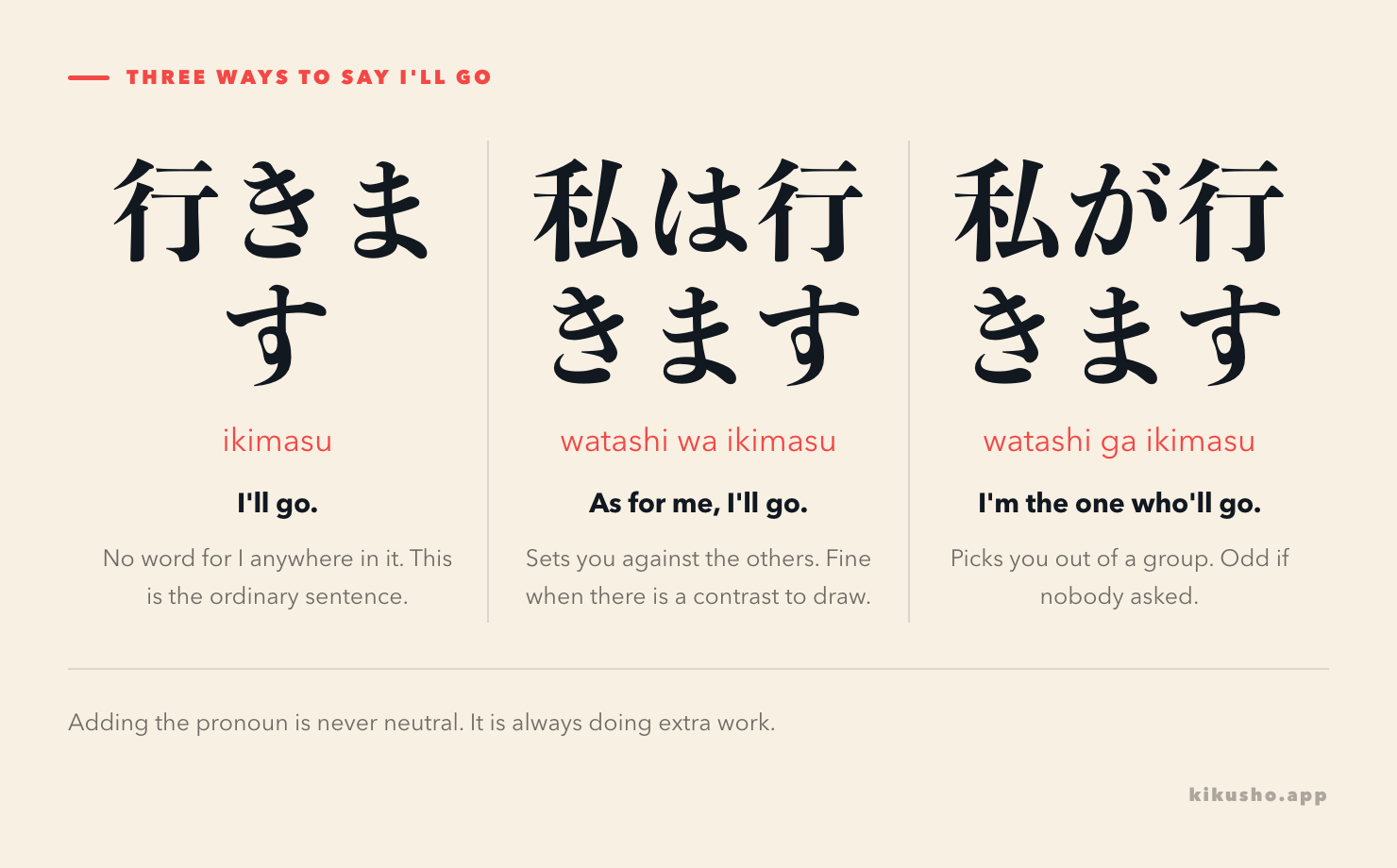
What the addition is doing is the difference between は and が, which is the same distinction that runs through the whole language: は sets you aside as the frame, が picks you out of a group. Neither one is the plain sentence. The plain sentence is the first.
So the honest answer to which word for I should I use is often none of them, and a learner who supplies 私 in every sentence sounds stranger than one who has never learned that 僕 exists.
They are nouns, not pronouns, which is why the list has no end
English has a closed set of pronouns. There are seven or so, no new ones arrive, and I is simply the one that means the speaker. It carries nothing else. You can be furious, deferential, drunk or on television and it is still I.
Japanese never built that closed set. The words that do the job are nouns, and you can watch them being nouns: 自分 means oneself, うち means the house or the inside, 私 is the word for private as opposed to 公, public. 僕 is the character for a servant, which is what you were calling yourself when you started using it.
Because they are nouns, nothing stops the supply. English can do this too, but only as a joke — yours truly, this reporter, muggins here. They are funny precisely because English has a real pronoun for them to be marked against. Japanese has no such default, so every one of these words is marked, and none of them is the joke.
What the common ones actually say about you
Seven cover almost everything you will hear.
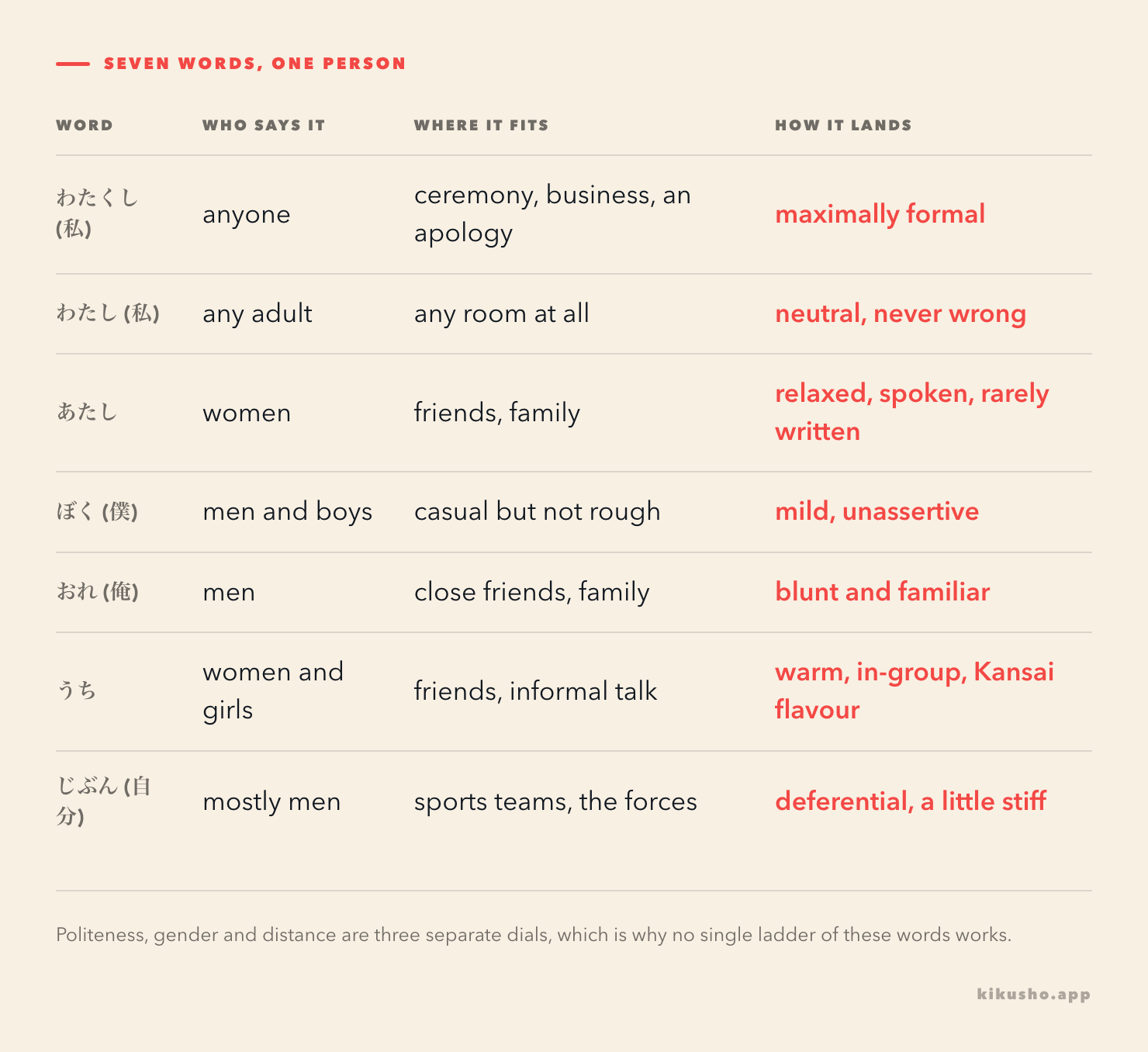
The reason a single ladder from rude to polite never quite works is visible in the table. わたくし and おれ do sit at opposite ends of formality, but ぼく is not a rung between them so much as a different axis: it is mild rather than polite, and a man using it in a board meeting sounds boyish, not respectful. うち is not more or less polite than あたし, it is warmer and more regional. You are setting three dials, not sliding one.
The words wear out, so the language keeps recruiting
Here is the engine that produced the list. A word you use about yourself soaks up the attitude you used it with. Say 僕 often enough and it stops sounding like your servant and starts sounding like nothing much, at which point it no longer does the lowering it was hired for, and something else gets recruited.
The clearest evidence is on the other side of the conversation, where the drift has gone further. 貴様 is written with the character for noble and the honorific 様. It is now an insult, the one a villain spits before a fight. お前 is 御前, the honourable one in front of me. It is now what you say to a younger brother, or to someone you are about to have an argument with.
English did the same thing to thou: you was the polite and plural form until it swallowed the familiar one whole. What is different in Japanese is that the worn-out word does not disappear. It stays in the inventory at its new register, still available, now meaning something else. Nothing is retired, so the list only grows.
There is no safe word for you either
This is where the textbook quietly fails people. あなた is taught as the equivalent of you, and it is not one. It is distant when used on a stranger, faintly cold on a colleague, and in the mouth of a wife addressing her husband it is closer to dear. None of those is the neutral slot the lesson implied.
What Japanese speakers do instead is not use a word for you at all. They use the person's name with さん, or their title — 先生, 部長, 店長 — or, most often, nothing, exactly as with I. 田中さんは行きますか is the ordinary way to ask someone whether they are going, addressed to that person's face. Using their name to their face feels wrong in English and is unremarkable in Japanese.
The pattern confirms the diagnosis. If these were pronouns, one of them would be neutral, because a pronoun's job is to be a placeholder. They are relationship words, and a relationship word cannot be neutral about the relationship.
Anime taught you a register nobody speaks
If the words feel more numerous and more vivid than the account above, fiction is why. Japanese fiction leans on first-person words to tell you who a character is before they have done anything, a device the linguist Satoshi Kinsui named 役割語, role language.
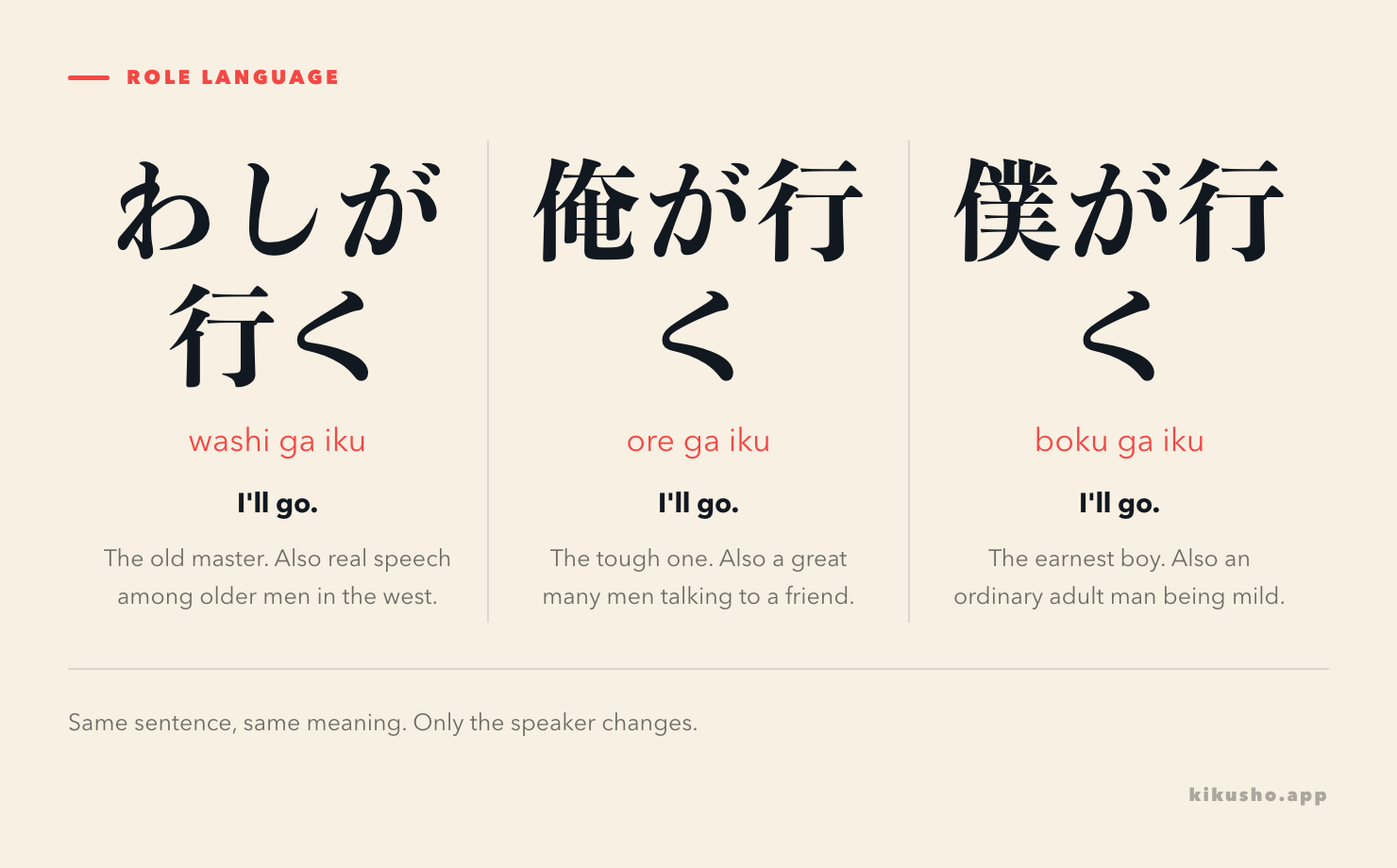
The information in the sentence is identical in all three. The pronoun is costume. Real speech uses far less of this, and where it does the signal is much weaker: わし is ordinary among older men in the west of the country, and 俺 is what a great many perfectly polite men say to their friends.
The risk is not that you will sound rude. It is that you will sound like a character. Subtitled dialogue is written to be legible fast, which is the same reason manga vocabulary needs handling with care: the register is deliberately louder than life.
Which one you should use
Start with the fact that one person uses several. The same man says 俺 to a friend at lunch, 僕 to a colleague he does not know well, and 私 on a call with a client an hour later. He has not changed personality three times. He has read three rooms, which is the same calculation that governs keigo and runs on the same information.
For a learner, the settings are simple:
- 私 (わたし) is your default. It is correct in every room, for any speaker, at any age. Nobody has ever been thought rude for using it.
- わたくし when the room is formal enough that you would use 敬語 anyway: an interview, an apology, a ceremony.
- 僕, if you are a man, once you have friends you speak casually with. It buys warmth at no risk.
- 俺 last, and only after you have heard the people around you use it with each other. It is not rude in itself. It is wrong with the wrong person, which is harder to judge.
- あたし is casual, spoken and slightly softer than 私 for women. It is rarely written outside dialogue.
The word is a fact about the room, not about you
Which is why this vocabulary resists the way vocabulary is usually studied. A card that says 俺 = I has recorded the one part that is identical across all seven words and thrown away everything that distinguishes them. What you needed was who said it, to whom, and what happened next.
So when a line of Japanese surprises you with a first-person word you did not expect, keep the line, not the word. The surprise is the interesting part, and by evening you will remember that something was odd and not what it was.
Kikusho keeps the sentence attached for exactly this reason. Every card carries the word, its reading, romaji, meaning, a note on register and politeness, and an example sentence with native audio — and you can select any word inside that sentence to make a card of its own. For a word whose entire content is social, the register note and the sentence are not extras around the card. They are the card.
None of this makes the choice hard once the frame is right. You are not translating I. You are choosing, briefly and out loud, who you are being in this particular conversation — and most of the time, the answer is to leave the question unasked and just say the verb.
Common questions
Which word for I should I use as a learner?
私, read わたし, is the safe default: it is correct for any speaker, at any age, in any room, and nobody has ever been thought rude for using it. In a formal setting — an interview, an apology, a ceremony — the same character is read わたくし. Men can move to 僕 once they have people they speak casually with, and to 俺 only after hearing the people around them use it with each other. The more useful habit is leaving the word out entirely, which is what Japanese speakers do most of the time.
Is it rude to say 俺?
Not in itself. 俺 is what a great many men say to friends and family every day, and it carries no insult. It is wrong with the wrong person: a stranger, a customer, a superior, anyone you would use polite forms with. The difficulty for a learner is not the word but judging which relationships it fits, and that judgement is easier to borrow by copying someone in a similar position than to work out from a rule.
Can women use 僕?
It happens, but it is marked. In fiction it is a recognisable character type, and in ordinary speech a woman using 僕 is making a noticeable choice rather than a neutral one. For a learner, 私 is the default and あたし the casual option; うち also works in informal speech, with a Kansai flavour.
Why is あなた not a safe way to say you?
Because あなた is not neutral. It sounds distant used on a stranger, cold on a colleague, and from a wife to her husband it works as a term of endearment closer to dear. Japanese speakers largely avoid a word for you altogether: they use the person's name with さん, or their title — 先生, 部長 — or nothing at all, which is the commonest option. 田中さんは行きますか, said to Tanaka's face, is the ordinary way to ask.