
On this page
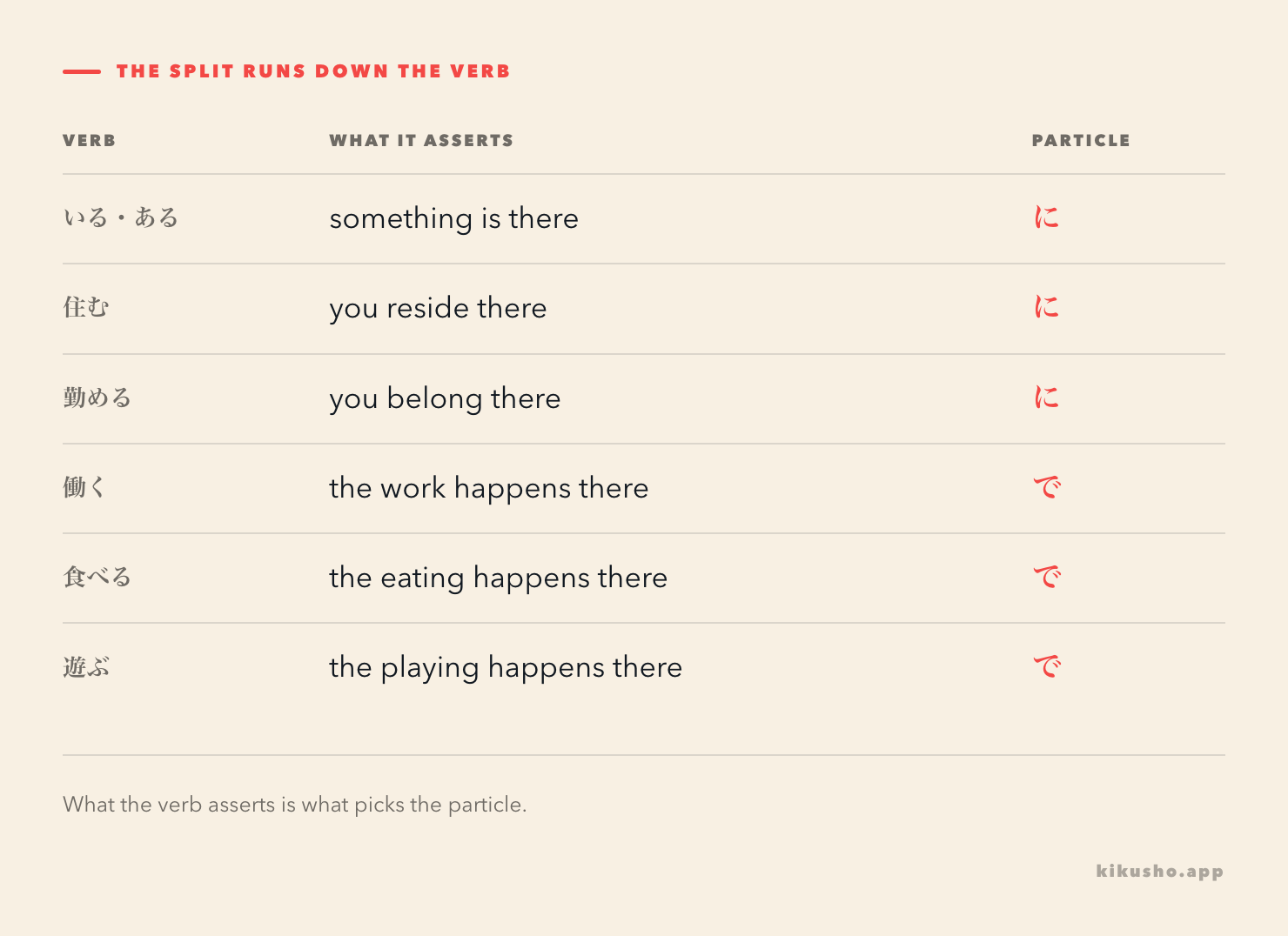
住む takes に and 働く takes で because the particle answers to the verb, not to 東京. 住む says something is located somewhere, and に is the particle for where a thing sits. 働く says something is being done somewhere, and で is the particle for where an action happens. Change the verb and the particle changes with it, even when the place in front of it never moved.
The verb picks the particle, not the place
The noun before the particle is a decoy. You can hold the real-world situation completely still, a job at a bank, and the particle still flips, because two different verbs can describe that one job. 銀行に勤める and 銀行で働く both mean you work at a bank. 勤める treats the bank as the organisation you are attached to, a state of belonging, so it reaches for に. 働く treats the bank as the site where the working gets done, so it reaches for で. Same bank, same pay, opposite particle.
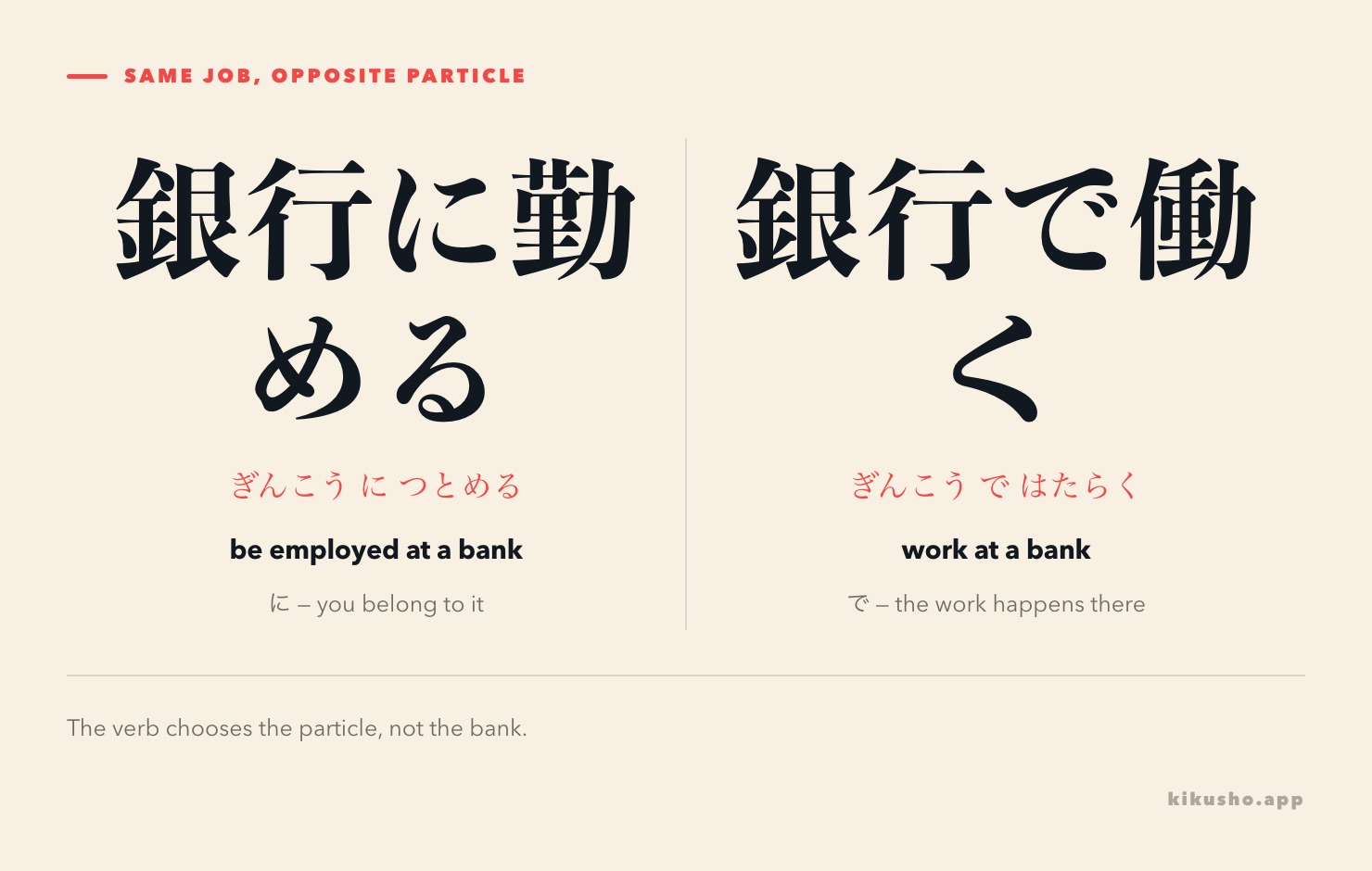
That pair is the whole lesson in miniature. If the particle were a property of 銀行, both verbs would take the same one. They do not, so the particle cannot belong to the noun. It belongs to the verb, and your job when you build a sentence is to ask the verb what it is claiming.
The test: does the verb say something is there, or happens there?
When you are mid-sentence and the particle catches you, put one question to the verb. Does it assert that someone or something exists, stays, sits, or is positioned somewhere? That is a claim about location, and location takes に. Or does it assert that an activity is carried out, some working or eating or studying or playing? That is a claim about an action, and the ground an action covers takes で.
住む passes the first test: to live somewhere is to be there. 働く passes the second: to work is to do something. The noun 東京 is happy to take either particle, and it simply waits for the verb to settle the matter.
A shortcut that holds up well: if the verb is really a way of saying something is present, so that you could swap in 「〜がある」or 「〜がいる」and keep the spirit, reach for に. If the verb names something you do, reach for で.
Where に is at home: verbs of being somewhere
に marks the place a thing occupies. The plainest cases are the existence verbs いる and ある, as in 部屋に犬がいる and 机の上に本がある, where the noun is nothing more than where the thing is. Choosing between those two verbs depends on the noun and its context: plants normally use ある, while people and animals use いる. Every other verb in this group is a variation on being located:
- 住む: 東京に住む, you reside there
- 勤める: 会社に勤める, you belong to that workplace
- 泊まる: ホテルに泊まる, you lodge there for the night
- 座る: 椅子に座る, you come to rest on the seat
- 立つ: 入口に立つ, you take up a position at the door
- 残る: 教室に残る, you stay behind there
These are not all motionless. 座る and 立つ involve movement, and 泊まる covers a whole night. But the movement resolves into a position, and に marks that position, not the range the action covered. The verb is asking where the subject ends up, and に answers it.
Where で is at home: verbs of doing something
で marks the ground an action fills. 働く, 食べる, 勉強する, 遊ぶ, 買う, 泳ぐ and 会う each name an activity, and で names the place that activity happens in:
- 働く: 会社で働く, the working goes on there
- 食べる: レストランで食べる, the eating happens there
- 勉強する: 図書館で勉強する, the studying happens there
- 遊ぶ: 公園で遊ぶ, the playing happens there
- 泳ぐ: 海で泳ぐ, the swimming happens there
The same test never fails you here, because none of these verbs is about where someone is. Look at 図書館 in 図書館で勉強する: it is not stating that you are present so much as naming where the studying takes place. Drop the studying and you would say 図書館にいる, with に, because now the only claim left is that you are there.
Then why does 駅に着く take に?
Because 着く is not asking where an activity spread out. It is asking where a motion ended, and に marks an endpoint as readily as it marks a resting place. The same holds for 帰る in 家に帰る and 入る in 部屋に入る: each verb names a movement toward a goal, and に is that goal. It is the same に as 椅子に座る, one step earlier. The seat is where sitting ends up; the station is where arriving ends up.
で would be wrong for these because no activity is filling the place. 駅で着く would ask what you were doing all over the station while you arrived, which is not what 着く means. Keep the two jobs of に straight and the split stays clean: に marks where a thing is, or where a motion lands, while で marks where an action is carried out.
When one verb takes both: 寝る
A few verbs sit on the line, because they can describe either a state or an action, and then the particle you choose is what says which one you mean. 寝る is the clearest. ベッドで寝る is で, because sleeping is something you do and the bed is where you do it, the place you spent the night. ベッドに寝る is に, because 寝る here means to lie down, and the bed is the surface your body comes to rest on.
Both sentences are correct Japanese, and they describe different things. で points at the activity of sleeping. に points at the act of putting yourself down onto a spot. When a verb straddles the line like this, do not try to memorise a particle for it. Read what the verb means in the sentence you are building, and let that choose, the same move you already make with 住む and 働く.
What the wrong particle really says
Pick the wrong one and you rarely produce nonsense. You produce a sentence that means something you did not intend, which is worse, because it sounds off without being wrong enough to correct.
東京で住む is not gibberish. It shoves 住む toward "carry out the act of living in Tokyo", an activity reading the verb does not want, so it lands as slightly broken, close to how "I perform residing in Tokyo" would sit in English. 東京に働く goes further wrong: に on an action verb makes 東京 read like a destination you work toward, not the place the work happens in. Both are the kind of slip that marks a sentence as translated rather than spoken.
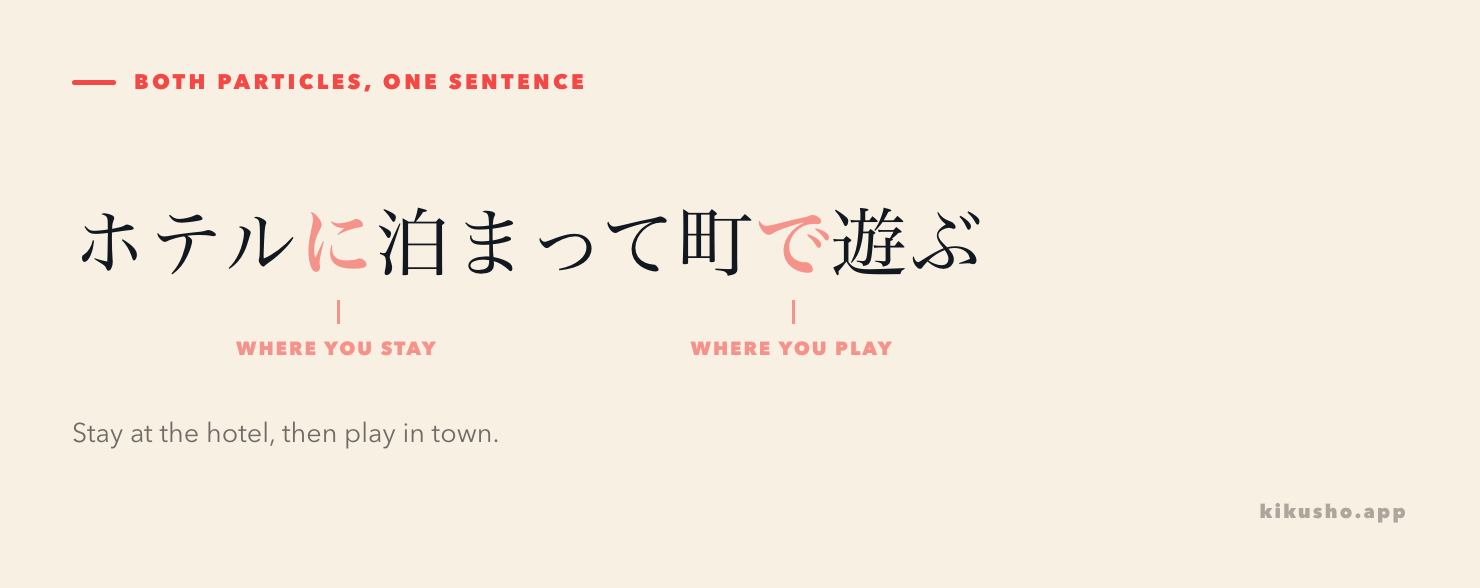
The fix is never to file "東京 takes に" and reach for it on sight. It is to hear what the verb is claiming, presence or activity, and match the particle to that. Once the question you ask is about the verb, the same reasoning carries you through verbs you have never met, which is more than a memorised list of places can do. If you want the wider pattern, the particles that particular verb families insist on run on this same logic, and the choice between は and が turns on a related question about what the sentence is really asserting.
This is a distinction you learn by meeting it, and the meetings are everywhere: a 立入禁止 notice, a line of dialogue, a station sign. When one of them turns on a に or a で you cannot explain, the thing worth keeping is the whole clause, verb and particle together, not the bare word. That is the capture Kikusho is built around: give it the sentence and it drafts the card, the verb and its reading, the meaning, and the particle left sitting where the verb put it, so に and で are learned as a pair with the word that governs them rather than as a rule in the abstract. に also has a life outside location, since it marks time as well, and when Japanese time words take に and when they refuse it is its own small rule worth having.
Common questions
Does 住む ever take で?
In standard Japanese, no. 住む describes residing, which is a state of being located somewhere, so it takes に: 東京に住む. 東京で住む pushes the verb toward an action reading it resists, and it lands as broken rather than as a different meaning.
Why does 働く take で but 勤める take に when both mean "to work"?
They frame the same workplace differently. 勤める treats it as the organisation you belong to, a state, so 銀行に勤める. 働く treats it as where the activity happens, so 銀行で働く. Same job, different claim about the place, different particle.
Is に versus で only about location?
No. に also marks time, direction and the indirect object; で also marks the means and the cause. This rule covers only the one case where both could mark a place, which is where learners mix them up.
How do I choose when a verb like 寝る accepts both?
Read what the verb means in that sentence. ベッドで寝る is で because sleeping is an activity and the bed is where you do it; ベッドに寝る is に because 寝る there means to lie down, and the bed is the surface you come to rest on.