On this page
Ask one question and the sentence answers for you: is the goal something you can just do, on purpose, yourself? If yes, it wants ために. If the goal is a state you can only hope arrives, being able to do something, something not happening, someone else acting, it wants ように. And if you are really saying what a task uses or costs rather than aiming at anything, it wants のに. All three come out as "so that" or "in order to" in English, which is exactly why the choice feels like three separate rules instead of one.
It is one rule. The English gloss throws away the distinction Japanese keeps, and once you know which distinction that is, the three tails sort themselves.
The one question that decides
The purpose you are reaching for is either an action or an outcome, and Japanese marks the difference.
An action is something with an agent who performs it: buy the ticket, save the money, look it up. You can decide to do it and then do it. That is ために territory: the dictionary form of a verb you control, or a noun plus の (健康のために, for your health).
An outcome is a state you cannot simply perform into existence. You can be able to speak, but you cannot "do" being-able; you practise, and the ability arrives. You can want something not to happen, but "not forgetting" is not an act you carry out. And when the doer changes, as when you arrange the room so the children can study, the goal is no longer yours to perform at all. Those are ように: the potential form (話せる), the negative (忘れない), or a clause whose subject is somebody else.
のに sits slightly apart. It is not really pointing at a goal you are working toward. It names an activity and then says what that activity takes: this is handy for it, that costs you thirty minutes, you need documents for it. If the sentence continues with 便利, 使う, 要る, 必要 or かかる, the tail was のに.
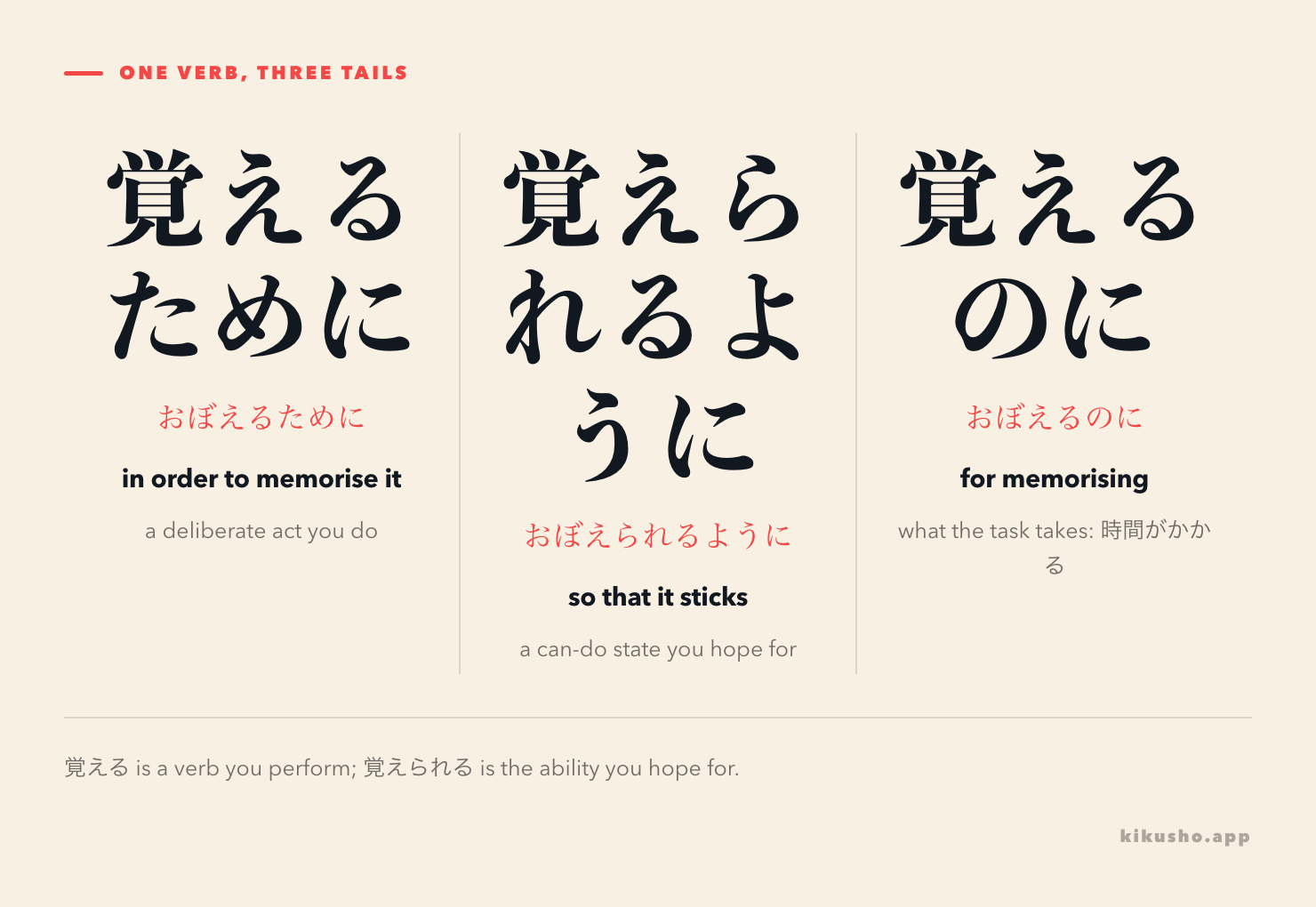
ために: something you set out to do
ために attaches to the dictionary form of a verb you can decide to perform, and both halves of the sentence usually belong to the same person.
車を買うために、お金を貯めている。 I'm saving money in order to buy a car. Buying is a deliberate act; saving is how I get there, and I am the one doing both.
日本語を勉強するために、日本へ行く。 I'm going to Japan in order to study Japanese.
For a purpose that is a thing rather than an action, use a noun plus の. 家族のために働く means I work for my family; 健康のために、毎朝走っている means I run every morning for my health. The の is doing the same job the verb form does elsewhere: naming the goal you have set.
The test that keeps ために honest is the same-agent, on-purpose check. If you cannot picture a person deciding to do the goal and then doing it, ために is the wrong tail, and the sentence almost always wanted ように instead.
ように: something you can only hope happens
ように takes the goal you are aiming at when you cannot perform it directly. Three shapes trigger it, and it is worth learning them as a set because they are the exact cases ために cannot cover. If you want the ように/ために pair on its own pushed further, through non-volitional verbs and mixed subjects, there is a dedicated breakdown of just those two.
The potential form, first. 日本語のニュースが聞き取れるように、毎日ラジオを聞いている。 I listen to the radio every day so that I can catch the Japanese news. You cannot decide to be able to understand it; you build the conditions and the ability arrives.
The negative, second. 忘れないように、メモを取る。 I take notes so that I won't forget. "Not forgetting" is a state, not an act, so it lands in ように, not ために.
A different subject, third. Here even an ordinary action verb takes ように, because the person who performs the goal is not the person acting in the main clause.
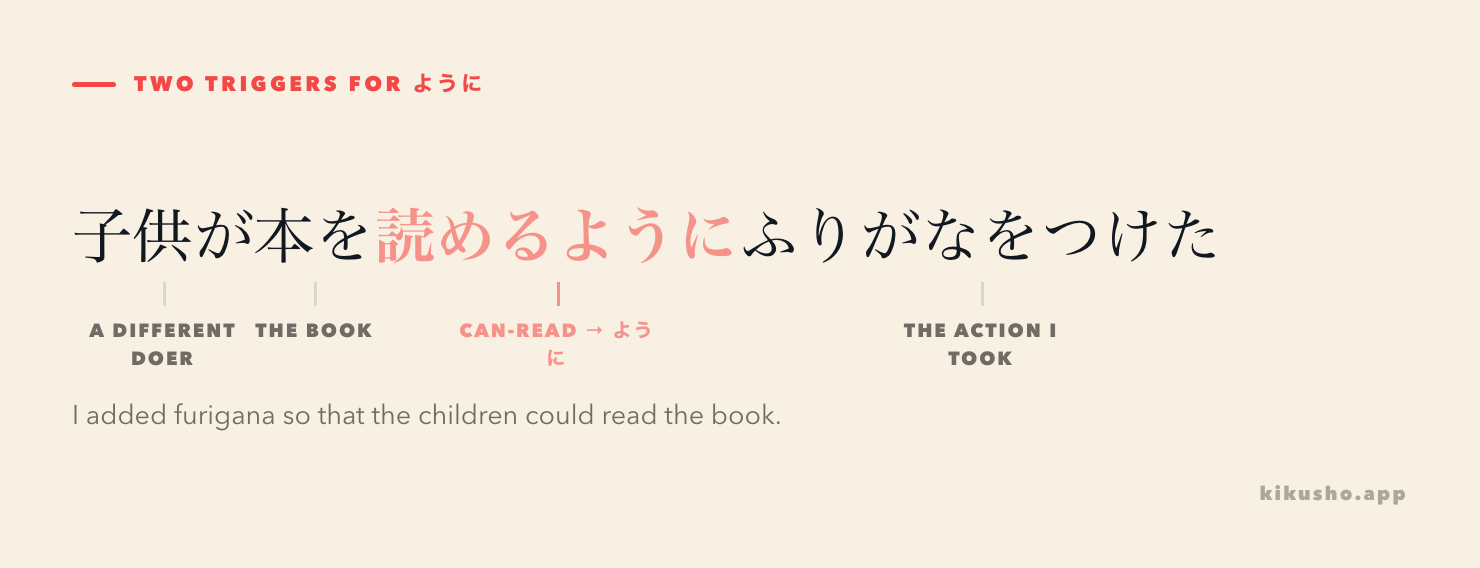
子供が本を読めるように、ふりがなをつけた。 I added furigana so that the children could read the book. I did the adding; the reading is theirs to do. That switch of subject is one of the quieter cues Japanese leaves lying around, the same kind of cue that tells you who is acting when the sentence names nobody at all.
のに: what a task uses or costs
Purpose のに is the one that surprises people, because they have already met のに meaning "even though," and the two look identical on the page.
この辞書は漢字を調べるのに便利だ。 This dictionary is handy for looking up kanji. 駅まで行くのに三十分かかる。 It takes thirty minutes to get to the station. ビザを取るのに、書類がたくさん要る。 You need a lot of documents to get a visa.
In each one, のに follows the plain, non-past form of an activity, and the sentence then reports what that activity demands: it is convenient, it costs half an hour, it requires paperwork. Rephrase it as "for looking up," "for getting to," "for obtaining," and it always works. That "for -ing" reading is the tell for purpose のに.
Concessive のに, the "even though" one, behaves differently on both sides. It happily follows a past tense or an adjective (薬を飲んだのに、まだ痛い, even though I took the medicine it still hurts), and what comes after it is a result that clashes with expectation, never a word like 便利 or かかる. So the disambiguation is mechanical: look at what sits on either side. Non-past activity in front and a use-or-cost word behind means purpose; a full contrasting clause behind means "even though."
The same verb, three claims
Because the tail encodes the kind of goal, one verb can take all three and say three different things. This is where the choice earns its keep, and where a table finally beats a paragraph.
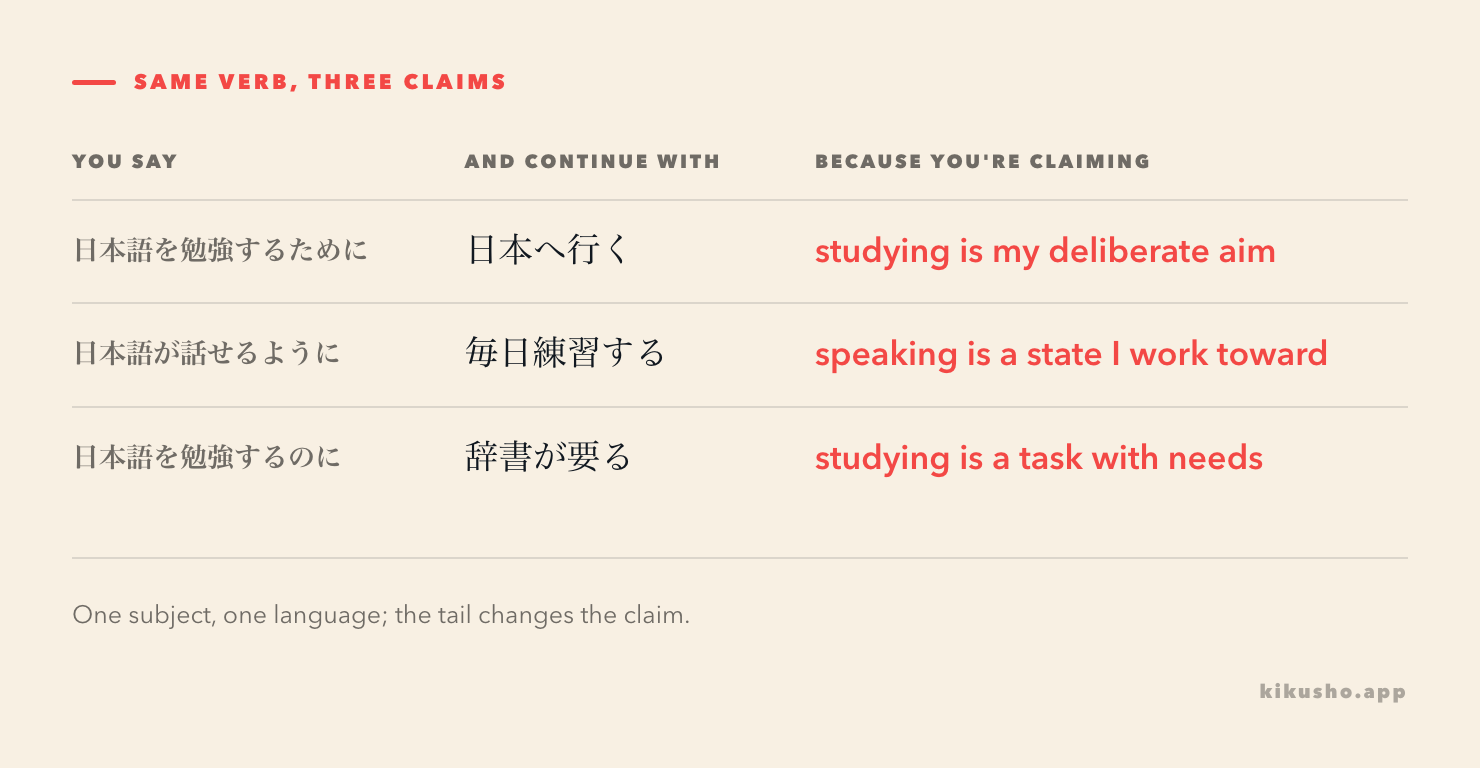
日本語を勉強するために日本へ行く says studying is my deliberate aim and going is how I pursue it. 日本語が話せるように練習する reframes the goal as an ability I am working toward, so the verb shifts to the potential and the tail to ように. 日本語を勉強するのに辞書が要る is not aiming at anything; it treats studying as a task and states what the task needs.
The interesting boundary is verbs like 合格する (to pass an exam). You can frame passing as the aim you have set (試験に合格するために勉強する) or as an outcome you are positioning yourself for (試験に合格できるように勉強する). Both are natural, and the difference is exactly the action-versus-outcome split: the first treats passing as something you do, the second as something you make likely. When a form has more than one gloss, the form you pick is the claim you make, and that is as true here as it is for は and が.
What the wrong tail actually says
Picking the wrong one is rarely a small slip; it usually makes a claim you did not mean, or none at all.
日本語が話せるために勉強する is the classic error. It attaches ために to a potential verb, which reads as though being able to speak were an act you perform on command. A Japanese ear rejects it and repairs it to 話せるように. Any potential, negative or spontaneous verb does the same thing to ために.
Swapping ために for のに breaks the sentence in the other direction. 日本語を勉強するのに日本へ行く does not mean "I go to Japan in order to study Japanese." のに cannot carry a goal you undertake by taking action; it wants a use or a cost after it, and finding neither, the listener falls back on the "even though" reading and gets nonsense. The two are not interchangeable, however close their English looks.
This is a distinction no flashcard of the bare tail can hold, because what decides it lives outside the tail: the verb in front, and the clause behind. A card that says "ように = so that" trains you to recognise the shape and leaves you guessing at the meaning. When you meet one of these in the wild, say a sign warning 忘れないように or a review that calls a gadget 〜のに便利, the useful unit to keep is the whole clause, not the tail. Paste that line into Kikusho and you get a card you can check and correct before it saves, with the surrounding verbs still attached, so the next time it comes back you are recalling which goal-type the tail marked, not just that のに exists. The three seconds it takes is the gap between recognising のに later and knowing which のに you are looking at.
Why のに carries both meanings at once
The overlap that trips everyone up is not an accident of spelling. Purpose のに breaks apart cleanly: の turns the verb into a noun (調べる becomes 調べること, "the looking-up") and に marks that noun with the "to, for" sense it carries everywhere else. 調べるのに便利 is literally "convenient for the looking-up." That is why it always reads as "for -ing," and why it always wants a word of use or cost after it: the に is pointing the activity at something.
The concessive のに, the "even though," came from the same two pieces long ago and then fused into a single conjunction that no longer pulls apart that way. So the reason you can tell them by looking at what sits on either side is that one of them is still two words doing two jobs, and the other has become one word doing a third. Once のに stops being a single item you have to disambiguate and becomes a nominaliser meeting a familiar particle, the "for" reading is the one you reach for first, and the exam sentence that pairs it with 便利 or かかる stops looking like a trap.
Common questions
Can I use ために with a potential verb like 話せる?
No. ために needs a verb you can decide to perform, so 話せるために is wrong. Being able to speak is a state you work toward rather than an act you carry out, and that goes with ように: 日本語が話せるように練習する. Any potential, negative or spontaneous verb behaves the same way.
Does のに always mean "in order to"?
No. のに has two unrelated jobs. After the plain non-past form of an activity, followed by a word like 便利, 使う, 要る or かかる, it means "for (doing)": 調べるのに便利だ, handy for looking up. After a plain clause that a contrasting result follows, it means "even though": 薬を飲んだのに、まだ痛い. What sits on either side tells you which one you are reading.
What decides between ために and ように when the meaning feels the same?
Whether the goal is an action you carry out yourself (ために) or an outcome you can only make likely: a potential form, a negative "won't", or someone else's action (ように). 日本語を勉強するために日本へ行く treats studying as your deliberate aim; 日本語が話せるように練習する treats speaking as an ability you are working toward.
Is ように only for purpose?
No. The same ように builds 〜ようにする (make a point of doing), 〜ようになる (come to do) and 〜ように言う (tell someone to do). They share the sense of aiming at a state, which is why 行くように can be a relayed instruction rather than a purpose, but they are separate patterns from the "so that" use.