On this page
Yes, some of the words on your JLPT list are words you will never say to anyone. They are there because the list you are studying descends from a version of the exam that was retired in 2010, and no one has rebuilt it from the ground up since. The list is not broken. What is broken is the assumption that every word on it is a word you were meant to use.
Once you know where these lists come from, the strange entries stop looking like mistakes. They look like what they are: residue from an older test, aimed at a kind of Japanese you may not read much of yet. Here is where the lists came from, why the odd words sit on them, and how to decide which ones deserve real effort.
The JLPT stopped publishing its word list in 2010
Before 2010 the test had four levels, numbered 4 up to 1, and the organisers published a specification for each one. That document listed, among other things, the vocabulary and kanji a level was allowed to draw on. If you studied for 1級 in 2008, there was an official book telling you which words were fair game.
The 2010 redesign replaced those four levels with five, N5 through N1, and made a decision that still shapes how everyone studies: no official vocabulary or kanji list would be published for the new test. The reasoning the organisers gave was that a fixed list turns study into memorising the list, when what the exam wants to measure is whether you can use the language at all.
So since 2010 there has been no authoritative answer to "which words are N3". There is the exam itself, and there is everyone's best guess about what it samples from.
So every "N3 list" you see is a reconstruction
The lists you download, the ones built into apps, the ones printed at the back of your textbook: none of them come from the people who write the test. Each is a reconstruction, and most of them lean on the same handful of sources.
The backbone of almost every modern list is the old pre-2010 specification, with its four levels remapped onto the new five. That remapping is itself a guess, because the boundaries moved. The new N3 had no direct predecessor; it sits in the gap the old test left between 3級 and 2級, so its words had to be split out of two neighbouring levels by estimate. On top of that skeleton, list-makers layer word-frequency data from large collections of text and whatever the common textbooks teach at each stage.
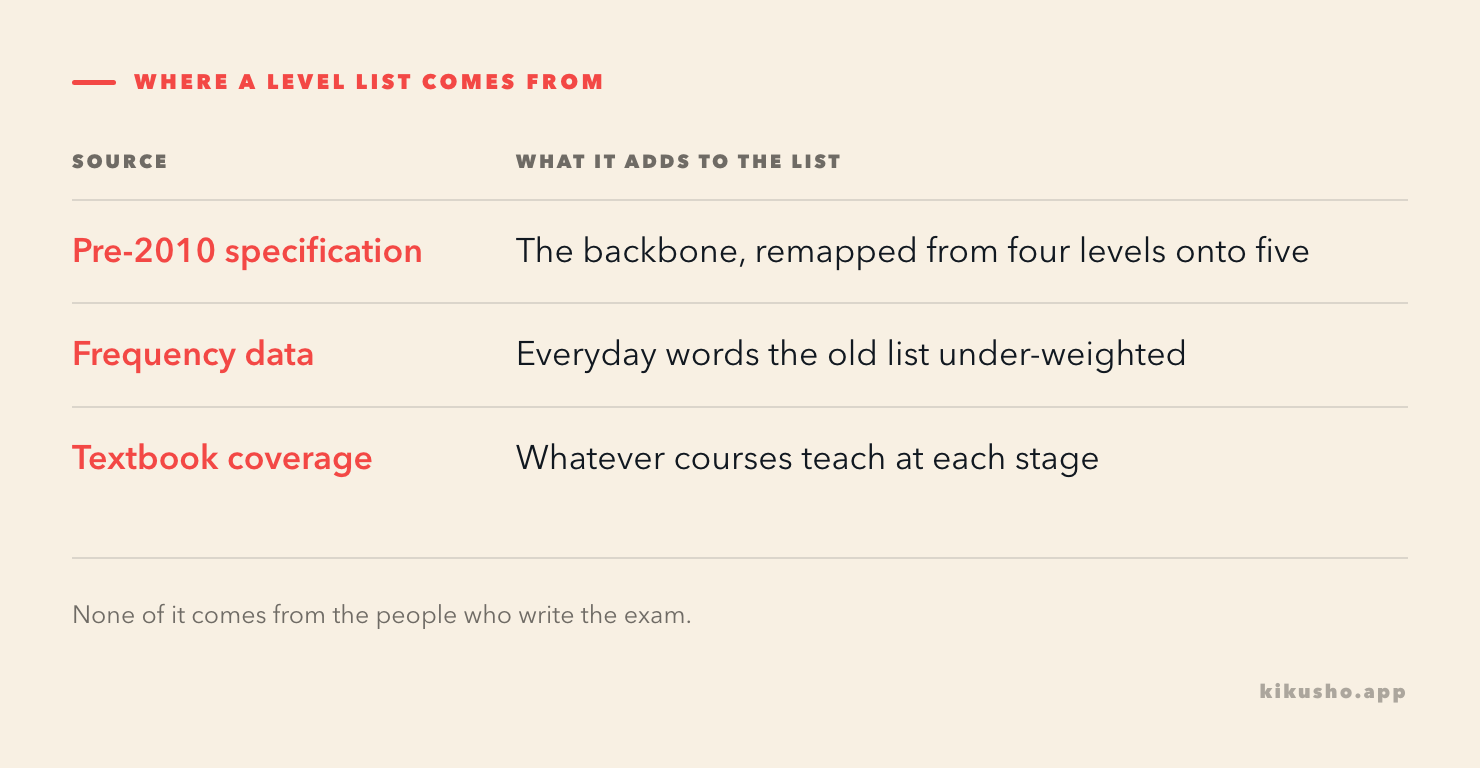
The result is useful. It is also an estimate stacked on an estimate, and it carries forward the vocabulary of a test that stopped existing in 2010.
The old test leaned on formal, written Japanese
The pre-2010 exam, especially at its top levels, sampled heavily from newspapers, editorials and formal essays. That is the register where a reader is expected to handle dense, precise, slightly literary vocabulary. The words that earn their place in an opinion column are not the words you reach for buying a train ticket.
Those words were in the old specification, so they survived into the reconstruction, so they are on your list today. A word can be common in written Japanese and almost absent from speech, and the list has no column to tell you which is which. That missing column is the whole problem.
"Never use" almost always means "never say"
This is the distinction the lists hide, and seeing it changes what you do about them. A word you "never use" is usually a word you will read constantly and say almost never.
Take 述べる (のべる). It means "to state" or "to express", and it is everywhere in writing: nearly every news report attributes a quote with 〜と述べた. You will read it hundreds of times. You will almost certainly never say it, because out loud you reach for 言う (いう). The two carry nearly the same idea. The list keeps the one you read, not the one you speak, and then it looks like a word nobody would use.
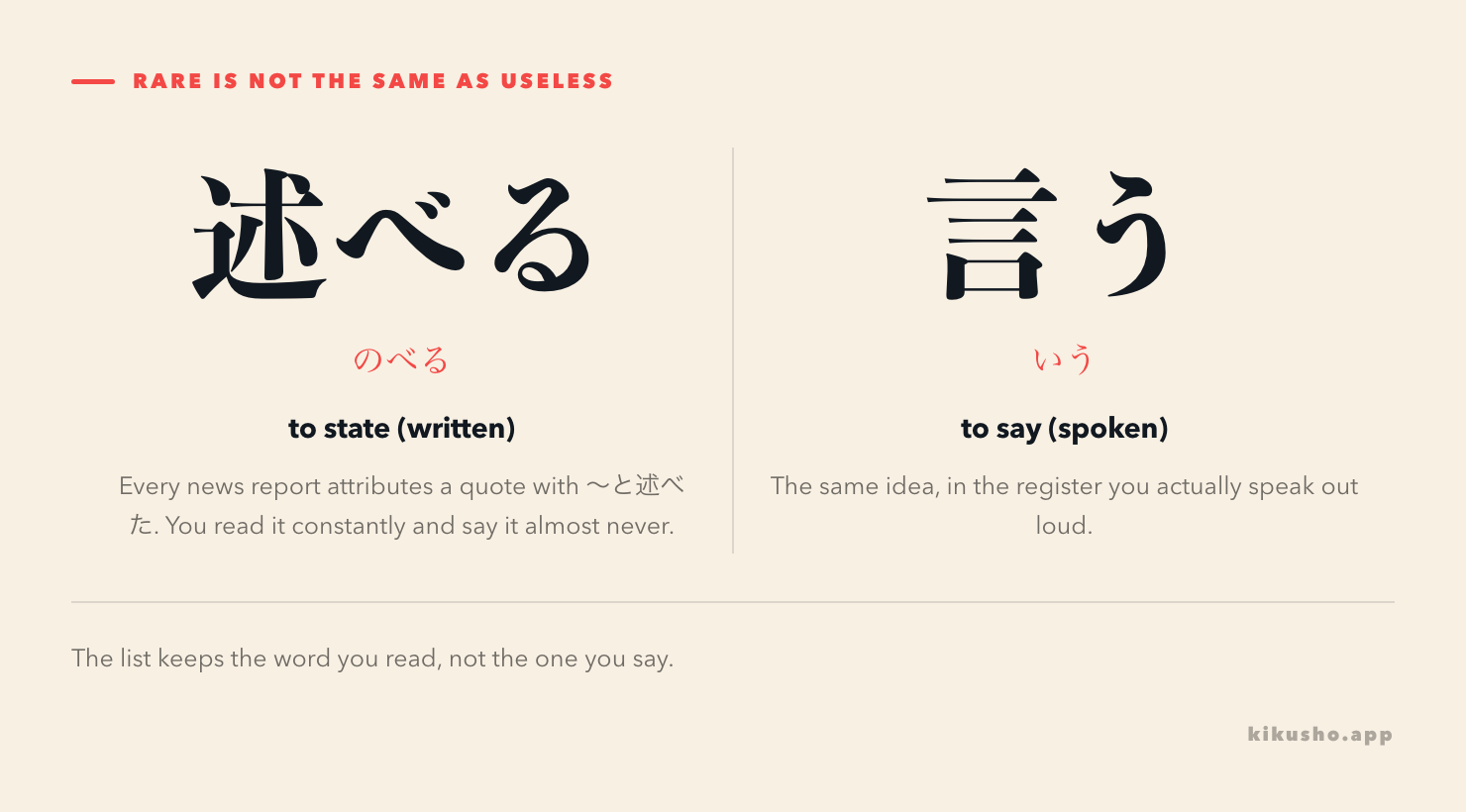
So before you file a word under useless, ask which register it belongs to. Formal, written, editorial vocabulary is not dead weight. It is the half of the language you meet with your eyes rather than your ears, and the reading section tests you in exactly that register, on purpose.
How to tell an exam word from one you'll actually meet
"Words you'll never hear" is not a fixed set. It depends entirely on what Japanese you put in front of yourself.
Read the news for a week and 露骨 (ろこつ, "blatant") or 漠然 (ばくぜん, "vague") stop being exam curiosities. If your input is anime and casual video, a large slice of the N1 written vocabulary will never appear, and drilling it as though it will is effort spent against your own experience of the language. The words worth keeping are the ones you keep running into, which is the case for collecting the Japanese you see around you rather than studying a list in a vacuum.
The test is simply this: does the word show up in the kind of Japanese you read and watch? If yes, it is not an exam-only word for you, so keep it. If no, and the exam is not close, it can wait. The list cannot make this call, because the list does not know what you read. You do.
Learn the artefacts for recognition, not production
For the words that really are exam residue, the ones you meet on the page and nowhere else, there is a cheaper way to carry them: learn them for recognition only.
Recognition is seeing 露骨 and recalling what it means. Production is hearing "blatant" and recalling 露骨, its kanji and its reading from nothing. Production costs far more, and for a word you will only ever read, it buys you nothing, because the moment to produce it never arrives.
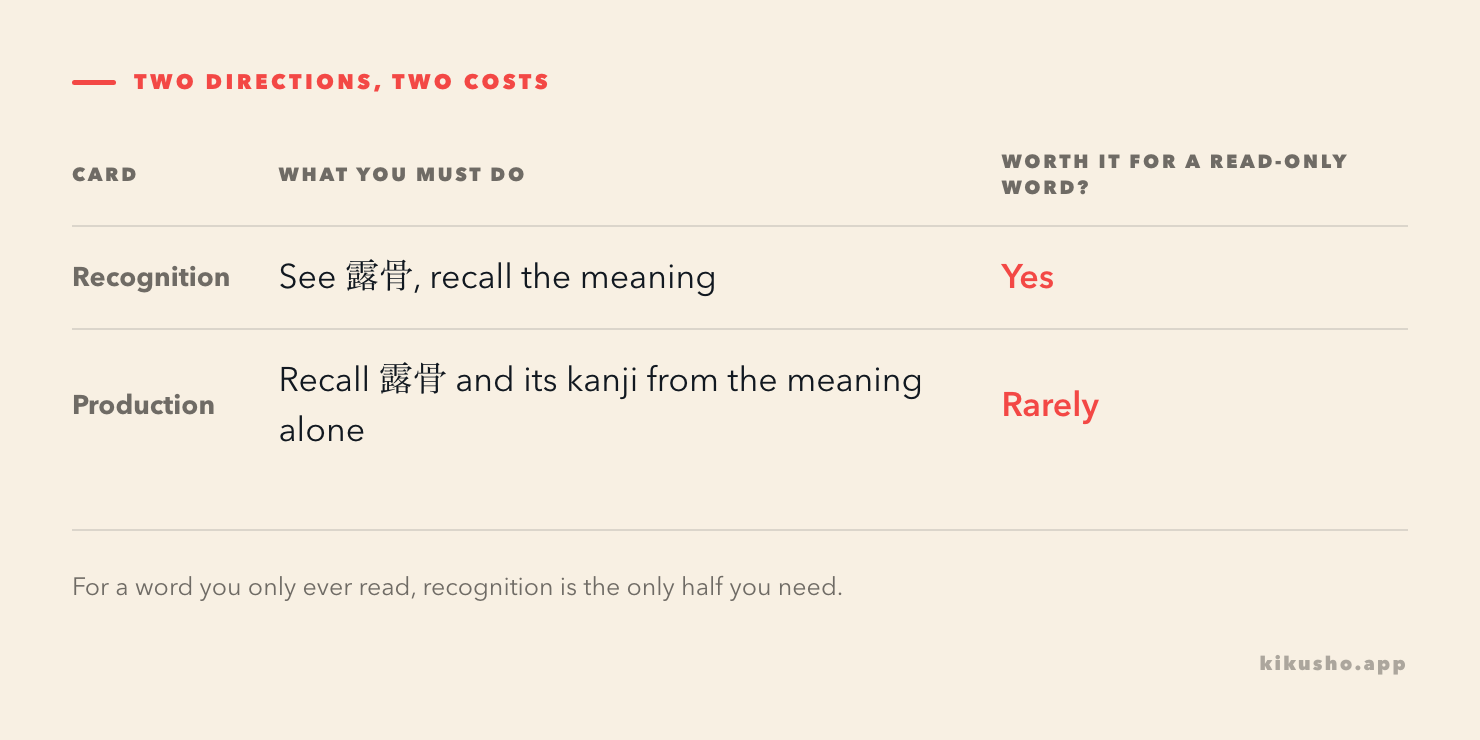
This reframes how to use a list at all. Reading one top to bottom and building a production card for every entry spends your most expensive kind of study on words a retired exam selected. The better order is the reverse: meet words in real Japanese, keep those, and let the list be a checklist you tick off rather than a syllabus you march through. Your production budget is small, as how many new words a day is realistic explains, so it should go to the words you will say.
This is the capture path Kikusho is built around. When one of these words finally turns up in something you are reading, that is the moment it has earned a place in your deck. Highlight it where you read it, or photograph the page it sits on, and Kikusho drafts the card for you: the reading, the sense, an example you can hear. Reviewing what you have collected is never rationed, so the deck that grows is made of words you ran into, not words a 2010 committee assigned you.
The list is a map of a test that no longer exists
A level list is the best available map of ground the mapmakers walked away from in 2010. That does not make it useless; a map drawn from the old survey still shows you most of the terrain. It means you read the map knowing what it is: an estimate of a retired exam, tilted toward the written language, silent on which words will ever reach your mouth.
So when the exam is near, carry the rare words. The reading section tests recognition, and recognition is already the cheap half you have been building. If you want to see how the exam's demands shift from one level to the next instead of merely growing longer, what the textbooks leave out at N4 is a closer look. But let your own reading, not a list, decide which words get your voice. The list can tell you a word exists at N2. Only the Japanese you actually meet can tell you whether it is a word you will use, or one more artefact of a test that stopped existing years ago.
Common questions
Does the JLPT publish an official vocabulary list?
No. Before the 2010 revision each level had a published specification that included its vocabulary and kanji. The revised test (N5 to N1) ships with sample questions and can-do descriptors but no official word or kanji list, so every level list in circulation is an unofficial reconstruction.
Are the N-level word lists wrong, then?
Not wrong, but estimated. They are built mainly from the old pre-2010 specification, remapped onto five levels, plus frequency data and textbook coverage. They are a good guide to what a level samples from, not an authoritative syllabus, and they carry forward the vocabulary of a test retired in 2010.
Should I skip the rare words on my list entirely?
Not if you are sitting the exam. The reading section puts formal, written vocabulary in front of you and tests whether you recognise it, so carry the rare words as recognition cards. What you can skip is building expensive production cards for words you will only ever read.