On this page
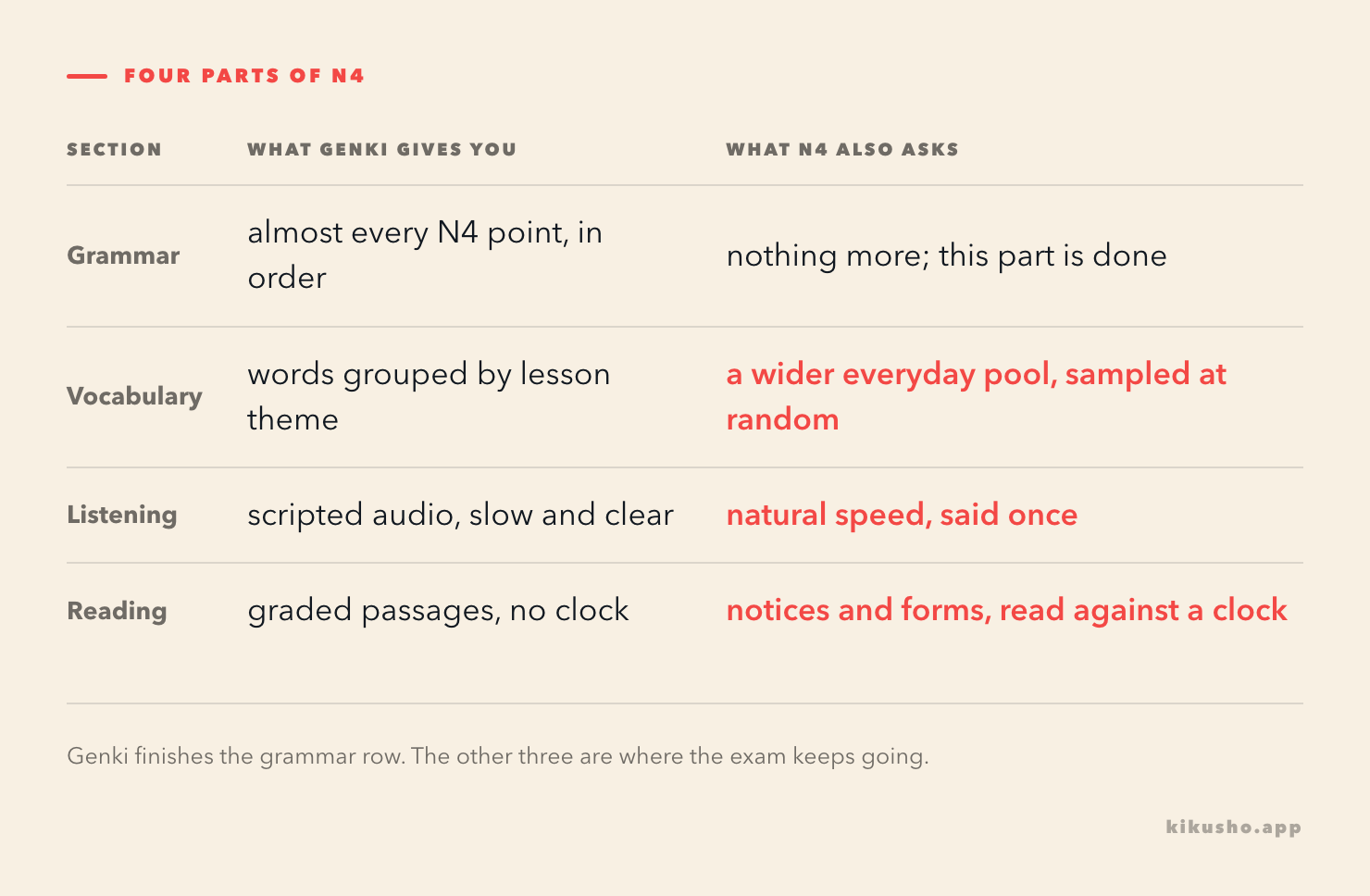
If you finish Genki I and II, you will have met almost every grammar point N4 tests, and you will still not be ready to sit the exam. Genki was written as a two-year university course rather than an exam primer, so what it leaves out is predictable: the breadth of vocabulary the test samples from, listening at the speed real speech runs, and a reading section built like nothing in either book. The grammar is the part Genki finishes. The other three are where the work after Genki really starts.
Genki takes you through the grammar, and that part is done
Start with the good news, because it is most of the news. The grammar N4 asks for is, point for point, close to what Genki II teaches. By the end of the second book you have worked through the conditionals (と, たら, ば and なら), giving and receiving (あげる, くれる, もらう), the potential form, the passive, the causative, the させられる that stacks the last two, the transitive and intransitive pairs, and the first layer of keigo. Those are the families that make N4 feel twice as hard as N5, and Genki introduces them in a workable order with drills attached.
So if the question is whether Genki teaches enough N4 grammar, the answer is yes, with the ordinary caveat that recognising a form in a textbook drill is not the same as parsing it at speed. Hold on to that caveat. It is the thread running through all three of the gaps below.
Where the vocabulary runs out
Genki's vocabulary is the first thing to fall short, and not because the books are thin. It is because they are organised the way a course has to be: by theme. Each lesson gathers the words for a situation, like family, the campus, travel, directions, a visit to the doctor. That is how you teach, and it is not how the exam samples. N4 draws from a broad everyday pool with no lesson plan behind it, so even if Genki's word count matched the exam's, and the two are in the same range, the sets would not line up. The test keeps reaching for ordinary words that never had a Genki lesson to belong to.
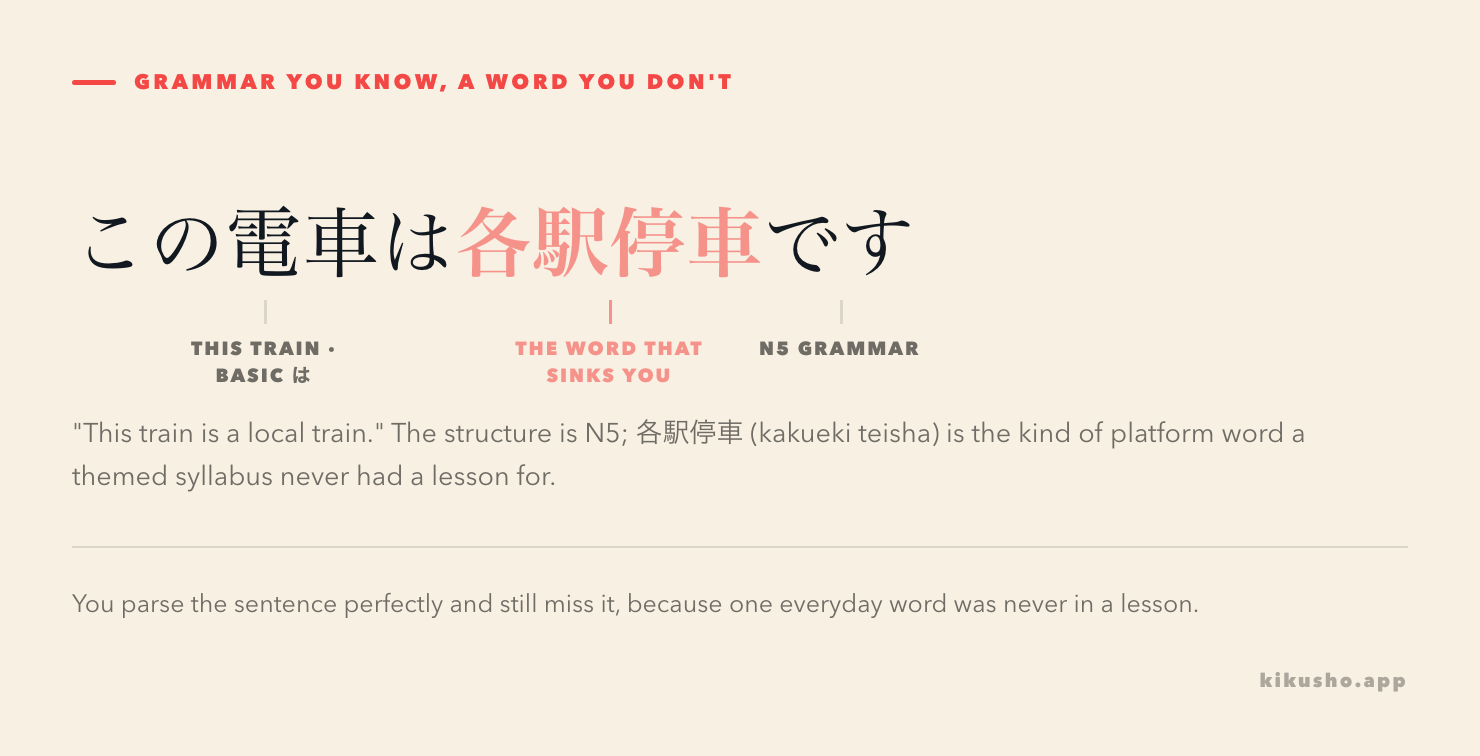
The practical shape of this gap is a question you parse correctly and still miss, because one plain word in it was never taught. A sentence can be pure N5 grammar and still stop you dead on a single word the books never found a slot for.
You close this gap by widening the net past the textbook, which is less a matter of which book to open next than of how many new words a day you can realistically keep.
This is the one gap you can work on without sitting back down with a book. The N4 words Genki never taught are, by their nature, the ones that live outside a lesson theme: the notice on a train door, the verb in a message from a friend, the noun a drama leaned on twice in an episode. Those are worth keeping, and the reason they slip away is that stopping to look one up and file it costs more than the few seconds you had. Kikusho is built for those few seconds. Aim the camera at the sign or drop in the line, and it drafts a card with the reading, the meaning and the register already on it, for you to glance over and save. It runs on iPhone; the free tier covers five new captures a day and never counts your reviews.
Listening: the audio in the book is slower than the room
Genki's listening audio is made to be understood. It is scripted, read at a measured pace, enunciated clearly, and built almost entirely from words the lesson has already taught. That is the right way to train a beginner, and it also sets your ear to a speed the exam does not use. N4 listening runs closer to how people talk: a natural clip, said once, with the occasional word you have never met, and no narrator slowing down so you can catch the particle. The jump from textbook audio to the exam is one notch; the jump from the exam to a real conversation is another, which is why passing the listening section still leaves a room full of native speakers feeling fast.
The fix is exposure to speech you do not control, which is the slow work behind understanding spoken Japanese when you already know the words. Genki gives you the vocabulary and grammar that make listening possible. It cannot give you the hours of hearing them at full speed, because a textbook's audio is a teaching tool, not a sample of the wild.
The reading section is a format before it is a passage
N4 reading is not a longer version of Genki's reading exercises. Genki closes each lesson with a graded passage you read for comprehension, untimed, using grammar you just studied. N4 reading is closer to a set of tasks: pull a fact out of a short notice, decide what an email is asking for, read a schedule or a flyer and answer what it says, all against a clock. The skill under test is finding the piece you need, not understanding every sentence. Someone who has only ever read Genki's passages meets this format cold, and loses time learning the shape of the question instead of answering it.
That gap closes with practice on the format itself, which is what past papers and N4-specific reading drills are for. It is the one place where a dedicated exam resource genuinely beats more immersion, because the thing being trained is the test's own conventions rather than the language.
When Genki really is enough
All of this assumes you want the certificate. If your N4 is for a conversation, a trip, or reading signs and menus rather than a seat in an exam hall, then Genki plus the habit of using it covers most of what you need, because the three gaps are gaps against the test, not against the language. The exam rewards a wide passive vocabulary, an ear that keeps up when nothing repeats, and speed at reading for one fact. Daily life asks for those too, but it lets you ask again, look longer, and lean on the context the exam strips away. The mismatch only bites when you book the test and study for it as though grammar were the thing being graded.
Why reaching for a second textbook is the wrong move
The instinct, when Genki runs out, is to buy another grammar book. It is the wrong one, because none of the three gaps above is a grammar gap. A second textbook re-explains forms you already have and leaves the vocabulary breadth, the listening speed and the reading format exactly where they were. What each gap needs is not more explanation but more contact: a wider stream of words than any syllabus can carry, hours of speech at a pace nobody is managing for you, and time spent inside the exam's own question shapes. A grammar book is the one thing you have already finished.
What "is Genki enough" is really asking
Underneath the question is a hope that finishing a book could be the same as being ready, and for grammar it nearly is. The three things Genki leaves undone are not oversights. They are the parts of the language a course cannot hand over, because they only exist in contact with Japanese you did not script: breadth, speed, and the pressure of a real task. Genki takes you to the edge of that and stops, which is what a good course should do. So the real answer is that Genki is enough to stop being your main teacher, and the N4 you are still missing is waiting in the Japanese you have been walking past. Finishing the book is the signal to go and meet it.
Common questions
Does Genki cover all the grammar on JLPT N4?
Close to all of it. By the end of Genki II you have met the conditionals, giving and receiving, the potential, passive and causative, the transitive–intransitive pairs and basic keigo, which are the families most references place at N4. The JLPT publishes no official list, so coverage is high rather than guaranteed, but grammar is not where Genki falls short of the exam.
If Genki isn't enough for N4, what should I add?
Not another grammar textbook. The gaps Genki leaves are vocabulary breadth, listening speed and the reading format, and none of them is a grammar gap. Add a wider stream of everyday vocabulary, listening practice at natural speed, and timed work with N4-style reading tasks such as past papers.
Can you pass N4 with only Genki I and II?
You can learn almost all the N4 grammar from Genki I and II, but passing also needs vocabulary the books do not cover, an ear trained above textbook-audio speed, and familiarity with the exam's reading format. People who pass on Genki alone usually got the rest from reading and listening they were doing anyway.
Is Genki or a JLPT-specific book better for N4?
They do different jobs. Genki teaches the grammar in a sensible order with practice built in. A JLPT-specific book mainly drills the exam's question formats, which helps with the reading and listening sections Genki does not mirror. Use Genki to learn the language, and an exam book, late, to learn the test.