On this page
You passed N3, opened your first N2 reading passage, and understood almost every word in it while losing the thread of what the paragraph was saying. That gap is the N2 jump, and it is not the one the level-up charts predict. They count words and kanji, so they describe the step as a bigger pile of the same material. The material is what changes. N2 is the level where Japanese stops being written for you and starts being written for readers the author assumes need no help: newspaper writers, editorialists, whoever drafts a formal notice. Learning more words helps at the margin. It does not close a gap that was never about how many words you know.
What the level adds over N3
Register is the missing variable. It is the difference between how you write a line to a friend and how the same information appears in a public announcement: the same facts, dressed for a different reader. N3 sits at the top of practical, everyday Japanese. Its reading is the Japanese of emails, short notices, blog posts and conversations written down, text produced to be understood by an ordinary person going about an ordinary day.
N2 introduces public written Japanese. This is the register of material published for a general but literate audience the writer assumes can already read: newspapers, opinion columns, company announcements, instructions that carry weight. The sentences run longer, the clauses nest inside one another, and the words that join them come from a set you almost never hear out loud. The grid below is the whole article in one look.
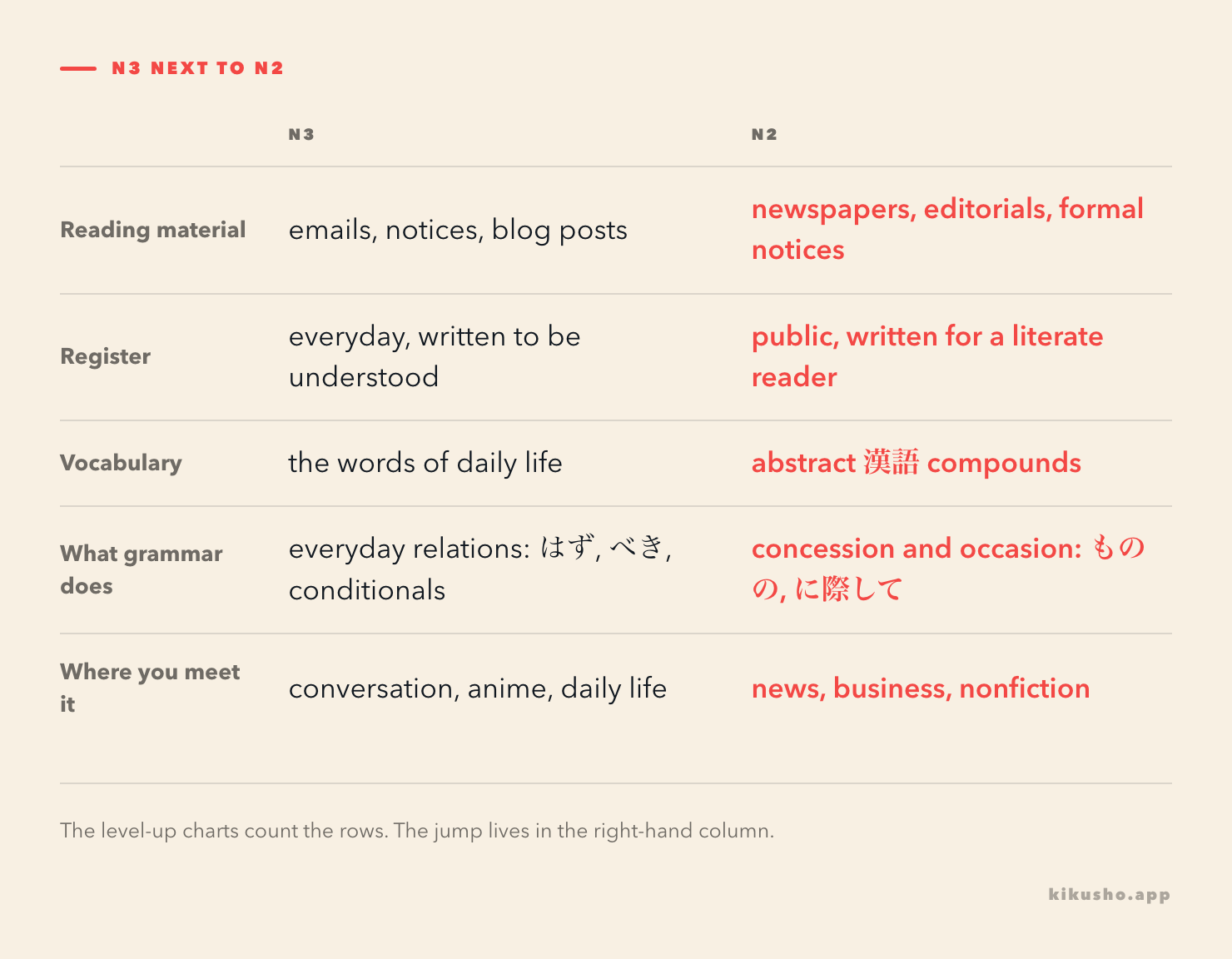
Read down the right-hand column and the pattern is plain. Nothing in it is simply more. Each row is a change of kind, and the last row is the one that reorganises how you have to study.
The grammar that carries the most weight
N3 grammar still describes everyday relations between everyday things. Whether something is likely (はず), what a person ought to do (べき), how one situation follows from another (と, たら, ば, なら): you can hear every one of these in conversation, and most learners first meet them there. They are the joints of spoken sentences.
N2 grammar is largely the connective tissue of written argument. The forms that carry the most weight mark concession, occasion and grounds: ものの and とはいえ for granted that, and yet; に際して and にあたって for on the occasion of; に基づいて for on the basis of; をめぐって for concerning. You will not overhear these on a train. They belong to writing that builds a case, and learning to read that writing means learning to expect them. The words that fill the gaps between clauses are worth studying as their own group, the way the formal written connectors are, because the connective is what tells you how the next clause answers the last.
The shift is easier to feel than to describe. Here is one event, written twice.
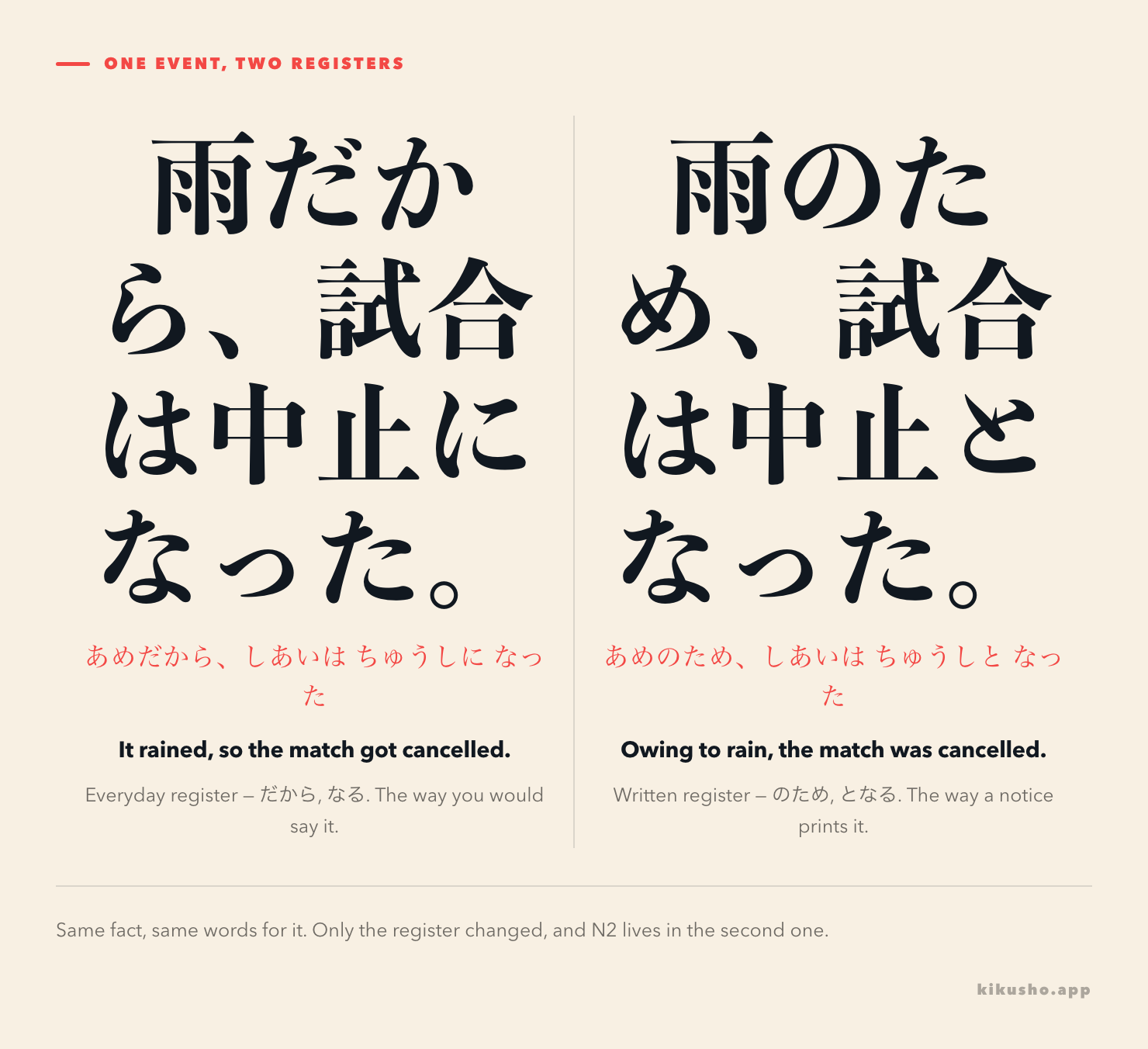
Both sentences report the same cancellation with almost the same words. The first is what you would say. The second, with のため where speech uses だから and となる where speech uses なる, is what the notice on the gate would print. That one substitution, repeated across a whole passage, is a large part of why N2 text can feel foreign even when you recognise every character in it. Concession forms like ものの and とはいえ do the same work higher up, at the level of the argument rather than the clause.
The vocabulary the charts count, and the one they miss
The comparison pages are not wrong about the numbers. The word and kanji lists do grow between the levels, and by most published estimates the totals roughly double. Those estimates deserve one caveat: the JLPT publishes no official vocabulary or kanji list, so every count you see is somebody's reconstruction, and reconstructions disagree at the edges.
The number is the least interesting part of the change. What matters is which words arrive. N3 vocabulary is still mostly the words of daily life. N2 vocabulary tilts hard toward 漢語 (かんご), the two-character Sino-Japanese compounds that written Japanese runs on: 影響 (えいきょう, influence), 傾向 (けいこう, tendency), 現象 (げんしょう, phenomenon), 対象 (たいしょう, target or object of study). They are abstract, they cluster in writing far more than in speech, and you will not absorb them from a drama the way you absorbed everyday verbs. A word list can hold them. It cannot teach you the sentence shapes they live in.
Where you will meet N2 Japanese, and where you will not
The register has a practical consequence, and it decides how you should study. The input that carried you to N3 stops carrying you. Anime, manga, casual video and everyday conversation are written in the everyday register, or close to it. You can log hundreds of hours of that and still never meet に際して or the clipped syntax of an editorial, because those live somewhere else: in newspapers, editorials, business email, official notices and nonfiction. If your aim is the N2 exam, or reading the news for its own sake, you have to seek the register out on purpose. It will not reach you through the media that felt like progress at N4.
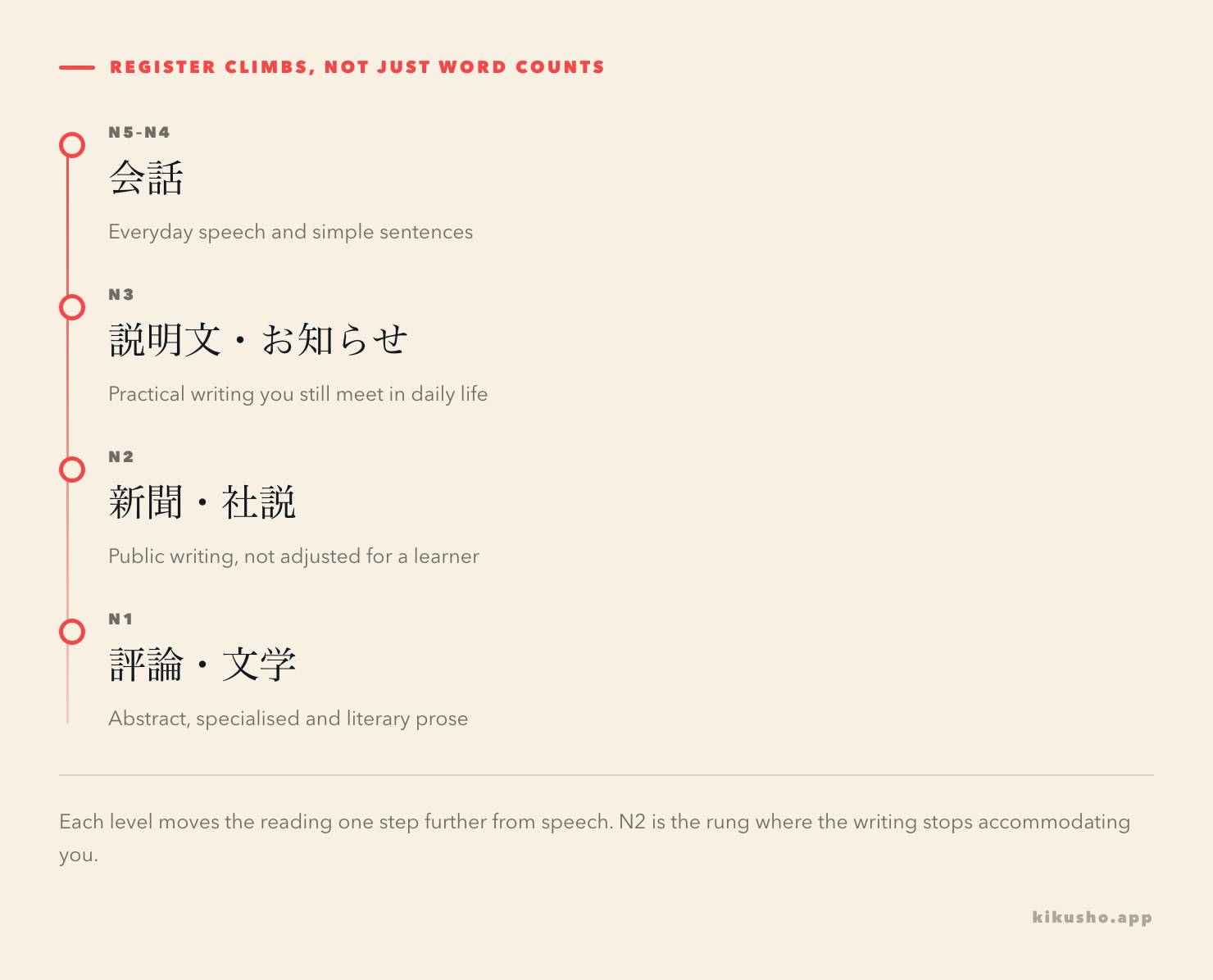
Seen as a ladder, N2 is one specific rung: the point where the writing stops being adjusted for a learner at all. That is why newspaper vocabulary becomes a study target in its own right at this level, and not merely a place to harvest a few more words.
What this guide covers, and what still needs practice
This is a map of where the difficulty sits. It is not a syllabus, and it is not a substitute for the reading and listening you have to do. Two limits are worth stating plainly. First, the level boundaries used here are editorial estimates. The exam does not hand out a definitive list of its grammar, words or kanji, and reputable sources place particular items on different sides of the N3 or N2 line. Where you see a form called N2 in one book and N3 in another, both can be defensible.
Second, treat N2 is only written Japanese as an oversimplification, the same way N1 is only rare vocabulary is one. The listening section steps up at N2 as well: it speeds up and drops some of the scaffolding that made N3 audio followable. What a guide like this can do is point you at the part of the difficulty a word count hides, so your reading hours go to the register that moved rather than to more of the words you already half-know.
The order that wastes the least time
If you want a sequence, this is the one that spends the fewest hours on the wrong thing.
- Shore up the N3 grammar you are shaky on first. N2 sentences assume it and stack on top; a passage you cannot parse is often N3 grammar you never solidified, wearing N2 vocabulary.
- Front-load the written connectives and the on-the-occasion forms. They unlock sentence structure, and structure is what makes a long passage readable. A paragraph you can segment is already half understood.
- Start reading real N2-register text before you feel ready. An editorial or a news column is short. One 社説 (しゃせつ, newspaper editorial) a few times a week trains the register faster than any amount of isolated vocabulary.
- Grow your 漢語 from that reading, not from a deck of loose words. A compound learned inside its sentence arrives with the grammar it attracts and the register it signals, which a bare headword never carries.
- Let the reading pay back the listening. Spoken N2 is easier to follow once the written vocabulary behind it is familiar, so the two feed each other instead of competing for your week.
This is also where a capture habit earns its keep. When you are working through a column and a compound like 影響 or 傾向 stops you, the useful moment is right then, with the sentence still in front of you. Kikusho is built for that instant: you paste the line or point the camera at it, choose the word, and a review card comes back carrying its reading, its meaning and the register note, so the word stays attached to the sentence that taught it instead of becoming a stray entry in a list. The scheduler, FSRS, decides when it returns. The free plan covers five of these a day, which for a single editorial is usually enough.
Where the level's reputation is wrong
N2 has a reputation as N1 without the rare words, or as the level where you finally know enough vocabulary to relax. Both put the weight on the size of your word list, and both send you to the wrong drill. The learner who fails an N2 reading passage usually knows most of the words in it. What they have not built is the reflex for a register in which the writer expects you to hold several clauses open and resolve them at a verb near the very end, with a に基づいて or a とはいえ signalling how the pieces fit before the sentence lands.
That reflex cannot be counted, which is exactly why the comparison charts miss it. It comes from reading the register until its shapes stop surprising you. So the most useful thing to carry out of the N3-to-N2 step is a sense of where not to spend your effort: not on grinding a longer list of words you will half-recognise anyway, but on the slow sitting-with-real-text that turns a passage you can decode into one you can simply read.
Common questions
How long does it take to go from N3 to N2?
There is no fixed figure, and anyone quoting one is guessing. The N3-to-N2 step often takes longer than the ones before it, because it is the first that asks you to learn a new register rather than more of the same material. Time spent reading real N2-register text tends to move it faster than time spent drilling isolated vocabulary.
Is N2 really just written Japanese?
No, that is a useful half-truth. The written register is the largest and most visible change, but the listening section also speeds up and becomes less accommodating at N2. Treating the level as reading-only leaves you unprepared for the audio.
Should I keep studying N3 grammar while working on N2?
Yes. N2 sentences are built on N3 grammar and assume it is solid. A passage that feels impossible is often N3 structure you never fully secured, carrying unfamiliar N2 vocabulary. Shoring up the earlier grammar usually does more for N2 reading than starting new N2 points.