On this page
You can register for JLPT N4 without ever sitting N5. The exam sets no prerequisite: choose the level you want, pay, and take it. Skipping the material is the move that costs you, because the N4 paper is built on top of N5 and never stops to re-teach it. So the honest question is not whether to skip the exam — skip it if you like — but which parts of N5 to make solid before you book the harder test.
Almost everything N4 introduces fastens onto something N5 already taught. Take the foundation away and the new grammar has nothing to hold. What follows is a map of what the N4 paper quietly assumes you bring up from N5, how to check that you have it, and the narrow slice of N5 study you can genuinely leave behind.
You can skip the exam; the material is a different question
Two decisions hide inside "should I skip N5", and they have opposite answers. Skipping the N5 exam is usually fine. The certificate marks a point on the road rather than opening a door: the schools and workplaces that ask for a JLPT result are nearly always asking for N2 or N1, so an N5 pass mostly proves a milestone to yourself. If the fee and a Sunday morning cost you little, sit it for the practice. If they do not, there is no strong reason to.
Skipping the N5 material is the decision that goes wrong. N4 is not a fresh syllabus that starts where N5 stopped; it is a layer of new operations laid over everything N5 built, and the exam writes its questions assuming that base is already automatic. A learner who jumps to N4 having only skimmed N5 does not meet a harder version of familiar work. They meet unfamiliar work resting on gaps they cannot see.
What an N4 sentence is mostly made of
Pull an ordinary N4 sentence apart and most of what you find is N5. Take 漢字が読めるようになりました — "I've become able to read kanji." It is a sentence an N4 question would expect you to read without effort, and it is mostly N5 grammar with two new pieces set into it.
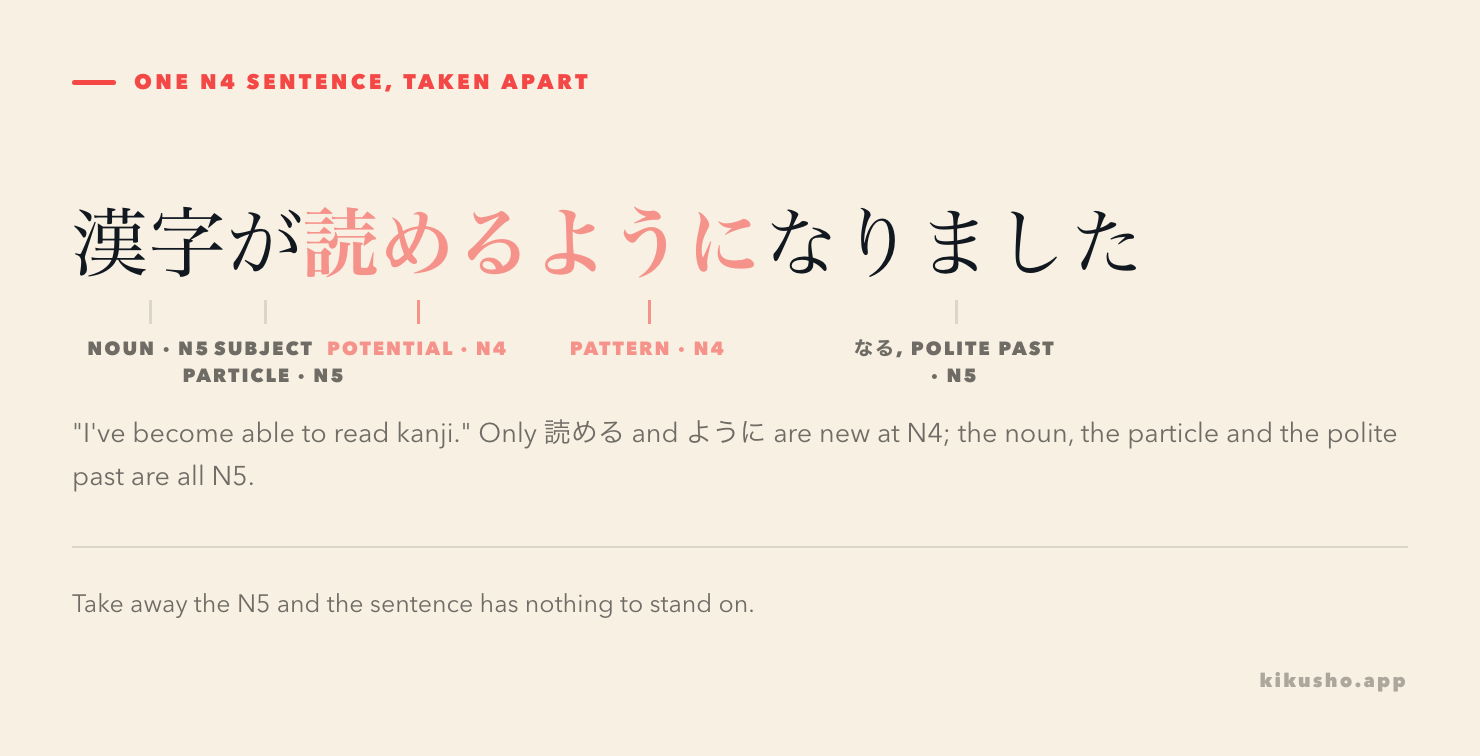
The noun, the subject particle, and the polite past of なる are all N5. The genuinely new material is 読める, the potential form, and ようになる, the pattern for a change over time. Strip the N5 away and the N4 has nothing to attach to: no particle to mark the subject, no polite ending to land on. This is the shape of most of the exam. A thin layer of new grammar, fastened to a thick base you were supposed to bring with you.
The N5 grammar N4 builds straight on top of
A few N5 foundations do almost all the load-bearing. If any of them is shaky, a whole family of N4 grammar wobbles with it.
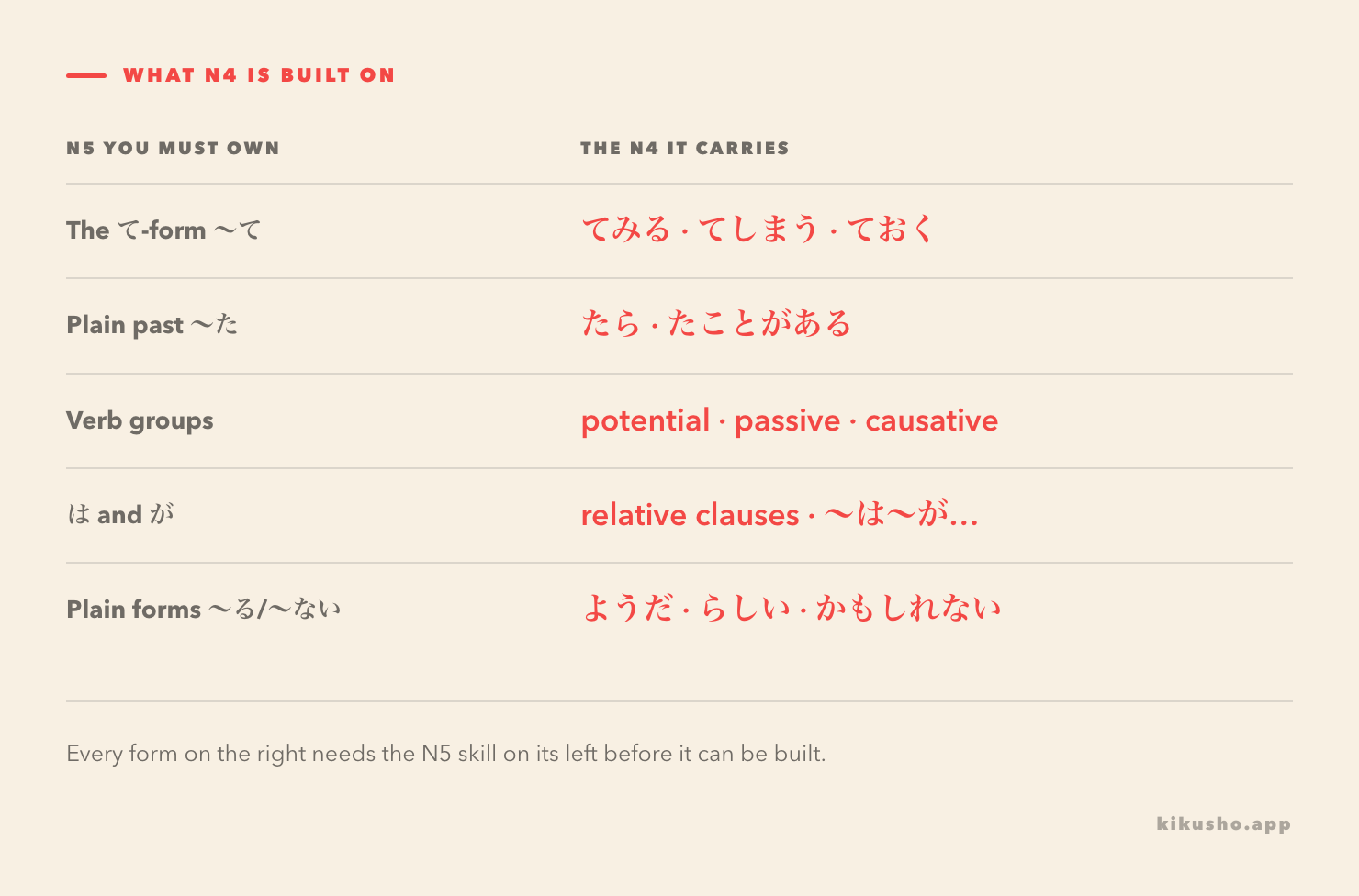
The て-form is the hinge. N5 usually teaches it last, and it is the single thing N4 cannot do without: てみる, てしまう and ておく are all the て-form plus one more word, and if assembling the stem still takes you a beat, every one of them arrives as a puzzle rather than a pattern. If you shore up nothing else from N5, learn to build the て-form cold.
The plain past carries the conditional たら and the experience form たことがある. は and が, the particles N5 spends so long on, are what let an N4 relative clause modify a noun without collapsing into ambiguity. And the plain forms — dictionary, negative, past — are the shapes that ようだ, らしい and かもしれない attach to. None of these is taught again at N4. The exam simply expects the join to already be there.
The verbs stay the same; the operations are new
Here is the part that surprises people who skipped ahead: N4 barely hands you new verbs. It hands you new things to do to the verbs you already have, and every one of those operations runs on the N5 verb groups.
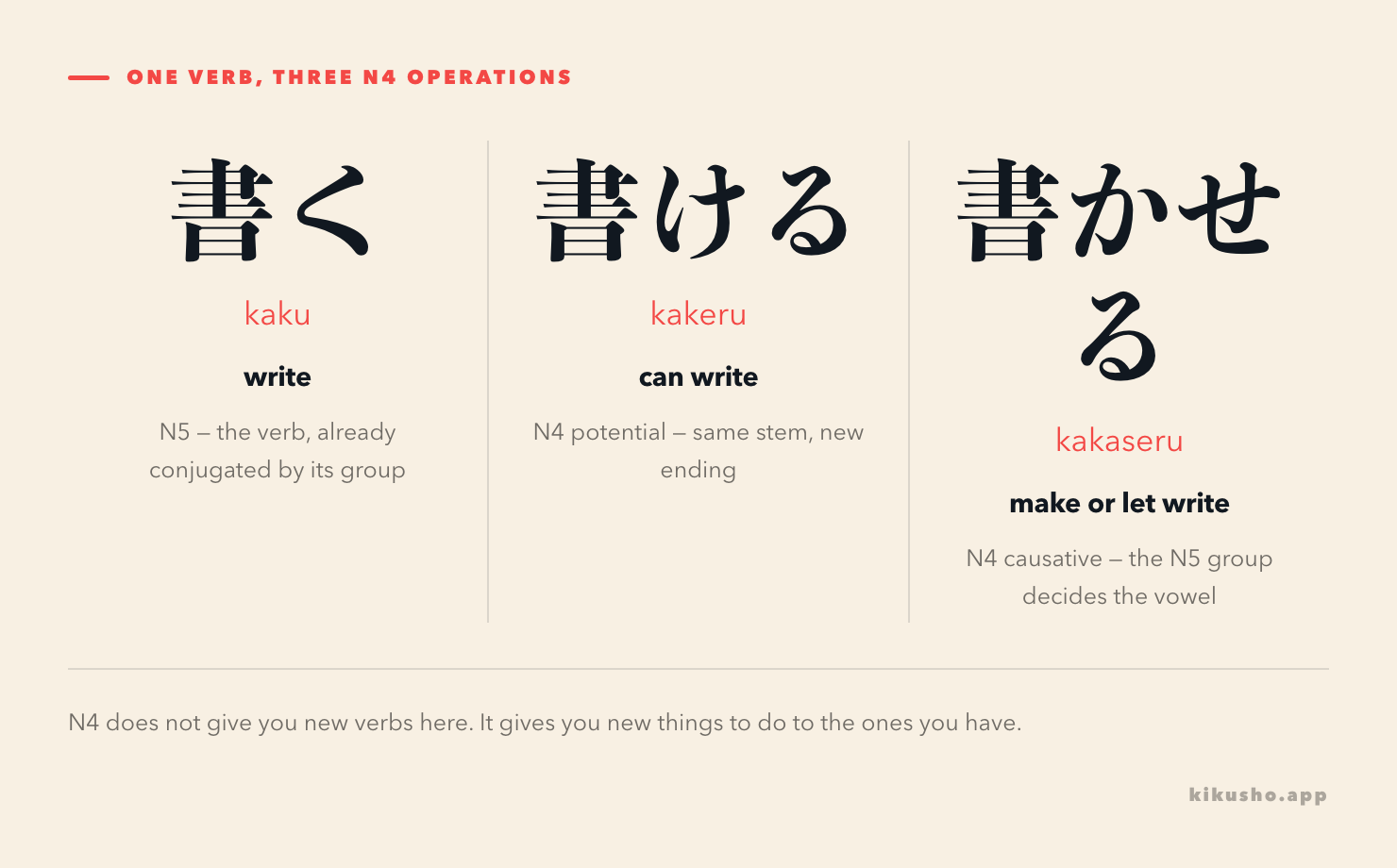
書く becomes 書ける to say can write, and 書かせる to say make or let write. The potential, the passive and the causative are three different endings on the same stem, and which vowel you reach for is decided by whether 書く is a group-one verb or a group-two verb — the exact distinction N5 drills when it teaches conjugation. Someone who never made the godan–ichidan split automatic at N5 does not have three new forms to memorise at N4. They have three new forms multiplied by a grouping they still have to work out each time, which is why this is where a skipped foundation hurts most.
The N5 words N4 keeps using, and the drill you can drop
Vocabulary is where "I'll just skip N5" quietly fails, because N4 word lists never reprint the N5 words. They assume them. An N4 reading passage is not written in N4 vocabulary; it is written in mostly N5 vocabulary with N4 words threaded through, and if the everyday verbs and nouns are not solid, the new words have nothing to sit among. Those lists are estimates to begin with — the JLPT publishes no official vocabulary, so every count is a reconstruction — but the direction is not in doubt: N4 adds words, it does not replace the old ones.
This is the additive load a capture habit is built to carry. When an unfamiliar word stops you mid-page — a verb on a notice, a line in a manga frame — Kikusho lets you keep it in the moment: you grab the word and get back a card with its reading, its meaning and the nuance a bare list leaves out, which you check before it is saved. The scheduler is FSRS, the same algorithm Anki uses, so the word returns on its own timetable while your attention stays on the grammar. It works offline on iPhone once a card exists, and the free plan's limit is five new cards a day, with revision left uncapped.
What you can drop is the N5 exam scaffolding you have outgrown. If you already read hiragana and katakana at speed, the recognition drills that fill N5 prep books are time you will not get back. The same goes for rote number and greeting practice once those are reflexes. Skipping that is sensible. Skipping the words themselves is not.
How to check your N5 is solid before you book N4
The decision to skip comes down to a short list of foundations rather than a feeling about difficulty. Run these, and be honest about the ones where you pause.
| Can you, without stopping to think… | A quick test |
|---|---|
| build the て-form from any verb? | 書く → 書いて, 食べる → 食べて, する → して |
| choose は or が for the subject? | 私は学生です · 水がほしい |
| conjugate to the plain past? | 飲む → 飲んだ, 見る → 見た, 行く → 行った |
| sort a verb into its group on sight? | 食べる is group two, 飲む is group one |
| read katakana at reading speed? | コンビニ, エレベーター, アルバイト |
Every row you sail through is a foundation N4 can build on. Every row you stumble over is a repair to make first, and the order is worth respecting: the て-form and the verb groups before anything else, because the whole potential–passive–causative family and half the て-form extensions depend on them. If a textbook is your route in, knowing where Genki stops tells you which of these it will and will not have drilled.
Where "just skip N5" goes wrong
The advice travels as a single line — N5 is trivial, everyone skips it — and it collapses the two decisions into one. The exam is skippable. The material underneath it is the thing the whole level above is standing on, and the learner who stalls partway through N4 is rarely the one who skipped the test. It is the one who skipped the て-form, or never made the verb groups automatic, and is now paying for it one unfamiliar sentence at a time.
So treat the skip as a checklist, not a leap. When the table above runs clean, booking N4 directly is not a gamble; it is the efficient path, and the months you would have spent preparing for a certificate few people ask to see go instead into the grammar that actually moves you forward. The one foundation to refuse to skip is the て-form. Get that automatic, and N4 stops being a wall and becomes what it really is — new work resting on ground you already hold.
Common questions
Do I need to pass N5 before I can take N4?
No. The JLPT sets no prerequisite, so you can register for any level directly. What N4 requires is the N5 material, not the N5 certificate: the paper assumes N5 grammar and vocabulary and never stops to re-teach them.
Is the N5 certificate worth getting anyway?
For most learners it is optional. It marks a milestone, but the schools and employers who ask for a JLPT result usually want N2 or N1. If the fee and the exam day cost you little, there is no harm in sitting it; if they do, the material matters far more than the paper.
What is the one N5 thing I must have solid before N4?
The て-form. Almost every N4 pattern attaches to it, including てみる and てしまう, the conditionals built on the past, and the potential and causative, so starting N4 before the て-form is automatic means building on a base that keeps shifting under you.
Can I skip N5 vocabulary too?
No. N4 word lists never reprint the N5 words; they assume them, and N4 reading leans on everyday N5 vocabulary constantly. You can drop N5 exam drills you have outgrown, such as kana recognition once you read it fluently, but not the words themselves.