On this page
Japanese has four ways to say if — たら, ば, と and なら — and which one is correct depends less on the if clause than on the half of the sentence that comes after it. Look at what your main clause is doing: giving a command, stating a result that happens on its own, or answering something that was just said. That is what makes one conditional legal and rules the other three out.
Most guides sort the four the other way round, by the shade of meaning each if carries, and leave you holding four nuances with no way to choose one under pressure. The nuance is real. But it is not where the decision lives. The decision lives in the clause you have not written yet.
The main clause decides, not the "if"
A conditional sentence has two halves: the condition, ending in たら, ば, と or なら, and the result, everything after it. Learners spend their attention on the first half, because that is where the grammar visibly changes. Yet all four conditionals attach to almost any condition. 行く becomes 行ったら, 行けば, 行くと, 行くなら with no trouble at all. What they cannot all attach to is the result.
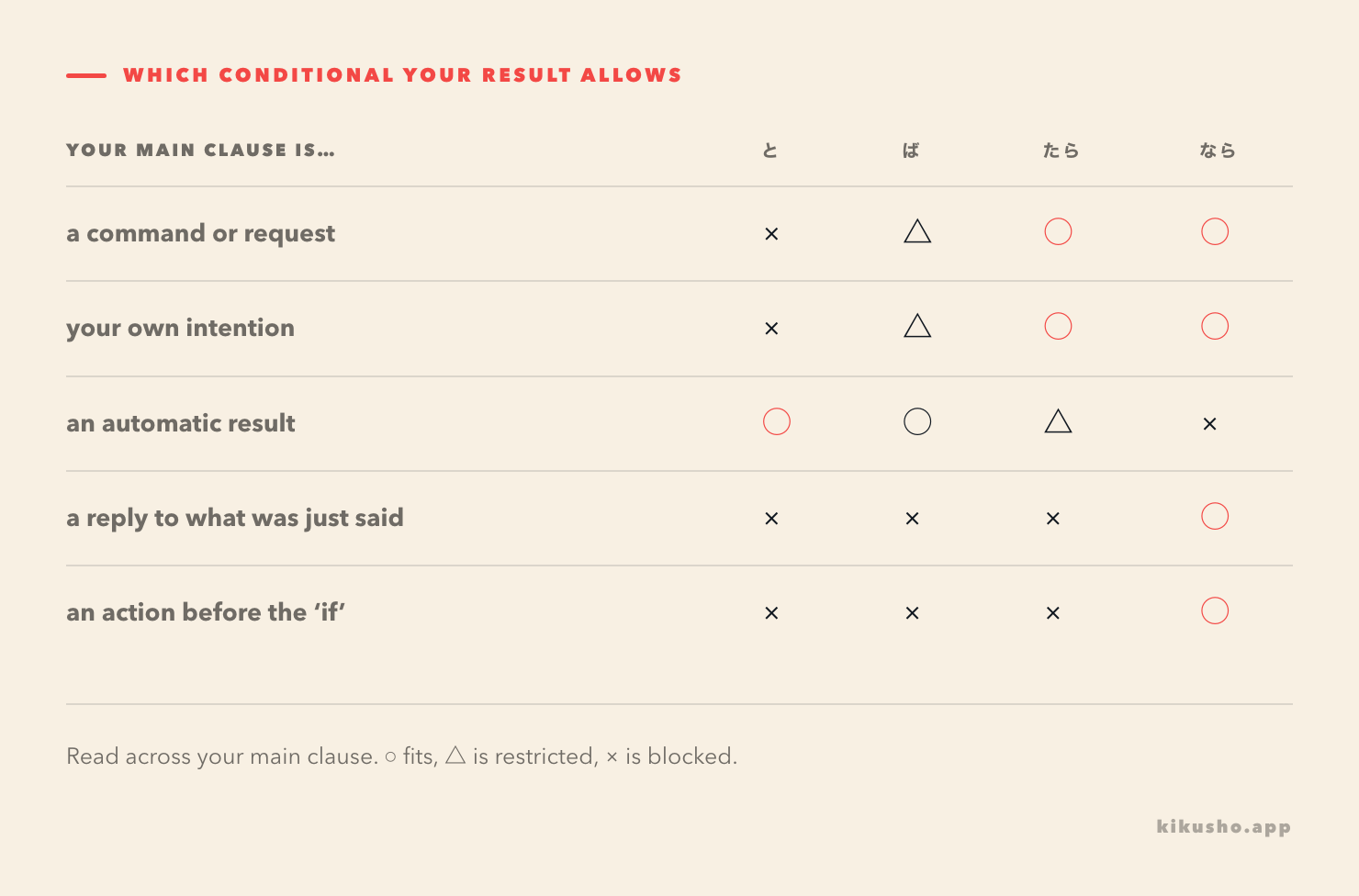
と refuses a result that expresses anyone's will. なら refuses a result that is an automatic consequence. ば turns awkward when the result is a request and the condition is an action you take yourself. たら refuses almost nothing. So the quick way to choose is to look past the if, read the result you are about to say, and ask which conditionals that result will accept.
The question to ask yourself
One question does most of the sorting: is the result something a person decides, or something that just happens?
If a person decides it, meaning you are giving an order, making a request, stating your own intention or offering a suggestion, then と is out at once and you are choosing between たら and なら. If it just happens, meaning a light comes on, a door opens, water boils or prices fall, then なら is out and と is the natural home, with ば close behind for general truths.
That single split handles most sentences. What is left is the difference between たら and なら on one side, と and ば on the other.
This is the same reflex as reading a sentence to decide に or で before a place: you stop asking what the word means and start asking what the rest of the sentence will allow.
と: only for what happens on its own
と states that the result follows the condition automatically, every time, with nobody choosing it. Press the button and the door opens. Turn the key and the engine starts.
- 春になると、桜が咲く。 When spring comes, the cherry trees bloom.
- このボタンを押すと、ドアが開きます。 Press this button and the door opens.
Because と means this always follows, it cannot lead to anything a person chooses. You cannot end a と clause with a command, a request, an invitation or an intention. The sentence in the middle below is the single most common conditional mistake, and it is wrong for exactly that reason.
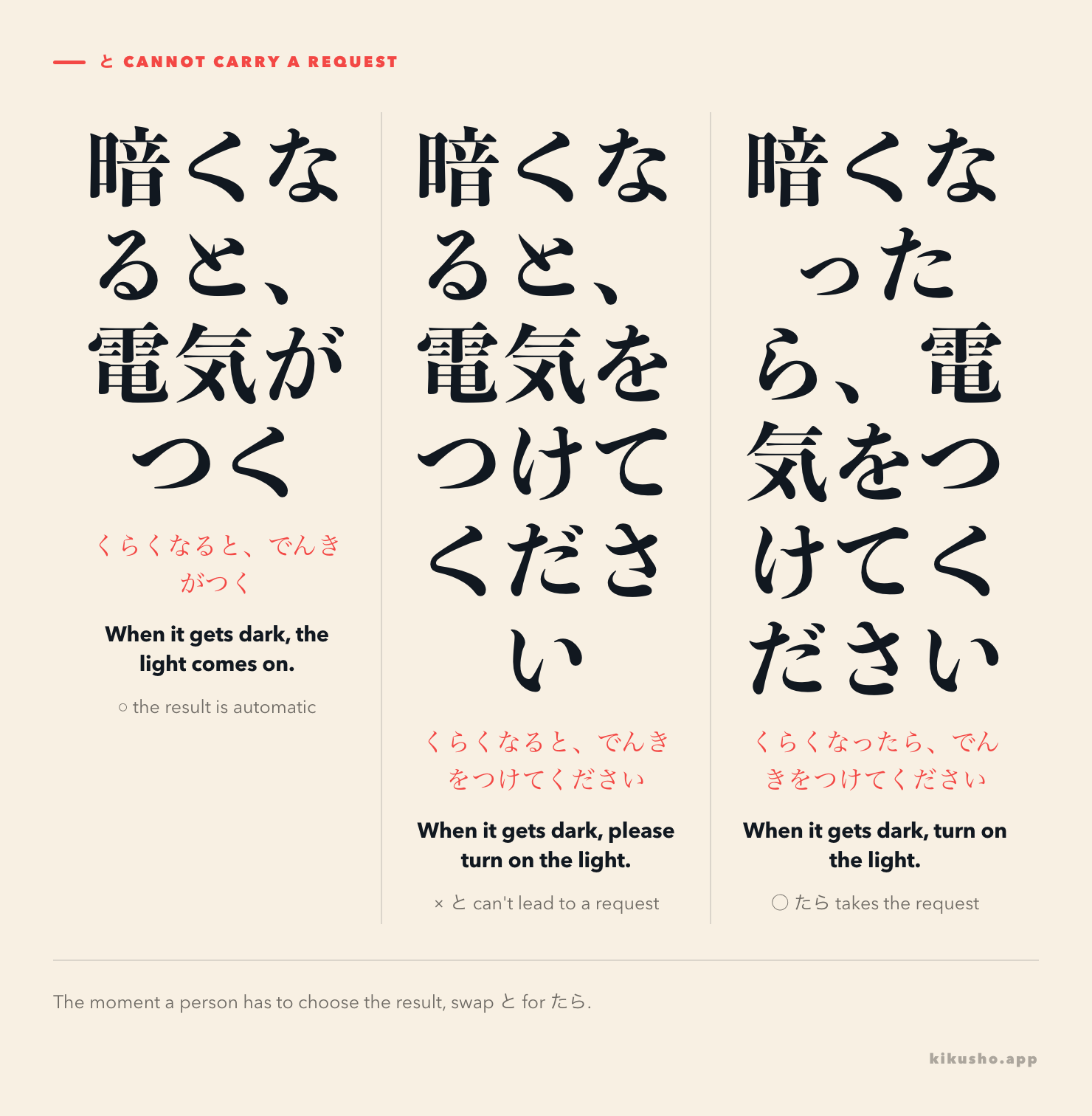
と is also how directions and machine instructions are given, precisely because they are framed as inevitable: go straight and the station is on your right, press and hold and it resets. If your result is a fact of the world rather than a plan of yours, と is right.
ば: a condition you hinge on, and asking what to do
ば puts the weight on the condition itself: provided this holds, that follows. It is at home with states and general truths rather than one-off events, which is why it sits so comfortably after adjectives and the verb ある.
- 安ければ、買います。 If it's cheap, I'll buy it.
- お金があれば、旅行したいです。 If I had money, I'd want to travel.
ば carries the specific "the more, the more" pattern (高ければ高いほど, the higher, the better), and it is the form advice hides inside. どうすればいいですか is literally if I do how, is it good?, the everyday way to ask what to do, and ~ばいい is how you answer it.
One restriction is worth naming, because it is where ば trips people. When the condition is an action you perform and the result is your own command or intention with the same subject, ば sounds wrong, and native speakers switch to たら. 日本に行けば、着物を買いたい is off; 日本に行ったら、着物を買いたい is right. Keep ば for conditions that are states, and you sidestep the trap.
たら: the one-off, and the form to reach for when unsure
たら is the most permissive of the four and the closest to a plain English when or if. It marks a single, specific occasion, once this happens, and it accepts nearly any result: commands, requests, intentions, suggestions, all fine.
- 駅に着いたら、電話してください。 When you get to the station, call me.
- 宝くじが当たったら、家を買う。 If I win the lottery, I'll buy a house.
Because it refuses so little, たら is the safe default when you are not sure. It will rarely be outright wrong, where と or なら easily can be. It also has a use the others lack: たら with a past-tense result reports a discovery, something you found already true when the condition was met.
- 窓を開けたら、雪が降っていた。 When I opened the window, it was snowing.
Nobody made it snow. The result is not a consequence of opening the window, only what you found when you did. That reading belongs to たら alone.
なら: a reply, and the conditional that bends time
なら does something the other three cannot. It takes up a premise already in the air, something the other person just said or a topic you are picking up, and comments on it: if that's the case, then…
A: 日本に行きます。 B: 日本に行くなら、京都がおすすめです。 If you're going to Japan, I recommend Kyoto.
B is not predicting a consequence of A going to Japan. B is responding to the fact that A raised it. This is why なら is the conditional you reach for when your result is advice or an opinion about what someone just told you.
なら also breaks the time order the other three hold to. With たら, と and ば the result comes after the condition. With なら the result can come first: you act before the condition is met, because なら supposes the condition rather than waiting for it.
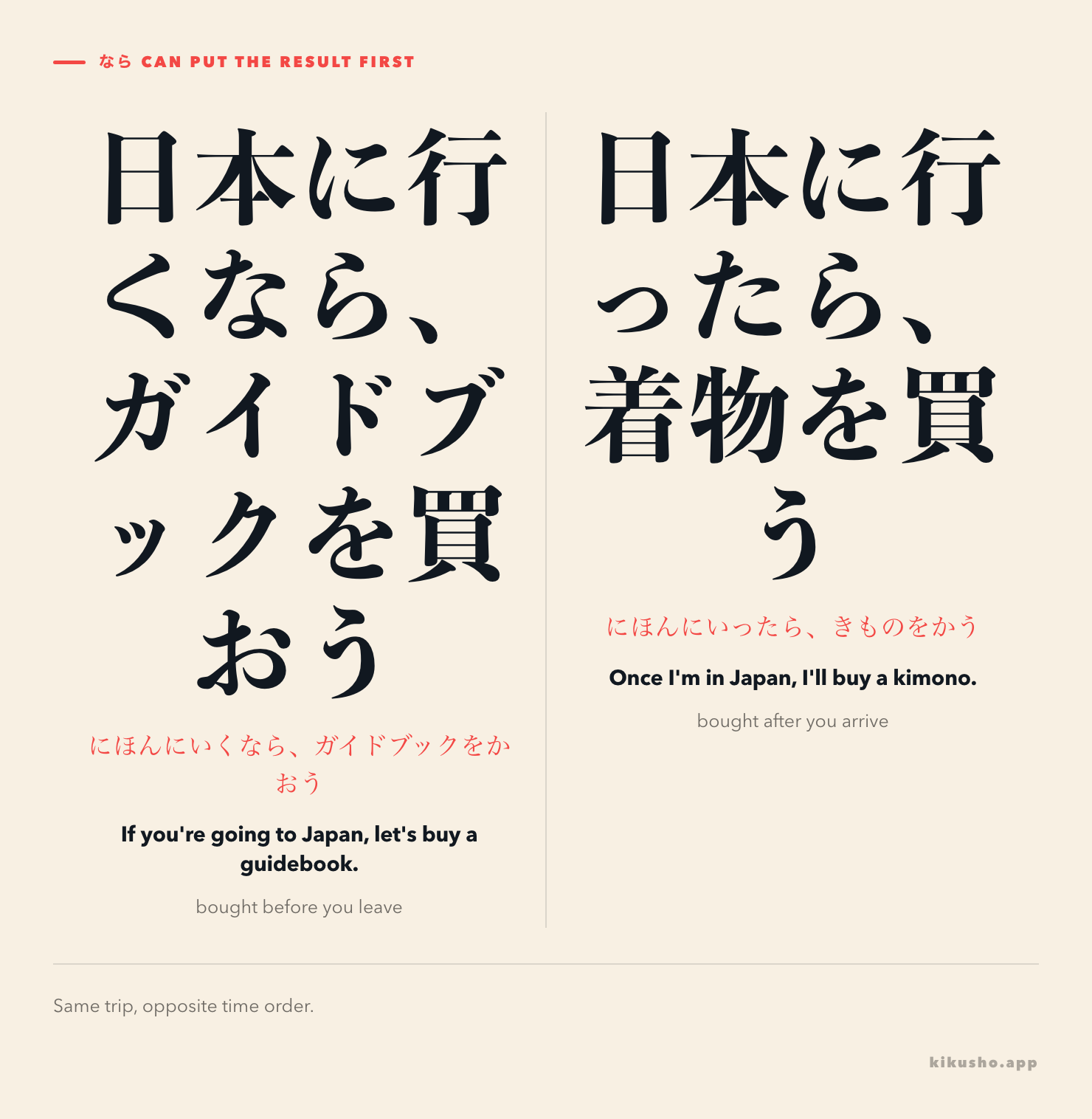
Set the ば and なら pair side by side and the split sharpens further: ば states a plain condition where なら supposes one you were handed.
Where two are both correct
The forms overlap, and the overlap is not a loophole. It is where the choice carries meaning. Take 日本に行くと and 日本に行ったら. Both can open when I go to Japan, but と frames a routine with a habitual result, whenever I go this happens, while たら frames a single trip. Take 安ければ and 安かったら: both mean if it's cheap, and here they run close to interchangeable, with ば a touch more formal. When two conditionals both fit, they are not saying the same thing twice. They offer two readings, and the sentence keeps whichever one you chose.
The rules give you the map, but the sentences that teach you the conditionals are the ones that surprise you: a なら that put its result first where you expected たら, a と in a spot you would have reached for ば. Those are worth keeping whole, both clauses together, because the lesson is in the pairing and not in either half alone. When you meet one in a subtitle or a message, that is a sentence to capture rather than a word to look up. Kikusho takes the line by voice, photo or paste and files it as a card with its reading, a translation and native audio, so the pattern stays reviewable offline instead of dissolving back into if the moment you scroll past.
What the wrong one does to your meaning
Picking the wrong conditional rarely makes you unintelligible. It makes you sound like something else. と where you wanted たら turns a request into a law of nature, when it gets dark, the light gets turned on, and reads like a manual describing a room rather than a person asking a favour. ば where たら belonged makes a specific plan sound like an abstract hypothesis. なら for an automatic result is simply ungrammatical, and it is the one a listener will stop and reparse.
This is why a native speaker corrects your conditional at once but cannot always say why. They are not checking the if against a rule. They are hearing the result and feeling it clash with the form in front of it. You can run the same check deliberately, before you speak, by reading your own second clause first. The if will wait. The result is what has already decided.
Common questions
Isn't たら just the casual form of ば?
No. They differ in what the result clause can be, not in politeness. たら accepts commands, requests and one-off events freely; ば prefers a stated condition, especially an adjective or a general truth, and resists a same-subject action followed by your own intention. Either form can be formal or casual depending on the rest of the sentence.
Can I always use たら to be safe?
Almost. たら is the most permissive conditional and is rarely outright wrong, so it is a reasonable default when you are unsure. The two places it fails are automatic, always-true results, which want と, and comments on what someone just said, which want なら.
What is the difference between 行くと and 行ったら?
行くと frames the result as automatic and usually habitual, so it cannot lead to a command or an intention. 行ったら frames a single occasion and accepts any result, including a request. Same condition, different reading of the result.