On this page
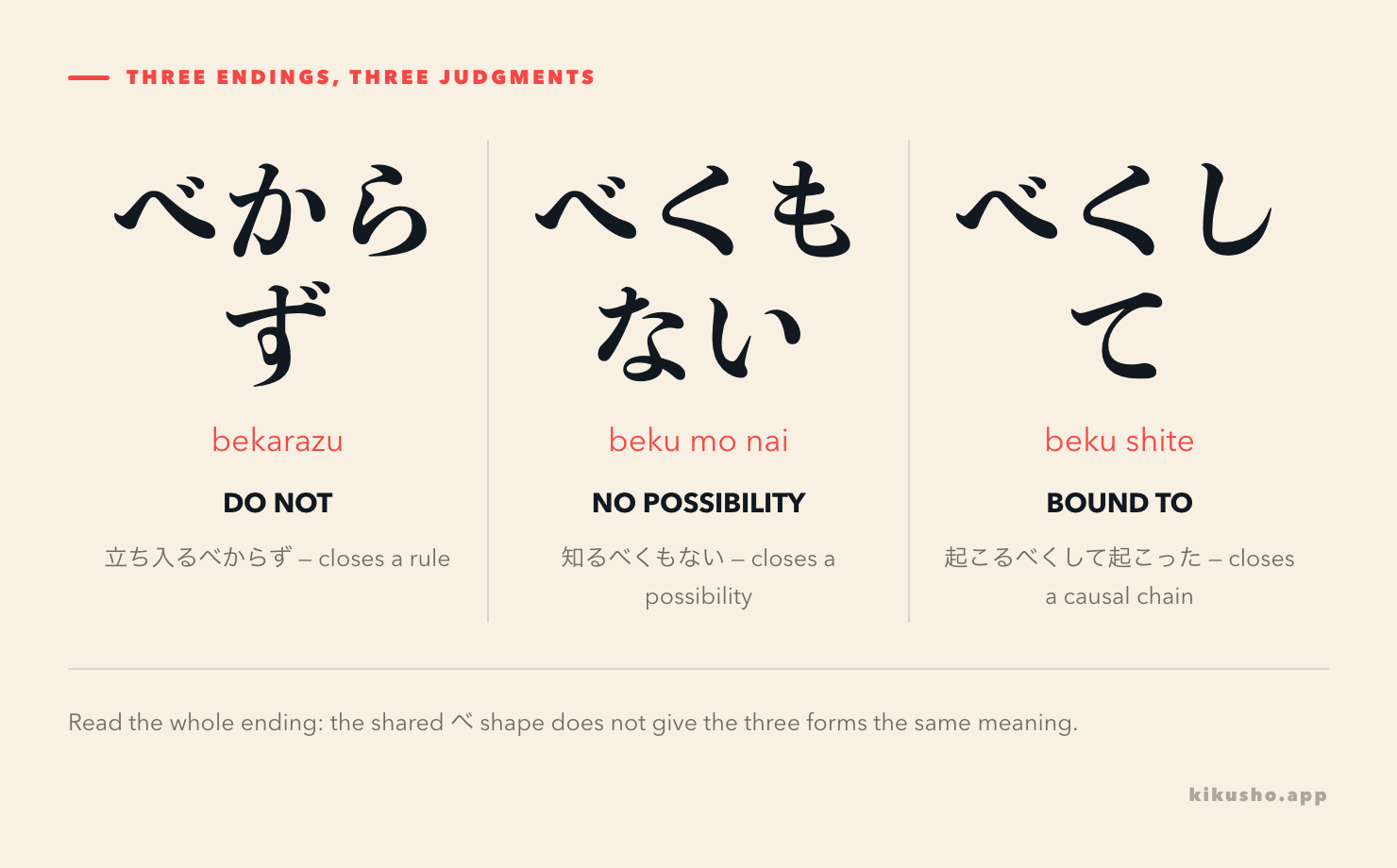
Use べからず (bekarazu) to prohibit an act, べくもない (beku mo nai) to rule out any possibility, and べくして (beku shite) to call a result inevitable. All three preserve forms of the classical auxiliary べし, but each construction performs a different job in formal Japanese.
Three endings, three judgments
The shared べく / べから shape can make these expressions look like variants of one meaning. They are better learned as three complete signals.
| Form | Basic pattern | Judgment |
|---|---|---|
| Vる + べからず | 立ち入るべからず | “must not”: a rule or prohibition |
| Vる + べくもない | 真相を知るべくもない | “cannot possibly”: no realistic possibility |
| Vる + べくして + same V | 起こるべくして起こった | “was bound to”: the result followed naturally |
These forms belong mainly to writing, formal notices, commentary and literary narration. In conversation, a speaker will normally choose ~てはいけない, ~はずがない / ~ことはできない, or 当然~した. On the JLPT, recognition matters more than sounding natural while producing them.
The two shapes come from different inflections of classical べし. べく is its connective form; べから is the base used before the classical negative ず. That history explains the spelling, but it does not let you infer the modern meaning by itself. Read the whole ending.
べからず closes a rule
Verb dictionary form + べからず issues a categorical “must not” or “do not.” It sounds severe, impersonal and old-fashioned, which is why it suits signs, regulations, maxims and deliberately weighty statements.
関係者以外、立ち入るべからず。
かんけいしゃ いがい、たちいる べからず。
No entry except for authorized personnel.
研究者は、結果に合わせてデータを改変するべからず。
けんきゅうしゃは、けっかに あわせて データを かいへんする べからず。
A researcher must not alter data to fit the result.
The second sentence sounds like a maxim or written code. Said directly to a colleague, 改変してはいけない or the more formal 改変してはならない would be ordinary modern Japanese.
With する, both するべからず and the older-looking すべからず occur. A sign may say 駐車するべからず, while a maxim can favor 軽率に判断すべからず. The important point for recognition is that neither す nor する is a negative form here.
Bunpro's べからず reference classifies the pattern as formal and records its strong prohibition reading. JLPT Sensei likewise places it at N1 and highlights its use for rules on signs.
べからざる points forward to a noun
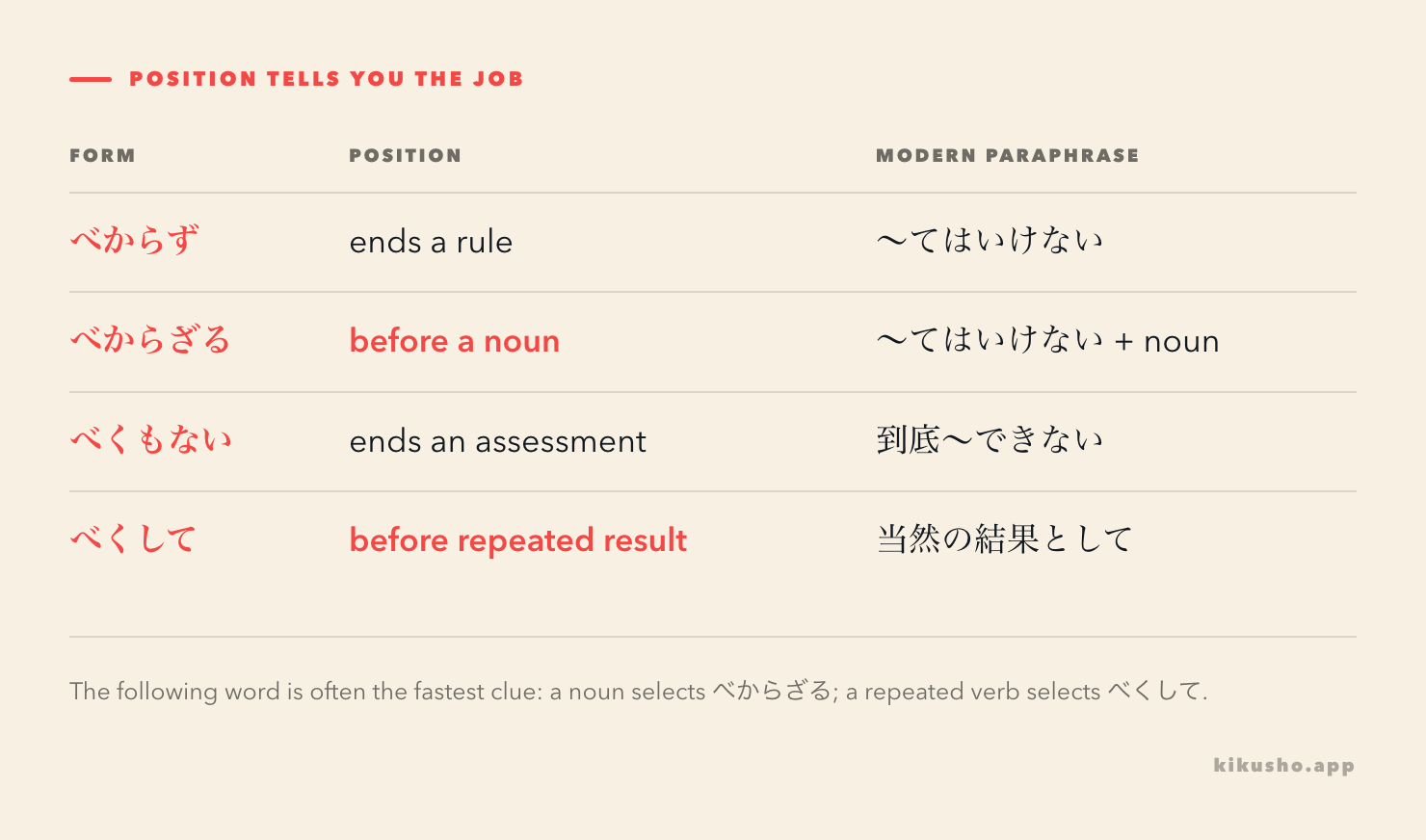
べからざる carries the same negative judgment, but it modifies the noun that follows. This gives a quick reading test:
- if the expression ends the command, expect べからず;
- if a noun follows immediately, expect べからざる + noun.
高齢者をだますなど、許すべからざる行為だ。
こうれいしゃを だますなど、ゆるす べからざる こういだ。
Deceiving an elderly person is an unforgivable act.
信頼は、協力に欠くべからざる条件である。
しんらいは、きょうりょくに かく べからざる じょうけんである。
Trust is an indispensable condition for cooperation.
The second example is not a prohibition against lacking trust. 欠くべからざる has become an attributive way to say “indispensable” or “essential.” Modern べからざる is not freely productive with every verb; it is concentrated in established combinations, especially 許すべからざる, 欠くべからざる and ありうべからざる.
べくもない eliminates possibility
Verb dictionary form + べくもない means that there is no way to do, know, expect or imagine something. The particle も strengthens the negative scope: even the possibility represented by the verb is unavailable.
当時の記録が残っていない以上、真相を知るべくもない。
とうじの きろくが のこって いない いじょう、しんそうを しる べくもない。
Since no records from the time remain, there is no way to know the truth.
初心者が現役の王者にかなうべくもない。
しょしんしゃが げんえきの おうじゃに かなう べくもない。
A beginner could not possibly match the reigning champion.
This is a formal impossibility judgment, not a ban. 知るべからず would tell someone not to know, an odd prohibition; 知るべくもない says the circumstances make knowing impossible.
The construction strongly favors verbs whose possibility can be assessed: 知る, 想像する, 望む, 疑う, 比べる, 及ぶ and かなう are common partners. With する, both するべくもない and すべくもない can appear. Bunpro's べくもない lesson analyzes the form as べく + も + ない and records this concentration around thought, expectation and comparison verbs.
The translation changes with the verb. 疑うべくもない is “there can be no doubt,” while 比べるべくもない is “there is no comparison.” Do not force every example into the English frame “cannot do.” The constant idea is that the writer dismisses the possibility completely.
べくして looks back on an inevitable result
Verb dictionary form + べくして + the same verb says that prior conditions made the result natural, expected or inevitable. The second verb commonly appears in the past, because the writer looks back and judges why the event occurred.
点検を長く怠ったのだから、事故は起こるべくして起こった。
てんけんを ながく おこたったのだから、じこは おこる べくして おこった。
Because inspections had long been neglected, the accident was bound to happen.
十分に準備したチームは、勝つべくして勝った。
じゅうぶんに じゅんびした チームは、かつ べくして かった。
The well-prepared team won because it had done what made winning the natural result.
二人は共通の友人を通じて、出会うべくして出会った。
ふたりは きょうつうの ゆうじんを つうじて、であう べくして であった。
Through their mutual friends, the two met as though they were destined to.
The repeated verb is the signature. It binds the expected course to the result that actually followed: 起こる → 起こった, 勝つ → 勝った, 選ばれる → 選ばれた. Bunpro's べくして lesson describes the two sides as the same verb and distinguishes the construction from an ordinary reason. JLPT Sensei gives the same “following the natural course” reading.
Context decides whether the tone is causal or almost fated. An avoidable accident after neglected maintenance invites “inevitable result.” Two people meeting in a novel may invite “destined to meet.” In both cases, the writer presents the outcome as no surprise.
Do not confuse purpose べく with べくして
Standalone Vる + べく can introduce a purpose: 優勝するべく、毎日練習した means “trained every day in order to win.” It looks forward from an intention to the action taken toward it.
勝つべくして勝った looks backward from the actual victory and says the conditions made it the natural outcome. The same historical form survives in both patterns, but the syntax does the sorting:
| Shape | Time direction | Meaning |
|---|---|---|
| 優勝するべく練習した | goal → effort | trained in order to win |
| 勝つべくして勝った | conditions → result | won as was to be expected |
For the purpose construction and its contrast with ~んがため, see ~んがため and ~べく. Keeping the two lessons separate prevents the familiar べく shape from flattening three different readings into “in order to.”
Practice: identify what is being closed
Question 1: grammar choice
A warning sign says that visitors must not enter. Choose the best completion.
危険区域につき、立ち入る( )。
- ① べくもない
- ② べからず
- ③ べくして
- ④ べからざる
Question 2: noun modification
Complete the phrase “an unforgivable breach of trust.”
許す( )裏切り
- ① べからず
- ② べくもない
- ③ べからざる
- ④ べくして
Question 3: sentence composition
Arrange the pieces into “Without any surviving evidence, there is no way to verify the claim”: 証拠が残っていない以上 / その主張を / 確かめるべくもない.
Question 4: repeated result
Which sentence means “The problem occurred because the warning signs made it an unsurprising result”?
- ① 問題は起こるべからず。
- ② 問題は起こるべくもない。
- ③ 問題は起こるべくして起こった。
- ④ 問題を起こすべく調査した。
Question 5: grammar in connected text
Fill A and B with べくもない or べくして.
記録が廃棄された今、当時の判断を完全に知る( A )。ただし、管理体制に重大な欠陥があった以上、この事故は起こる( B )起こったとも言える。
Question 6: explain the contrast
Why does 欠くべからざる人材 mean “indispensable personnel” rather than “personnel who must not be missing”? Explain the role of べからざる and the noun that follows.
Answers and explanations
Answer 1
② べからず. The sign ends with a strong formal prohibition. べからざる would need a noun after it, while べくもない and べくして express impossibility and an expected result.
Answer 2
③ べからざる. The form modifies 裏切り, so the attributive ざる shape is required. 許すべからざる裏切り is a betrayal that cannot or must not be forgiven.
Answer 3
証拠が残っていない以上、その主張を確かめるべくもない。 The missing evidence removes any realistic possibility of verification. Nothing in the sentence is issuing a prohibition.
Answer 4
③ 問題は起こるべくして起こった. The same verb appears before and after べくして, presenting the completed event as the natural result of prior conditions.
Answer 5
Use A=べくもない and B=べくして. Destroyed records make complete knowledge impossible. Serious flaws in the management system make the accident an unsurprising result: 起こるべくして起こった.
Answer 6
べからざる modifies the following noun 人材. In the established combination 欠くべからざる + noun, the literal idea “must not be without” has settled into “indispensable.” The phrase evaluates how essential the person is; it is not a command addressed to the personnel.
When these forms appear in a dense N1 passage, look one word to the right before translating. A following noun identifies べからざる, a repeated verb identifies べくして, and もない closes off possibility. The remaining べからず is the rule with the door shut.
Common questions
What is the difference between べからず, べくもない and べくして?
べからず gives a strong formal prohibition, べくもない says something is impossible even to imagine or know, and べくして presents an outcome as the natural or inevitable result of earlier conditions.
When should I use べからざる instead of べからず?
Use べからず to finish the prohibition and べからざる directly before the noun it modifies. Modern べからざる is concentrated in fixed combinations such as 許すべからざる行為 and 欠くべからざる存在.
Is べくして the same as purpose べく?
No. Purpose べく introduces an intended goal, as in 調査すべく現地へ向かった. The repeated-verb pattern 事故は起こるべくして起こった looks back on a result and says that the circumstances made it inevitable.
Can I use these constructions in everyday conversation?
They are highly formal and literary. べからず appears in rules, signs and maxims, while べくもない and べくして are more at home in analysis, commentary and written narration than in casual speech.