On this page
Use に堪えない (ni taenai) when the object fails a limit: it is too awful to watch, too poor to read, or an emotion is too strong to contain. Use に忍びない (ni shinobinai) when your heart resists the act itself because of sympathy, attachment or conscience.
The object or your conscience decides
Both forms can become “cannot bear to” in English, but they point in different directions. に堪えない evaluates what reaches you or what fills you. に忍びない describes your emotional reluctance to carry out or witness an action.
| Form | Attachment | What reaches its limit |
|---|---|---|
| Vる + に堪えない | 見る・聞く・読む and a narrow group of similar verbs | the object's quality or painful content |
| emotion noun + に堪えない | 感謝・感激・喜び・後悔・遺憾・~の念 | the feeling is too strong to contain |
| Vる + に忍びない | 見る・聞く・捨てる・断る・別れる and other emotionally charged acts | the speaker cannot bring themself to do it |
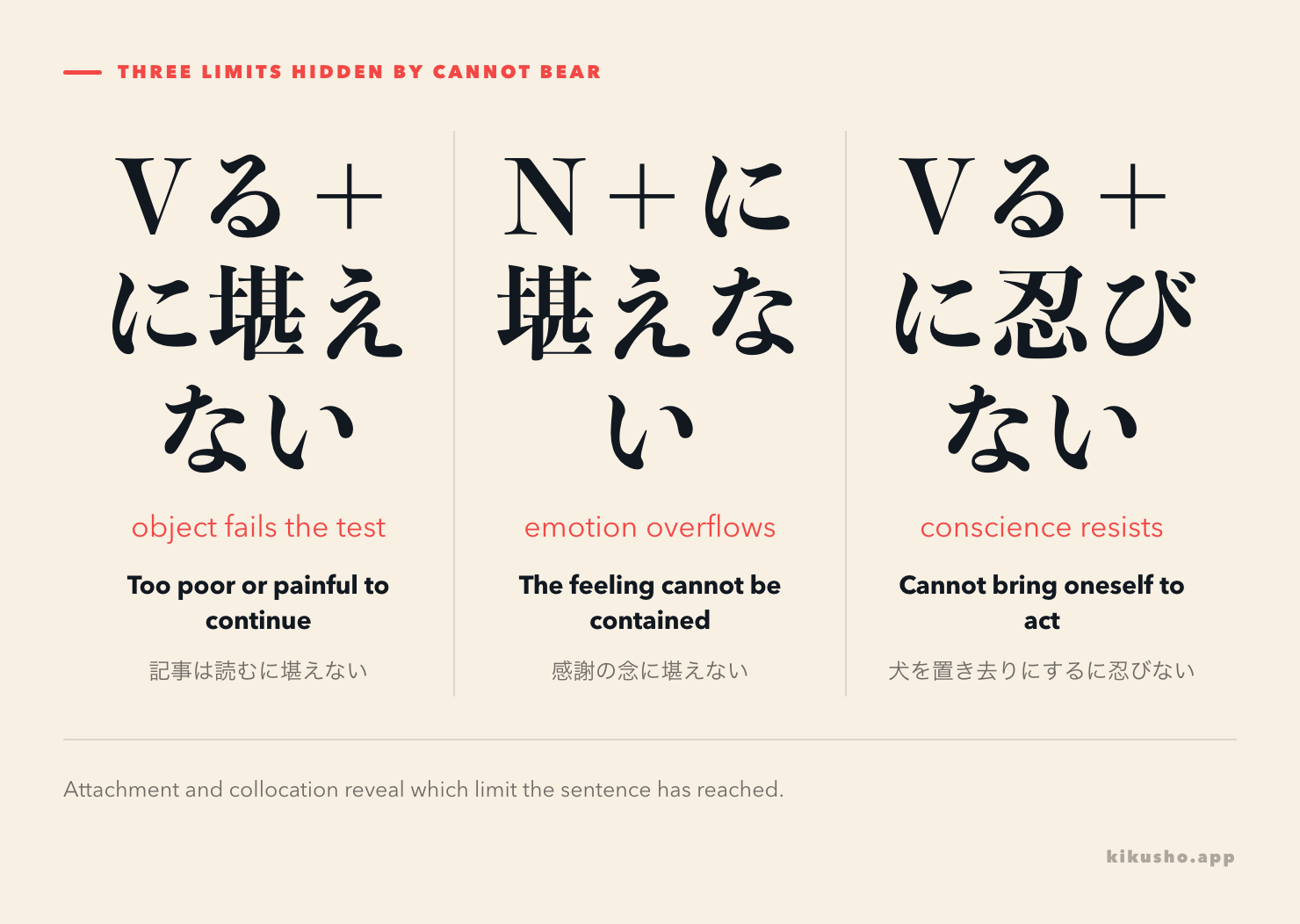
The verb stays in dictionary form in both verbal patterns. Do not conjugate it into a negative before adding the expression: 見るに堪えない and 捨てるに忍びない are complete forms.
Ask what the sentence is judging
When the translation says “I cannot bear to X,” ask one question: is the sentence judging X's object, or explaining why the person cannot bring themself to do X?
この報告書は誤字が多く、読むに堪えない。
この ほうこくしょは ごじが おおく、よむに たえない。
This report has so many errors that it is unbearable to read.
The report is being judged. Its quality makes continued reading impossible or not worthwhile.
父の蔵書を一括して処分するに忍びなかった。
ちちの ぞうしょを いっかつして しょぶんするに しのびなかった。
I could not bring myself to dispose of my father's book collection all at once.
The books need not be bad or physically impossible to discard. Attachment to the father makes the action emotionally difficult.
This test is more reliable than translating both forms with “unbearable.” JLPT Sensei's に忍びない lesson gives the dictionary-verb attachment and describes the act as painful to the speaker's heart. Iku Teacher's comparison likewise separates emotional reluctance from simple inability or unwillingness.
に堪えない has two different negative readings
With a dictionary-form verb, に堪えない most often follows perception or evaluation verbs such as 見る, 聞く and 読む. Something is so poor, vulgar, distressing or painful that one cannot continue experiencing it.
発表は準備不足で、聞くに堪えない内容だった。
はっぴょうは じゅんびぶそくで、きくに たえない ないようだった。
The presentation was so poorly prepared that its content was unbearable to listen to.
This reading often carries a harsh judgment. “Not worth hearing” may fit better than a literal claim that listening is physically impossible. The construction does not attach freely to every activity. 勉強するに堪えない is not a general way to say that studying is difficult.
After a limited set of emotion nouns, however, に堪えない intensifies the feeling. The negative does not cancel the emotion. It says that the emotion cannot be held in.
長年にわたり支えていただき、感謝の念に堪えません。
ながねんに わたり ささえて いただき、かんしゃの ねんに たえません。
I am filled with gratitude for your support over so many years.
判断が遅れたことは、後悔に堪えない。
はんだんが おくれた ことは、こうかいに たえない。
I deeply regret that the decision came too late.
The noun tells you which reading is active. 感謝の念, 喜び, 感激, 後悔 and 遺憾 are established partners. This is formal language, especially common in statements, speeches and written apologies. The polite に堪えません often appears when the feeling is addressed to an audience.
毎日のんびり日本語教師 separates these two uses by attachment: emotion noun for an uncontainable feeling, dictionary-form perception verb for an unbearable state. PassJapanese makes the same division and records both under N1.
Positive に堪える reverses the evaluation
The assigned N1 family also includes に堪える. In an evaluative sentence, the positive form says that something has enough merit to deserve attention.
この短編は、十分鑑賞に堪える作品だ。
この たんぺんは、じゅうぶんに かんしょうに たえる さくひんだ。
This short film is fully worthy of appreciation.
It can also describe resistance to a test or pressure:
この設計なら、長期の使用に耐える。
この せっけいなら、ちょうきの しように たえる。
With this design, it will withstand long-term use.
The spelling helps but does not provide an absolute mechanical rule. 堪える is common when the point is worth, merit or containing emotion; 耐える readily appears for physical or functional endurance. Sources and real texts also vary, and hiragana たえる removes the distinction from the page. The Digital Daijisen entry hosted by Kotobank lists endurance, capability and “worth doing” readings together while marking the worth reading with 堪える.
に忍びない keeps the action personal
に忍びない needs a reason grounded in feeling: pity for someone, attachment to something, grief at a scene, or reluctance to violate one's conscience.
長年働いてくれた職人を、業績だけで解雇するに忍びない。
ながねん はたらいて くれた しょくにんを、ぎょうせきだけで かいこするに しのびない。
I cannot bring myself to dismiss a craftsperson who has worked for us for years based only on performance.
被災した町の姿は、見るに忍びなかった。
ひさいした まちの すがたは、みるに しのびなかった。
It was heartbreaking to look at the disaster-stricken town.
The speaker is not claiming that the town lacks visual merit. The sight awakens pity and pain. The Digital Daijisen entry for 忍びない defines it as being unable to endure, especially in the frame ~に忍びない, and records both action and perception examples.
Simple preference is not enough. If you merely do not want to study, 勉強するに忍びない gives the listener a reason to look for compassion, attachment or conscience that the sentence has not supplied. Say 勉強したくない for ordinary unwillingness.
見る and 聞く create real overlap
Perception verbs can take either form, so the noun and context must do the final work.
| Sentence | Natural focus |
|---|---|
| 演技があまりに雑で、見るに堪えない | the performance is too poor to watch |
| 負傷した選手の姿は、見るに忍びない | sympathy makes the sight painful |
| 内容が下品で、聞くに堪えない | the content is offensive or worthless |
| 遺族の話は、聞くに忍びない | compassion makes listening painful |
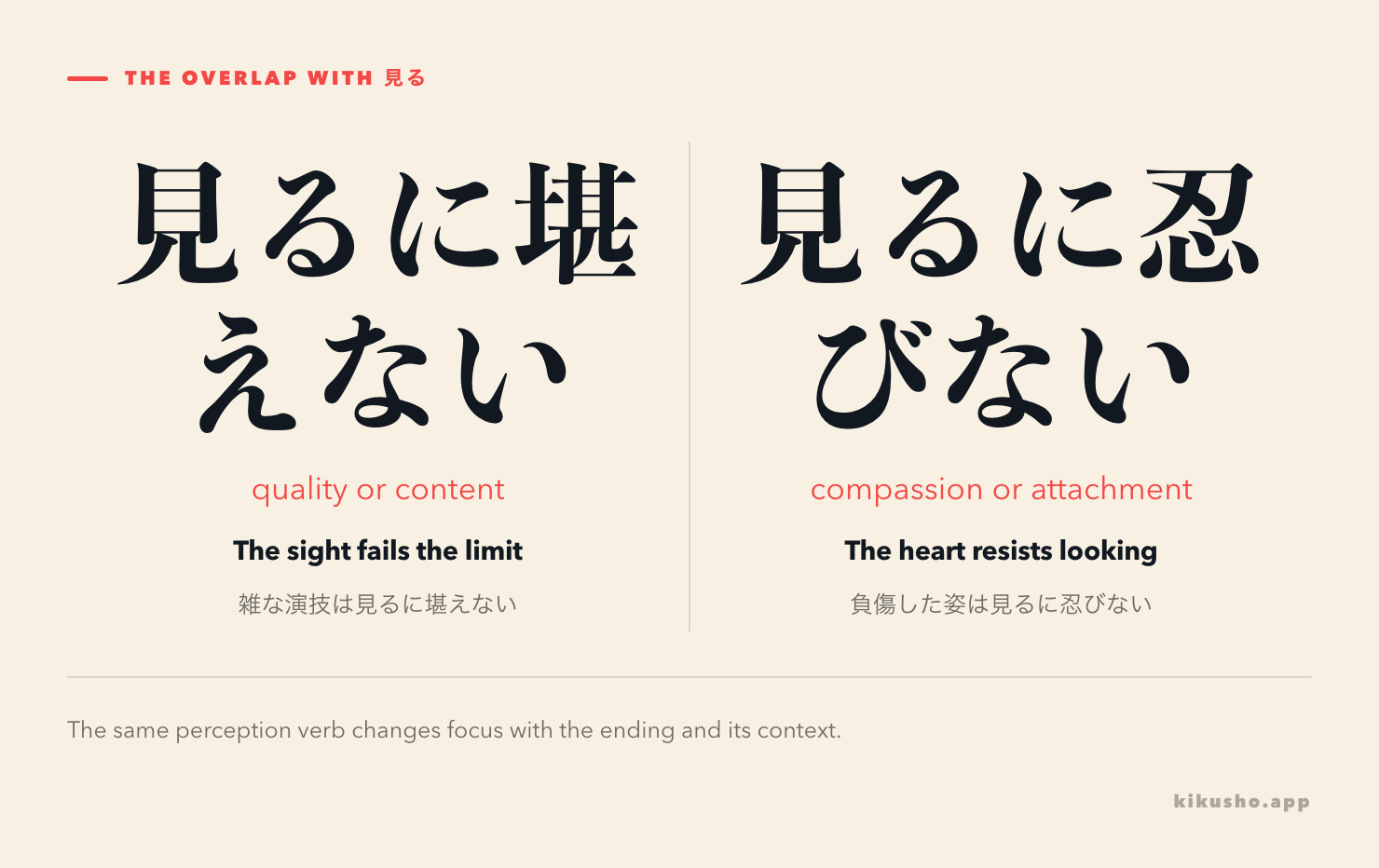
The boundary is semantic, not a ban. A tragic image may be described with 見るに堪えない when its horror is what overwhelms the viewer. 見るに忍びない foregrounds the viewer's compassionate response. The choice tells the reader how to frame the scene.
This is also why ~にかたくない is not a substitute. That form says an inference is easy to make; it does not evaluate an object or express reluctance to act. If the obstacle is social duty rather than pity, ~わけにはいかない usually names it more directly.
A report or novel seldom leaves the decisive clue inside the grammar ending. Keep the noun or object that chooses the reading; a card containing only に堪えない = unbearable erases the distinction. In Kikusho, capture the whole clause and leave 感謝の念, 演技, or the person affected by the action in the example field before saving it.
Practice: identify the kind of limit
Question 1: grammar choice
The speaker cannot bring themself to abandon a dog that has trusted them. Choose the best form.
長年一緒に暮らした犬を置いていく( )。
- ① に堪える
- ② に堪えない
- ③ に忍びない
- ④ にかたくない
Question 2: collocation
Complete the formal expression of strong gratitude.
皆様の温かいご支援に、感謝の( )に堪えません。
- ① 念
- ② 性
- ③ 力
- ④ 方
Question 3: sentence composition
Arrange the pieces into “The article contains too many factual errors to be worth reading”: 読むに堪えない / 事実誤認が多く / この記事は.
Question 4: positive form
Choose the sentence that says a work is worthy of appreciation.
- ① この作品は鑑賞に堪える。
- ② この作品は鑑賞に忍びない。
- ③ この作品は鑑賞の念に堪えない。
- ④ この作品は鑑賞するにかたくない。
Question 5: grammar in connected text
Fill both blanks with 堪えない or 忍びない.
新人の演奏は音程が不安定で、聞くに( A )。しかし、本人が舞台裏で泣いている姿は見るに( B )。
Question 6: explain the reading
Does 遺憾に堪えない mean “I feel no regret” or “I feel profound regret”? Explain what the negative form is doing.
Answers and explanations
Answer 1
③ に忍びない. The relationship with the dog makes the act emotionally impossible. に堪えない would normally turn attention toward something unbearable about the object or experience, which is not the intended reason.
Answer 2
① 念. 感謝の念に堪えません is an established formal collocation meaning that gratitude cannot be contained. The other nouns do not form this expression.
Answer 3
この記事は事実誤認が多く、読むに堪えない。 The article's poor accuracy is being judged, so dictionary-form 読む takes に堪えない.
Answer 4
① この作品は鑑賞に堪える。 Positive に堪える says the work has enough merit to deserve appreciation. に忍びない would require emotional reluctance to perform an action.
Answer 5
Use A=堪えない and B=忍びない. Unstable pitch makes the performance hard to listen to as a matter of quality. Seeing the performer cry produces compassionate pain in the observer.
Answer 6
It means “I feel profound regret.” With an emotion noun, に堪えない says the feeling is too strong to contain. Reading ない as a simple cancellation would reverse the established expression.
The safest clue is often several words before the grammar. 感謝の念 opens an emotion reading, a badly made object invites evaluation, and a person who will be hurt gives 忍びない its moral weight.
Common questions
What is the difference between に堪えない and に忍びない?
Verb plus に堪えない usually judges something too bad, painful or unpleasant to keep seeing, hearing or reading. Verb plus に忍びない says sympathy, attachment or conscience makes the speaker unable to bring themself to act.
Why can に堪えない express a strong positive feeling?
After a limited set of emotion nouns, に堪えない means that the feeling cannot be contained. 感謝の念に堪えない therefore means to be filled with gratitude, even though the form is grammatically negative.
What does に堪える mean in positive sentences?
It can say that something is worthy of viewing or evaluation, or that it can withstand a test or use. 鑑賞に堪える作品 is a work worthy of appreciation.
Are 堪える and 耐える both read たえる?
Yes. Study materials vary in spelling, and hiragana also appears. 堪える is common for worth and contained-feeling readings, while 耐える readily marks endurance against pressure or use.