On this page
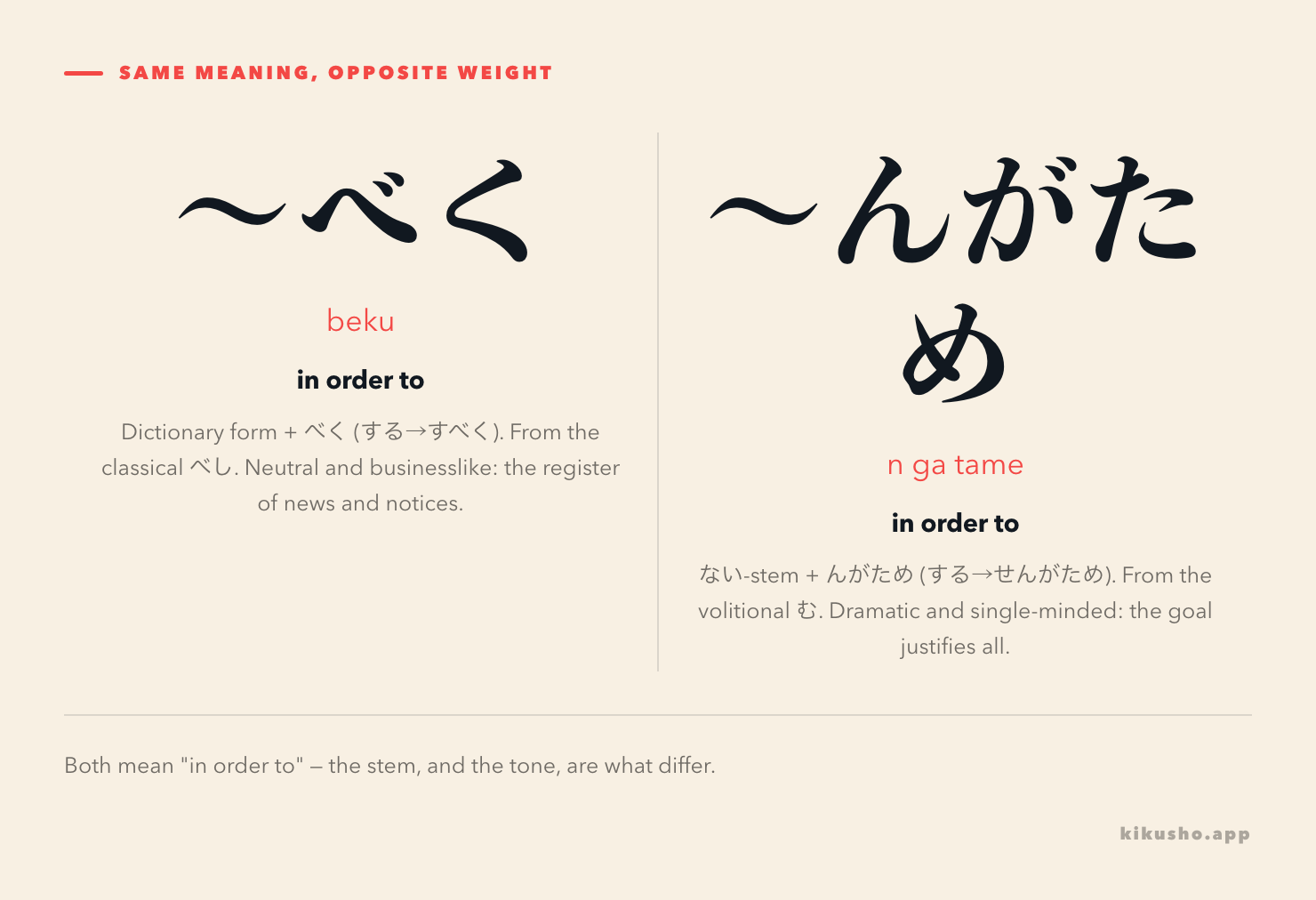
~べく and ~んがため both translate as "in order to," and both belong to a formal, written Japanese that nobody reaches for in conversation. What separates them is not meaning but the verb stem each one grips: ~べく hangs off the dictionary form, ~んがため off the ない-stem, and that single difference is what lets you read せんがため as a purpose rather than mistaking it for a negative.
That is the whole job these forms give you. They are classical survivals, kept alive because formal Japanese still wants their weight, and at N1 you meet them in a newspaper editorial, a company statement, a wedding speech or a line of narration. You almost never have to build one yourself. So the skill worth having is fast recognition: seeing "purpose" the moment the form appears, and not tripping over the stem it sits on.
How each one attaches
The forms diverge at the stem, and everything else follows from that.
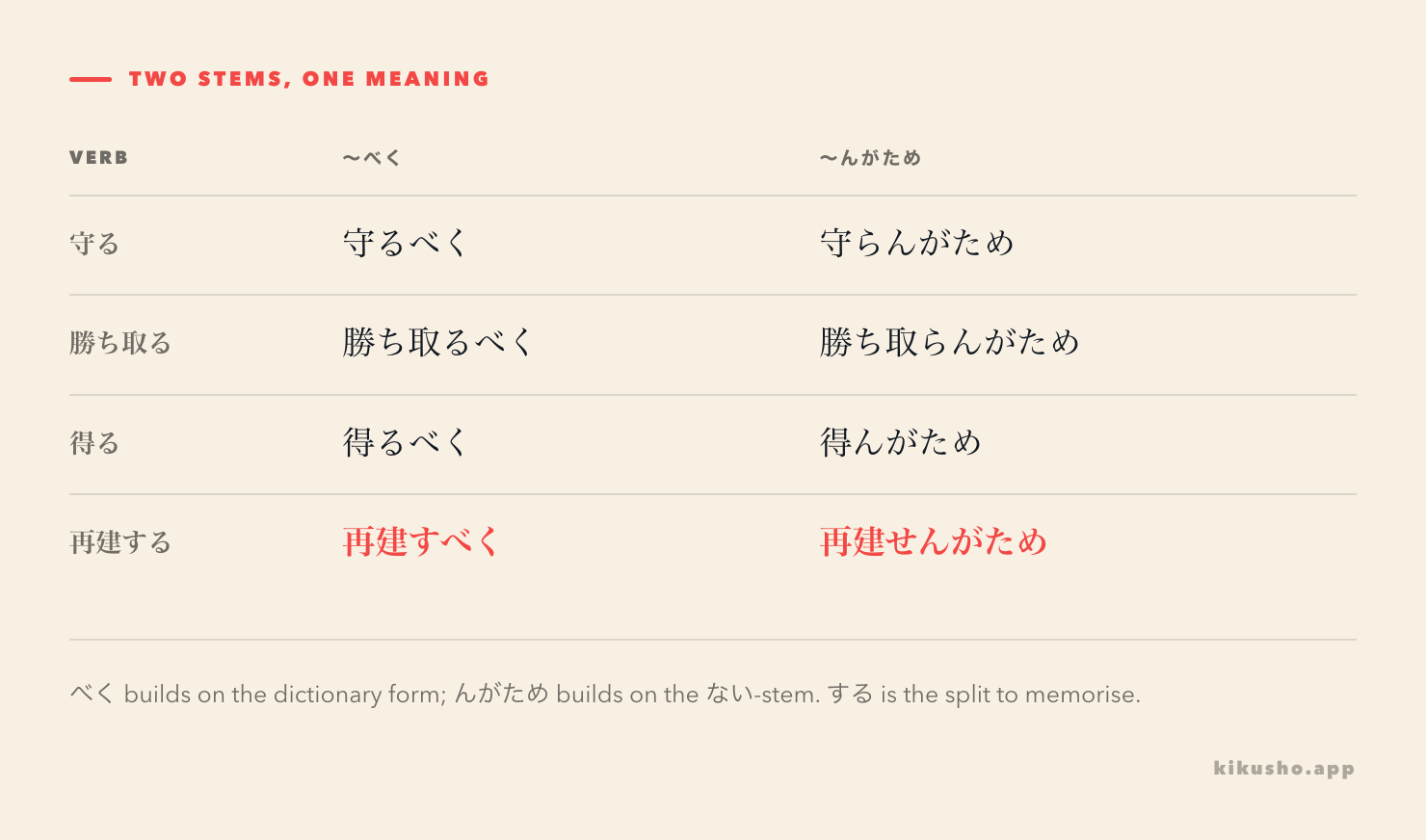
~べく takes the plain dictionary form and adds べく: 守る becomes 守るべく, 勝ち取る becomes 勝ち取るべく. It descends from the classical auxiliary べし, and べく is that auxiliary's connective form. The same べし is still visible in べき ("should"), べからず ("must not") and the fossil べし itself, so recognising the family helps you place べく on sight.
~んがため(に) takes the ない-stem, the 未然形: form the plain negative, drop the ない, and add んがため. 守る → 守らない → 守らんがため; 得る → 得ない → 得んがため. Put a noun after it and the ため takes の: 私腹を肥やさんがための政策, "a policy meant only to line one's own pockets." The ん here is the classical volitional む, the ancestor of modern ~う/~よう, which is why んがため reads as "intending to do, and for the sake of that." It is never the negative.
| Verb | ~べく (dictionary form) | ~んがため (ない-stem) |
|---|---|---|
| 守る (mamoru) | 守るべく | 守らんがため |
| 勝ち取る (kachitoru) | 勝ち取るべく | 勝ち取らんがため |
| 得る (eru) | 得るべく | 得んがため |
| 再建する (saiken suru) | 再建すべく | 再建せんがため |
The one verb that trips everyone: する
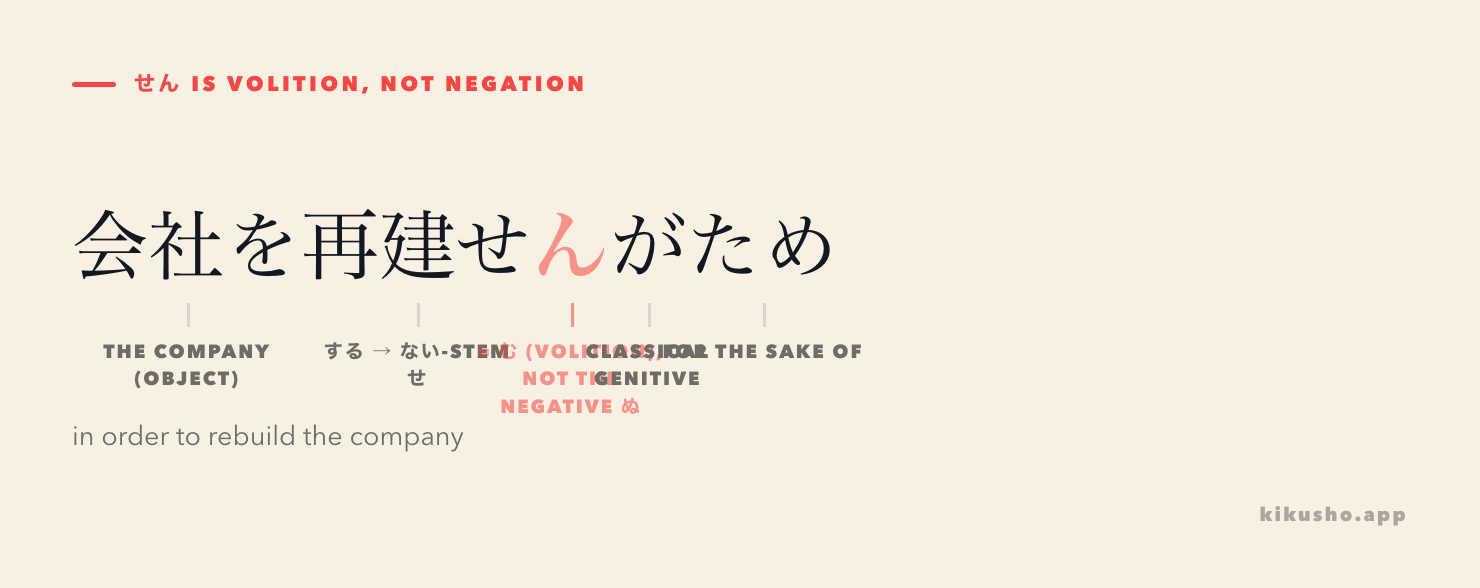
Every other verb is regular; する is where readers stall. Its dictionary form gives 再建すべく (classical Japanese used す where we now say する, and すべく survives intact), while its ない-stem, せ, gives 再建せんがため. Modern writing also accepts 再建するべく, so both するべく and すべく are safe to read. What has no variant is せんがため: it is せ, never し, so しんがため is simply wrong.
That せん is the single most misread piece of either form. It looks like a negative, and it is not.
What each form is doing
They share a meaning and split the work by tone.
~べく is the neutral, businesslike one. It is the register of reporting and official statement, the "in order to X, an organisation did Y" of a broadsheet: 感染の拡大を防ぐべく、政府は緊急の対策をまとめた ("in order to curb the spread of infection, the government put together emergency measures"). It also survives at the end of a clause in two fossilised shapes you should recognise rather than produce. ~べくもない means "there is no way one could possibly": 素人の私に、その苦労が分かるべくもない ("there is no way an amateur like me could grasp that hardship"). ~べくして means "destined to," as in 起こるべくして起こった事故 ("an accident that was bound to happen"). Both are the same べし, still carrying its "is to, is bound to" sense.
~んがため is the dramatic one. It frames an effort as all-consuming, and it leans toward the desperate or the self-serving: 生き延びんがため、人々は住み慣れた土地を捨てた ("in order to survive, people abandoned the land they knew"); 利益を得んがために、彼らは都合の悪い事実を隠した ("in order to turn a profit, they buried the inconvenient facts"). Where べく reports, んがため dramatises, and a writer who picks it is telling you the goal justified everything the sentence goes on to describe.
Where they do not go
Both forms demand a goal someone can actually pursue. The verb before them, and the action after them, have to be deliberate: 生き延びんがため works because surviving is something you strive for, but 雨が降らんがため or 忘れるべく do not, because nobody sets out to make it rain or to forget. When the aim is a state you cannot will, formal Japanese reaches for ~ように instead.
Two confusions do more damage than any of that, though, because they flip the meaning rather than merely sounding odd. The first is reading せんがため as a negative; the ん is volitional む, so せんがため is "in order to do," full stop. The second is mixing up べく and べき. べく is purpose and べき is obligation, and after a noun they part ways cleanly: 国民を守るべく法を改正した ("revised the law in order to protect citizens") against 守るべき伝統 ("a tradition that ought to be protected").
The form you will actually use instead
In speech, and in any writing that is not reaching for gravity, "in order to" is just ~ために or ~ように, sometimes ~(し)ようと. You say 生き延びるために逃げた, not 生き延びんがため. That is the honest reason to treat べく and んがため as recognition targets first: you will read them long before you have any reason to write one.
Because the skill they ask for is recognition, the thing worth keeping is the sentence you met one in, not the bare rule. Kikusho is built around that kind of noticing: highlight the line in an editorial, or capture a printed notice with the camera, and it comes back as a card carrying the reading, the meaning and an example sentence, all reviewable later with no signal. Keep 再建せんがため inside the sentence it came from and the card teaches you the stem; reduce it to んがため glossed "in order to" and you have saved the translation and lost the very thing that identifies the form.
Which mistake gives it away
A learner's べく and んがため go wrong in three predictable places, and each one is worth a deliberate check. Misreading せん as a negative is the first and the costliest. Crossing the stems is the second: there is no しんがため and no せんべく, because する is すべく on the dictionary side and せんがため on the ない side, and nothing swaps between them. Reaching for べき when the sentence wants purpose is the third; if you can substitute "in order to," the form is べく, and if you can substitute "should," it is べき. Get those three right and the rest of either form takes care of itself.
Practice
Question 1. Choose the natural form: 「新記録を___、彼は毎朝五時から練習を続けている。」 (In order to set a new record, he keeps training from five every morning.)
a) 出さんがため b) 出すがため c) 出したがため d) 出せんがため
Answer 1: a) 出さんがため. 出す is a godan verb, so its ない-stem is 出さ, and 出さ + んがため gives the purpose reading the sentence needs. (b) attaches が directly to the dictionary form, which is not the pattern. (c) 出したがため is 〜たがため, "because he set the record," a reason clause in the past, not a purpose. (d) uses 出せ, the potential stem, which also reads as the contracted negative 出せん ("can't set"); the ない-stem is 出さ, so 出せんがため is the wrong stem.
Question 2. Arrange these four pieces into a natural sentence, then say which one lands in the ★ (third) slot: 「住民たちは、___ ___ ★___ ___ 署名を集め始めた。」 (In order to stop the development plan, the residents began collecting signatures.)
Pieces: 中止せんがため ・ 計画を ・ 開発 ・ の
Answer 2: 住民たちは、開発 の 計画を 中止せんがため 署名を集め始めた。 The ★ slot holds 計画を. の links 開発 to 計画 to make 開発の計画, "the development plan"; を marks that plan as the object; and 中止せんがため (from 中止する, ない-stem 中止せ) closes the purpose clause, so it must sit directly before the main clause 署名を集め始めた.
Question 3. Fill each blank with the natural form. 「田中さんは、ある難病の治療薬を長年研究してきた。一日も早く薬を _(1)_、今も世界中の研究者と情報を交換している。だが、利益を _(2)_ 研究では、本当に苦しんでいる人は救えないと彼は言う。」 (Tanaka has spent years researching a cure for a serious illness. In order to get the medicine to people as soon as possible, he still shares information with researchers worldwide. But research done only to make a profit, he says, cannot save those who are truly suffering.)
(1) a) 届けんがため b) 届けるべからず c) 届けたがため (2) a) 得んがための b) 得んがために c) 得るべき
Answer 3: (1) a) 届けんがため, the purpose reading (届ける → ない-stem 届け → 届けんがため). (b) べからず is a prohibition, "must not deliver," which contradicts the sentence. (c) is the past reason 〜たがため, "because he delivered." (2) a) 得んがための, because a noun, 研究, follows and the ため needs its attributive の. (b) ends in adverbial に and cannot attach straight to a noun. (c) 得るべき研究 would mean "research one ought to do," an obligation, not the purpose the passage is describing.
What a form tells you before its sentence does
Native readers do not conjugate べく or んがため; they hear the register drop and read "purpose" in one motion, and the stem is a spelling detail they never stop on. You can borrow that. Meeting one of these forms tells you as much about the text as about the clause it sits in: you have left conversational Japanese and entered the register of editorials, ceremonies and formal record. Read the weight first, confirm the stem only when a せん makes you hesitate, and the two forms stop being a grammar problem and become what they are for a fluent reader, a signal about where the writing stands.
Related formal grammar worth having nearby: ~にあたって and ~に際して, the on-the-occasion-of forms one level down, and the wider question of how Japanese registers work without memorising keigo.
Common questions
Is ~べく the same as ~べき?
No. べく marks purpose, "in order to"; べき marks obligation, "should" or "ought to." They come from the same classical auxiliary べし, but べく is its connective form and べき its attributive one, so before a noun the two look different: 守るべく (in order to protect) versus 守るべき (that ought to be protected).
Does せんがため mean "in order not to"?
No. The ん in せんがため is the classical volitional む, the ancestor of today's ~う/~よう, so it means "in order to do," never "in order not to." A reader who takes it for the negative ん (as in 知らん) flips the whole sentence.
Do I need to produce ~べく and ~んがため for N1?
Rarely. Both live in editorials, speeches, notices and narration, so they turn up in the reading and listening sections far more often than you would ever need to write them. Recognising one and parsing its stem correctly is the skill the exam actually tests.