On this page
Use に至る (ni itaru) when a process reaches a result, conclusion or stage. Use に至って (ni itatte) when the sentence continues from that stage to the action or realization that finally occurs there.
One verb creates five different views of an endpoint
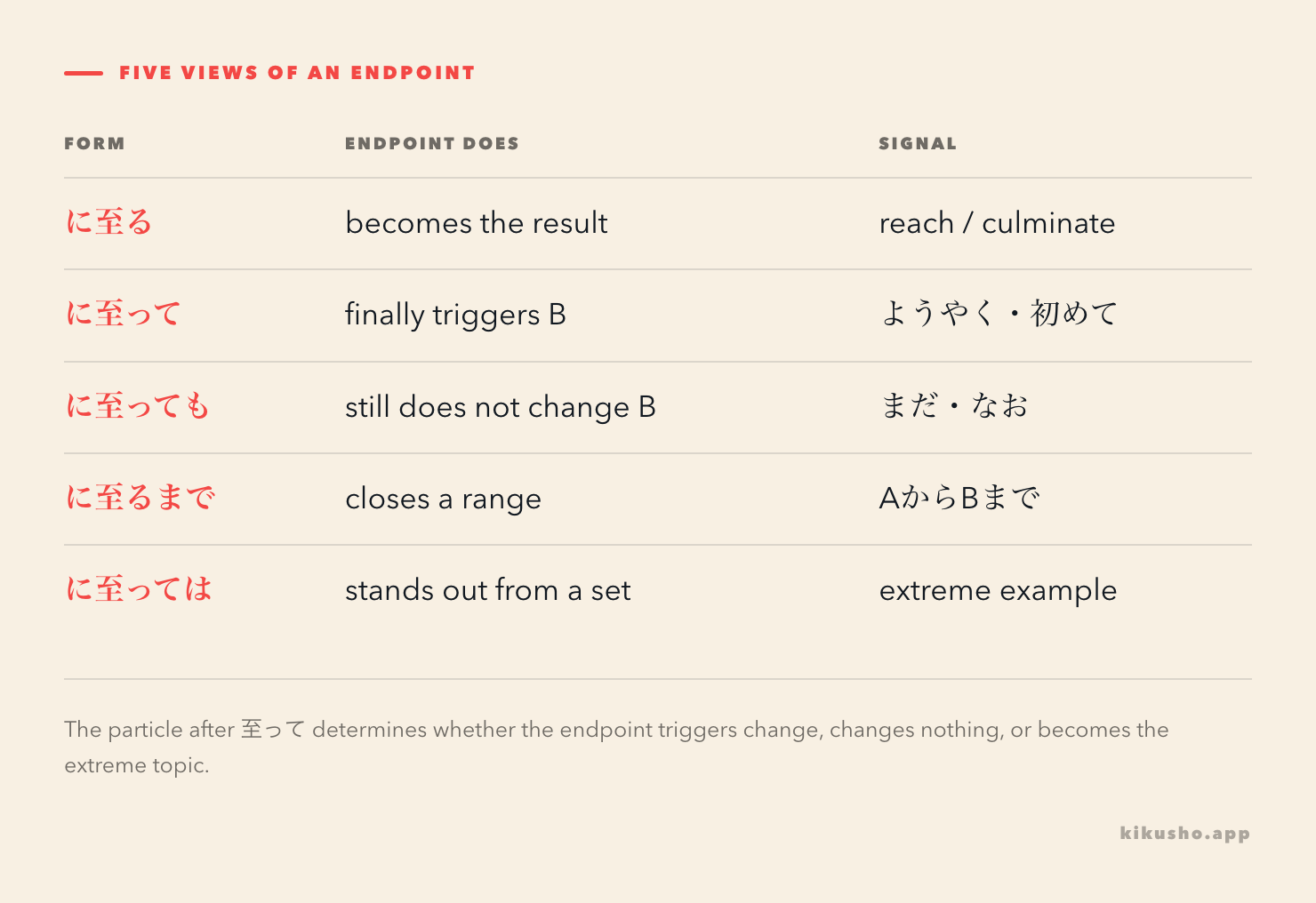
至る literally means “to reach” or “to arrive at.” In this N1 family, the destination is often abstract: a conclusion, an agreement, a crisis, a serious condition or an extreme case. The ending attached to 至る decides what the sentence does with that endpoint.
| Form | Question it answers | Core reading |
|---|---|---|
| N / Vる + に至る・に至った | What result or stage was reached? | culminate in; come to |
| N / Vる + に至って・に至り | What finally happened at that stage? | only when; upon reaching |
| N / Vる + に至っても | Did even that stage change the result? | even after reaching |
| N + に至るまで | How far does the range extend? | all the way to; up to |
| N + に至っては | Which case is the most striking? | when it comes to; in particular |
These are related, but they are not freely interchangeable. も creates concession, は turns an extreme case into the topic, and まで marks the far edge of a range.
に至る reports the result of a development
Attach に至る to a noun or to a verb in dictionary form. The preceding context usually supplies the path that led there.
長い交渉の末、両社は合意に至った。
ながい こうしょうの すえ、りょうしゃは ごういに いたった。
After lengthy negotiations, the two companies reached an agreement.
The agreement is the endpoint. に至った does not by itself say whether the endpoint was welcome or regrettable. That differs from あげく and 末に, which look back over the process and can make the speaker's evaluation of its outcome central.
検討を重ねた結果、計画を全面的に見直すに至った。
けんとうを かさねた けっか、けいかくを ぜんめんてきに みなおすに いたった。
After repeated consideration, we eventually came to revise the plan completely.
The verb 見直す stays in dictionary form before に至った. A noun attaches directly: 合意に至る, 結論に至る, 事態に至る. The negative forms say the endpoint was not reached: 合意には至らなかった means that discussion did not result in an agreement.
JLPT Sensei's に至る entry records the noun and dictionary-form attachments, including に至らず and に至らなかった, and places the construction at N1. Treat that level as a reference-site placement rather than a binding list issued by the exam.
に至って marks what finally happens at that stage
に至って turns the reached point into the setting for the next event. In the characteristic N1 use, the development has gone unreasonably far before somebody reacts. Words such as ようやく and 初めて often expose that delay.
被害が隣県にまで広がるに至って、政府はようやく対策本部を設置した。
ひがいが りんけんにまで ひろがるに いたって、せいふは ようやく たいさくほんぶを せっちした。
Only after the damage spread into a neighbouring prefecture did the government finally establish a response headquarters.
The damage reaches an extreme stage. That stage triggers the response. The sentence often criticizes how late the action came, although criticism is a frequent use rather than a mechanical part of the form.
事ここに至って、初めて判断の誤りを認めた。
こと ここに いたって、はじめて はんだんの あやまりを みとめた。
Only when things had come to this point did they admit the error in judgment.
事ここに至って is a set-like formal expression for “now that things have come to this.” に至り is the more formal conjunctive alternative to に至って: 事態は深刻な段階に至り、会議が招集された. Bunpro's に至って account confirms both attachments, the に至り variant and the common delayed-response reading.
に至っても says the expected change still does not happen
Add も when even reaching the extreme stage fails to produce the expected response.
重大な事故が起きるに至っても、会社は管理体制を改めなかった。
じゅうだいな じこが おきるに いたっても、かいしゃは かんりたいせいを あらためなかった。
Even after a serious accident occurred, the company did not reform its management system.
Compare the logic:
| First clause | Continuation | Meaning |
|---|---|---|
| 事故が起きるに至って | 会社はようやく制度を改めた | the endpoint finally triggered change |
| 事故が起きるに至っても | 会社は制度を改めなかった | even the endpoint did not trigger change |
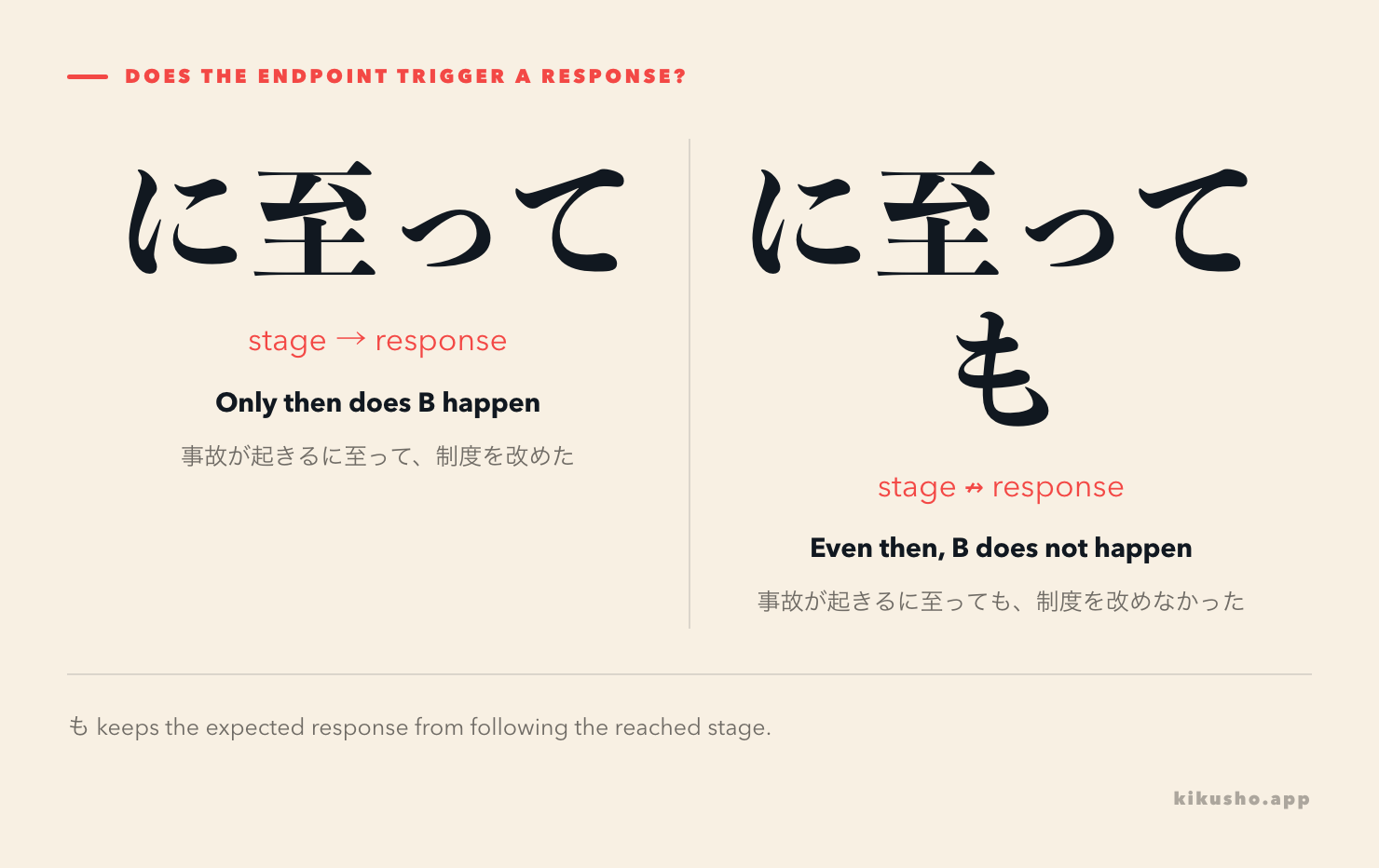
The second clause often contains まだ, なお, a negative form, or a refusal such as ~ようとしない. These make the lack of change explicit. Positive resolve is possible too: どんな状況に至っても方針を変えない says the policy will remain unchanged under any situation reached.
Bunpro's に至っても entry verifies the noun and dictionary-form attachments and the unchanged-result contrast. The Japanese teacher's comparison at 日本語教師のネタ帳 independently frames に至って and に至っても as opposite outcomes after an abnormal development: a state finally changes, or still does not.
に至るまで stretches a range to its far edge
に至るまで does not ask what happens after the endpoint. It defines how far a range or duration extends.
企画から製造、販売に至るまで、すべての工程を自社で管理している。
きかくから せいぞう、はんばいに いたるまで、すべての こうていを じしゃで かんりしている。
From planning through manufacturing and all the way to sales, the company manages every process itself.
The pattern AからBに至るまで stresses breadth and inclusion. The B endpoint may be remote, detailed or surprising. With time, it means “up to”:
発見から現在に至るまで、この遺跡の調査は続いている。
はっけんから げんざいに いたるまで、この いせきの ちょうさは つづいている。
From its discovery up to the present, investigation of this site has continued.
Bunpro's に至るまで entry shows the AからBに至るまで frame and its noun-modifying に至るまでの + noun form. This is stronger and more formal than ordinary から~まで because it presents B as the reached edge of the whole span.
に至っては selects the most striking case
に至っては usually follows a noun. It does not move along a timeline. The preceding sentence establishes a group or trend; は then picks one member as the outstanding, often worst or most surprising example.
各部署で作業が遅れている。開発部に至っては、納期を一か月も過ぎている。
かくぶしょで さぎょうが おくれている。かいはつぶに いたっては、のうきを いっかげつも すぎている。
Work is delayed in every department. The development department in particular is already a full month past its deadline.
The development department belongs to the set already under discussion. It is selected because its delay is extreme. に至っても would instead require a stage that was reached without changing the later result.
兄弟はみな料理が苦手だ。弟に至っては、米の炊き方さえ知らない。
きょうだいは みな りょうりが にがてだ。おとうとに いたっては、こめの たきかたさえ しらない。
All the siblings are poor cooks. The younger brother, for his part, does not even know how to cook rice.
Bunpro and JLPT Sensei both place this use at N1 and describe its formal, evaluative focus. The particle は is doing real work: it presents the extreme member as the topic.
Ordinary stages do not need 至る
The family becomes heavy when nothing develops, culminates or stands out. 昼休みに至って、弁当を食べた overstates an ordinary schedule. Say 昼休みになって、弁当を食べた or simply 昼休みに弁当を食べた.
Likewise, a formal date boundary may call for をもって, while an important occasion may call for にあたって or に際して. Choose 至る when the idea of reaching an endpoint still contributes to the sentence.
When you save one of these forms from a report, capture the clause after it too. 事故が起きるに至って and 事故が起きるに至っても differ by one mora, but the following action or non-action is what fixes the contrast. Kikusho lets you edit a captured card before saving it, so keep both halves and make the delayed response visible during review.
Practice: decide what the endpoint does
Question 1: grammar choice
The crisis finally triggers a response. Choose the best completion.
被害が全国に広がる( )、政府はようやく調査を始めた。
- ① に至って
- ② に至っても
- ③ に至っては
- ④ に至るまで
Question 2: grammar choice
Even the extreme stage produces no change.
三度警告を受ける( )、彼は態度を改めなかった。
- ① に至るまで
- ② に至っては
- ③ に至っても
- ④ に至った
Question 3: range
Complete the sentence meaning that every stage from design through sales is covered.
設計から販売( )、品質を厳しく管理する。
- ① に至っては
- ② に至るまで
- ③ に至っても
- ④ に至らず
Question 4: sentence composition
Arrange the pieces into “After repeated discussion, we reached the conclusion that the plan should be postponed”: 延期すべきだという結論に至った / 議論を重ねた結果 / 計画を.
Question 5: follow the outcome across two sentences
Fill both blanks with a form from this family. The company must react in the earlier clause but remain unchanged in the later one.
問題が深刻な段階に( A )、会社はようやく専門家を呼んだ。しかし、損失が一億円に達する事態に( B )、責任者は方針を変えなかった。
Question 6: extreme example
Several departments are late, and the sales department is the worst case. Choose the best form.
どの部署も遅れている。営業部( )、報告書をまだ一枚も提出していない。
- ① に至って
- ② に至っても
- ③ に至るまで
- ④ に至っては
Question 7: correction
Why is 昼休みに至って、弁当を食べた too heavy for an ordinary daily schedule, and how would you rewrite it?
Answers and explanations
Answer 1
① に至って. The spread reaches an extreme stage and finally triggers the investigation. ようやく makes the delayed response explicit. に至っても would predict that the government still did not act.
Answer 2
③ に至っても. The three warnings form an extreme reached point, yet 態度を改めなかった states that no change followed. The particle も supplies “even then.”
Answer 3
② に至るまで. 設計から販売に至るまで marks the full range from design all the way to sales. The other forms would turn sales into a trigger, an unchanged condition or an extreme example rather than the far edge of a range.
Answer 4
議論を重ねた結果、計画を延期すべきだという結論に至った。 The process is 議論を重ねた and the endpoint is the noun phrase 計画を延期すべきだという結論. に至った reports the conclusion reached.
Answer 5
Use A=至って and B=至っても. Reaching a serious stage finally causes the company to call an expert. After that, even a loss of one hundred million yen fails to change the manager's policy.
Answer 6
④ に至っては. The opening sentence establishes a group of delayed departments. 営業部に至っては selects the sales department as the especially bad example. No development through time is being linked to a later response.
Answer 7
An ordinary lunch break is a point on a schedule, not the culmination of a development. Say 昼休みになって、弁当を食べた if the change of stage matters, or 昼休みに弁当を食べた if you only mean “I ate lunch during the break.”
The smallest particles in this family carry the largest exam distinction. Read beyond 至って: も asks why nothing changed, は asks which case stands out, and no added particle asks what finally happened at the reached stage.
Common questions
What is the difference between に至る and に至って?
に至る says that a process reaches a result, conclusion or serious stage. に至って links that reached stage to what finally happens there, often a delayed realization, decision or response.
What is the difference between に至って and に至っても?
に至って presents the stage that finally triggers a result. に至っても adds も and says that even after reaching that stage, the expected result or change still does not happen.
How does に至っては differ from に至っても?
に至っては selects one especially striking or extreme example from a broader set. に至っても follows a development through time and says that reaching an extreme stage still changes nothing.
What does に至るまで mean?
It marks the far endpoint of a range or duration: AからBに至るまで means everything from A all the way to B, while 現在に至るまで means up to the present.