On this page
そう can mean “looks about to” or “I hear that,” and its attachment tells you which. らしい can report a tentative conclusion, while よう and みたい can infer from clues or describe likeness; they are not four fixed ranks of certainty.
This N4 grammar lesson covers the assigned forms そうだ in both uses, そうな/そうに, らしい, ようだ/ような/ように, and みたいだ/みたいな/みたいに. JLPT Sensei's N4 list includes these forms. The JLPT itself publishes no exhaustive grammar list, and other study guides place some surface forms differently. Learn the actual use before treating a level label as a rule.
The attachment test separates the two そう forms
If you see a bus approaching, バスが来そうです (バスが きそうです) says “The bus looks about to arrive.” 来そう attaches appearance そう to 来ます → 来, the ます-stem. If a station employee has told you the bus will arrive, 駅員によると、バスが来るそうです (えきいんに よると、バスが くるそうです) means “According to the station employee, the bus is coming.” 来るそう attaches hearsay そう to the plain verb 来る. The one syllable before そう changes the evidence, not merely the strength of your guess.
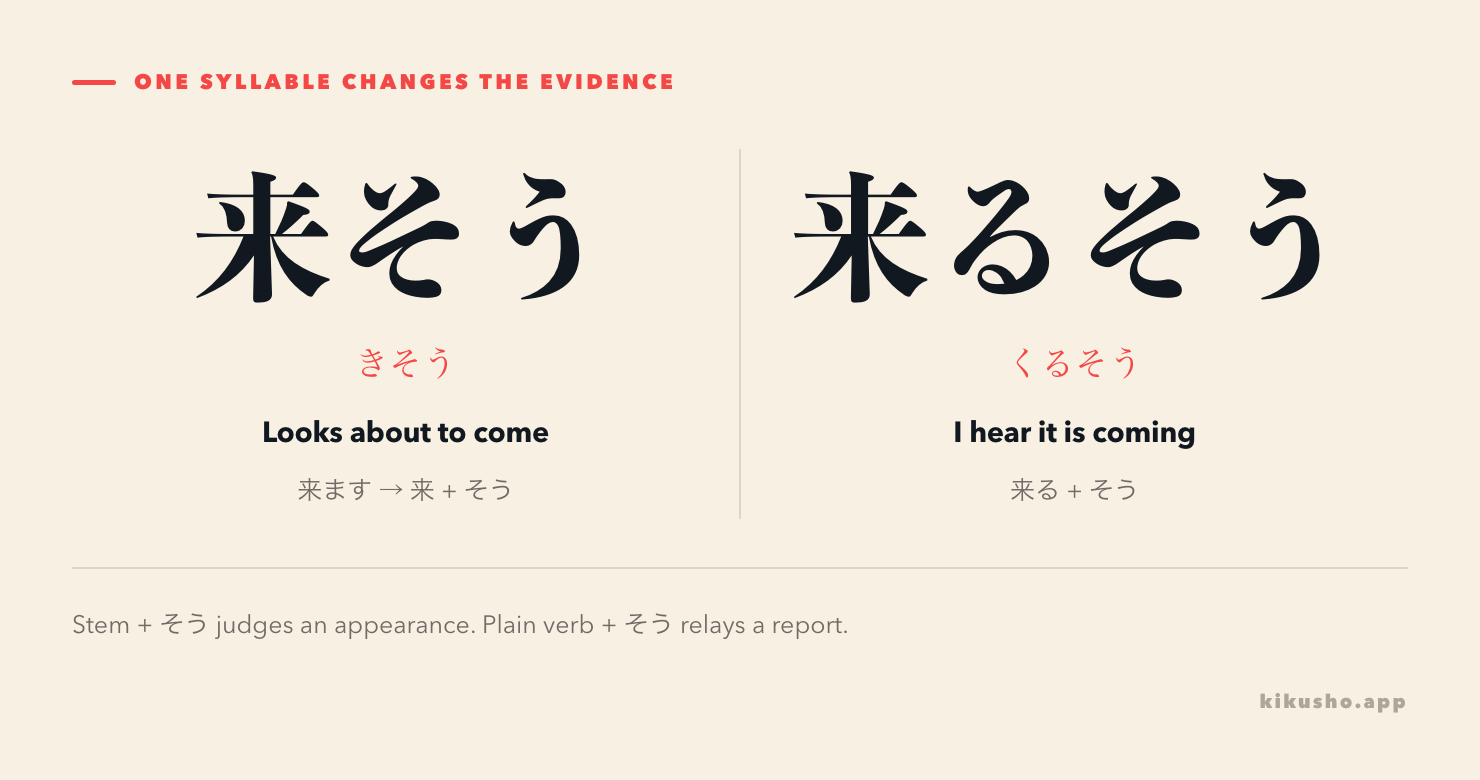
| Before そう | Form | What the speaker does |
|---|---|---|
| Verb ます-stem: 来ます → 来 | 来そうだ | Judges that the action looks imminent |
| い-adjective minus い: 高い → 高 | 高そうだ | Judges an appearance, “looks expensive” |
| な-adjective base: 静か | 静かそうだ | Judges an appearance, “seems quiet” |
| Plain verb: 来る | 来るそうだ | Relays a report, “I hear it is coming” |
| Full い-adjective: 高い | 高いそうだ | Relays a report, “I hear it is expensive” |
| Noun or な-adjective plus だ: 休みだ/静かだ | 休みだそうだ/静かだそうだ | Relays what someone said |
The appearance pattern is described in Bunpro's N4 そう lesson and Tofugu's adjective そう guide. The Japan Foundation's Irodori Lesson 13 distinguishes a plain-form そうだ report from the speaker's own judgment. A そう after a full clause is hearsay, even when the reported claim itself concerns an appearance. Ask what そう attaches to first.
Appearance そう also changes shape to fit what follows: 眠そうな顔 (ねむそうな かお) is a “sleepy-looking face,” and うれしそうに話した (うれしそうに はなした) means “spoke looking pleased.” そうな modifies a noun; そうに describes the action. This pair is the assigned そうな/そうに item, not a second hearsay ending. Bunpro's N4 account confirms both positions.
らしい can suggest a report or what is characteristic
来週は休みらしいです (らいしゅうは やすみらしいです) means “Apparently, next week is a day off.” The speaker has heard or noticed something and draws a tentative conclusion. 来週は休みだそうです instead relays a statement about the holiday without presenting that same personal conclusion. After a noun, らしい attaches directly: 休みらしい, not 休みだらしい. Irodori Lesson 13 gives this distinction and the noun attachment. Heard information can feed らしい, so “らしい means only things I saw” would be false.
秋らしい空 (あきらしい そら) is “a sky characteristic of autumn.” Nobody needs to have reported a fact about this sky; らしい here names a typical quality. Bunpro's N4 らしい account records both the reported/inferred and characteristic uses. The inventory's JLPT Sensei N4 row is assigned here, while a Tanos N3 list matches the surface form. That difference does not prove a different sentence wrong or give one meaning a precise exam boundary.
よう and みたい can infer from clues or describe resemblance
An entrance is shut and the lights are off: 今日は店が休みのようです (きょうは みせが やすみのようです) says “It seems the shop is closed today.” 今日は店が休みみたいです gives a similar inference in a more conversational register. For nouns, the shape matters: 休みのようだ but 休みみたいだ. With a な-adjective, use 静かなようだ but 静かみたいだ. A plain verb can precede either form. Japan Foundation Irodori Lesson 4 describes みたいだ as a judgment from seen, felt or experienced clues; Tae Kim's original grammar guide explains the more formal よう and colloquial みたい forms.
Neither word is limited to uncertain guesses. 図書館のような部屋 (としょかんの ような へや) and 図書館みたいな部屋 both describe a “room like a library.” 図書館のように静かです (としょかんの ように しずかです) and 図書館みたいに静かです say it is “quiet like a library.” The comparison can be quite confident: you are describing a resemblance, not claiming that the room may literally be a library. The Japan Foundation's よう teaching material gives the predicate, noun-modifying and adverbial likeness shapes.
| Job in the sentence | よう form | みたい form |
|---|---|---|
| Finish a thought | 図書館のようだ | 図書館みたいだ |
| Modify a noun | 図書館のような部屋 | 図書館みたいな部屋 |
| Describe an action or quality | 図書館のように静か | 図書館みたいに静か |
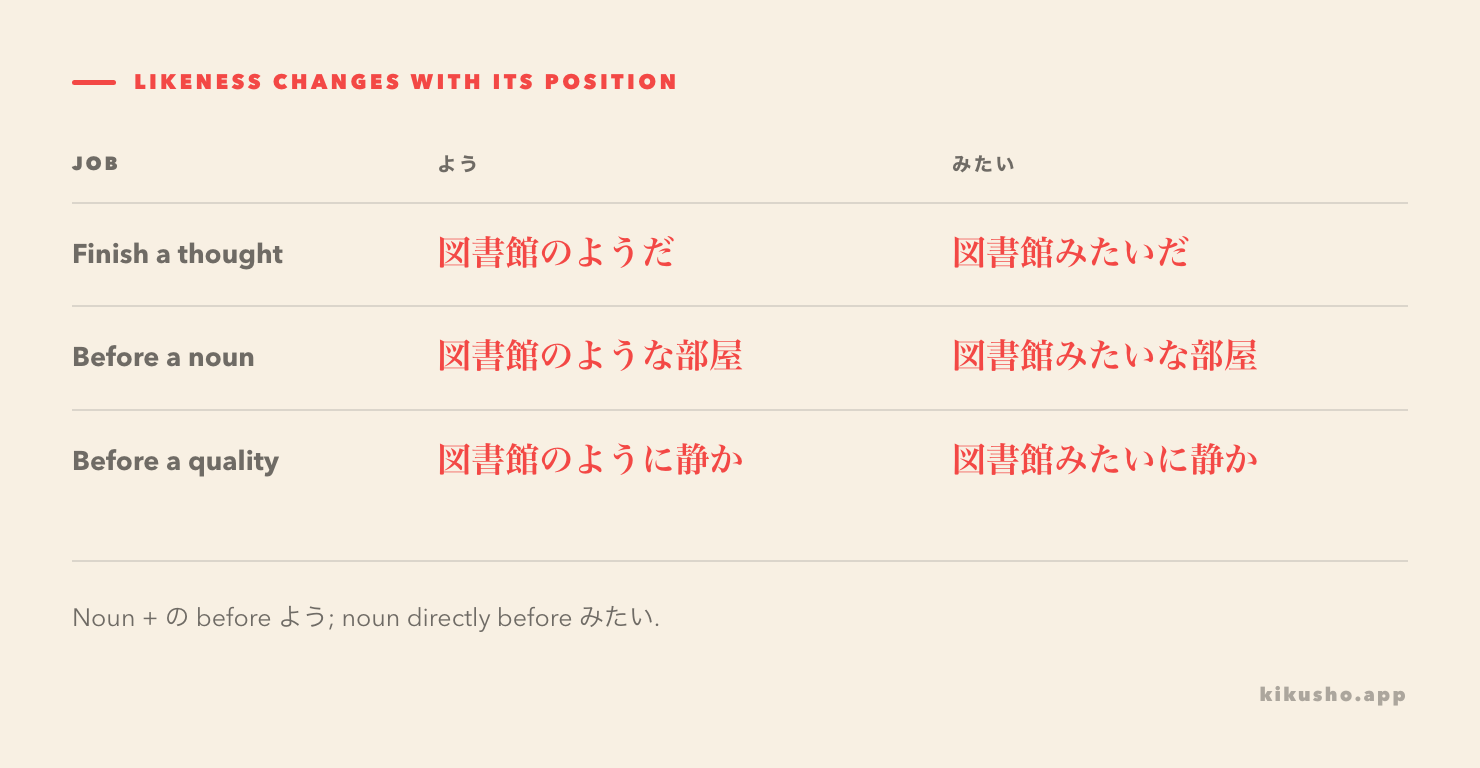
That table teaches the assigned ようだ, ような/ように, みたいだ, みたいな, and みたいに items. The な or に depends on what follows, while the の before よう depends on the noun that precedes it. Do not confuse this comparison ように with purpose ように in ように versus ために, or with the volitional ~よう in ~ようと思う.
Ask what you know, then check the form
Relaying a named person's words? Use plain-clause そうだ. Judging that something is about to happen or seems a certain way from its presentation? Use stem そうだ. Making a tentative conclusion from what you heard or noticed? らしい is available, but it also names typical qualities. Interpreting clues or comparing one thing with another? ようだ and みたいだ overlap, with よう often sounding more formal. These are useful starting questions, not an automatic translation grid: evidence and context overlap.
When you save a real Japanese sentence in Kikusho, keep the clause before the ending. A card containing only そう loses the contrast between 来そう and 来るそう. Retain the whole line and, when it returns in offline review, identify both the attachment and the source of the claim.
Practice: read the evidence and complete the sentence
Try all six questions before opening the answer section. The choices and clues are original to this lesson.
Question 1 — grammar choice. You can see a bus approaching in the distance. Which sentence says it looks about to arrive?
- A. バスが来そうです。
- B. バスが来るそうです。
- C. バスが来たそうです。
Question 2 — grammar choice. An employee has told you that tomorrow is a day off, and you want to relay that statement. Which ending fits 明日は休み__?
- A. そうです
- B. だそうです
- C. らしいです
Question 3 — sentence composition. Describe a room that looks like a library. Use 図書館 and 部屋 with the more formal likeness form, ending at the noun.
Question 4 — sentence composition. Say “She spoke looking pleased” in the past. Use うれしい and 話す, with an appearance form that describes the action.
Question 5 — text grammar. A sign and a closed door are your clues. Complete the more conversational sentence “It seems the shop is closed today”: 今日は店が休み__です。 Use みたい or よう and decide whether 休み needs a connector.
Question 6 — text grammar. In 秋らしい空, is the speaker relaying someone's report about the sky, or saying the sky has a quality typical of autumn? Explain what らしい attaches to.
Answers and explanations
Answer 1. A, バスが来そうです。 来 is the ます-stem of 来る; stem + そう is the appearance or imminence pattern. B, 来るそうです, relays a report because 来る is a full plain verb. C reports that the bus came and changes the time as well.
Answer 2. B, 明日は休みだそうです。 The noun 休み needs だ before hearsay そうです. A omits that connector and does not form this noun report. C, 休みらしいです, is a possible sentence, but it presents an apparent or inferred conclusion rather than straightforwardly relaying the employee's words.
Answer 3. One model answer is 図書館のような部屋 (としょかんの ような へや), “a room like a library.” The noun 図書館 takes の before よう; ような then modifies 部屋. 図書館みたいな部屋 also describes likeness, but the prompt requested the more formal form.
Answer 4. うれしそうに話した (うれしそうに はなした), “She spoke looking pleased.” Remove い from うれしい before appearance そう, then use そうに to describe 話した. うれしそうな would need a following noun, such as 顔.
Answer 5. 今日は店が休みみたいです (きょうは みせが やすみみたいです) is the conversational model. 休み is a noun, so みたい attaches directly. 今日は店が休みのようです also makes a reasonable inference from the same clues, but its noun requires の and its register is more formal.
Answer 6. 秋らしい空 describes a sky with a quality typical of autumn. らしい attaches directly to the noun 秋 and modifies 空 as an い-adjective-like form. There is no claimed source saying the sky “is autumn”; this is the characteristic use, not a report.
Common questions
What is the difference between 来そうです and 来るそうです?
来そうです attaches そう to the verb's ます-stem and means the arrival looks imminent. 来るそうです attaches it to the plain verb and relays that someone says the arrival will happen.
Is らしい always hearsay?
No. It can express a conclusion from what you have heard or noticed, and it can mean characteristic of something, as in 秋らしい空, an autumn-like sky.
When do you use ような or みたいな instead of ように or みたいに?
Use ような or みたいな before a noun, and ように or みたいに before an action or quality. A noun before よう normally takes の, while a noun before みたい attaches directly.