On this page
~的 (てき) builds descriptive words that normally take な before a noun and に when modifying an action. In 消極的 (しょうきょくてき), the complete word describes holding back, lacking initiative or taking a negative stance; the suffix alone cannot decide which translation fits.
This N2 vocabulary lesson concentrates on that word and compares it with the earlier 積極的. It assumes the basic noun and na-adjective endings; it does not offer a recipe for deriving a whole N2 vocabulary list.
The pair shares a suffix, while the base changes the attitude
消極的 and 積極的 both end in 的, but point in opposite directions: holding back versus willingly moving into action. If you have read the N3 set with 不, 未, 化 and 的, 積極的 is a familiar comparison word. The new headword here is 消極的, with closer attention to what a sentence says the person is reluctant about.
The curriculum's reference inventory places 消極的 at N2 and 積極的 at N3. Its two vocabulary baselines descend from Jonathan Waller's lists, so their agreement is one source family's placement. Separately authored teaching pages from JLPT Sensei and Maggie Sensei place the suffix pattern at N3. You are applying an earlier pattern to an N2 study word, rather than learning a newly advanced conjugation. These remain study estimates: the JLPT explains why it no longer publishes exhaustive vocabulary and grammar specifications.
Two headwords give the pattern a concrete meaning
| Word | Reading | Class | Meaning in this lesson | Phrase to notice |
|---|---|---|---|---|
| 消極的 | しょうきょくてき | na-adjectival word | reserved, lacking initiative; negative toward a proposal | 消極的な態度; 計画に消極的だ |
| 積極的 | せっきょくてき | na-adjectival word | willing to act, proactive | 積極的な姿勢; 積極的に取り組む |
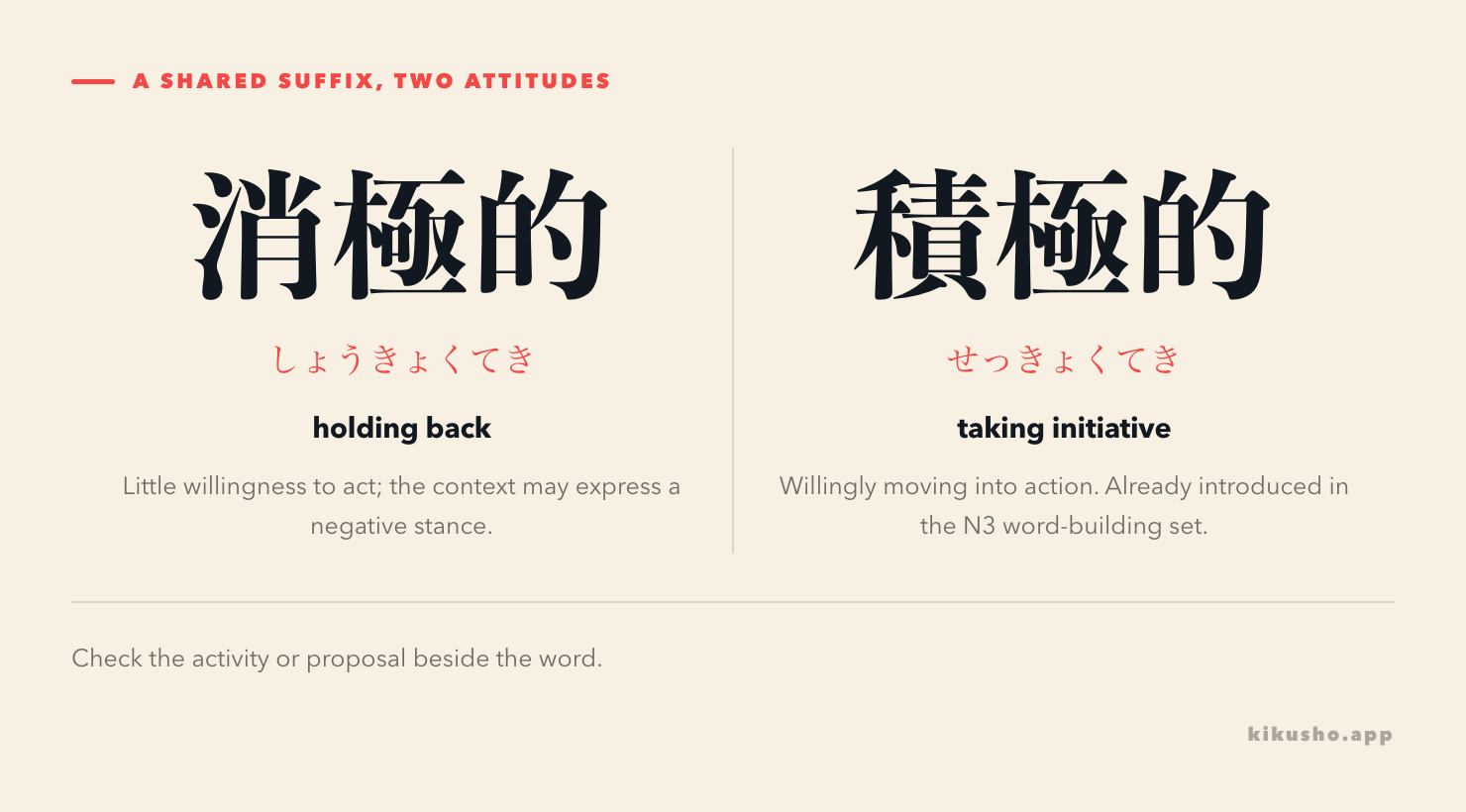
Shogakukan's 消極的 entry includes both reluctance to act and a negative stance; its 積極的 entry describes willingly doing things. Independently, the Japan Kanji Aptitude Testing Foundation's 消極 and 積極 entries confirm the contrast between holding back and acting on your own initiative.
Calling a person 消極的 often carries criticism. It can suggest that you wanted them to participate more. It need not accuse them of hostility, and it does not tell you why they held back. Calling someone 積極的 praises or identifies initiative in many settings; it need not mean angry or threatening.
的 builds the stem; な, に and です place it in the sentence
You can see the join as 消極 + 的 → 消極的. Shogakukan's suffix entry describes 的 as forming a na-adjectival stem from a noun. Learn the completed headword, then choose its attachment from the job it performs.
| Job | Pattern | Example | Reading and sense |
|---|---|---|---|
| Describe a noun | 消極的 + な + noun | 消極的な態度 | しょうきょくてきな たいど: a reserved or unenthusiastic attitude |
| Describe an action's manner | 消極的 + に + action | 消極的に対応する | しょうきょくてきに たいおうする: respond without much willingness to act |
| Make a plain statement | 消極的 + だ | その案には消極的だ | その あんには しょうきょくてきだ: be reluctant about that proposal |
| Make a polite statement | 消極的 + です | その案には消極的です | その あんには しょうきょくてきです: the same assessment in polite style |
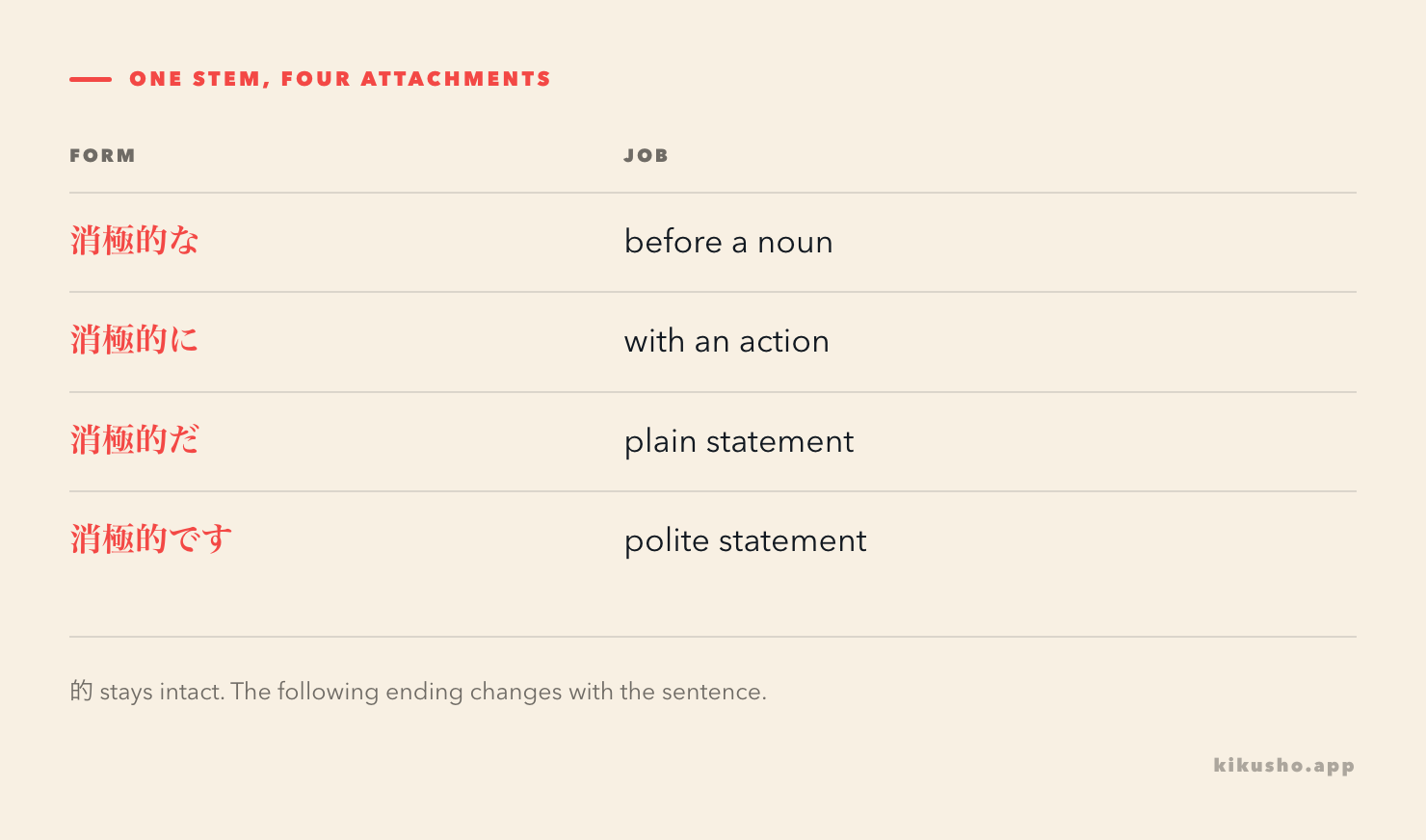
的な is therefore two pieces with different jobs. 的 belongs to the word you have built; な links that descriptive stem to the following noun. 消極的なです incorrectly keeps the noun-linking な before the sentence ending. 消極的い invents an い-adjective that this word is not.
For the negative, use 消極的ではない or conversational 消極的じゃない. For the past, use 消極的だった. You leave 的 intact and change the na-adjective ending, rather than treating the final き as an い-adjective tail.
最初は消極的だったが、今は自分から質問している。
さいしょは しょうきょくてきだったが、いまは じぶんから しつもんしている。
They were reserved at first, but now they ask questions on their own initiative.
The change is in the person's approach. It is not a change in how the suffix is pronounced.
The words beside 消極的 tell you what the person holds back from
A phrase about a personality and a phrase about one plan do not make the same claim.
彼女は人前で話すことに消極的です。
かのじょは ひとまえで はなすことに しょうきょくてきです。
She is reluctant to speak in front of people.
Here 話すことに supplies the activity. The sentence does not say that she avoids everything or opposes every proposal. She could be willing to organize the event while being reluctant to speak at it.
部長は、新しい計画に消極的な態度を示した。
ぶちょうは、あたらしい けいかくに しょうきょくてきな たいどを しめした。
The department manager showed an unenthusiastic attitude toward the new plan.
The manager's attitude concerns this plan. Translating it as “The manager is a passive person” turns a local assessment into a general personality judgment. If the surrounding response rejects the plan, “negative” may be the better English choice. The word by itself does not prove that a rejection occurred.
The inventory's short gloss “passive” is useful as a reminder, but English passive also names a grammatical voice. 消極的 supplies no passive verb ending. For that separate topic, use the Japanese passive lesson.
A visible suffix does not guarantee a natural new adjective
的 occurs in many established compounds, often built from Sino-Japanese nouns. That pattern helps you recognize a seam; it does not settle the completed word's meaning or whether people use it. Maggie Sensei explicitly warns against adding it to every noun. A dictionary entry for the whole word and examples of its usual company are stronger evidence than a plausible English translation.
Nor does every 的 expression look like the elementary X的な + noun pattern. Written compounds can connect directly without な. Treat that as an attested expression to recognize, rather than an instruction to remove な at will. The dictionary also records conversational わたし的には, roughly “from my point of view.” That spoken extension is a different register from the ordinary headword 消極的. It prevents an absolute claim that 的 only ever follows two-kanji nouns, but is not a model for coining your study vocabulary.
For this lesson's ordinary phrases, keep 消極的な態度, 消極的に対応する and 計画に消極的だ. The last phrase also keeps the object of reluctance in view. When you save a passage in Kikusho through text capture, you can check and edit the resulting card before saving it. Keeping 新しい計画に with 消極的 preserves the specific attitude you met in that passage.
Try the six tasks before opening the answer block
These original tasks use the N2 vocabulary categories in the official test-item structure. Six questions give you a small check of this lesson; they are not an official sample or a full practice test.
Question 1 — kanji reading. Read the headword aloud in 消極的な態度を示した. Which sound sequence matches 消極的?
A. しょうきょくまと
B. せっきょくてき
C. しょうきょくてき
D. しょうごくてき
Question 2 — orthography. Which spelling matches しょうきょくてき, the word describing a reserved or unenthusiastic attitude?
A. 消局的
B. 消極的
C. 積極的
D. 消極敵
Question 3 — word formation. Add the suffix that creates the na-adjectival stem in 消極__な態度.
A. 者
B. 性
C. 化
D. 的
Question 4 — meaning in context. Read 部長は新しい計画に消極的な態度を示した. What is the sentence saying?
A. The manager showed little enthusiasm for the new plan.
B. The manager volunteered to carry out the new plan.
C. The manager used a passive verb form.
D. The manager had already completed the new plan.
Question 5 — paraphrase. Which expression best preserves 彼は人前で話すことに消極的だ?
A. 人前で話すのが得意だ。
B. 人前で必ず反対意見を言う。
C. 人前で誰よりも多く話す。
D. 人前で進んで話そうとはしない。
Question 6 — usage. Which sentence uses 消極的 naturally to describe someone's willingness to act?
A. 田中さんは消極的く働いている。
B. 田中さんは新しい役割を引き受けることに消極的だ。
C. 田中さんは消極的を引き受けた。
D. 田中さんは消極的なです。
For the usage task, consider both the description's ending and the action it concerns. Record your choices for all six questions before comparing them below.
Answers and explanations
Answer 1. C: しょうきょくてき. This full headword has no small っ. B is the contrasting 積極的, A substitutes the standalone reading まと for the suffix, and D changes きょく to ごく. In this compound, 的 is read てき.
Answer 2. B: 消極的. 消 and 極 give the assigned word its base, followed by 的. A changes 極 to 局; C spells the opposite comparison word, and D replaces the suffix 的 with 敵. Similar sounds or shapes do not make those spellings interchangeable.
Answer 3. D: 的. The construction is 消極 + 的 + な + 態度. 的 forms the descriptive stem and な links it to the noun. A, B and C do not produce the taught na-adjectival word in this frame; they are not alternate spellings of 的.
Answer 4. A. The sentence reports the manager's attitude toward a particular plan. B adds willing initiative, C confuses an attitude with grammatical voice, and D invents a completed action. A leaves open whether the manager merely hesitated or later rejected the plan.
Answer 5. D. 人前で進んで話そうとはしない (ひとまえで すすんで はなそうとは しない) means that he does not willingly try to speak in front of people. A says he is good at public speaking, which could coexist with reluctance but does not paraphrase it. B adds inevitable opposition, while C adds a claim that he speaks more than anyone else. None of those is supplied by 消極的.
Answer 6. B. 新しい役割を引き受けることに消極的だ (あたらしい やくわりを ひきうけることに しょうきょくてきだ) means being reluctant to take on a new role. A invents an い-adjective-style く ending, C treats the descriptive stem as the object taken on, and D places noun-linking な before です. In B, ことに identifies the action the person is reluctant about; it does not label every aspect of their personality.
Common questions
How do you read 消極的?
消極的 is read しょうきょくてき. It describes someone who holds back or lacks initiative, or a negative attitude toward something, depending on context.
Is な the suffix that turns a noun into an adjective?
In 消極的な態度, 的 is the word-building suffix. な connects the resulting na-adjectival stem to 態度. The same stem takes に when it modifies an action, and だ or です when it finishes a statement.
Does 消極的 mean the grammatical passive voice?
No. 消極的 describes an attitude or approach. It does not mark a passive verb. A sentence can describe 消極的 behavior without containing any passive verb form.
Can you attach 的 to any noun?
Many established words use 的, especially Sino-Japanese compounds, but recognizable pieces do not guarantee a natural new word. Check the complete expression and its context; conversational inventions also differ from ordinary dictionary vocabulary.