On this page
だに and すら can both be translated as “even,” but they do different work. だに belongs to a small written set built around a mere thought, perception or total absence; すら selects one extreme example on a scale and lets you infer what happens to the less surprising cases.
That attachment difference is the safest test. If merely recalling an event causes a reaction, 思い出すだに may fit. If the point is that the claim reaches even an expert, a child, one page or your own family, use すら after that focused phrase.
First ask whether the sentence contains a trigger or a scale
Compare these two sentences:
あの夜のことは、思い出すだに背筋が寒くなる。
あの よるの ことは、おもいだすだに せすじが さむくなる。
The mere thought of that night sends a chill down my spine.
この判断には、専門家ですら迷った。
この はんだんには、せんもんかですら まよった。
Even experts hesitated over this decision.
The first sentence does not rank 思い出す, “recall,” against other actions. It says that carrying out that mental act alone is enough to produce the reaction. The second deliberately chooses experts as the surprising edge of a group. If even they hesitated, people with less expertise can be expected to hesitate too.
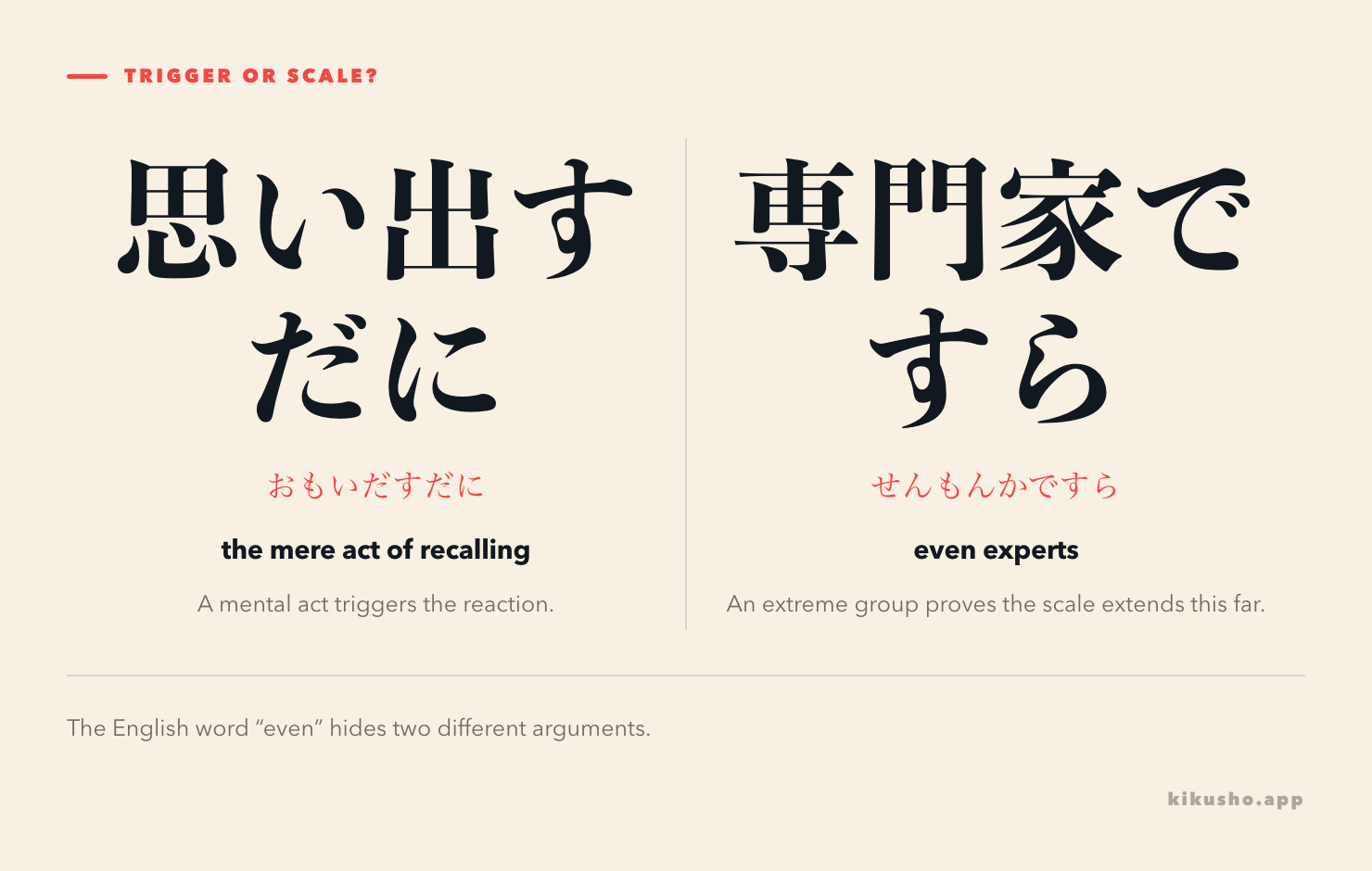
This is why swapping the particles mechanically fails. 専門家だに迷った does not become an elegant version of the second sentence, and 思い出すすら背筋が寒くなる does not have the required attachment. The shared translation hides two different sentence structures.
だに turns a mere mental or sensory act into a trigger
In its productive-looking but lexically narrow pattern, だに follows the dictionary form of a verb:
| Form before だに | Model phrase | What follows |
|---|---|---|
| 思う | 思うだに | a feeling or bodily reaction |
| 考える | 考えるだに | a judgment such as frightening or painful |
| 思い出す | 思い出すだに | a reaction to recalling |
| 見る/聞く | 見るだに/聞くだに | a response to perception |
被害の大きさは、考えるだに胸が痛む。
ひがいの おおきさは、かんがえるだに むねが いたむ。
Merely thinking about the scale of the damage is painful.
その施設の実情は、聞くだに気が重くなった。
その しせつの じつじょうは、きくだに きが おもくなった。
Just hearing about the conditions at that facility made me feel heavy.
The reaction is often unpleasant: fear, pain, anger, disgust or dread. That tendency comes from use, not from a grammatical rule that forces every following predicate to be negative. The main clause may be affirmative in form, as 胸が痛む is; its content supplies the adverse response.
MLC’s だに reference identifies dictionary-form attachment, the written and old-fashioned register, and the narrow group of verbs that actually occurs. The Japanese-teacher review independently records the same mental and sensory verbs and describes the following emotional response. This is a pattern to recognize in prose, not an invitation to add だに after any verb that happens to translate well.
だにしない intensifies complete absence in a small set
The negative family looks different. A verbal noun or fixed noun phrase comes before だに, and the predicate denies the action or any trace of it:
| Expression | Practical reading |
|---|---|
| 予想だにしなかった | did not anticipate it in the slightest |
| 想像だにしない | does not even imagine it |
| 微動だにしない | does not move at all |
| 夢にだに思わなかった | never even dreamed of it |
こんな静かな町で事件が起きるとは、予想だにしなかった。
こんな しずかな まちで じけんが おきるとは、よそうだに しなかった。
I never imagined that an incident would occur in such a quiet town.
呼びかけても、その動物は微動だにしなかった。
よびかけても、その どうぶつは びどうだに しなかった。
Even when called, the animal did not move at all.
The exception 夢にだに preserves に. Treat the whole phrase as something you recognize together. Modern Japanese does not freely turn every ordinary action noun into Nだにしない. 連絡すらしなかった, “did not even contact [me],” is productive; replacing すら with だに would sound forced outside a deliberately archaic style.
JLPT Sensei’s だに entry places the form at N1, lists verb and noun attachment, and records 夢に as the exceptional shape. The guide also calls the expression old and commonly negative. Those labels are useful study placement, rather than an official item-by-item JLPT syllabus.
すら places one member at the edge of a scale
すら attaches to a noun, a nominalized action or a phrase already marked by a case particle. It says that the predicate reaches this surprising case, so the listener can extend the claim to cases nearer the expected center.
初心者ですら、その違いに気づいた。
しょしんしゃですら、その ちがいに きづいた。
Even a beginner noticed the difference.
忙しくて、一ページ読むことすらできなかった。
いそがしくて、いちページ よむことすら できなかった。
I was so busy that I could not even read one page.
その事情は、同僚にすら話せない。
その じじょうは、どうりょうにすら はなせない。
I cannot tell even my colleagues about the situation.
The scale changes with the predicate. A beginner can be the surprising low-expertise person who succeeds; an expert can be the surprising high-expertise person who fails. Negation is common because it makes the inference vivid, but affirmative 初心者ですら気づいた is fully possible.
| Role of the focused phrase | Attachment | Example |
|---|---|---|
| ordinary noun focus | N + すら | 名前すら覚えていない |
| category or status | N + で + すら | 専門家ですら迷う |
| recipient or target | N + に + すら | 家族にすら言えない |
| action treated as a thing | V + こと + すら | 立つことすらできない |
In ですら, the boundary is で+すら. It is not the polite copula です followed by ら. Other case particles can remain for the same reason: に still identifies the person who would receive the information in 家族にすら言えない.
Bunpro’s すら account gives the structure as noun plus an optional particle plus すら, identifies the register as formal, and describes the extreme-case inference. Tanosuke’s teacher reference likewise records noun-plus-particle attachment, frequent negative contexts and the more literary tone. JLPT Sensei independently places すら/ですら at N1.
The overlap is narrow, and the inference is different
There is one important overlap:
誰もその展開を予想すらしなかった。
だれも その てんかいを よそうすら しなかった。
No one even anticipated that development.
誰もその展開を予想だにしなかった。
だれも その てんかいを よそうだに しなかった。
No one anticipated that development in the slightest.
Both are possible. The すら version treats anticipating as a minimal or surprising action that did not occur. The だに version belongs to the established negative collocation and intensifies the complete absence of anticipation. The second sounds older and more literary.
Elsewhere, the substitution breaks. 専門家ですら分からない chooses experts as an extreme group. 思い出すだに苦しい says that merely recalling is enough to hurt. One asks “which case proves the scale extends this far?” The other asks “is this bare act enough to trigger the reaction?”
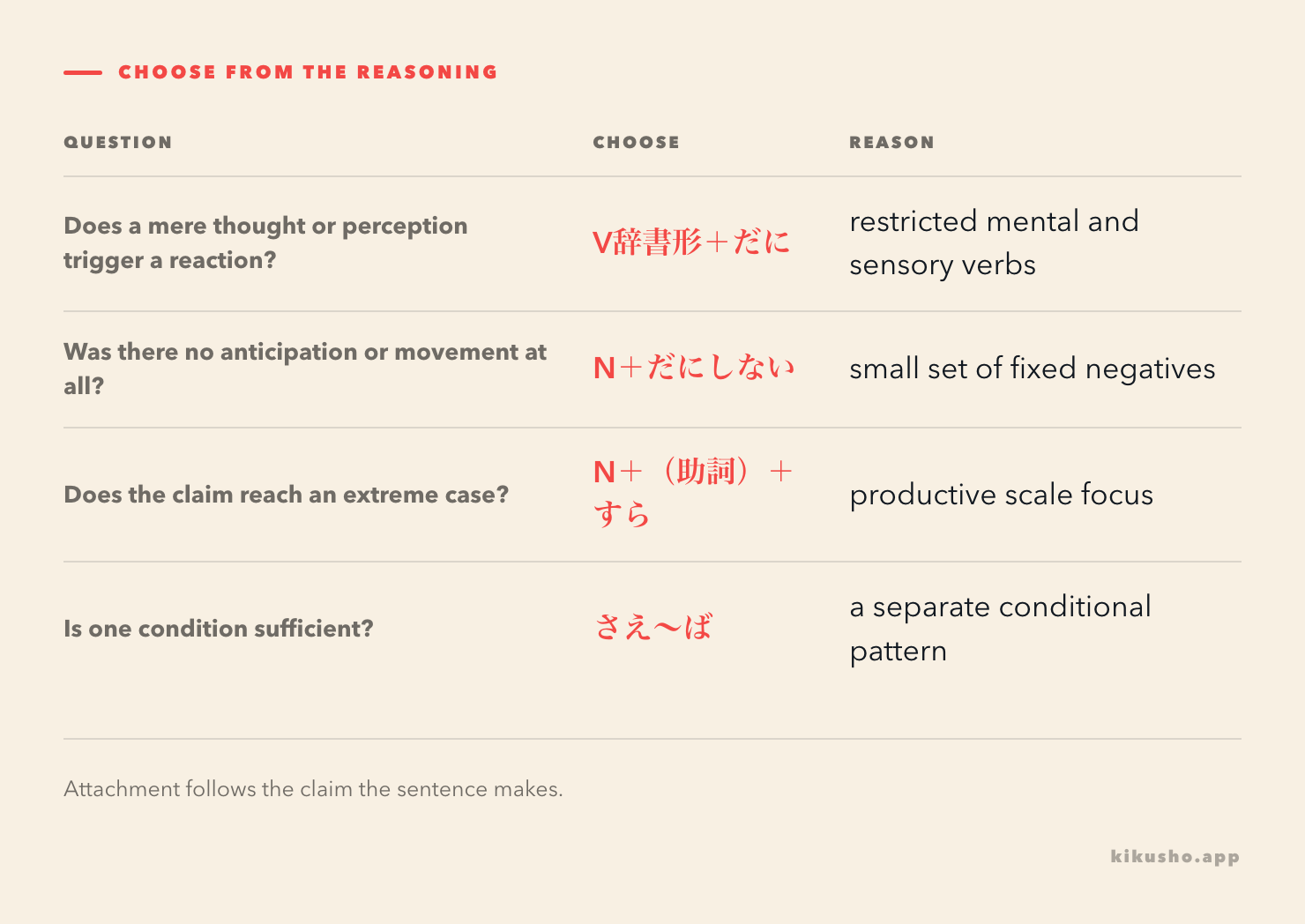
The nearby particle さえ overlaps far more with すら than だに does. The こそ and さえ lesson covers ordinary extreme focus; すら is its more literary or formal neighbour. The さえ~ば lesson covers a boundary that cannot be transferred: これさえあれば means “as long as you have this,” while これすらあれば is not the standard sufficiency construction. A Japanese applied-linguistics account of さえ and すら confirms both the frequent overlap and this conditional limit.
Register changes whether the emphasis helps or insults
Both forms belong more readily to careful writing, narration and formal commentary than to relaxed daily conversation. だに is the more restricted and archaic of the two. In ordinary speech, 考えるだけでも怖い often carries the idea of 考えるだに恐ろしい, while まったく予想していなかった avoids the literary weight of 予想だにしなかった.
すら remains productive, but its scale can evaluate people. 新人ですら知っている may be a useful argument about how basic some knowledge is; said in front of a newcomer, it can also reduce that person to the bottom of a scale. The grammar does not create contempt by itself. The chosen extreme and the situation do.
This is also why a one-word flashcard is weak here. Save 予想だにしなかった as a collocation, and keep the whole predicate beside 専門家ですら判断できない so the scale remains visible. Kikusho can turn the line you found in an essay into an editable card with its reading, register note, example and audio. During review, the clause then restores the reasoning that the shared gloss “even” would erase.
Practice: find the trigger, the fixed negative or the scale
Question 1
Choose the natural completion for “The mere thought of that winter makes me shiver.”
あの冬のことは、思い出す( )体が震える。
- ア. だに
- イ. ですら
- ウ. にすら
- エ. だにしない
Question 2
Choose the phrase that marks researchers as the surprising extreme group.
研究者( )判断に迷った。
- ア. だに
- イ. ですら
- ウ. にだに
- エ. ことすら
Question 3
What does その結果は予想だにしなかった emphasize?
- ア. The result was predicted only by experts.
- イ. The result was not anticipated in the slightest.
- ウ. Predicting the result caused an emotional reaction.
- エ. The result was less surprising than other outcomes.
Question 4
Arrange these chunks to say “I could not explain the circumstances even to my family.”
- 話せなかった
- 家族
- 事情を
- にすら
Question 5
Which sentence naturally means “My throat hurt, and I could not even drink water”?
- ア. 喉が痛くて、水を飲むだに恐ろしかった。
- イ. 喉が痛くて、水すら飲めなかった。
- ウ. 喉が痛くて、水ですら飲めなかったことだに。
- エ. 喉が痛くて、水にすら飲めなかった。
Question 6
A report is so disturbing that merely hearing its outline makes the speaker feel sick. Choose the form.
報告の概要は、聞く( )気分が悪くなる。
- ア. ですら
- イ. ことすら
- ウ. だに
- エ. にだにしない
Question 7
Read the passage:
専門家ですら原因を特定できず、報告書には「この規模の障害は予想だにしなかった」とある。
What does each marked form contribute?
- ア. Both forms simply make the sentence polite.
- イ. すら focuses experts as an extreme case; だにしなかった denies any prior anticipation.
- ウ. すら gives a sufficient condition; だに marks the cause of the failure.
- エ. すら focuses the report; だに means the prediction was accurate.
Answers and explanations
Answer 1
ア. だに. Dictionary-form 思い出す belongs to the narrow trigger pattern: merely recalling the winter brings on the reaction. ですら needs a nominal extreme, and だにしない would build a negative expression.
Answer 2
イ. ですら. Researchers form a category expected to judge confidently, so the sentence reaches a surprising edge: even they hesitated. Here で+すら follows the noun. だに does not productively mark a group on this scale.
Answer 3
イ. 予想だにしなかった is an established written negative meaning that the speaker did not anticipate the result at all. It neither identifies an expert group nor describes an emotion caused by the act of predicting.
Answer 4
2 → 4 → 3 → 1: 家族にすら事情を話せなかった。 The target marker に remains before すら. The whole phrase makes family the surprising people to whom the speaker still could not explain the circumstances.
Answer 5
イ. 水すら飲めなかった. Water is the minimal item the speaker could not drink. に would give water the wrong case role, and ordinary noun 水 does not belong to a fixed だに negative expression.
Answer 6
ウ. だに. 聞くだに気分が悪くなる means that the act of hearing alone triggers the adverse reaction. 聞くことすら would focus the nominalized action as an extreme case and would need a predicate suited to that scale.
Answer 7
イ. 専門家ですら selects experts as the surprising edge: if they cannot identify the cause, others are even less likely to. 予想だにしなかった is the restricted literary negative and says that an incident of this scale had not been anticipated at all.
Common questions
What is the difference between だに and すら?
だに is restricted in modern Japanese. After a dictionary-form mental or sensory verb, it means that merely thinking, seeing or hearing is enough to trigger a reaction; in fixed negative expressions it strengthens complete absence. すら productively focuses a noun or particle-marked phrase as an extreme case and implies that less surprising cases follow.
What attaches before だに?
One pattern uses a dictionary-form verb, especially 思う, 考える, 想像する, 見る or 聞く. The negative pattern often uses a verbal noun such as 予想 or 想像 before だにしない. Fixed expressions include 微動だにしない and 夢にだに思わない.
Is すら the same as さえ?
They often overlap when marking an unexpected example, but すら is more literary or formal. さえ is more common and also forms the sufficiency pattern さえ~ば; すら does not replace it there.
Is ですら the polite form of すら?
No. In a phrase such as 初心者ですら, the sequence is the connective で followed by the focus particle すら. It marks the category “even a beginner”; it is not polite です plus an ending.