On this page
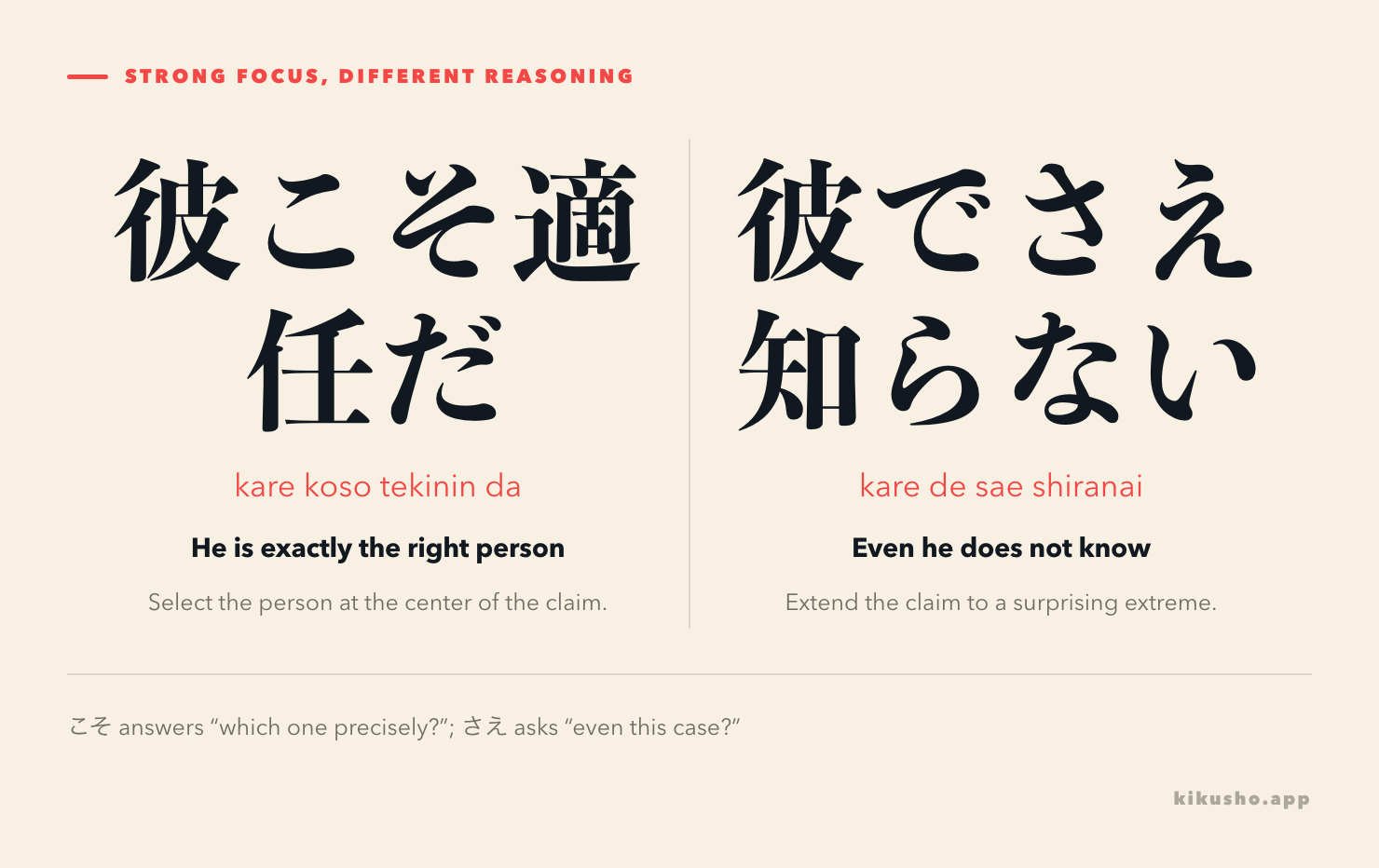
Use こそ to mark the person, time, thing or reason that is precisely central: 彼こそ適任です means “He is exactly the right person.” Use さえ to present an unexpectedly extreme example: 彼でさえ答えを知らない means “Even he does not know the answer.”
Both particles place strong focus on what comes before them, but they make different arguments. こそ selects: this one rather than the alternatives, or this time after earlier failures. さえ extends: if this surprising or minimal case is true, the surrounding claim is stronger than expected. JLPT Sensei, Bunpro and Tanos place both uses at N3. That agreement belongs to study guides; the exam authority does not issue a form-by-form grammar inventory.
こそ marks the very element that matters
In 彼こそ適任です (かれこそ てきにんです), the speaker does more than say that he is suitable. こそ picks him out as the especially appropriate choice: “He is the very person for the role.” Bunpro describes こそ as strong highlighting, comparable to underlining or stressing a word in speech.
The contrast may be explicit or supplied by the situation. 今年こそN3に合格したい means “This year, for sure, I want to pass N3,” usually after earlier years did not produce that result. 今こそ制度を見直すべきです means “Now is precisely the time to review the system.” これこそ探していた本です means “This is the very book I was looking for.” The particle does not itself mean “finally,” but repeated attempts or rejected alternatives often make that translation natural.
こちらこそ is a frequent response to thanks or an apology. If someone says ありがとうございます, こちらこそ、ありがとうございます means “I should be thanking you.” The reply redirects the emphasized obligation toward the speaker's side. JLPT Sensei's こそ lesson records noun + こそ, this reciprocal phrase, and time expressions such as 今年こそ.
The core lesson here is noun or noun phrase + こそ. Related frames give the focus a larger job: 努力したからこそ成功した means “It succeeded precisely because of the effort.” That sentence focuses the reason after から. 大人になってこそ分かる uses てこそ for a condition under which understanding becomes possible; Bunpro treats that as a later, separate pattern. Do not assume every こそ sentence has the same attachment as simple 彼こそ.
さえ chooses an unexpected or minimal case
彼でさえ答えを知らない (かれでさえ こたえを しらない) chooses someone expected to know, then says the claim reaches even him. The listener can infer that other people are unlikely to know either. 子供でさえ知っている works in the other direction: if even a child knows, adults are certainly expected to know. The sentence is affirmative, so さえ is not tied to negation.
Negative predicates are common because they create a clear low threshold. 忙しくて、水さえ飲む時間がない means “I am so busy that I do not even have time to drink water.” ひらがなさえ読めない says “cannot even read hiragana.” Water and hiragana are presented as minimal, ordinary cases; failing there suggests failure at more demanding cases too.
JLPT Sensei gives さえ and でさえも as “even” or “not even”. Bunpro's N3 さえ account also includes affirmative and negative examples and calls the register standard. さえも can add another layer of emphasis, but さえ alone already marks the extreme.
Track the particle that the focused phrase needs
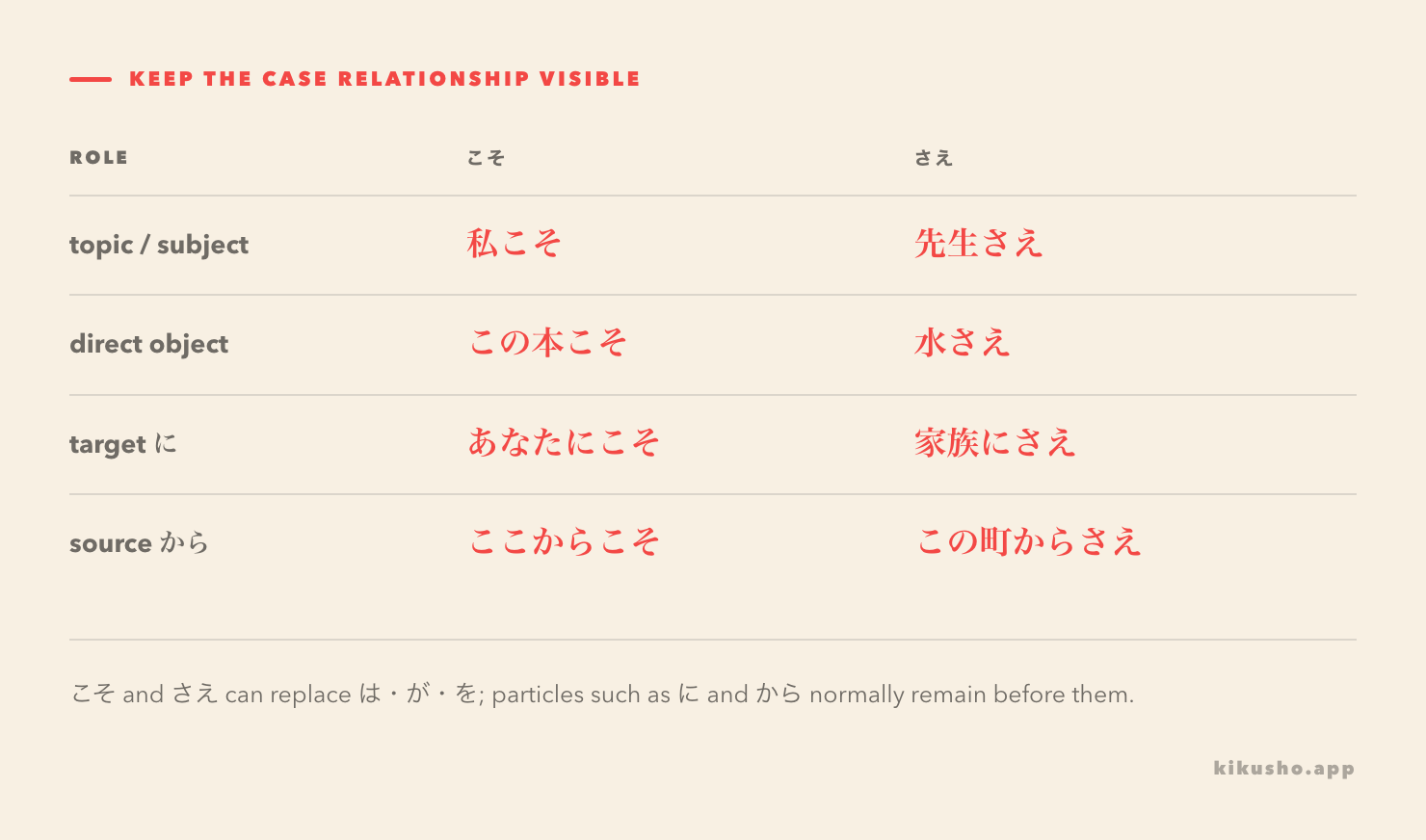
When は, が or を would mark the noun, こそ or さえ commonly occupies that focus slot instead: 私こそ責任者です, 彼こそ助けられる, 水さえ飲めない. Do not stack an ordinary が or を before these examples.
Other case relationships usually remain visible. あなたにこそ話したい means “You are precisely the person I want to tell.” 家族にさえ言えない means “I cannot say it even to my family.” この町からさえ山が見える means “The mountain is visible even from this town.” The case particle identifies the relationship, then こそ or さえ adds focus.
| Relationship | Focused form | What happened to the ordinary particle? |
|---|---|---|
| topic or subject | 私こそ/先生さえ | は or が is normally replaced |
| direct object | この本こそ/水さえ | を is normally replaced |
| recipient or target | あなたにこそ/家族にさえ | に remains before the focus particle |
| source | ここからこそ/この町からさえ | から remains before the focus particle |
でさえ needs context rather than one mechanical translation. In 子供でさえ知っている, it frames “being a child” as the surprising category. In 教室でさえ携帯を使う, で marks the location: “They use their phones even in class.” Read the phrase before さえ and recover the role it plays in the sentence.
Selection and extension produce different contrasts
Compare 今度こそ成功させる with 彼でさえ失敗した. The first speaker selects the next attempt as the decisive one: “Next time, I will make it succeed.” The second chooses a highly capable person as the unexpected edge of failure: “Even he failed.” Replacing one particle with the other would not merely change intensity; it would change the reasoning.
The same distinction appears with people. あなたこそ必要です identifies you as exactly the person needed. あなたさえ知らなかった would mean “Even you did not know,” implying that the speaker expected you, of all people, to know. こそ elevates the phrase as the answer or center. さえ places it on a scale and reaches a surprising point.
Do not merge this extreme-example use with さえ~ば. お金さえあれば大丈夫です means “As long as there is money, it will be fine”; it presents one condition as sufficient. The shared さえ supplies focus, but the conditional ending creates a different construction. This lesson stays with standalone さえ meaning “even.”
If you want to see さえ inside a larger escalation, ばかりか can introduce a second, more striking fact. For a formal argument using 今こそ, see ではないか and じゃないか for checking and challenging.
In Kikusho, keep the particle with the predicate that explains its scale. A card with only 彼でさえ does not reveal why he is surprising; 彼でさえ答えを知らない does. Likewise, save the failed earlier attempt beside 今度こそ when that history supplies the emphasis. The full sentence preserves the contrast that a one-word gloss loses during offline review.
Practice: locate the focused element
Try all seven situations before moving to the shared explanation section.
Question 1 — choose the particle. After failing twice, you say “This time for sure, I will finish it.” Which beginning fits?
- A. 今度こそ
- B. 今度さえ
- C. 今度でさえ
Question 2 — choose the inference. 専門家でさえ分からない most naturally means that the expert is precisely the chosen person, that even an expert does not know, or that only experts know?
Question 3 — particle order. Complete “There are things I cannot say even to my family”: 家族__言えないこともある。
Question 4 — sentence composition. Say “This is the very book I was looking for.” Use これ, こそ, 探していた, and 本.
Question 5 — contrast. Complete the two ideas: “You are exactly the person we need” with こそ, then “Even you did not know” with さえ.
Question 6 — text grammar. Read: 来年こそ試験に合格したい。でも、今は基本の漢字さえ読めない。 What does each particle focus, and what contrast does the passage create?
Question 7 — boundary. In 時間さえあれば手伝えます, does さえ only mark a surprising extreme? Name the larger pattern and its contribution.
Answers and explanations
Answer 1. A, 今度こそ終わらせる。 こそ selects the next attempt as the decisive one against the failed attempts in the prompt. B and C would require a scale on which “even this time” is surprising, which is not the intended promise.
Answer 2. It means “Even an expert does not know.” The expert represents a high expected level of knowledge, so failure at that extreme supports the inference that the answer is very difficult. こそ would be needed to identify the expert as precisely the chosen person.
Answer 3. 家族にさえ言えないこともある。 The target relationship uses に, and that case particle remains before さえ. 家族さえ would change the structure and could make family the subject or direct focus rather than the person to whom something cannot be said.
Answer 4. これこそ私が探していた本です (これこそ わたしが さがしていた ほんです). こそ identifies これ as exactly the object that matches the search.
Answer 5. あなたこそ私たちに必要な人です。あなたさえ知らなかった。 The first sentence selects “you” as precisely the needed person. The second places “you” at a surprising point on the knowledge scale: if even you did not know, the fact was poorly known.
Answer 6. 来年こそ selects next year as the hoped-for decisive attempt after an implied earlier failure. 基本の漢字さえ marks basic kanji as a minimal threshold the speaker cannot yet meet. The passage contrasts strong future focus with the unexpectedly low present starting point.
Answer 7. It belongs to さえ~ば, the sufficiency pattern: “As long as I have time, I can help.” さえ focuses time as the one condition needed, while あれば supplies the conditional frame. That is related to, but broader than, standalone “even.”
Common questions
What is the difference between こそ and さえ?
こそ singles out the preceding element as precisely the important or appropriate one. さえ presents it as an unexpected or extreme example, often supporting a wider inference.
Do こそ and さえ replace other particles?
They commonly replace は, が or を when those mark the focused noun. Other case particles such as に and から normally remain before them, as in あなたにこそ and 家族にさえ.
Is さえ always used with a negative sentence?
No. 子供でさえ知っている, “even a child knows,” is affirmative. Negative predicates are common because “not even” naturally marks a low expected threshold.