On this page
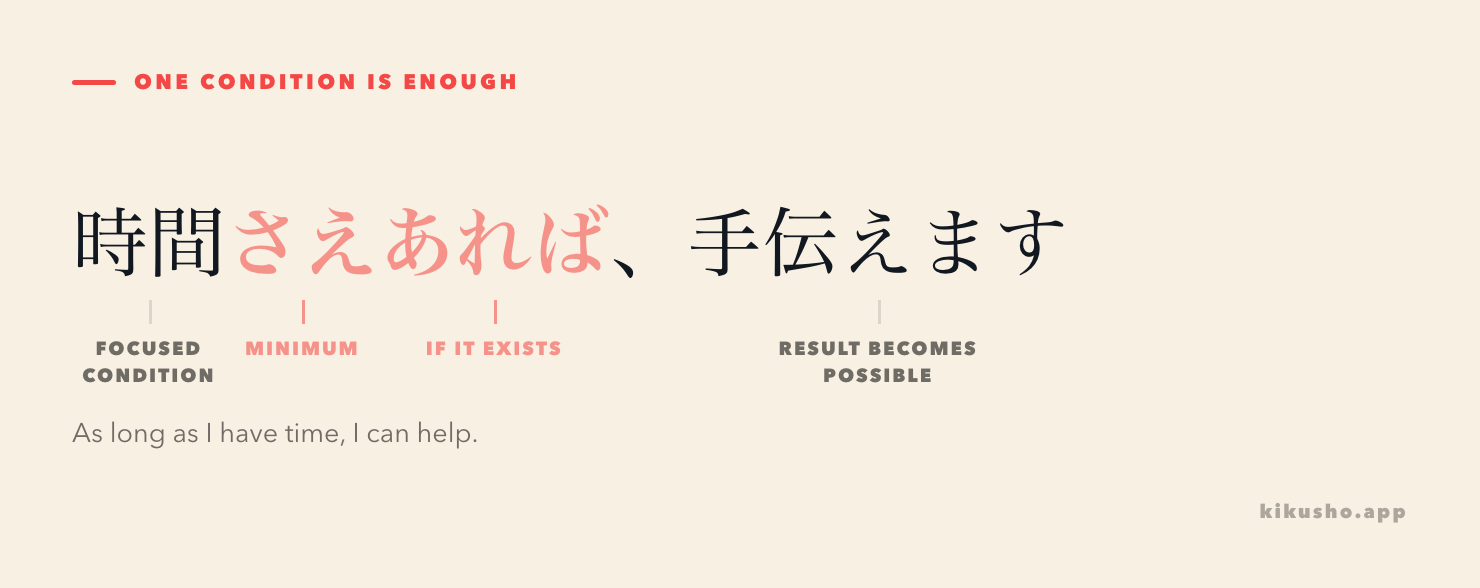
時間さえあれば手伝えます means “As long as I have time, I can help.” The construction さえ~ば singles out one minimum condition and presents it as enough for the result.
This is stronger than an ordinary “if.” 時間があれば merely sets a condition. 時間さえあれば adds the speaker's judgment that time is the only requirement that matters.
One condition carries the whole result
The pattern has two working parts:
- さえ focuses the minimum item or action.
- A conditional form, usually ~ば, connects that item to the result.
The claim of sufficiency comes from the whole structure. In チケットさえあれば入れます, the ticket is presented as all that is needed for entry. The sentence puts identification, money and every other possible requirement outside the speaker's chosen frame.
チケットさえあれば、会場に入れます。
チケットさえ あれば、かいじょうに はいれます。
As long as you have a ticket, you can enter the venue.
The Japan Foundation's Minna no Kyozai grammar note defines the pattern as a condition whose fulfillment is sufficient, with other matters treated as no problem. Bunpro's さえ~ば entry independently describes the focused clause as the only condition needed for the result and places it at N3.
Nouns focus the thing you need
A noun commonly comes before さえ, while the predicate after it carries the ば form.
| Focused noun | Conditional predicate | Complete condition |
|---|---|---|
| 時間 | ある → あれば | 時間さえあれば |
| 君 | いる → いれば | 君さえいれば |
| 天気 | いい → よければ | 天気さえよければ |
| 名前 | わかる → わかれば | 名前さえわかれば |
名前さえわかれば、こちらで調べられます。
なまえさえ わかれば、こちらで しらべられます。
If we at least know the name, we can look it up here.
The focused noun need not be the grammatical subject. In 名前さえわかれば, knowing the name is the minimum information required. In この本さえ読めば十分です, reading this book is presented as enough.
When さえ focuses an ordinary subject or direct object, が and を normally disappear:
- 時間がある → 時間さえあれば
- この本を読む → この本さえ読めば
Other particles can remain when their relationship matters:
京都へさえ行ければ、今回の旅行は満足です。
きょうとへさえ いければ、こんかいの りょこうは まんぞくです。
If I can at least get to Kyoto, I will be satisfied with this trip.
Here へ still marks the destination. The Japan Foundation note explicitly distinguishes the replacement of が and を from combinations in which another particle remains before さえ.
Verbs focus the action that is enough
For a deliberate action, use the ます-stem + さえすれば.
毎日少し復習しさえすれば、内容を忘れにくくなります。
まいにち すこし ふくしゅうしさえすれば、ないようを わすれにくく なります。
If you just review a little every day, the material will become harder to forget.
説明を最後まで読みさえすれば、使い方がわかります。
せつめいを さいごまで よみさえすれば、つかいかたが わかります。
All you need to do is read the explanation to the end to understand how to use it.
The form is 読みます → 読み + さえすれば. Do not put a complete ば-form before さえ: 読めばさえすれば duplicates the conditional machinery.
When the minimum condition is an ongoing action or state expressed with ている, place さえ inside that expression:
約束を守ってさえいれば、問題はありません。
やくそくを まもってさえいれば、もんだいは ありません。
As long as you keep the promise, there is no problem.
The underlying form is 守っている. Inserting さえ gives 守ってさえいれば. This is different from 守りさえすれば, which focuses carrying out the action; the ている version presents continued compliance as the sufficient state.
Adjectives make the required quality conditional
An い-adjective uses ~くさえあれば. A な-adjective uses ~でさえあれば.
| Word class | Formation | Example |
|---|---|---|
| い-adjective | stem + くさえあれば | 安くさえあれば |
| な-adjective | stem + でさえあれば | 静かでさえあれば |
家賃が安くさえあれば、駅から遠くてもかまいません。
やちんが やすくさえあれば、えきから とおくても かまいません。
As long as the rent is cheap, I do not mind if it is far from the station.
部屋が静かでさえあれば、広さは気にしません。
へやが しずかでさえあれば、ひろさは きにしません。
As long as the room is quiet, I do not care about its size.
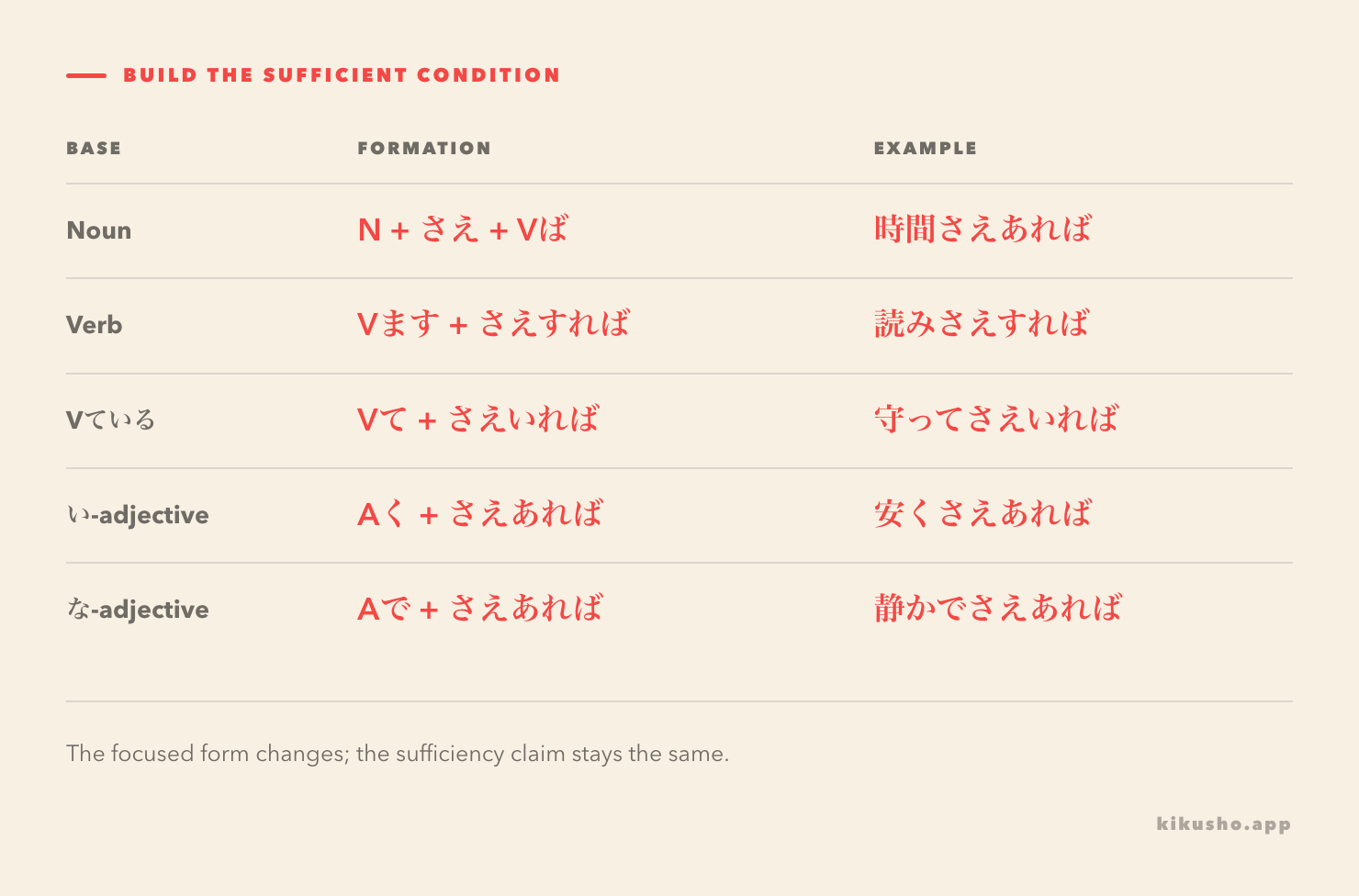
The adjective is part of the condition, so its linking form matters. 安いさえあれば and 静かなさえあれば do not follow this construction.
The result reveals what the speaker counts as enough
The second clause often expresses possibility, satisfaction, safety or another acceptable result:
- 時間さえあれば完成できます: time is enough for completion.
- 元気でさえあれば何もいりません: good health is enough for contentment.
- 一言謝りさえすれば許します: one apology is enough for forgiveness.
The tone can be hopeful, reassuring or critical. Consider:
彼は自分さえよければ、それでいいと思っている。
かれは じぶんさえ よければ、それで いいと おもっている。
He thinks everything is fine as long as things are good for him.
The grammar still marks one sufficient condition. The criticism comes from choosing the speaker's own welfare while ignoring everyone else.
Nor does the construction prove that the condition really is enough. 薬さえ飲めば治る presents taking medicine as sufficient from the speaker's perspective. Medical reality may be more complicated. Read さえ~ば as a claim about the threshold, not as a guarantee supplied by grammar.
Standalone さえ makes a different argument
Compare these two sentences:
名前さえ知らない。
I do not even know the name.
名前さえわかれば、連絡できます。
If I at least know the name, I can make contact.
In the first, さえ selects an unexpectedly basic example. In the second, さえ~ば makes the name the minimum sufficient information. The こそ and standalone さえ lesson teaches the “even” reading without importing sufficiency into it.
The ordinary ば and なら comparison is also a prerequisite. A bare 時間があれば says what happens if time is available. Adding さえ tells the reader how the speaker ranks that condition among all possible requirements.
JLPT Sensei, Bunpro and the Tanos comparison list all place this construction at N3, and the Japan Foundation's older teaching reference records it under the former Level 2. These study labels are compatible rather than contradictory. The exam authority does not publish a complete grammar-item list.
Practice the threshold
Answer all six questions before opening the explanations.
Question 1: noun condition. Complete “As long as I have time, I can finish it”: 時間__あれば、終わらせられます。
- A. がさえ
- B. さえ
- C. をさえ
- D. でさえ
Question 2: verb formation. Choose the natural completion: この説明を最後まで__、答えがわかります。
- A. 読めばさえすれば
- B. 読みさえすれば
- C. 読んださえあれば
- D. 読むさえなら
Question 3: adjective condition. Which phrase correctly means “as long as it is cheap”?
- A. 安いさえあれば
- B. 安くさえあれば
- C. 安さえすれば
- D. 安いでさえあれば
Question 4: sentence production. Arrange チケット, さえ, ある, and 入れます to say “All you need is a ticket to enter.” Conjugate ある as needed.
Question 5: particle rule. Change 京都へ行ければ満足です so that Kyoto becomes the minimum destination that would satisfy the speaker. Keep the destination particle.
Question 6: short passage. Read: この仕事は経験がなくても、説明をよく読みさえすればできます。 Which interpretation is supported?
- A. Experience is required, but reading is optional.
- B. Reading the explanation carefully is presented as sufficient even without experience.
- C. The writer cannot even read the explanation.
- D. Reading and experience are both said to be unnecessary.
Answers and explanations
Answer 1. B, 時間さえあれば. The subject marker が is replaced by さえ, and ある becomes あれば. The condition presents time as the single requirement that matters.
Answer 2. B, 読みさえすれば. The ます-stem 読み comes before さえすれば. A stacks two conditional formations, while C and D use attachments that do not build the target verb pattern.
Answer 3. B, 安くさえあれば. An い-adjective changes to its く-form before さえあれば. The other answers either keep the dictionary ending or use noun and な-adjective material incorrectly.
Answer 4. チケットさえあれば、入れます. さえ focuses the ticket, and あれば makes its existence conditional. The result says entry becomes possible once that minimum is met.
Answer 5. 京都へさえ行ければ満足です. The particle へ remains because it marks Kyoto as the destination. さえ follows the particle and focuses reaching that destination as enough.
Answer 6. B. 経験がなくても removes experience as a requirement. 説明をよく読みさえすれば then names careful reading as the sufficient action. The passage does not claim that reading is impossible or unnecessary.
The useful information is often outside the form itself. When you meet さえ~ば, save the result clause too: it tells you exactly what the speaker believes becomes possible once the chosen threshold is crossed.
Common questions
What does さえ~ば mean in Japanese?
さえ~ば presents one condition as sufficient for a result: if that one condition is met, the speaker treats the rest as unimportant or already settled. Common translations are as long as, if only, and all you need is.
How do you attach さえ~ば to a noun?
Focus the noun with さえ and put its predicate in a conditional form, as in 時間さえあれば. Subject が and object を normally disappear when さえ replaces them, while particles such as に and へ can remain before さえ.
How do you use さえ~ば with a verb?
One common form is the ます-stem + さえすれば, as in 読みさえすれば. With an ongoing state or a ている expression, use the て-form + さえいれば, as in 元気でいてさえくれれば.
Is さえ~ば the same as standalone さえ meaning even?
No. Standalone さえ focuses an unexpected extreme, as in 名前さえ知らない, not even knowing the name. In さえ~ば, the conditional clause presents the focused element as the one sufficient requirement.