On this page
であれ (de are) means “whether it is X or Y” or “whoever it is”: the rule stays the same across cases. たりとも (tari tomo) in 一+counter+たりとも~ない means “not even one”: the smallest unit is denied or forbidden. Both sound formal, but their attachment and the work done by the following clause are different.
This is an N1 grammar comparison. JLPT Sensei and Bunpro place であれ at N1; JLPT Sensei and the Japanese teacher's account at 毎日のんびり日本語教師 place the minimum-unit たりとも pattern at N1. These are study classifications, not an official exhaustive JLPT syllabus. You should already be able to read noun phrases, counters and a negative or prohibitive clause.
Ask whether the writer varies a case or denies a unit
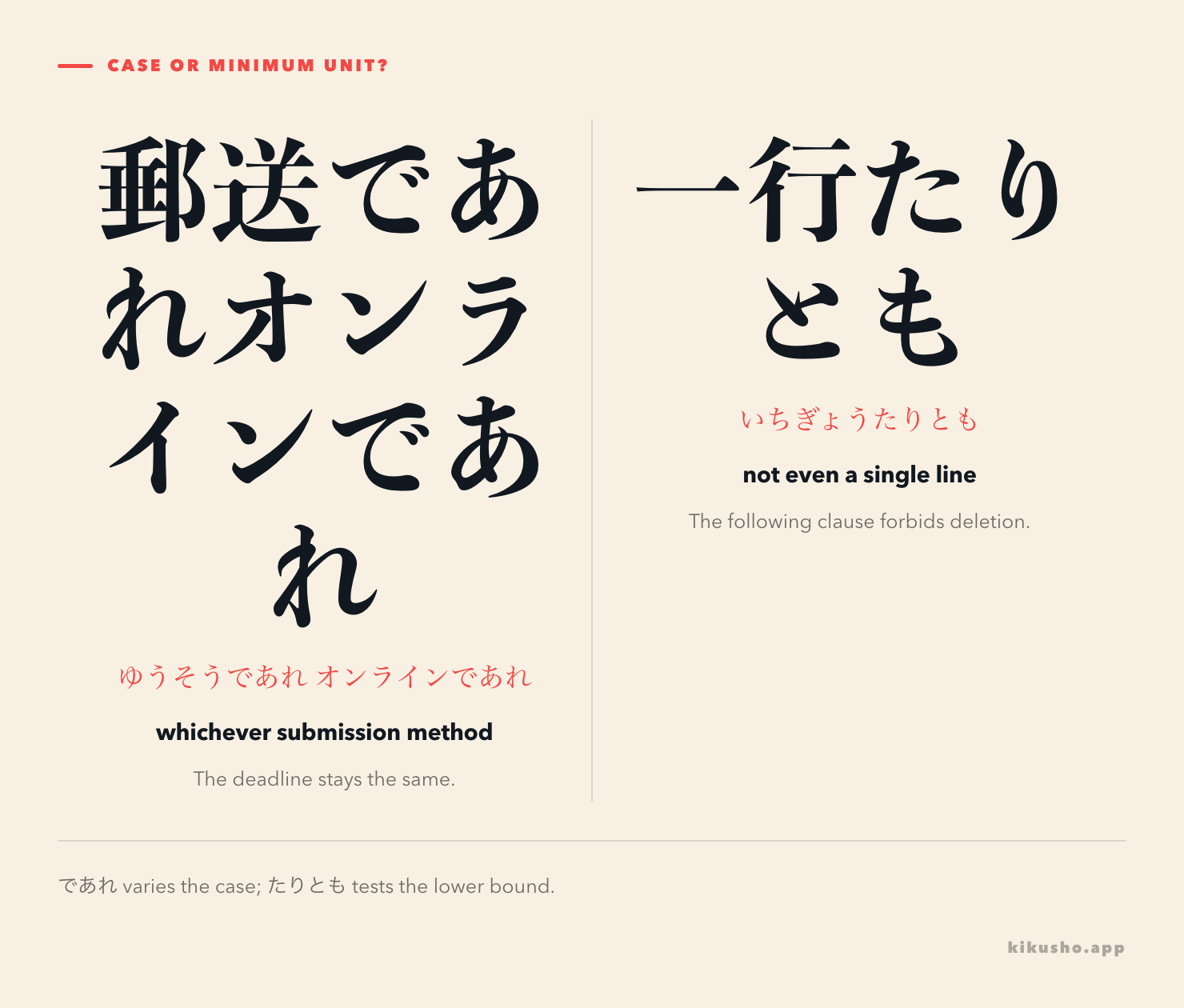
An English sentence with “even” can point to either pattern. In 郵送であれオンラインであれ、締切は同じだ, the writer changes the method of submission and keeps the deadline fixed. In 一分たりとも遅れてはならない, the writer denies permission to be late by even one minute. The first is indifferent to which case; the second puts a boundary at one unit.
| What the writer tests | Useful frame | What must follow |
|---|---|---|
| Two categories or circumstances | AであれBであれ、… | A result that holds in both cases |
| Any person or reason | 誰であれ/どんな理由であれ、… | A result unaffected by that identity or circumstance |
| The smallest counted unit | 一+counter+たりとも、… | A negative claim or a prohibition |
| No person as an exception | 何人たりとも、… | A prohibition or denial about anyone |
であれ leaves the result intact across cases
Attach であれ to a noun or an interrogative expression. You can name one possible case after たとえ, ask about any case with 誰 or どんな理由, or list two alternatives. There is no requirement that the second clause be negative.
| Input | Form | Reading and meaning |
|---|---|---|
| 郵送/オンライン | 郵送であれオンラインであれ | ゆうそう/オンライン: whether by post or online |
| 誰 | 誰であれ | だれ: whoever |
| どんな理由 | どんな理由であれ | どんな りゆう: whatever the reason |
| 小さな誤り | たとえ小さな誤りであれ | たとえ ちいさな あやまり: even if it is a small error |
提出方法が郵送であれオンラインであれ、締切は金曜日です。
ていしゅつほうほうが ゆうそうであれ オンラインであれ、しめきりは きんようびです。
Whether submission is by post or online, the deadline is Friday.
Neither method is preferred in that sentence. The two alternatives are examples of a larger rule: the deadline does not move. The paired use and its formal register are independently described by 日本語教師たのすけ and 日本の言葉と文化.
担当者が誰であれ、この規則を守らなければなりません。
たんとうしゃが だれであれ、このきそくを まもらなければなりません。
Whoever is in charge must follow this rule.
Here 誰であれ covers every possible person. The obligation is negative in form, but that is a fact about 守らなければならない, not a requirement imposed by であれ. You could also say 担当者が誰であれ、説明を受けられます, “Whoever is in charge can receive an explanation.”
であろうと keeps the same concessive test
であろうと is a closely related, often stiffer alternative after a noun. It is part of the assigned であれ/であろうと learning unit. Neither one means “not even one.”
たとえ小さな誤りであろうと、見つけたら報告してください。
たとえ ちいさな あやまりであろうと、みつけたら ほうこくしてください。
Even if it is a small error, please report it if you find it.
The instruction applies even under the named circumstance. Bunpro's であれ account explains both forms as formal concession, while 日本語教師たのすけ describes paired であろうと as especially stiff.
たりとも leaves no minimum unit outside the claim
For the modern N1 minimum-unit pattern, use 一 plus an appropriate counter, then たりとも. A negative assertion such as できない, a ban such as してはならない, or a negative imperative such as するな follows. The result denies even one occurrence, moment or person.
| Minimum unit | Form | Common continuation |
|---|---|---|
| 一分(いっぷん) | 一分たりとも | 遅れてはならない: may not be late even a minute |
| 一行(いちぎょう) | 一行たりとも | 削除してはならない: may not delete a single line |
| 一人(ひとり) | 一人たりとも | 取り残してはいけない: must not leave one person behind |
| 一度(いちど) | 一度たりとも | 忘れたことがない: never once forgot |
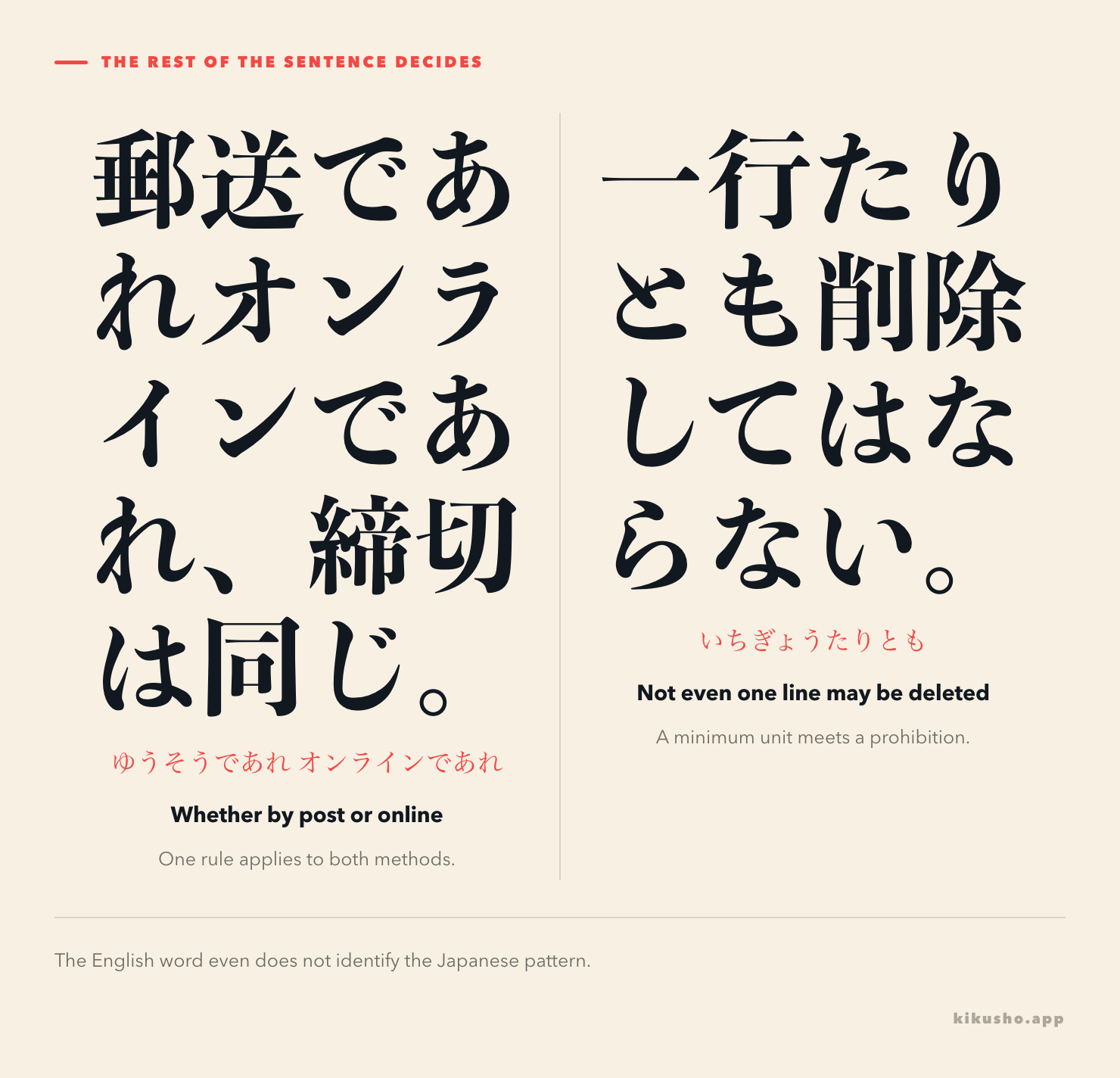
この記録は一行たりとも削除してはならない。
このきろくは いちぎょうたりとも さくじょしてはならない。
Not a single line of this record may be deleted.
The counted unit is 一行, one line. The prohibition してはならない makes it clear that even that line is protected. JLPT Sensei's construction chart gives the one-plus-counter frame; 毎日のんびり日本語教師 independently confirms the negative continuation and prohibitive use.
出発前に、一人たりとも取り残してはいけません。
しゅっぱつまえに、ひとりたりとも とりのこしては いけません。
Before departure, we must not leave even one person behind.
何人たりとも(なんぴとたりとも/なんびとたりとも)is a fixed, very formal expression meaning “no one whatsoever” when paired with a prohibition. It does not require a literal numeral 一. For example, 何人たりとも、この資料を持ち出してはならない says that no person may remove this document. 毎日のんびり日本語教師 identifies this exceptional expression; Bunpro also shows it in a formal ban.
The Japanese dictionary entry for たりとも records a broader historical concessive use after a noun. That does not make every noun equally natural in the modern one-counter-plus-negative pattern taught here. Treat a general dictionary gloss “even if” as a clue to its history, and the full sentence as the test of its current use.
Numbers can appear with both, but they settle different questions
一円であれ十円であれ、盗んではいけない compares amounts: “Whether it is one yen or ten yen, you must not steal it.” 一円たりとも盗んではいけない selects the smallest amount: “You must not steal even one yen.” Both end in a prohibition; their first halves do different work. 日本の言葉と文化 shows であれ with two amounts, so “number” alone cannot decide the form.
For a less formal concession joining two facts in written Japanese, compare ものの and とはいえ. For classical constructions, まじき and ずして show how a formal register can preserve shapes you rarely hear in daily conversation.
When you meet 一行たりとも in a document you want to remember, keep the entire restriction on your card, not only the ending. Kikusho can turn text you select or paste into a card whose reading and example you check before saving; the free plan allows five captures a day, and saved cards remain reviewable without a daily review limit. Here the counter and the prohibition are the useful memory cue.
Try the forms before checking the explanations
Write your answer to each question before scrolling to the separate answer block.
Question 1: grammar choice
Choose the best pair for a rule applying equally to both employment types.
社員( )アルバイト( )、研修を受けなければならない。
ア. であれ/であれ
イ. たりとも/たりとも
ウ. であれ/たりとも
エ. たりとも/であれ
Question 2: sentence composition
Write one formal sentence meaning: “Whether the application is sent by post or submitted online, the deadline is the same.” Use the paired であれ frame. You may use 申請(しんせい), 郵送(ゆうそう), オンライン, and 締切(しめきり).
Question 3: grammar in connected text
Read the short notice and choose the pair that fits both blanks.
当日、担当者が誰( A )、規則は変わりません。記録は一行( B )削除してはなりません。
ア. A=であれ、B=たりとも
イ. A=たりとも、B=であれ
ウ. A=であれ、B=であれ
エ. A=たりとも、B=たりとも
Question 4: grammar choice
Complete a ban on missing even a single day. The writer is not comparing two categories of days.
この期間は、一日( )練習を休んではならない。
ア. であれ
イ. たりとも
ウ. であろうと
エ. ものの
Answers and explanations
Answer 1
ア. であれ/であれ. The two employment types are categories. The obligation to attend training applies to either. たりとも needs the minimum-unit reading and a following negative or ban; 社員たりとも is not the one-counter frame taught here. Mixed options break the matched pair.
Answer 2
One model answer is 申請が郵送であれオンラインであれ、締切は同じです。 It means “Whether the application is sent by post or submitted online, the deadline is the same.” The nouns name two submission methods, each followed by であれ; 締切は同じです states the invariant. 申請方法が郵送であれオンラインであれ、締切は同じです is another natural answer. A たりとも sentence would instead need a minimum unit and a denied amount or occurrence.
Answer 3
ア. A=であれ、B=たりとも. 誰であれ lets the rule cover every possible person in charge; 一行たりとも削除してはなりません protects even one line. At B, 一行であれ would require a different comparison or circumstance and would not express the minimum-unit ban. At A, 誰たりとも is not the fixed prohibition 何人たりとも.
Answer 4
イ. たりとも. 一日たりとも練習を休んではならない forbids missing even one day. であれ and であろうと could compare or concede types of days in another sentence, but here the single counted unit and 休んではならない select たりとも. ものの attaches to a clause of conceded fact, not to 一日 in this frame.
Common questions
What is the difference between であれ and たりとも?
であれ says a result holds regardless of a category or circumstance. The N1 pattern 一+counter+たりとも~ない says that not even one smallest unit is exempt from a negative claim or prohibition.
Does たりとも need a negative ending?
In the minimum-unit pattern taught here, yes: the following clause is negative or prohibitive, as in 一秒たりとも無駄にできない or 一秒たりとも気を抜くな. Historical dictionary uses of たりとも are broader than this exam pattern.
Can であれ be used with numbers?
Yes. 一円であれ十円であれ can compare two amounts and say the same rule applies to both. 一円たりとも~ない instead denies even the smallest amount.