On this page
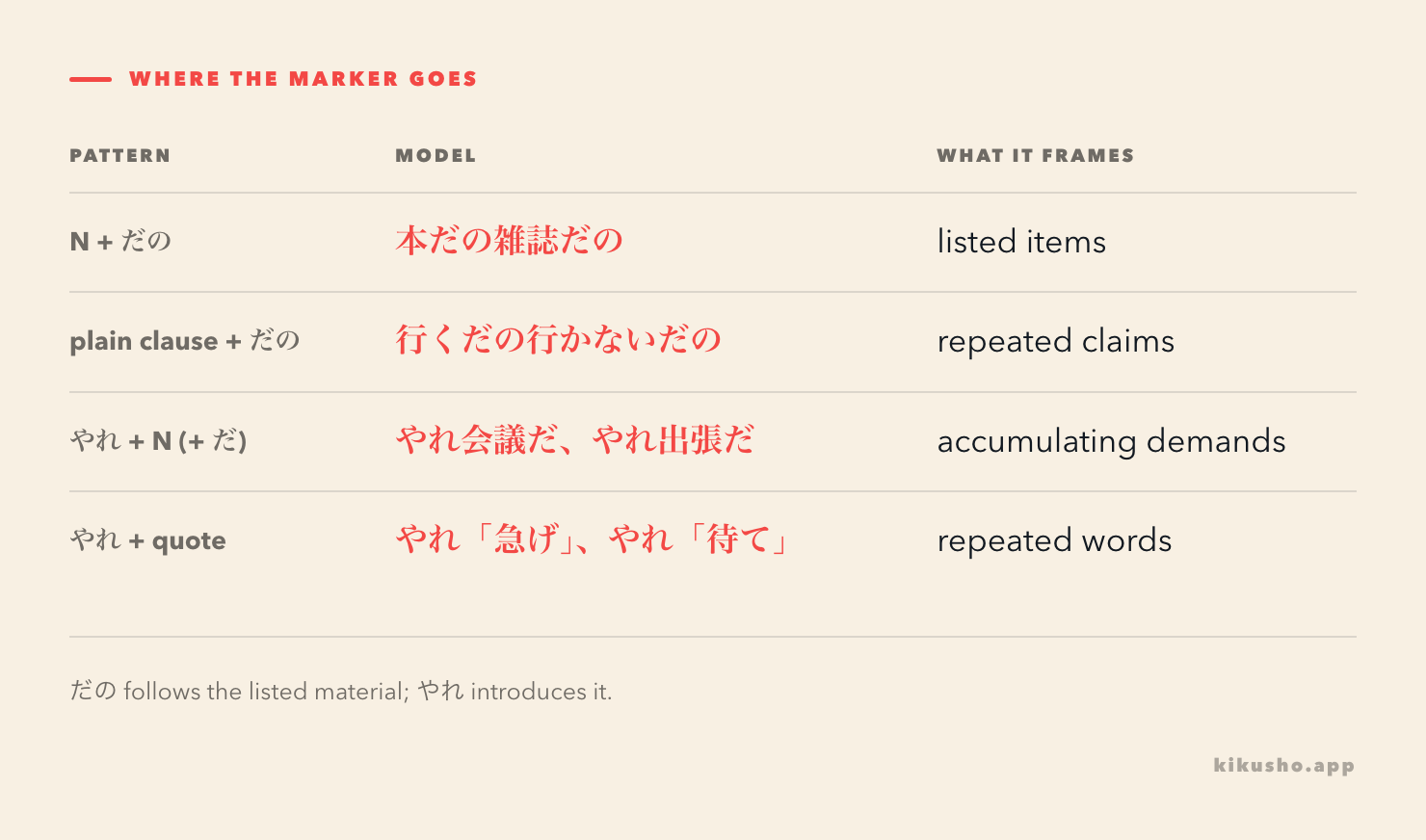
だの~だの and やれ~やれ both give an incomplete list with an attitude attached. だの follows the words or claims being repeated, often with criticism or impatience; やれ introduces each item and makes the succession sound busy, noisy or burdensome.
The position of the marker is the quickest test. Read 時間がないだの、資料が足りないだの from the inside as two complaints. Read やれ会議だ、やれ出張だと from the outside as a speaker pointing to one demand after another.
Put the marker on the side where its viewpoint begins
Compare a manager hearing excuses with an employee describing a crowded schedule:
彼は時間がないだの、資料が足りないだのと言い訳ばかりしている。
かれは じかんが ないだの、しりょうが たりないだのと いいわけばかり している。
He keeps making excuses, saying he has no time, that he lacks the materials, and so on.
やれ会議だ、やれ出張だと、今月は落ち着かない。
やれ かいぎだ、やれ しゅっちょうだと、こんげつは おちつかない。
With one meeting after another business trip, I cannot settle down this month.
The first sentence repeats the content of somebody's talk. だの comes after each claim, and と言い訳ばかりしている tells you how the speaker judges it. The second sentence stages the items as they arrive. Each やれ feels like another finger pointing at the next demand.
| Construction | Position | Safest shape | Typical effect |
|---|---|---|---|
| だの~だの | after each item | plain clause + だの | repeats claims, complaints or alternatives |
| だの~だの | after each item | noun + だの | names an untidy or disfavoured set |
| やれ~やれ | before each item | やれ + noun (+ だ) | dramatizes an accumulating list |
| やれ~やれ | before each item | やれ + quoted words | evokes repeated demands or remarks |
だの is at home after complaints and changing claims
だの can follow nouns, verbs and adjectives. That flexibility makes it useful when the listed material consists of things people have said.
| Material being listed | Formation | Example |
|---|---|---|
| nouns as items | N + だの | 本だの雑誌だの |
| verbs | V plain + だの | 行くだの行かないだの |
| i-adjectives | i-adjective plain + だの | 高いだの狭いだの |
| na-adjective or noun predicates | plain predicate + だの | 必要だの不要だの |
弟は行くだの行かないだの、まだ返事を決めていない。
おとうとは いくだの いかないだの、まだ へんじを きめていない。
My younger brother keeps saying he will go and then that he will not, and still has not decided what to answer.
客は部屋が狭いだの、駅から遠いだのと不満を並べた。
きゃくは へやが せまいだの、えきから とおいだのと ふまんを ならべた。
The guest listed complaints, saying the room was small and the station was far away.
The repeated parts need not be direct quotations with quotation marks. They can be propositions attributed to the person. Final と often gathers the list before a verb such as 言う, 文句を言う, 騒ぐ or 言い訳する.
Nouns can also be listed without representing speech:
机の上には、請求書だの領収書だのが散らばっている。
つくえの うえには、せいきゅうしょだの りょうしゅうしょだのが ちらばっている。
Bills, receipts and such are scattered across the desk.
Here the disorder makes the marked list natural. A calm inventory of office documents would be better with 請求書や領収書.
Tanosuke's だの~だの reference records plain-form attachment across verbs and adjectives, direct noun attachment, and the frequent feeling of dissatisfaction or blame. A Japanese-teacher grammar guide independently emphasizes reported complaints and the common closing と. These descriptions support an N1 study placement, although J-nihongo lists the same form at N2. Since there is no official item-by-item syllabus, those level labels remain study-guide estimates.
やれ makes the list arrive one item at a time
In the listing construction, やれ comes before what it presents:
年末は、やれ大掃除だ、やれ買い物だと忙しい。
ねんまつは、やれ おおそうじだ、やれ かいものだと いそがしい。
At the end of the year it is one thing after another, cleaning, shopping and everything else.
子どもたちは、やれ「早くして」、やれ「まだ帰りたくない」と騒いでいた。
こどもたちは、やれ「はやくして」、やれ「まだ かえりたくない」と さわいでいた。
The children were making a fuss, first saying “Hurry up,” then “I don't want to go home yet.”
The safest productive frame is やれ + noun, often followed by だ, or やれ + a clearly quoted utterance. と then closes the whole series. Unlike だの, this やれ is not a suffix-like marker that you attach freely after every verb and adjective.
Kotobank's dictionary entry for やれ identifies a parallel-listing particle meaning roughly “this and that” and gives the structure with repeated events and expenses. Onigiri's N1 teaching reference likewise gives やれ + noun + やれ + noun and notes dissatisfaction, confusion or amazement. JLPT Sensei provides a separate N1 placement and examples with recurring worries and activities.
The same situation can shift where the irritation lands
The two constructions can describe related scenes, but they package them differently:
同僚は会議が多いだの、出張が続くだのとこぼしている。
どうりょうは かいぎが おおいだの、しゅっちょうが つづくだのと こぼしている。
My colleague complains that there are too many meetings and that the business trips keep coming.
今月は、やれ会議だ、やれ出張だと予定が詰まっている。
こんげつは、やれ かいぎだ、やれ しゅっちょうだと よていが つまっている。
This month is packed with one meeting and business trip after another.
The だの sentence puts distance between the current speaker and the colleague's complaints. The やれ sentence lets the current speaker perform the accumulation directly. Neither construction simply means “and.” Each tells you how the list is being viewed.
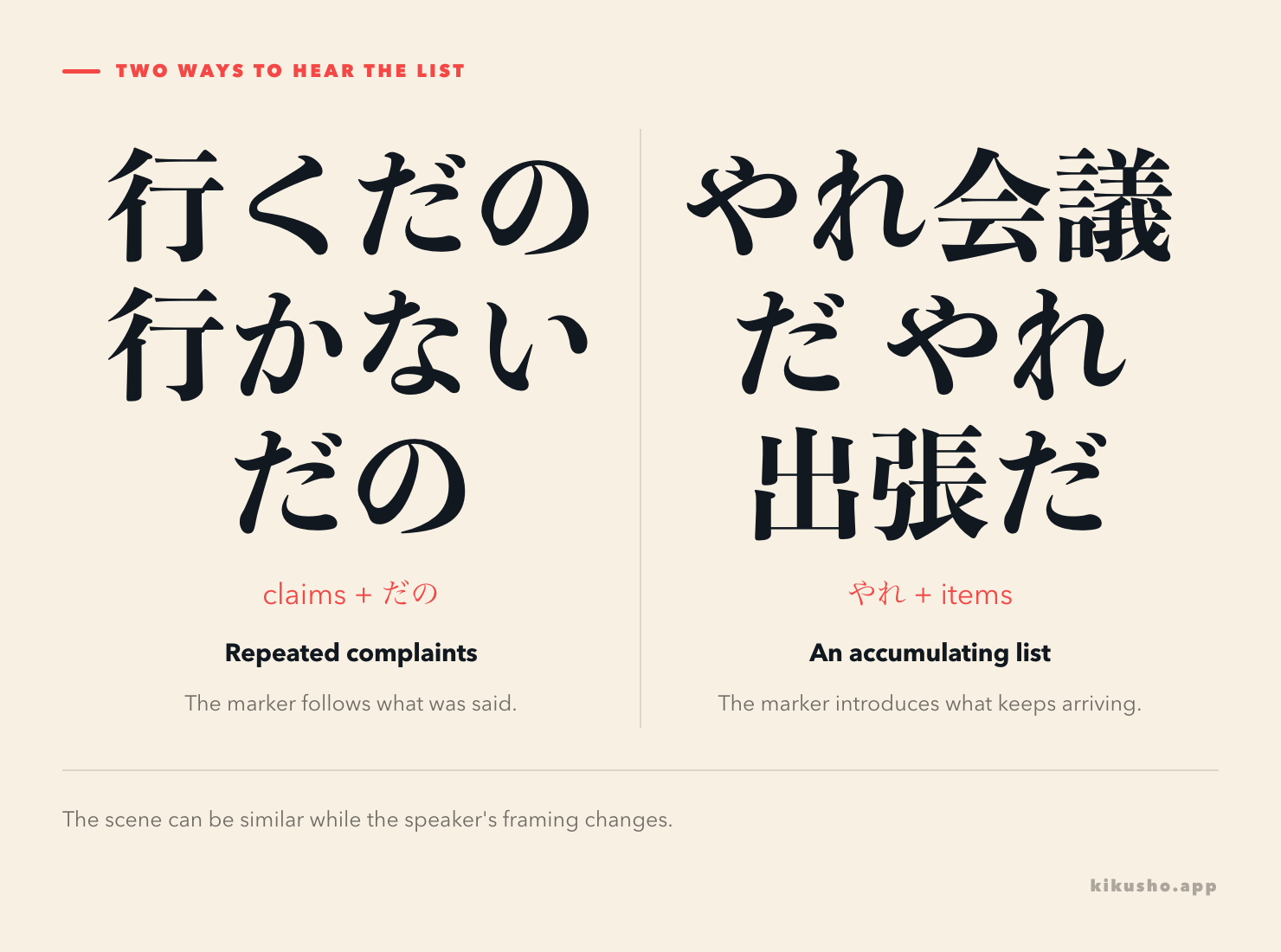
That difference is a tendency rather than a ban on overlap. A noun list with だの can express the current speaker's dislike, and やれ can introduce reported demands. When both seem possible, ask whether the sentence is built from the content of claims or from the rhythm of one item following another.
A neutral list needs a quieter marker
Using either form for pleasant facts without a contrasting context can create an attitude you did not intend.
週末は本や雑誌を読みます。
しゅうまつは ほんや ざっしを よみます。
I read books, magazines and similar things on weekends.
休みの日は本を読んだり、音楽を聞いたりします。
やすみの ひは ほんを よんだり、おんがくを きいたり します。
On days off, I might read a book or listen to music.
The first is a neutral noun list. The second lists example activities. For conversational examples, とか~とか is another ordinary choice. The とか, なんて, なんか and など comparison shows how an example list differs from an evaluation, while the たり~たり lesson handles actions.
This boundary matters in praise. 料理はおいしいだの、店員は親切だの can sound as though you are repeating somebody's remarks with distance or impatience. If you simply want to say what was good, use 料理はおいしいし、店員は親切だった.
Listing やれ~やれ is not the sigh やれやれ
Written without an item between the repetitions, やれやれ is an interjection:
やれやれ、やっと仕事が終わった。
やれやれ、やっと しごとが おわった。
Whew, the work is finally finished.
It can express relief, fatigue, disappointment or “oh dear,” depending on the scene. It does not list two things. Listing やれ must introduce material: やれ電話だ、やれメールだと.
The sound overlap makes poor one-line flashcards especially risky. Keep やれ会議だ、やれ出張だと as a complete pattern, and save やれやれ、終わった separately. If you capture the line in Kikusho, the surrounding sentence can remain beside the reading and register note, so review restores whether the speaker was counting burdens or simply sighing after them.
Practice: identify whose attitude shapes the list
Question 1 — choose the position. Complete the complaint report: 彼は給料が安い__、休みが少ない__と文句を言っている。
- やれ / やれ
- だの / だの
- と / も
- たり / たり
Question 2 — stage the accumulation. Complete: 今週は__会議だ、__締め切りだと、息をつく暇もない。
- だの / だの
- とか / など
- やれ / やれ
- たり / たり
Question 3 — find the neutral list. Which sentence simply says that the speaker reads books, magazines and similar material?
- 本だの雑誌だのを読む。
- やれ本だ、やれ雑誌だと読む。
- 本や雑誌を読む。
- 本を読むだの、雑誌を読むだの。
Question 4 — interpret the viewpoint. In 父は忙しいだの疲れただのと言って、旅行に来なかった, whose words are 忙しい and 疲れた, and what stance does the sentence suggest?
Question 5 — text grammar. Read: 引っ越しの前は、__契約だ、__荷造りだと、毎日することが増えていった。 Supply the repeated listing marker that presents tasks arriving one after another.
Question 6 — write the report. Use 行く, 行かない, まだ決めない and だの~だの to say that someone keeps wavering between going and not going and still will not decide.
Question 7 — separate the homophones. Explain why やれやれ、終わった cannot be analyzed as the same construction as やれ掃除だ、やれ洗濯だと忙しい.
Answers and explanations
Answer 1: 2, だの / だの. Each plain claim is followed by だの, and final と文句を言っている gathers them as reported complaints. Preposed やれ would require a different structure.
Answer 2: 3, やれ / やれ. Each やれ introduces the next burden, and the noun predicate uses だ: やれ会議だ、やれ締め切りだと. The ending describes the speaker as overwhelmed by the accumulation.
Answer 3: 3, 本や雑誌を読む. や gives neutral examples from a larger noun set. Choice 1 adds an evaluative or untidy-list tone; choice 2 misbuilds the predicate after the list; choice 4 leaves the sequence without a suitable governing expression.
Answer 4. 忙しい and 疲れた are presented as the father's words or claims. Repeating them with だの and following the list with his failure to join the trip suggests that the current speaker regards them with impatience, criticism or distance.
Answer 5. やれ契約だ、やれ荷造りだと. The repeated preposed やれ makes each moving task arrive as another item in the sequence. だの would follow the items and would more readily echo claims about them.
Answer 6. One natural version is 彼は行くだの行かないだのと言って、まだ決めない。 Both verb clauses are in the plain form before だの. Final と言って presents them as the person's shifting statements.
Answer 7. やれやれ is one interjection expressing relief, fatigue or dismay; no listed item appears between its repetitions. In やれ掃除だ、やれ洗濯だと, each separate やれ stands before a noun and coordinates two examples in an accumulating list.
The useful reading clue is small but dependable: material before だの, material after やれ. Once that direction is visible, the list reveals who is repeating the words and who is reacting to the pile.
Common questions
What is the difference between だの~だの and やれ~やれ?
だの follows each listed word or plain-form clause and often repeats claims, excuses or complaints with criticism or impatience. やれ comes before each item, most safely a noun or quoted demand, and presents the sequence as a noisy, troublesome or overwhelming succession.
What can come before だの?
A noun can take だの directly, as in 本だの雑誌だの. A verb or i-adjective uses its plain form, as in 行くだの行かないだの and 高いだの狭いだの. A plain predicate with a noun or na-adjective can retain だ, as in 必要だの不要だの.
Is やれ~やれ the same as the interjection やれやれ?
No. Listing やれ appears separately before two or more items, as in やれ会議だ、やれ出張だと. The interjection やれやれ is one repeated expression meaning roughly “whew” or “oh dear”; it does not coordinate a list.
Are だの~だの and やれ~やれ always negative?
They strongly invite an attitude such as irritation, criticism, amazement or feeling overwhelmed, but context decides the exact emotion. For a neutral list of examples, use forms such as や, とか~とか or たり~たり instead.