On this page
とか gives examples from a larger set; noun-attached なんか and なんて can downplay what you name, including yourself. など also presents examples, often in a calmer written style, while なんて after a clause can express a reaction such as surprise, admiration or disbelief.
These meanings overlap. A phrase containing なんか may suggest a film rather than reject it, and a polite です or ます ending does not remove a dismissive evaluation earlier in the sentence.
Decide whether you are listing, evaluating or reacting
This comparison teaches the grouped なんか・なんて・など construction, with example-list とか as background. Ask three questions when reading:
- Is the speaker naming examples of a broader category?
- Is a noun being downplayed, and does it refer to the speaker or somebody else?
- Is a whole event being presented as the basis for an emotional reaction?
Then read the predicate. “How about it?” and “I don't want it” can turn a similar noun phrase toward very different attitudes.
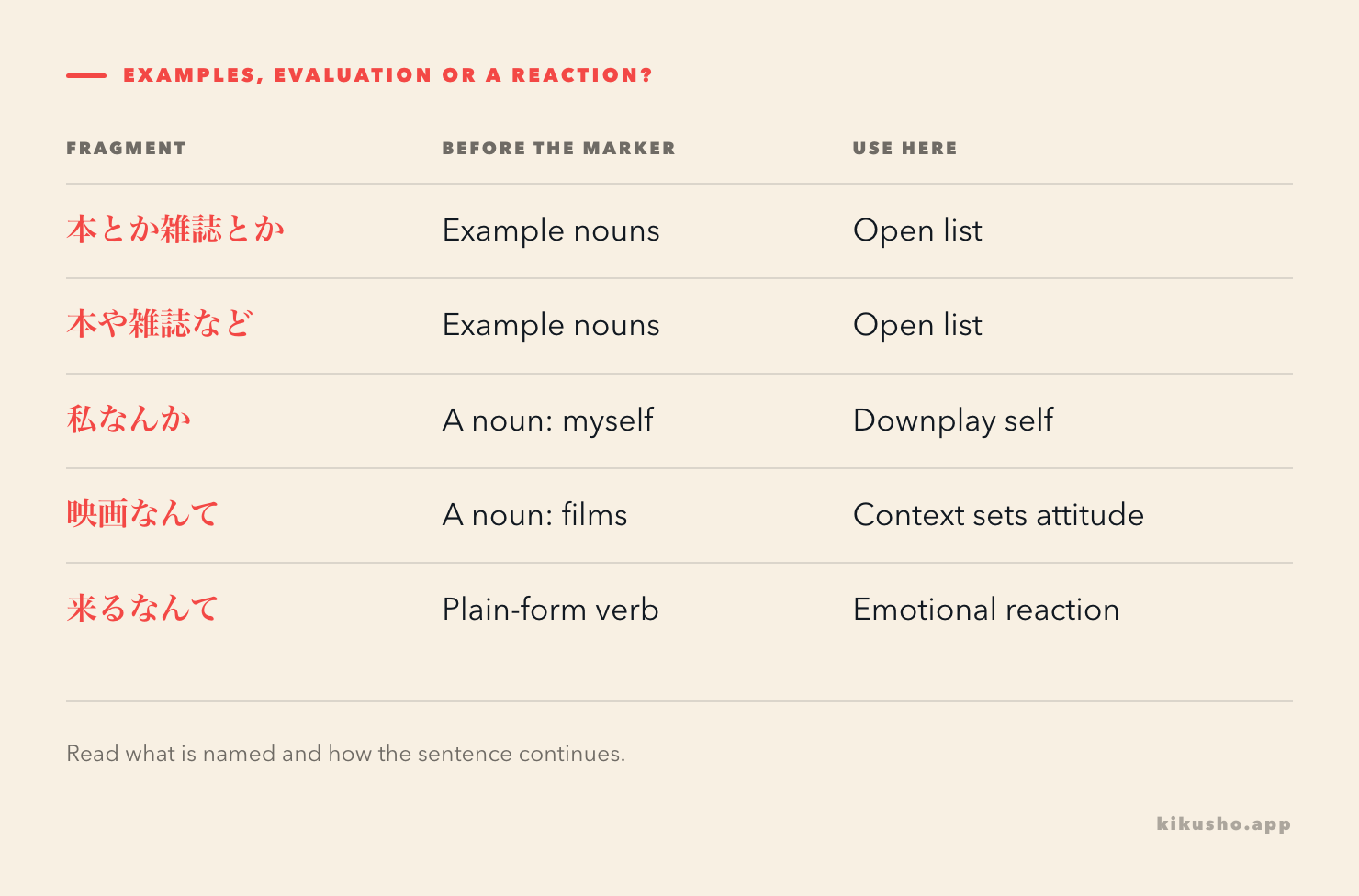
| Fragment | Reading | Function in these examples |
|---|---|---|
| 本とか雑誌とか | ほんとかざっしとか | Books and magazines as examples |
| 本や雑誌など | ほんやざっしなど | Books, magazines and so on |
| 私なんか | わたしなんか | Someone like me, downplaying oneself |
| 映画なんて | えいがなんて | Films framed for evaluation; context supplies the attitude |
| 来るなんて | くるなんて | Coming presented as the basis for a reaction |
The N3 grammar label needs a scope note. JLPT Sensei groups なんか・なんて・など at N3. Bunpro places なんか・なんて at N3, but its example-list pages for など and とか are N4. The lists partly separate different uses. The official JLPT FAQ explains why exhaustive vocabulary and grammar specifications are no longer published.
とか supplies examples without completing the list
本とか雑誌とかを読みます。
ほんとかざっしとかをよみます。
“I read things like books and magazines.”
The two nouns are examples of reading material. This listing use does not itself express contempt for books or magazines. It leaves a broader category implied.
The pattern is noun + とか + noun + とか. The last とか can be omitted: 本とか雑誌を読みます is also possible. One example can suffice in conversation:
映画とかどう?
えいがとかどう?
“How about something like a film?”
That offers a possible activity without fixing the whole plan. Wasabi's parallel-marker lesson describes conversational とか examples and suggestions.
Unlike noun-list や, とか can also follow verb phrases: 本を読むとか、音楽を聞くとか (ほんをよむとか、おんがくをきくとか), “things like reading books or listening to music.” Bunpro's listing とか page distinguishes these attachments. This is the example-list use; reported-information とか requires a separate explanation.
For the earlier contrast between complete noun lists, example lists and “also,” use the も・と・や lesson.
なんか can lower an evaluation or make a suggestion tentative
After a noun, なんか can frame it as something of little importance or worth. If that noun is 私, the speaker downplays themselves:
私なんかには難しいです。
わたしなんかにはむずかしいです。
“It's difficult for someone like me.”
The phrase can show modesty or a lack of confidence. It does not necessarily mean the task is objectively impossible. JLPT Sensei's grouped explanation separates giving examples, modesty and belittling.
After a thing you reject, a negative predicate makes the dismissal clearer:
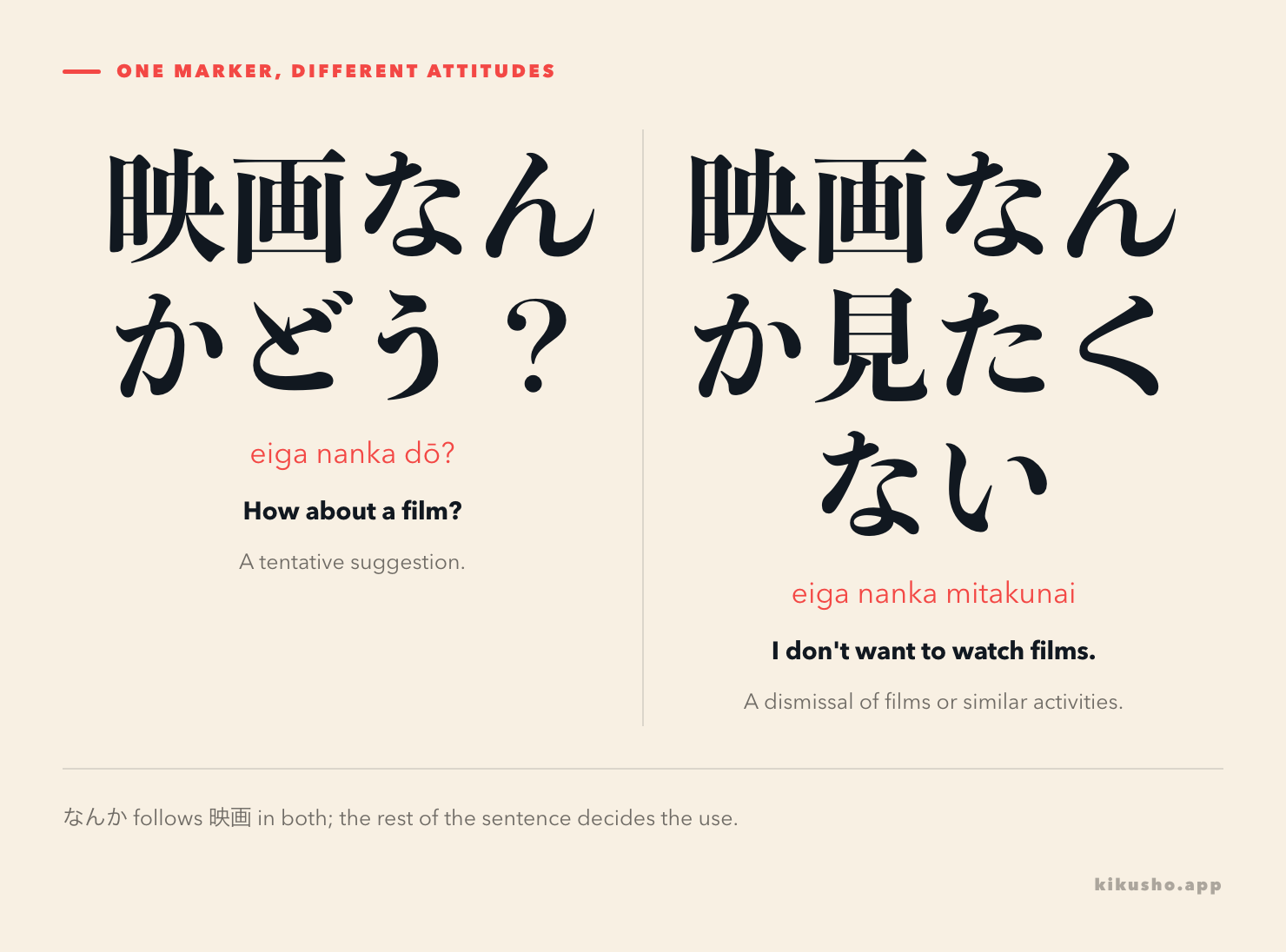
映画なんか見たくない。
えいがなんかみたくない。
“I don't want to watch films or anything like that.”
But the following question changes the use:
映画なんかどう?
えいがなんかどう?
“How about a film, for example?”
Here the film is one possible suggestion, presented lightly. It is not automatically an insult to cinema. Maggie Sensei's なんか lesson explicitly includes both belittling and tentative suggestions.
なんて can evaluate a noun or react to a whole clause
With a noun, なんて overlaps with なんか in many evaluations:
映画なんて見たくない。
えいがなんてみたくない。
“I don't want to watch films or anything like that.”
The shared refusal supports a dismissive reading in both versions. That overlap does not make the markers interchangeable in every position.
A particularly useful なんて pattern follows an entire plain-form clause:
友達が来るなんてうれしいです。
ともだちがくるなんてうれしいです。
“I'm so happy about my friend coming.”
The event 友達が来る, “my friend comes/is coming,” is presented with an emotional reaction. うれしい makes that reaction positive. The same kind of construction can express disbelief, disappointment or admiration in other sentences. Maggie Sensei's なんて guide explains the positive and negative possibilities.
Keep the clause in the plain form: 来るなんて, or 来たなんて (きたなんて) for a past coming. For this clause-reaction pattern, なんて is the useful marker; substituting a sentence-opening filler なんか does not preserve its construction. Han Kyu An's comparative-study abstract confirms that the differences extend beyond formality to syntactic roles. This comparison concerns なんて after a noun or clause; sentence-initial exclamatory なんて has another structure.
など is a written-list option, but context can still make it sharp
本や雑誌などを読みます。
ほんやざっしなどをよみます。
“I read books, magazines and so on.”
など follows the final example here. It can also follow one noun, as in 雑誌など (ざっしなど), “magazines and things like that.” Bunpro's など reference describes the example-from-a-larger-group meaning. This is an ordinary choice for a written list and also occurs in speech.
Changing the predicate can make a sentence dismissive even with など:
そんな冗談など聞きたくありません。
そんなじょうだんなどききたくありません。
“I don't want to hear jokes like that.”
The rejection remains despite the polite ありません. Similarly, 私などには難しいです (わたしなどにはむずかしいです) can downplay oneself in a less conversational style than 私なんか. The grouped source includes this modesty use too. Calling など “formal” is not a promise that everything you attach it to becomes respectful.
A polite ending and a generous attitude are separate choices
Compare what the complete sentence does:
| Sentence | What the listener receives |
|---|---|
| 映画とかどう? | A film offered as one possible activity |
| 映画なんかどう? | A lightly presented film suggestion |
| 映画なんて見たくない。 | A dismissal of films or activities like them |
| 映画なんて見たくありません。 | That dismissal with a polite verb ending |
With なんか or なんて, inspect the target of the evaluation before producing the sentence. Downplaying yourself and downplaying your listener's work have different social effects. です/ます describes how you address the listener; it does not undo the earlier word choice. The Japanese politeness guide separates addressee politeness from other respectful choices.
Even an expression that often accompanies criticism needs context. The ばかり comparison shows a similar need to distinguish the construction from the speaker's attitude toward the activity.
There is one more listening trap: なんか、今日は静かですね (なんか、きょうはしずかですね) means “Somehow, it's quiet today, isn't it?” Here なんか introduces a vague impression. It is not attached to a preceding noun being belittled. Tae Kim's section on filler なんか explains this separate function and its relation to casual 何か, “something.”
For a voice capture in Kikusho, say the whole film suggestion, 映画なんかどう?, and check that the saved meaning keeps the offer. An editable register note can distinguish a casual suggestion from the refusal 映画なんか見たくない. Keeping only “なんか = unimportant things” would lose the invitation you intended to remember.
Seven exercises: keep the purpose of the sentence in view
The official JLPT task table includes selecting grammar forms, composing sentences and interpreting grammar in text at N3. The following seven prompts are new practice examples using those tasks. Record your choices before scrolling to the shared explanations.
Question 1. What does the listing marker imply here?
本とか雑誌とかを読みます。
A. Books and magazines are examples of reading material.
B. The speaker refuses to read books.
C. No reading material besides these two is implied.
D. The books were read only a moment ago.
Question 2. Who is being downplayed in this sentence?
私なんかには難しいです。
A. The listener B. The speaker C. The speaker's friend D. A named teacher
Question 3. Select the marker for the whole-clause emotional-reaction pattern taught here.
友達が来る(____)うれしいです。
A. や B. なんて C. も D. なにか
Question 4. For a straightforward written list of prepared equipment, choose the usual calmer example marker.
会場には机や椅子(____)を用意しました。
A. なんか B. など C. なんて D. とか
Question 5. Arrange all four pieces to express happiness about a friend coming to Japan. Which piece occupies ★?
友達が __ __ ★ __。
A. 日本に B. うれしいです C. なんて D. 来る
Question 6. Complete the text with a tentative suggestion of one possible activity.
週末の予定はまだ決まっていません。友達に「(____)」と聞きました。ほかの案でもかまいません。
A. 映画なんかどう?
B. 映画なんか見たくない。
C. 映画しか見ない。
D. もう映画を見た。
Question 7. What is なんか doing at the start of this observation?
なんか、今日は静かですね。
A. Belittling a noun immediately before it
B. Introducing a vague impression
C. Asking which film to watch
D. Marking a complete list of quiet places
Make a note of the sentence purpose you identified, especially where a suggestion and an evaluation could share a noun.
Answers and explanations
Answer 1. A. 本とか雑誌とかを読みます (ほんとかざっしとかをよみます) presents books and magazines as examples. Listing とか leaves the category open; it supplies neither a refusal nor recency. C would make the relevant list complete, which is a different presentation.
Answer 2. B. 私なんかには難しいです (わたしなんかにはむずかしいです), “It's difficult for someone like me,” places the lower evaluation on 私, the speaker. That can be modesty or low confidence. The sentence does not identify the listener, a friend or a teacher as its target.
Answer 3. B: なんて. 友達が来るなんてうれしいです (ともだちがくるなんてうれしいです) presents the friend's coming as the basis for a happy reaction. 来る is a plain-form verb. Listing や joins nouns; も and なにか do not make this clause-reaction pattern in the supplied position.
Answer 4. B: など. 会場には机や椅子などを用意しました (かいじょうにはつくえやいすなどをよういしました) means “We prepared things such as desks and chairs at the venue.” など fits this written equipment list. The other markers can occur in grammatical sentences, but their more conversational or evaluative framing is not the usual choice requested here. They are not all forbidden attachments.
Answer 5. C: なんて. The order is A → D → C → B: 友達が日本に来るなんてうれしいです (ともだちがにほんにくるなんてうれしいです). “I'm so happy about my friend coming to Japan.” 日本に belongs inside the coming clause; なんて follows that clause, and うれしいです gives the reaction. The third piece is C.
Answer 6. A: 映画なんかどう? The passage reads 週末の予定はまだ決まっていません。友達に「映画なんかどう?」と聞きました。ほかの案でもかまいません。 Its reading is しゅうまつのよていはまだきまっていません。ともだちに「えいがなんかどう?」とききました。ほかのあんでもかまいません。 “The weekend plans aren't decided yet. I asked my friend, ‘How about a film?’ Other ideas are fine too.” A offers one possible activity. B rejects films, C restricts the activity to films, and D reports an already-watched film; those do not supply the requested tentative suggestion.
Answer 7. B. なんか、今日は静かですね (なんか、きょうはしずかですね) gives an impression along the lines of “Somehow, it's quiet today, isn't it?” No preceding noun is its belittled target. It neither asks about a film nor lists places.
Choose one weekend activity you would be happy to suggest. Write the message you would send a friend, then draft the same plan as a short club notice. Check which change makes the language suitable for the notice, and which change would accidentally make it sound as though you disliked your own idea.
Common questions
Are nanka and nante always rude?
No. After a noun they can downplay something, including oneself, but context may instead make the phrase a tentative suggestion. なんて after a clause can express positive surprise or admiration. A dismissive predicate makes a negative interpretation much clearer.
How does nado differ from toka?
Both can present examples from a larger set. とか is conversational and can follow each listed item; など commonly follows the final example, often after a や list. など is suitable for written lists too, but it can still contribute to a dismissive sentence in the right context.
Can I replace every nante with nanka?
No. They overlap in some noun-attached evaluations and suggestions. For the whole-clause emotional-reaction pattern here, use なんて, as in 友達が来るなんてうれしいです. Sentence-opening なんか expressing a vague impression has a different function.
Is this N3 or N4 grammar?
JLPT Sensei groups なんか, なんて and など in an N3 lesson. Bunpro labels なんか・なんて N3, but example-list など and とか~とか N4. This N3 comparison uses those earlier listing patterns as background. Study-list levels are estimates rather than an exhaustive official JLPT syllabus.