On this page
明日は本を読んだり、パンを作ったりします means “Tomorrow I'll do things like read a book and make bread”: ~たり~たりする presents actions as examples from an open list. Each action takes its た-form plus り, while the final する/します/した/しました supplies tense and politeness in a simple list statement.
Read that opening as あしたは ほんを よんだり、パンを つくったり します. The reading form contains だ, but the activity is tomorrow. That is the distinction this lesson teaches: how to build an example list without accidentally turning it into a past report or an ordered itinerary.
This page belongs to our N4 grammar study sequence. JLPT Sensei places たり~たり at N5, whereas Nihongo to Japan labels it N4. These are study-list estimates; the official JLPT FAQ explains why item lists are not published. The construction here includes action examples and alternating actions or states; the prerequisite is a comfortable plain-past た-form. Its earlier-level placement remains visible rather than being renamed N4 content.
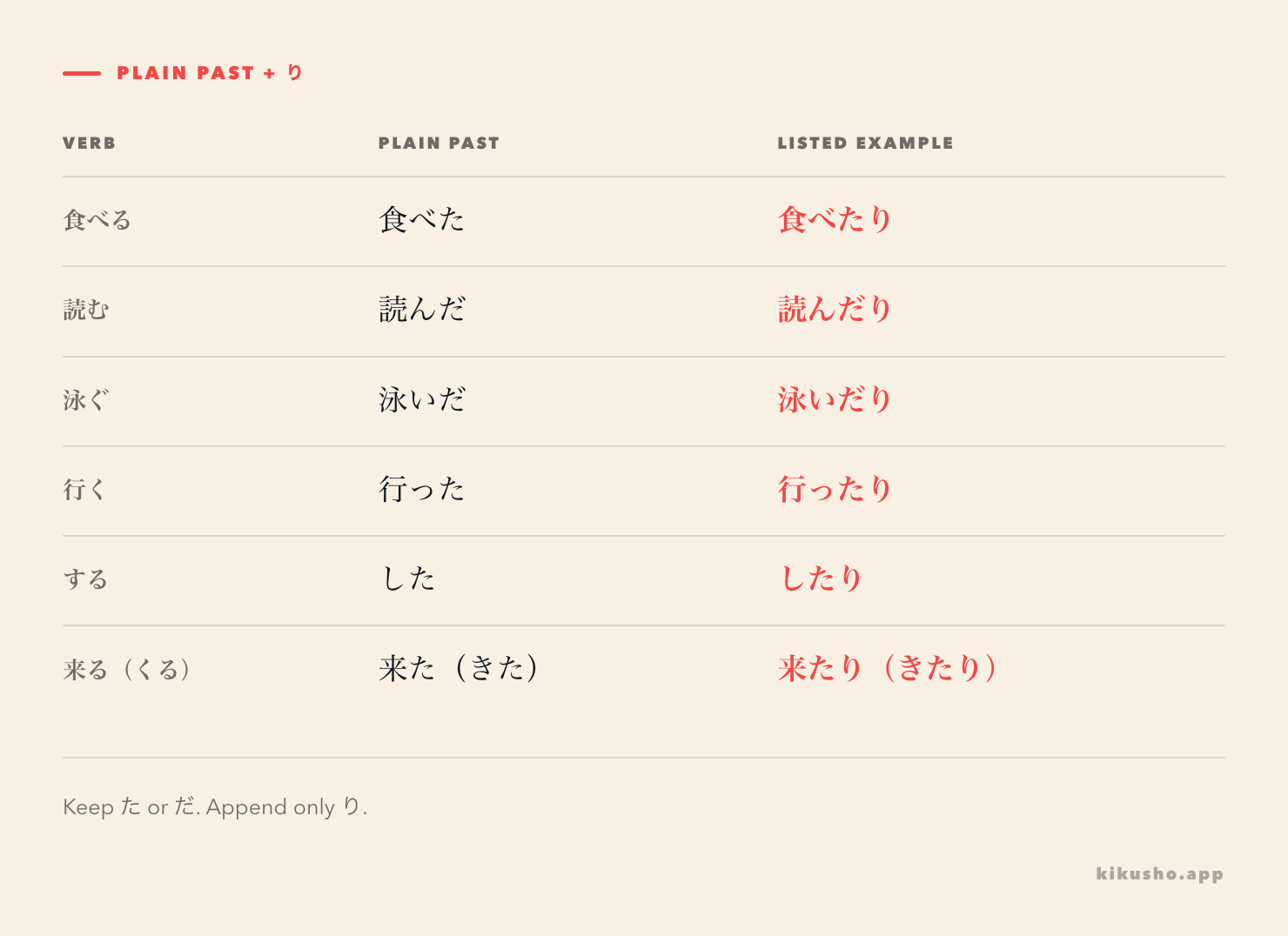
Make the た-form first, then append り
The name たり can tempt you to attach those two kana directly to the dictionary form. Instead, conjugate the verb first. 食べる → 食べた → 食べたり works; 食べるたり does not.
| Dictionary form and meaning | Plain past | Listed form and reading |
|---|---|---|
| 食べる(たべる), eat | 食べた | 食べたり(たべたり) |
| 読む(よむ), read | 読んだ | 読んだり(よんだり) |
| 泳ぐ(およぐ), swim | 泳いだ | 泳いだり(およいだり) |
| 書く(かく), write | 書いた | 書いたり(かいたり) |
| 作る(つくる), make | 作った | 作ったり(つくったり) |
| 行く(いく), go | 行った | 行ったり(いったり) |
| する, do | した | したり |
| 来る(くる), come | 来た(きた) | 来たり(きたり) |
Keep だ in a voiced past ending. 読んだり follows 読んだ, and 泳いだり follows 泳いだ. There is no extra た to insert. The exceptional 行った gives 行ったり, and 来 changes reading to き in 来たり.
Nora Farley's Mango Languages guide checks this attachment, including the voiced forms. If your uncertainty starts before り, revisit the past-form chart rather than memorising a second set of verb sound changes.
The final する sets the time of the whole list
Use the same listed actions with four different endings:
| Complete list | Ending's job | Reading of the ending |
|---|---|---|
| 本を読んだり、パンを作ったりする。 | Plain nonpast | する |
| 本を読んだり、パンを作ったりします。 | Polite nonpast | します |
| 本を読んだり、パンを作ったりした。 | Plain past | した |
| 本を読んだり、パンを作ったりしました。 | Polite past | しました |
Nonpast can describe a habit or an intended future activity, depending on context. 休みの日は(やすみのひは), “on days off,” frames a habit; 明日は frames tomorrow. 昨日は(きのうは), “yesterday,” fits the past versions.
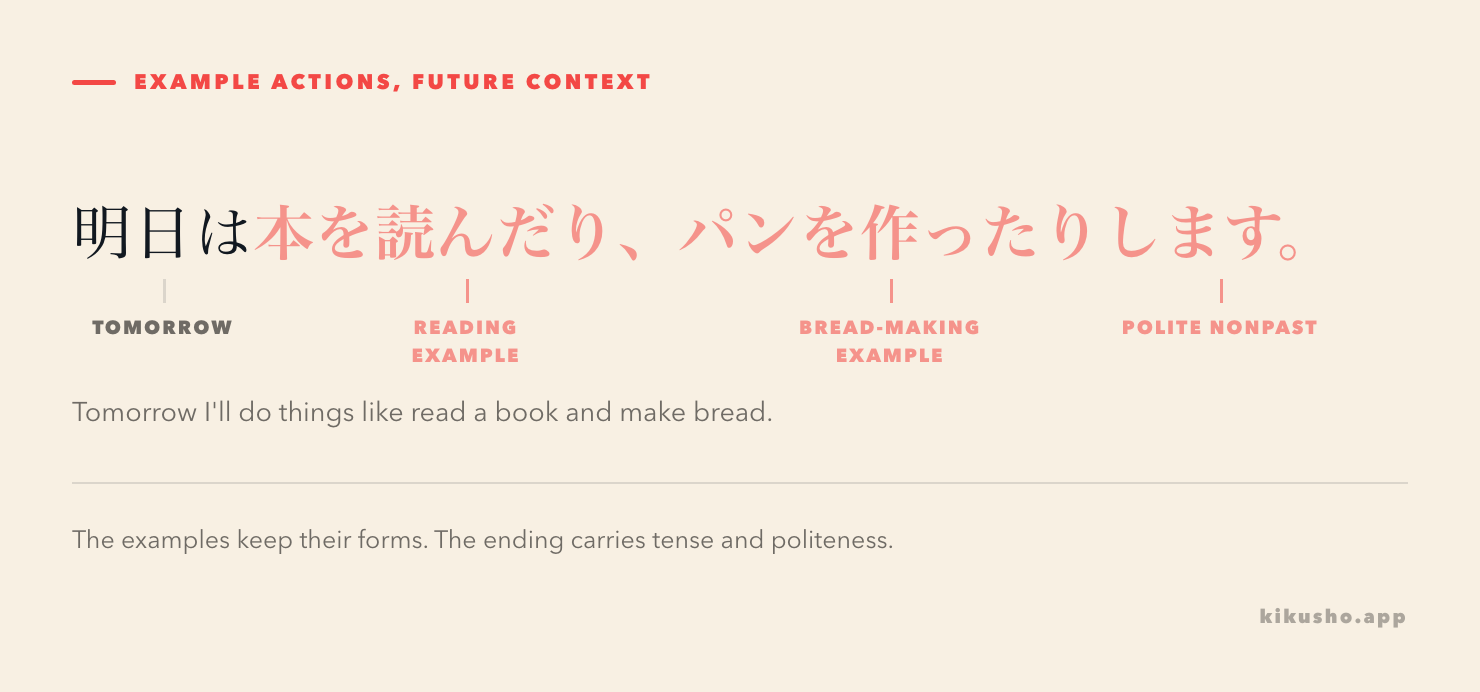
Yoko Kano's UNCW teaching page explicitly tells learners to inspect the sentence ending for past versus nonpast. Here, 読んだり stays fixed when you change します to しました. Its inner だ belongs to the construction's attachment, not an independent claim that the reading already happened.
Give representative activities without promising their order
An account of a day can select activities worth mentioning:
土曜日は、公園を歩いたり、写真を撮ったりしました。
どようびは、こうえんを あるいたり、しゃしんを とったり しました。
On Saturday I did things like walk in the park and take photos.
歩く(あるく) gives 歩いたり, and 撮る(とる) gives 撮ったり. The speaker presents both as examples. The sentence does not establish that walking came first, that photography came second, or that this is an exhaustive record of Saturday.
“Non-exhaustive” concerns how you present the list. It invites an “and that sort of thing” interpretation; it does not identify a hidden third activity that the reader can name with certainty. Nor does it mean the actions must have happened simultaneously.
You can give one representative too:
休みの日は、パンを作ったりします。
やすみのひは、パンを つくったり します。
On days off I do things such as make bread.
This still leaves the range of activities open. The doubled たり~たり is a useful practice frame, not a rule requiring exactly two examples. Longer lists are possible, but two well-chosen activities are easier to follow than a catalogue.
Opposite actions and changing states can alternate
A paired list can also describe movement back and forth:
猫は部屋に入ったり、部屋を出たりしています。
ねこは へやに はいったり、へやを でたり しています。
The cat keeps going into the room and coming back out.
出る(でる)→ 出たり and 入る(はいる)→ 入ったり are opposite movements here. The context and the pairing support alternation; たり alone does not turn every pair of unrelated verbs into a back-and-forth cycle. Final しています describes the ongoing activity in this example.
A negative partner can show variation between doing and not doing:
朝ごはんを食べたり、食べなかったりします。
あさごはんを たべたり、たべなかったり します。
Sometimes I eat breakfast, and sometimes I don't.
The negative attachment is also a plain-past shape plus り: 食べない → 食べなかった → 食べなかったり. It does not mean that all the examples are past events. The affirmative and negative partners contrast occasions.
States use their own plain-past forms before り:
| Type | Starting form | Past shape | Listed state |
|---|---|---|---|
| い-adjective | 高い(たかい), expensive | 高かった | 高かったり |
| な-adjective | 静か(しずか), quiet | 静かだった | 静かだったり |
| Noun | 休み(やすみ), a day off | 休みだった | 休みだったり |
料金は日によって高かったり、安かったりします(りょうきんは ひによって たかかったり、やすかったり します)means the fee is high on some days and low on others. 部屋は日によって静かだったり、にぎやかだったりします means the room is quiet on some days and lively on others; にぎやか is a な-adjective. For a noun pair, 日曜日は休みだったり、仕事だったりします(にちようびは やすみだったり、しごとだったり します)means some Sundays are days off and others are workdays.
These are variants of the same listing construction, not verb conjugations to apply to adjectives. Mango's adjective/noun section and Sensei's attachment table confirm かったり/だったり. An irregular adjective keeps its own past shape: いい → よかった → よかったり.
Use a sequence when the order is the point
If you are describing a particular sequence, choose wording that carries it:
手を洗って、パンを食べます。
てを あらって、パンを たべます。
I wash my hands and then eat bread.
This is the action-sequence use of the て-form. 手を洗ったり、パンを食べたりします instead selects washing hands and eating bread as examples; it no longer clearly communicates that washing precedes eating.
Keep the comparison narrow. The て-form also appears in requests and many other constructions. It does not invariably mean “then,” and listing actions with て does not prove you have described every event in someone's day. If timing matters, state the relevant relationship rather than expecting たり to supply it.
Likewise, a noun list needs a noun-list connector. 本や雑誌 means “books, magazines, and the like”; 本たり雑誌たり is not how this construction attaches. The と/や noun-list lesson separates complete and representative noun lists without changing the nouns into predicates.
A spoken list can trail off, but practise complete endings
する is plain; します addresses the listener politely. The activities inside the list retain the same たり forms in both registers. You do not make each example polite by writing 読みましたり.
In conversation, someone may stop after 本を読んだり、パンを作ったり…, leaving the rest understood. Mango documents this unfinished-list use. Treat it as conversational ellipsis, rather than a beginner rule that every written list can lose its ending. A continuing sentence can also have material beyond する; the tables here deliberately model simple complete statements.
When collecting a line with Kikusho, paste the whole example list rather than only the first verb. Its editable example can preserve 明日 and the final します, which make a future activity visible despite 読んだり. Check that context on the review screen before keeping the card; an isolated dictionary headword cannot show this sentence's time.
The repeated mistake is attaching たり before conjugating
読みたり, 読むたり and 読んたり all miss the checked form 読んだり. Make 読んだ first, then append only り. The same procedure gives 食べたり, without inventing 食べったり.
For a two-action example list, keep both actions in the pattern: 本を読んだり、パンを作ったりします. If you intend that paired list, dropping the second たり and writing 本を読んだり、パンを作ります does not reproduce the taught structure. This is a correction to that intended list, not a ban on every larger sentence that contains one たり.
To continue the N4 sequence after this lesson, the ~たことがある page reuses a plain-past form to ask about experience. Its attachment looks familiar, but its question is whether you have ever done something, rather than which activities you select as examples.
Practice
Try all six questions before checking the numbered solutions. These exercises are original and focus on formation, sentence assembly and meaning in connected text.
Question 1
Choose the listed form of 読む(よむ).
- A. 読みたり
- B. 読んだり
- C. 読んたり
- D. 読むたり
Question 2
Complete this polite statement about tomorrow:
明日は、パンを作ったり、本を読んだり( )。
- A. した
- B. しました
- C. します
- D. したです
Question 3
Put all four blocks into the blanks. Which block goes at ★? 散歩(さんぽ) means a walk.
休みの日は、( )( )( ★ )( )。
- A. したりします
- B. 本を
- C. 読んだり
- D. 散歩を
Question 4
Complete both gaps with an example list. Use 読む and 食べる, in that order, and a polite past ending.
昨日は、本を__、パンを__。
Question 5
Read the short message:
昨日は、公園を歩いたり、ベンチで本を読んだりしました。今日は家で休みます。
ベンチ is a bench; 休みます(やすみます) means rest. Which claim about yesterday is supported?
- A. The writer necessarily walked before reading.
- B. Walking and reading are presented as examples of yesterday's activities.
- C. The writer will walk in the park tomorrow.
- D. The writer did not read a book.
Question 6
The room is quiet on some days and lively on others. Choose the pair that fits:
部屋は日によって静か( )、にぎやか( )します。
- A. たり・たり
- B. かったり・かったり
- C. だったり・だったり
- D. だり・だり
Keep your six responses on paper before moving down the page.
Answers and explanations
Answer 1
B: 読んだり. 読む has the plain past 読んだ, so adding り preserves the voiced だ. A starts from the ます-stem 読み; C drops the voicing; D attaches to the dictionary form. None follows the past-plus-り rule.
Answer 2
C: します. 明日(あした)means tomorrow, and the prompt asks for polite nonpast. B is polite past; A is plain past. D adds です to した and is not the standard polite verb ending. The two examples remain 作ったり/読んだり in the future statement.
Answer 3
D: 散歩を. The complete order is B → C → D → A: 休みの日は、本を読んだり散歩をしたりします, “On days off I do things like read and go for walks.” 本を belongs with 読んだり, and 散歩を belongs with したり; final します closes the sentence. Swapping those objects would give “read a walk” and “do a book,” and stopping at an object or a listed verb would leave this requested statement unfinished.
Answer 4
読んだり/食べたりしました gives 昨日は、本を読んだり、パンを食べたりしました, “Yesterday I did things like read a book and eat bread.” Keep the voiced past 読んだ and the ichidan past 食べた before り. The last gap includes しました, because the whole report is polite past. 食べましたり would put politeness in the wrong place.
Answer 5
B. The message gives two representative past activities, then separately says the writer will rest at home today. A invents an obligatory order that the たり list does not express. C changes yesterday to tomorrow; D contradicts the reading activity. You can report both activities without knowing which happened first or what else occupied the day.
Answer 6
C: だったり・だったり. Both 静か and にぎやか are な-adjectives. Their plain-past state uses だった, followed by り. A omits that attachment, B incorrectly gives them the い-adjective pattern, and D omits った. With します, the contrast describes a recurring variation, not a past day merely because だった appears inside each listed state.
Common questions
How do I form ~たり~たりする?
Take each verb's plain affirmative past form and append り, then close the example list with a form of する. 食べた becomes 食べたり, while 読んだ becomes 読んだり. The voiced だ remains. Use する or します for nonpast, and した or しました for past in a simple complete statement.
Does the た in たり make the sentence past tense?
No. The listed verbs keep their たり forms even when the activities are future or habitual. In 明日は本を読んだりします, final します is nonpast and 明日 means tomorrow. Changing the ending to しました makes a simple list statement polite past; the listed form 読んだり stays unchanged.
Can I use only one たり?
Yes. One たり can give a representative example while leaving the wider set open. 本を読んだりします can mean doing things such as reading. Two repetitions are a common teaching pattern, not a minimum count. A complete beginner example should still have an ending such as します.
What is the difference between たり and て when listing actions?
たり presents actions as examples and does not specify their order. In a concrete action sequence, て can connect an earlier action to a later one: 手を洗って、パンを食べます means washing your hands and then eating bread. That sequence use does not describe every possible meaning of the て-form.