On this page
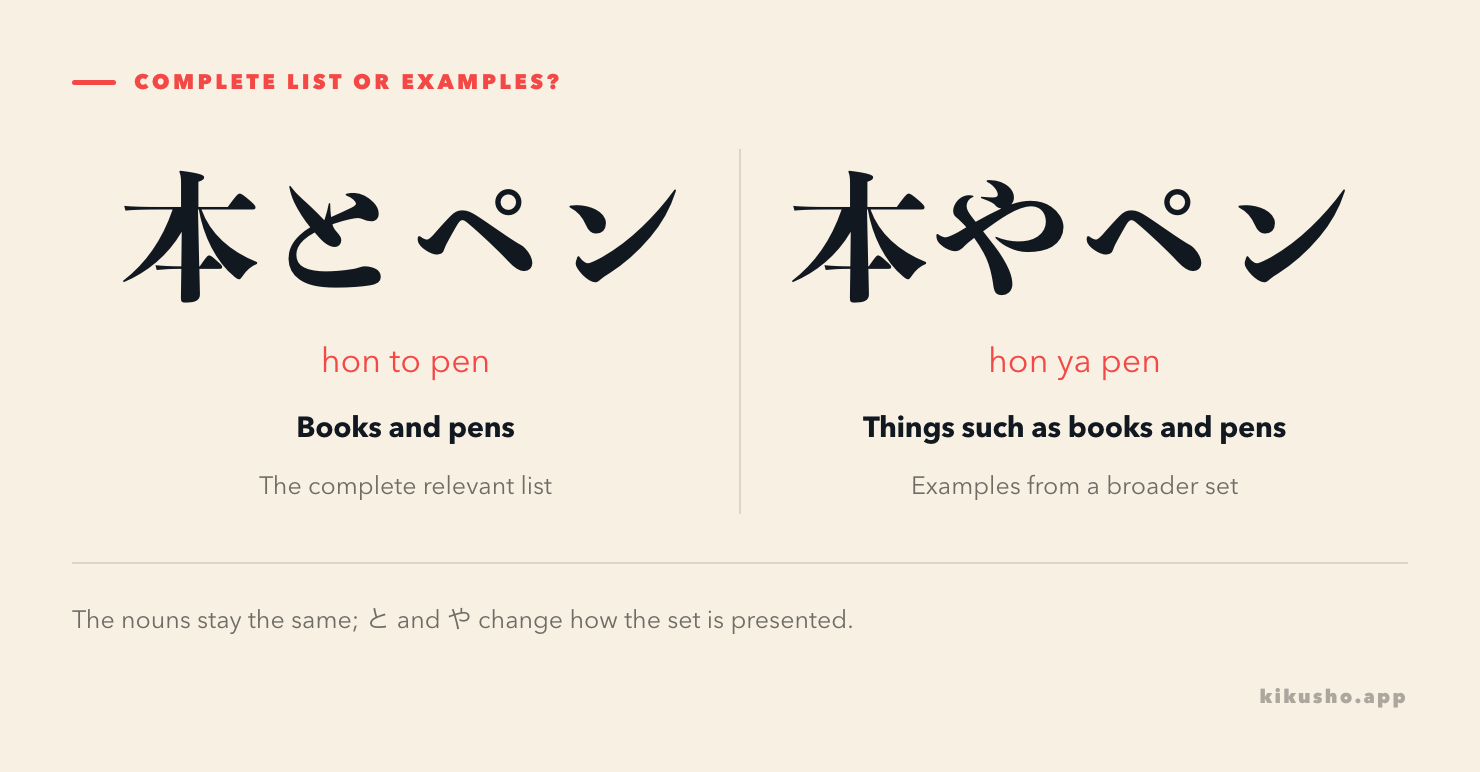
On a school shopping list, 本とノート names books and notebooks as the complete relevant list, while 本やノート gives books and notebooks as examples among other items. も does a different job: ノートも買います means “I will buy notebooks too,” adding notebooks to something already being bought.
Read 本 as ほん, ノート as nōto, and 買います as かいます. The nouns stay the same; the small particle changes how much of a list you are presenting, or what you are adding to an existing statement.
The test: a list, examples, or another case?
Ask which operation you need:
| Your intention | Pattern | Example phrase |
|---|---|---|
| Name the complete relevant set | noun + と + noun | 本とノート, books and notebooks |
| Give examples from a broader set | noun + や + noun | 本やノート, things such as books and notebooks |
| Add another item or person to the same claim | noun + も | ノートも, notebooks too |
The first two connect nouns inside a list. The third marks something as also fitting a statement. If you already said you will buy a book, ノートも買います adds another purchase without rebuilding the earlier list.
と names the list you are presenting
Use listing と (to) between nouns:
本とノートを買います。
ほんとのーとをかいます。
I will buy books and notebooks.
The joined group 本とノート is the object of buying, marked by を. In an exchange about the materials you need for a class, this presents the named materials as your full relevant list.
“Complete” needs a context. The sentence does not prove that you will never buy anything else, or that books and notebooks are the only objects in the shop. Mayumi Ito's Mango explanation defines the contrast in terms of the things relevant to the list you are giving.
Three nouns are fine:
本とノートとペンを買います。
ほんとのーととぺんをかいます。
“I will buy books, notebooks and pens.”
There is no universal rule that と can connect only two nouns. The TUFS noun-list lesson uses three joined nouns and treats the whole group like one noun. Normally leave と off after the final noun: 本とノートを, rather than adding another と before を.
と also marks the person you do something with
The same particle has an accompaniment use:
私は弟と学校に行きます。
わたしはおとうととがっこうにいきます。
I go to school with my younger brother.
弟(おとうと) means “my younger brother”; 学校(がっこう) is “school.” Here 弟と identifies a companion. It is not an unfinished list awaiting another noun after と.
Compare 私と弟は学校に行きます: “My younger brother and I go to school.” This time 私と弟 is the joined group, followed by the topic marker は. Both people go in either sentence, but the grammatical framing differs. TUFS's case-particle explanation and Bunpro's と-with page distinguish accompaniment from noun listing.
や gives examples and leaves the set open
Use や (ya) between nouns when you name examples:
本やノートを買います。
ほんやのーとをかいます。
I will buy things such as books and notebooks.
The speaker points to those kinds of purchases while leaving a broader set implied. や does not specify how many other items there are or name them for you.
You can add など (nado, “and so on”) after the final noun:
本やノートなどを買います。
ほんやのーとなどをかいます。
“I will buy books, notebooks and so on.”
など reinforces the examples reading; it is optional. 本やノートを買います already works. The TUFS や explanation shows both the broader-set implication and the optional ending.
Three examples also work: 本やノートやペンを買います, “I will buy things such as books, notebooks and pens.” Put や between the nouns, without a final や immediately before を.
も adds another case of the same statement
も (mo) says that the statement holds for something else too. Consider two people:
ユミさんは学生です。私も学生です。
ゆみさんはがくせいです。わたしもがくせいです。
Yumi is a student. I am a student too.
学生(がくせい) means “student.” The first sentence supplies the claim that someone is a student. 私も adds the speaker to that claim. Use 私も, rather than 私はも, for this basic “I too” pattern.
It can add an object instead:
お茶を飲みます。コーヒーも飲みます。
おちゃをのみます。こーひーものみます。
I drink tea. I also drink coffee.
飲みます(のみます) means “drink.” Here coffee joins tea as something the speaker drinks. Basic additive も takes the place of を: コーヒーも飲みます, rather than コーヒーをも飲みます in the ordinary N5 pattern taught here. For the underlying object construction, see what を marks.
With a negative statement, English often uses either:
お茶は飲みません。コーヒーも飲みません。
おちゃはのみません。こーひーものみません。
I do not drink tea. I do not drink coffee either.
The added claim is now “do not drink.” も does not turn the negative into a positive. Bunpro's も lesson checks both affirmative “also” and negative “either” uses.
The overlap changes how you present the purchases
| Sentence | What it presents |
|---|---|
| 本とペンを買います。 | Books and pens as the full relevant list being named. |
| 本やペンを買います。 | Books and pens as examples from a broader set of purchases. |
| ノートも買います。 | Buying notebooks as an additional case; an earlier or understood purchase supplies the reference. |
The first two are grammatical with the same nouns and verb. Choosing や when someone asked for a complete materials list leaves your answer open: they may still need to ask what else to bring. Choosing と when your intention is “things like these” presents the named set more completely than you intended.
も requires a reference for “too,” which can come from a previous sentence or a shared situation. Hearing ノートも買います alone does not tell you which other purchase the speaker has in mind. Nor can you replace listing と with も in 本とノートを買います and expect the same construction.
The finished noun group takes the case particle
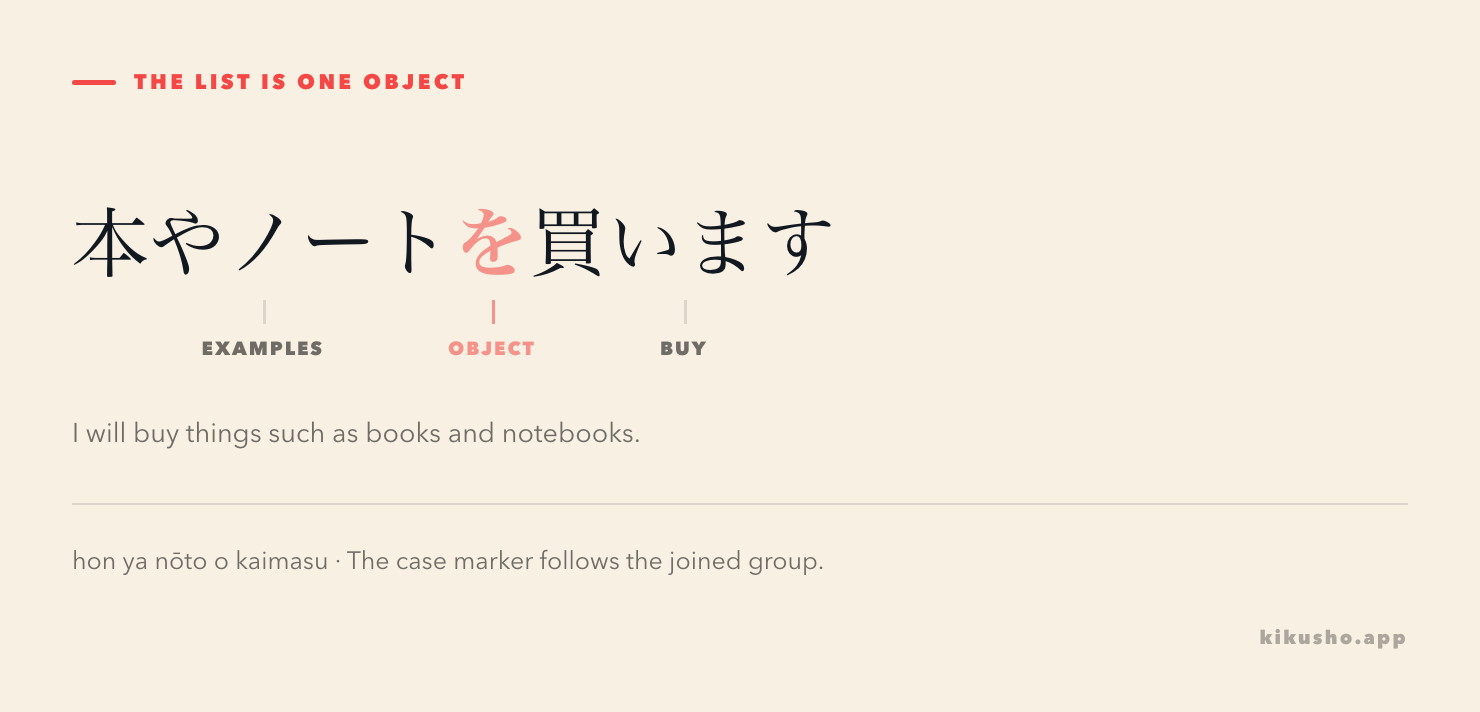
| Group | Its job in the sentence |
|---|---|
| 本やノート | The example list: books and notebooks |
| を | Marks that whole list as the object |
| 買います | Says what happens: buy |
Keep the nouns together, then attach the marker for the whole group's role: 本とノートを, 本やノートを, or 本やノートなどを. Both listing particles can also form groups followed by other markers, such as は or に, when the sentence calls for them.
These listing uses join nouns, not verb or adjective predicates. To join actions such as “read and write,” use the relevant て-form construction. A と after a verb may belong to another grammar pattern; it does not automatically mean the listing “and.”
The position of も tells you what is added
Compare these with a suitable earlier statement:
| Form | What “also” points to |
|---|---|
| 私もコーヒーを飲みます。 | I too drink coffee: someone else does. |
| 私はコーヒーも飲みます。 | I also drink coffee: I drink something else. |
| 学校でも勉強します。 | I also study at school: I study somewhere else. |
In the last row, imagine you have just said 家で勉強します (いえでべんきょうします, “I study at home”). 学校でも勉強します (がっこうでもべんきょうします) adds school as another study location. Keep the location marker で, then append も. The TUFS focus-particle explanation distinguishes this attachment from the omission of が and を before focus particles.
Here でも is location で + additive も, not the sentence-opening “but.” Context and attachment matter more than matching the sounds to one English word.
These forms work with plain or polite sentence endings. 本やノートを買う is plain; 本やノートを買います is polite. や is usable in speech as well as writing. A more conversational example-list marker, とか, has its own possibilities; it does not make や forbidden in conversation.
This is N5 grammar as classified by JLPT Sensei's と lesson and Bunpro's pages for listing と, や and も. The conditional と is a different use, explained in と versus たら; its N4 placement does not reclassify this basic “and/with” lesson. The JLPT FAQ explains the withdrawal of exhaustive vocabulary and grammar specifications.
A photographed materials list gives Kikusho something more useful than three isolated particle names. Capture the line, inspect the generated card's editable example, and check whether its と or や survived with the nouns. On review, turn that list into a second sentence with も: after 本を買います, produce ノートも買います. This checks whether you can assemble the addition from a situation.
Seven questions before the answers
Attempt the full set before scrolling further. These original exercises use grammar-form selection, sentence composition and linked-text grammar, categories shown in the JLPT test-item table. They practise these three particles; they do not measure overall exam readiness.
Question 1. A teacher asks you to name the complete set of two materials required for tomorrow: books and notebooks. Fill the blank to present that full list: 本(_____)ノートを持っていきます。 “I will bring books and notebooks.” Read 持っていきます as もっていきます.
A. や B. も C. と D. を
Question 2. Your purchases include several kinds of stationery. You want to give examples, without listing the complete set: 本(_____)ノートを買います。 “I will buy things such as books and notebooks.”
A. も B. や C. を D. と
Question 3. Yumi has just said she is a student. You want to say “I am a student too”: 私(_____)学生です。
A. は B. と C. を D. も
Question 4. Arrange the supplied fragments into “I will buy things such as books and notebooks”: を / 買います / 本や / ノート. Use each piece once, keeping its contents intact.
Question 5. Complete the second sentence so it adds another drink to the first statement:
朝はお茶を飲みます。コーヒー(_____)飲みます。
Read 朝 as あさ. Intended meaning: “In the morning I drink tea. I also drink coffee.”
A. を B. と C. も D. や
Question 6. Fill the blank to say “I go to school with my younger brother”: 私は弟(_____)学校に行きます。
A. と B. や C. を D. は
Question 7. You have said お茶は飲みません (“I do not drink tea”). Which continuation adds “I do not drink coffee either”?
A. コーヒーも飲みます。
B. コーヒーも飲みません。
C. コーヒーと飲みません。
D. コーヒーを飲みます。
Set down the negative continuation you chose; compare its verb ending as well as its particle when you check the solutions.
Answers and explanations
Answer 1. C — と. 本とノートを持っていきます presents the named pair as the complete relevant set. や would be grammatical but would frame them as examples, contrary to this question's instruction. も does not connect the two nouns as this list, and を cannot replace their connector. The object marker after ノート marks the joined group.
Answer 2. B — や. 本やノートを買います presents examples from the broader stationery purchases. と is also grammatical, but changes the intended listing scope. も would need a different additive sentence structure; を marks an object rather than linking these two nouns. You do not have to add など to make や work.
Answer 3. D — も. 私も学生です adds the speaker to the earlier student claim. 私は学生です is grammatical, but only states that I am a student without the required explicit “too.” と would not supply that addition, and を cannot mark the person as the object of 学生です.
Answer 4. 本やノートを買います。 The order is 本や → ノート → を → 買います. The example list forms first, を marks it as the object, and the verb follows. The intact piece 本や fixes which noun comes first, so exchanging the nouns is not an alternative arrangement of these supplied pieces.
Answer 5. C — も. コーヒーも飲みます adds coffee to what the speaker drinks. コーヒーを飲みます is grammatical, but would omit the requested additive marking. と would suggest an inappropriate companion reading with coffee here; や would leave the intended noun list unfinished.
Answer 6. A — と. 私は弟と学校に行きます marks the brother as the companion. や is not an accompaniment marker, を does not mark the companion of going, and inserting は here does not produce the requested “with” construction. Read 弟と as おとうとと: the noun itself ends in と, followed by particle と.
Answer 7. B — コーヒーも飲みません. も adds coffee to the negative claim, and 飲みません keeps that claim negative. A adds a positive coffee-drinking statement instead. C fails to express the intended addition, and D is positive without “either.”
Write a complete two-item list of things you will buy, then expand the situation to several kinds of purchases and name just two examples. Finally cover both lists and tell a partner one additional thing you will buy using も. Keep track of what the partner already knows.
Common questions
What is the difference between to and ya in Japanese?
と joins nouns as the complete relevant list you are presenting; や joins nouns as examples from a broader set. 本とノート means books and notebooks; 本やノート means things such as books and notebooks. Completeness concerns the list in context, not every object that exists or every purchase you have ever made.
Can to and ya join more than two nouns?
Yes. 本とノートとペン and 本やノートやペン are both grammatical noun lists. と presents the named set, while や presents examples. Neither listing particle has a universal two-noun limit. Normally put the sentence's case particle after the final noun, as in 本やノートを買います.
Does mo replace wa and wo?
In basic additive sentences, use 私も for I too, and コーヒーも飲みます for I also drink coffee. Do not insert は or を before も in those patterns. Other case particles can remain: 学校でも勉強します can mean I also study at school, with で marking the location and も adding that location.
Does to mean and or with?
Both uses are taught here. 私と弟は学校に行きます names I and my younger brother as a group; 私は弟と学校に行きます says I go to school with my younger brother. Conditional and quotation uses of と require separate explanations. Basic listing, accompaniment, や and additive も are classified as N5 by the study references, rather than an official exhaustive JLPT syllabus.