On this page
Use AであれBであれ、C when you want to name the alternatives that C covers. Use いずれにしても/いずれにしろ/いずれにせよ、C when the possibilities are already understood and you want to close them under one unchanged conclusion.
対面であれオンラインであれ、事前の予約が必要です。
たいめんであれ オンラインであれ、じぜんの よやくが ひつようです。
Whether it is in person or online, an advance reservation is required.
対面にするかオンラインにするかは、まだ決まっていません。いずれにしても、事前の予約が必要です。
たいめんに するか オンラインに するかは、まだ きまっていません。いずれにしても、じぜんの よやくが ひつようです。
We have not decided whether it will be in person or online. In either case, an advance reservation is required.
The conclusion is identical. The first sentence displays the alternatives inside its grammar; the second retrieves them from the previous sentence. That difference between listing and referring back is the quickest way to choose.
Name the cases or point back to them
Both families say that C survives a choice among possibilities. Their information structure is different.
| What the sentence needs to do | Pattern | Where the alternatives appear |
|---|---|---|
| present the relevant cases now | AであれBであれ、C | directly before C |
| summarize a choice already discussed | AかBか…。いずれにしても、C | in the earlier context |
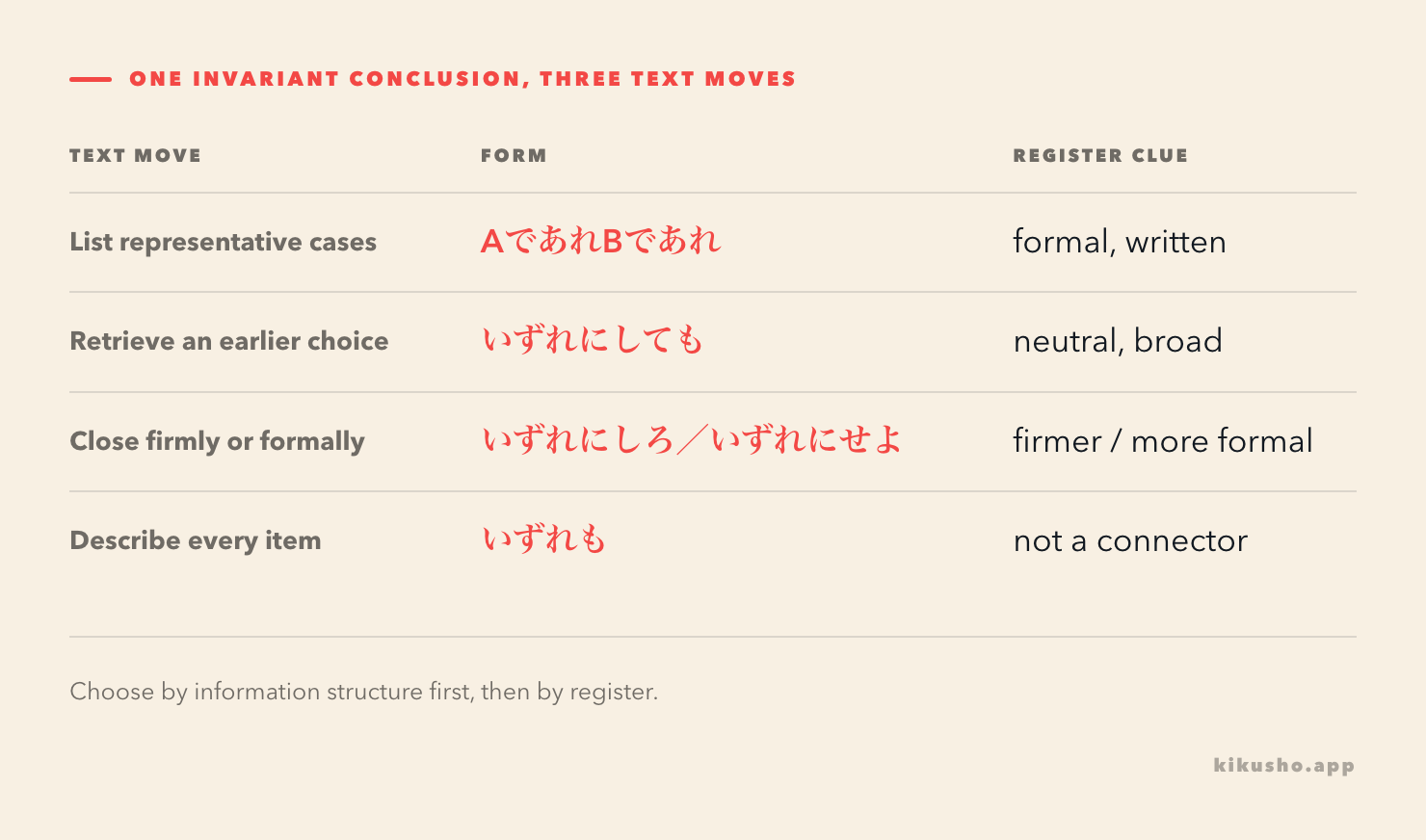
| state the invariant result when the exact outcome is unknown | いずれにしろ/いずれにせよ、C | recoverable or left implicit |
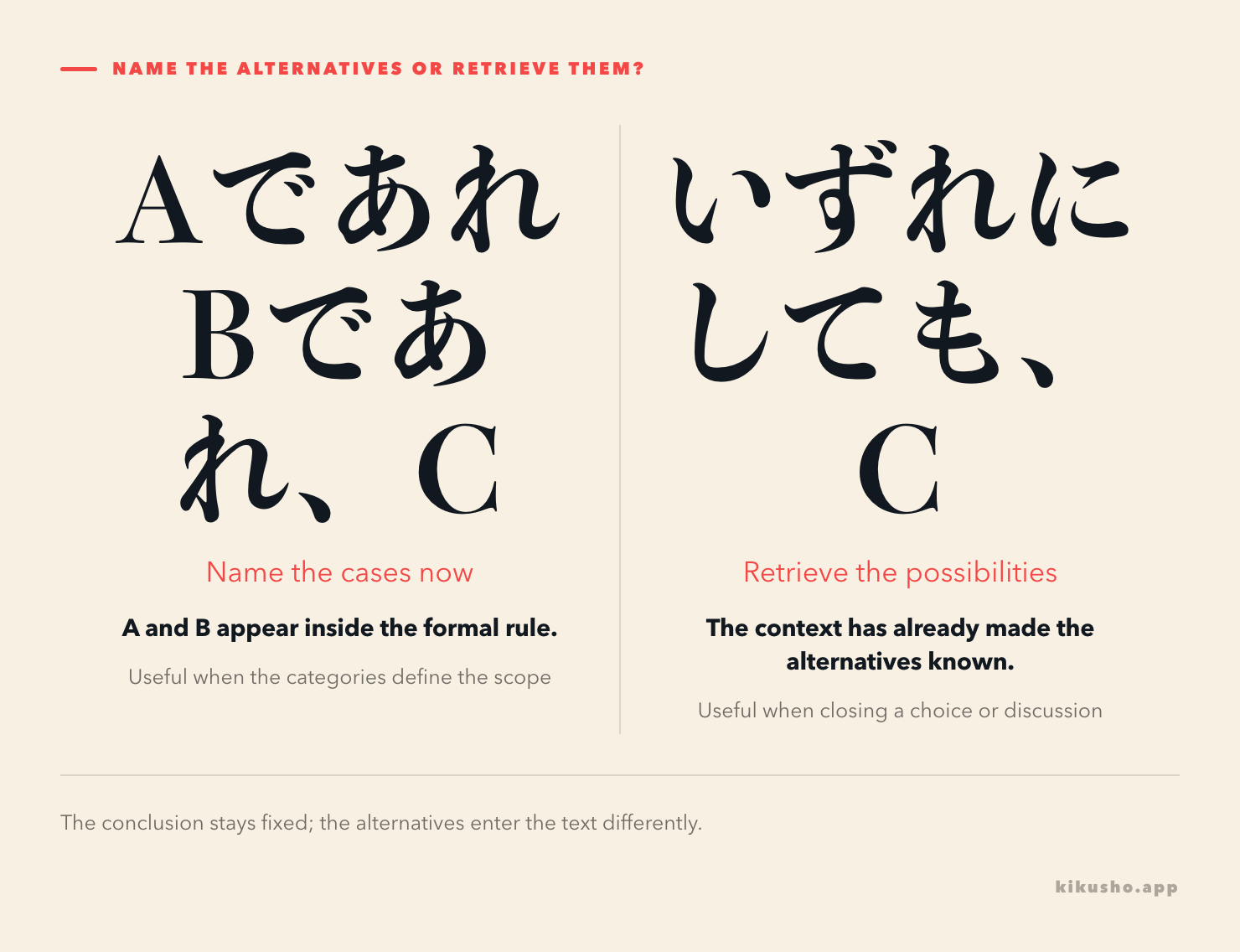
This is not a difference between “two possibilities” and “many possibilities.” A paired であれ frame can name two representatives from a larger range. いずれにしても can refer back to exactly two proposals. The real question is whether the writer needs to put the alternatives on the page at that point.
であれ~であれ puts the alternatives inside one formal frame
Attach であれ to each noun phrase or category, then state the result that applies across them.
初心者であれ経験者であれ、この説明を最初に読んでください。
しょしんしゃであれ けいけんしゃであれ、この せつめいを さいしょに よんでください。
Whether you are a beginner or an experienced user, please read this explanation first.
賛成であれ反対であれ、理由を明確に述べる必要がある。
さんせいであれ はんたいであれ、りゆうを めいかくに のべる ひつようが ある。
Whether you are for or against it, you need to state your reasons clearly.
The paired categories often contrast, but they can also be two members of the same class:
小説であれ論文であれ、引用した資料を示さなければならない。
しょうせつであれ ろんぶんであれ、いんようした しりょうを しめさなければ ならない。
Whether it is a novel or an academic paper, cited material must be identified.
Here the rule may extend beyond those two genres. The pair makes the scope concrete without asserting that novels and papers are the only kinds of writing.
The form is strongly associated with formal writing, policies, arguments and careful announcements. Bunpro's であれ~であれ entry gives the repeated pattern an N1 placement, while にほんご部 explicitly compares it with the less stiff paired にしろ/にせよ family. The existing であれ and たりとも lesson gives the full boundary with minimum-unit expressions such as 一円たりとも~ない.
A single であれ can cover any member
An interrogative expression can replace the named pair:
担当者が誰であれ、この記録は保存されます。
たんとうしゃが だれであれ、この きろくは ほぞんされます。
Whoever is responsible, this record will be preserved.
This still presents the variable inside the clause. 誰であれ means that the result does not depend on the person's identity. The present lesson concentrates on the paired form because it exposes the contrast with いずれ most clearly.
いずれにしても retrieves possibilities and closes the discussion
いずれ points across alternatives. In the fixed connector いずれにしても, those alternatives normally come from the previous sentence, the conversation or a decision everyone can infer.
電車は遅れているし、道路も混んでいる。いずれにしても、開始時刻には間に合わない。
でんしゃは おくれているし、どうろも こんでいる。いずれにしても、かいしじこくには まにあわない。
The trains are delayed and the roads are congested. Either way, we will not arrive by the start time.
The connector does not build the train-versus-car alternatives by itself. The earlier context makes them available. The speaker then removes the unresolved choice from the conclusion: the arrival problem is the same.
契約を更新するか、別の会社を探すか、今週中に判断する。いずれにせよ、費用の見直しは必要だ。
けいやくを こうしんするか、べつの かいしゃを さがすか、こんしゅうじゅうに はんだんする。いずれにせよ、ひようの みなおしは ひつようだ。
We will decide this week whether to renew the contract or find another company. In any event, the costs need to be reviewed.
JLPT Sensei records いずれにしても, いずれにしろ and いずれにせよ together with the “in any case” meaning and an N1 estimate. Japanese-language-education.com's account independently describes the shared logic and the register differences among the variants.
The three いずれ variants share logic but differ in tone
The following forms are largely interchangeable when their shared conclusion is clear:
| Form | Usual tendency | Example setting |
|---|---|---|
| いずれにしても | neutral and broadly usable | conversation, reports, explanations |
| いずれにしろ | concise and sometimes firmer | decisions, spoken or written conclusions |
| いずれにせよ | more formal or literary | essays, notices, formal discussion |
詳細はまだ不明だ。いずれにしろ、調査を続ける必要がある。
しょうさいは まだ ふめいだ。いずれにしろ、ちょうさを つづける ひつようが ある。
The details are still unclear. In any case, the investigation must continue.
どの案が採用されるかは分からない。いずれにせよ、十分な準備が求められる。
どの あんが さいようされるかは わからない。いずれにせよ、じゅうぶんな じゅんびが もとめられる。
We do not know which proposal will be adopted. In any event, thorough preparation will be required.
These are register tendencies, not three sealed meanings. The final predicate, the relationship between speakers and the genre of the text can matter more than the connector alone. せよ and しろ resemble command forms historically, but these fixed connectors do not order the listener to “do either one.” They function as concessive discourse markers.
Do not confuse いずれにしても with いずれも
One added particle changes the sentence's job.
二つの案はいずれも実現可能だ。
ふたつの あんは いずれも じつげんかのうだ。
Both proposals are feasible.
いずれも distributes the statement over every item in the available set. It sits inside the proposition and describes the proposals.
どちらの案を選ぶかは明日決める。いずれにしても、追加の予算が必要だ。
どちらの あんを えらぶかは あした きめる。いずれにしても、ついかの よさんが ひつようだ。
We will decide tomorrow which proposal to choose. Either way, an additional budget will be needed.
Here いずれにしても connects the unresolved choice to a conclusion outside it. Replacing it with いずれも would require a noun or other structure for “both,” such as いずれの案も.
The fixed connector also differs from とにかく. とにかく can push other matters aside and prioritise the next action: “anyway, let's begin.” いずれにしても normally preserves the logic that multiple possibilities lead to the same C. If no alternatives can be recovered, とにかく may be the more natural discourse move.
A two-stage drafting test
First decide whether readers need to see the alternatives. If the categories themselves establish the scope of a rule, name them with AであれBであれ. If readers already know the competing plans, causes or outcomes, retrieve them with an いずれ connector.
Then choose the register. A legal-style rule may favour paired であれ or formal いずれにせよ. A meeting summary may use いずれにしても. The にせよ, にしろ and にしても comparison covers the attached and repeated forms that explicitly follow predicates, while this N1 lesson treats いずれ as a fixed backward-pointing connector.
JLPT Sensei places both inventory items at N1, and Bunpro independently gives paired であれ~であれ the same level. No source in this lesson's inventory assigns either target elsewhere. These remain editorial study estimates because the current JLPT publishes no exhaustive grammar list.
For a Kikusho card, keep enough context to recover the alternatives. いずれにせよ、必要だ is grammatical but teaches little by itself. Saving the preceding choice with the shared conclusion makes the connector testable instead of turning it into a loose translation.
Practice: decide whether to list or retrieve
Question 1 — explicit categories
Choose the form that best completes the formal rule.
正規職員__臨時職員__、安全研修を受けなければならない。
ア) であれ/であれ
イ) にしても/いずれにしても
ウ) いずれも/いずれも
エ) にせよ/いずれも
Question 2 — a choice already stated
Choose the connector for the second sentence.
計画を延期するか中止するか、明日決定します。__、関係者への説明が必要です。
ア) いずれも
イ) いずれにしても
ウ) であれ
エ) それなのに
Question 3 — register
A formal written report has just listed several possible causes. Which conclusion fits best?
原因はまだ特定できない。__、再発防止策を講じる必要がある。
ア) いずれにせよ
イ) いずれも
ウ) そう言えば
エ) であれ~であれ
Question 4 — rebuild the paired frame
Put the four pieces in order, then add punctuation: “Whether it is a paper application or an online application, the deadline is the same.”
- 締切は同じだ\
- オンライン申請であれ\
- 書面申請であれ\
- 申請方法が
Question 5 — いずれも or いずれにしても
Choose the sentence that means “Both candidates have sufficient experience.”
ア) 候補者はいずれにしても十分な経験がある。
イ) 候補者はいずれも十分な経験がある。
ウ) 候補者であれ十分な経験がある。
エ) いずれにせよ候補者を十分な経験がある。
Question 6 — connected text
Choose the pair that best completes the notice.
参加者が学生__社会人__、本人確認書類を提出してください。登録方法は窓口とオンラインの二つです。__、金曜日までに手続きを終える必要があります。
ア) ①であれ/であれ ②いずれにしても
イ) ①いずれも/いずれも ②であれ
ウ) ①にしても/いずれにしても ②いずれも
エ) ①いずれにせよ/いずれにしろ ②であれ~であれ
Answers and explanations
Answer 1
ア, であれ/であれ. Two employment categories are stated, while one training obligation covers both. The repeated formal frame makes those categories part of the rule.
Answer 2
イ, いずれにしても. The first sentence has already supplied postponement and cancellation as the alternatives. The connector retrieves that choice and says the explanation is required whichever decision is made.
Answer 3
ア, いずれにせよ. The possibilities are already present as the still-unknown causes, and the formal written setting suits いずれにせよ. いずれも would describe every member of a set rather than introduce the invariant conclusion.
Answer 4
申請方法が書面申請であれオンライン申請であれ、締切は同じだ。 The order is 4 → 3 → 2 → 1. Each noun phrase takes であれ, followed by the deadline that remains unchanged.
Answer 5
イ. いずれも distributes “has sufficient experience” across both candidates. いずれにしても would need a decision or possibilities to point back to, followed by a conclusion such as “we can appoint either one.”
Answer 6
ア: ①であれ/であれ, ②いずれにしても. The first sentence explicitly names students and working adults inside one formal scope. The final sentence points back to the two registration methods already stated and keeps the Friday deadline under either method.
The useful contrast appears when you edit a paragraph, not when you translate one connector. Put alternatives into the sentence when they define the rule; retrieve them when the discussion has already done that work.
Common questions
What is the difference between であれ~であれ and いずれにしても?
であれ~であれ names two alternatives or representative cases inside the sentence. いずれにしても points back to possibilities already known from the context and states that the conclusion is unchanged whichever one applies.
Do いずれにしても, いずれにしろ and いずれにせよ mean the same thing?
They share the core meaning “in any case” or “either way.” いずれにしても is the most neutral, いずれにしろ can sound firmer, and いずれにせよ tends toward formal or written contexts, though their ranges overlap.
Does であれ~であれ cover only the two nouns that are named?
Not necessarily. The pair can give two representative cases and imply that the same result applies throughout the wider category. Context decides whether the pair is exhaustive or illustrative.
Is いずれも interchangeable with いずれにしても?
No. いずれも means every one or both of the available items, while いずれにしても introduces a conclusion that remains valid whichever possibility becomes relevant.