On this page
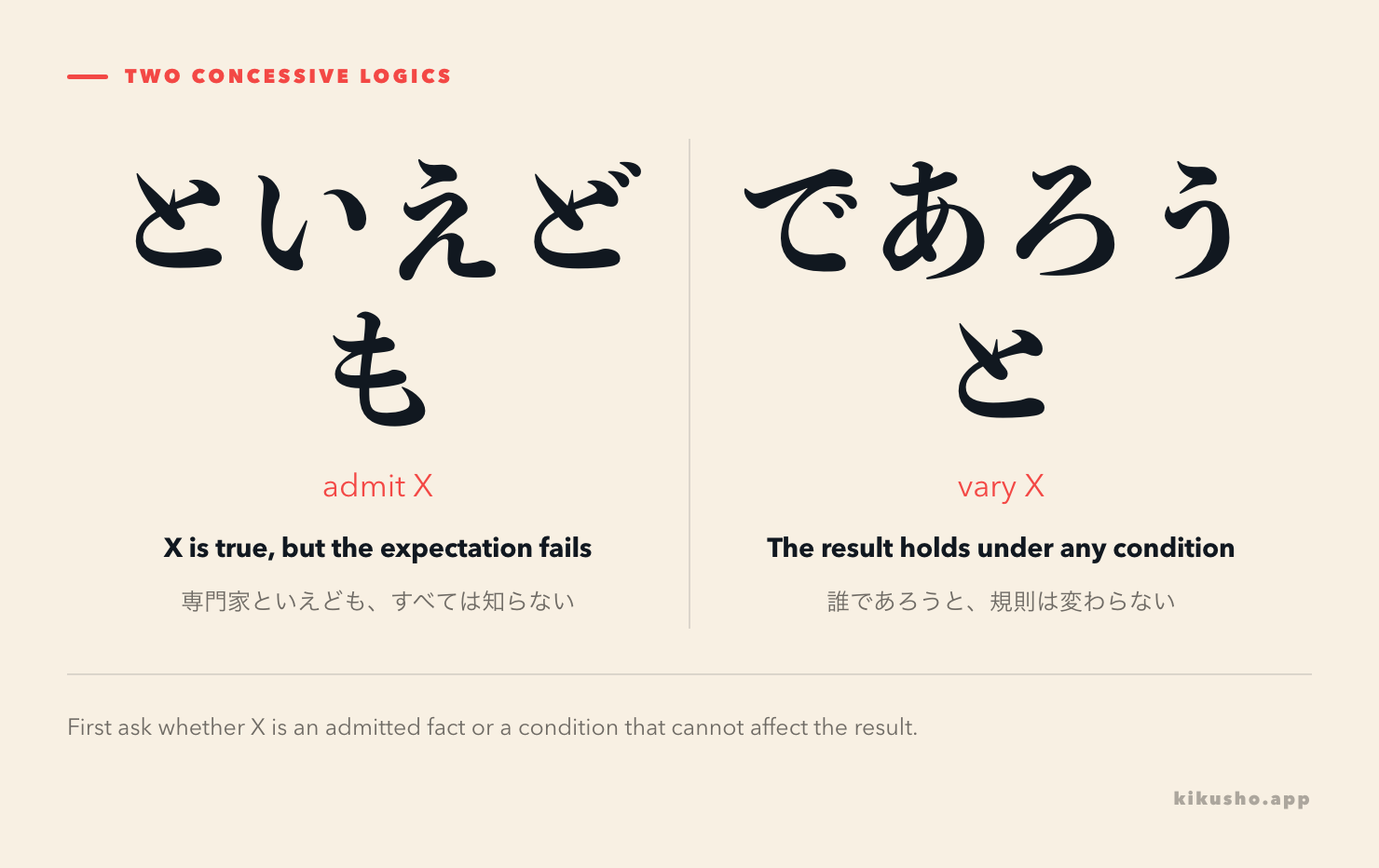
Use といえども (to iedomo) when the first clause is accepted as true but its usual implication fails. Use であろうと (de arō to) when a possible identity, category or condition cannot change what follows.
Decide whether X is admitted or made irrelevant
Both constructions can translate as “even if,” “even though” or “regardless of.” Those glosses hide the choice. Ask what the writer does with X.
| Test | といえども | であろうと |
|---|---|---|
| Status of X | accepted fact, status or label | possible condition, identity or alternative |
| Main move | deny the expectation created by X | declare that the result survives every case |
| Useful paraphrase | “X is true, but even so…” | “whether X or not / whoever X is…” |
| Common setting | formal correction or exception | formal rule, resolve or broad condition |
専門家といえども、すべてを知っているわけではない。
せんもんか といえども、すべてを しっている わけではない。
Even an expert does not know everything.
The person really is an expert. Expertise normally creates an expectation of extensive knowledge, and the second clause limits that expectation.
相手が専門家であろうと、疑問点は確認すべきだ。
あいてが せんもんか であろうと、ぎもんてんは かくにんすべきだ。
Even if the other person is an expert, you should check points you are unsure about.
Here 専門家 is a condition under which the same advice still applies. The sentence does not need to establish that the other person is actually an expert.
The Japan Foundation's guide to written concessive expressions describes といえども as accepting a socially recognised fact, person or thing before rejecting what would normally be expected from it. Teacher references for であれ and であろうと instead define the result as unchanged regardless of X and show the form with alternatives and interrogatives. That difference between an admitted premise and an irrelevant condition is more reliable than an English translation.
といえども grants X before limiting it
The clearest といえども sentences begin with a label that seems powerful enough to guarantee something: 専門家 (expert), 親 (parent), 子供 (child), 大企業 (large company), or 安全な地域 (safe area). The next clause then states a limit, exception or prohibition.
大企業といえども、将来が保証されているわけではない。
だいきぎょう といえども、しょうらいが ほしょうされている わけではない。
Even a large company does not have its future guaranteed.
The company is classified as large. The writer rejects the easy inference that size guarantees survival. Negation is frequent because the pattern often cancels an expectation, but it is not mechanically required.
子供といえども、一人の市民として意見を述べる権利がある。
こども といえども、ひとりの しみんとして いけんを のべる けんりが ある。
Even a child has the right to express an opinion as a citizen.
The positive 権利がある still reverses an expectation: being a child does not remove that right.
The form can also follow an event or quality that the writer concedes:
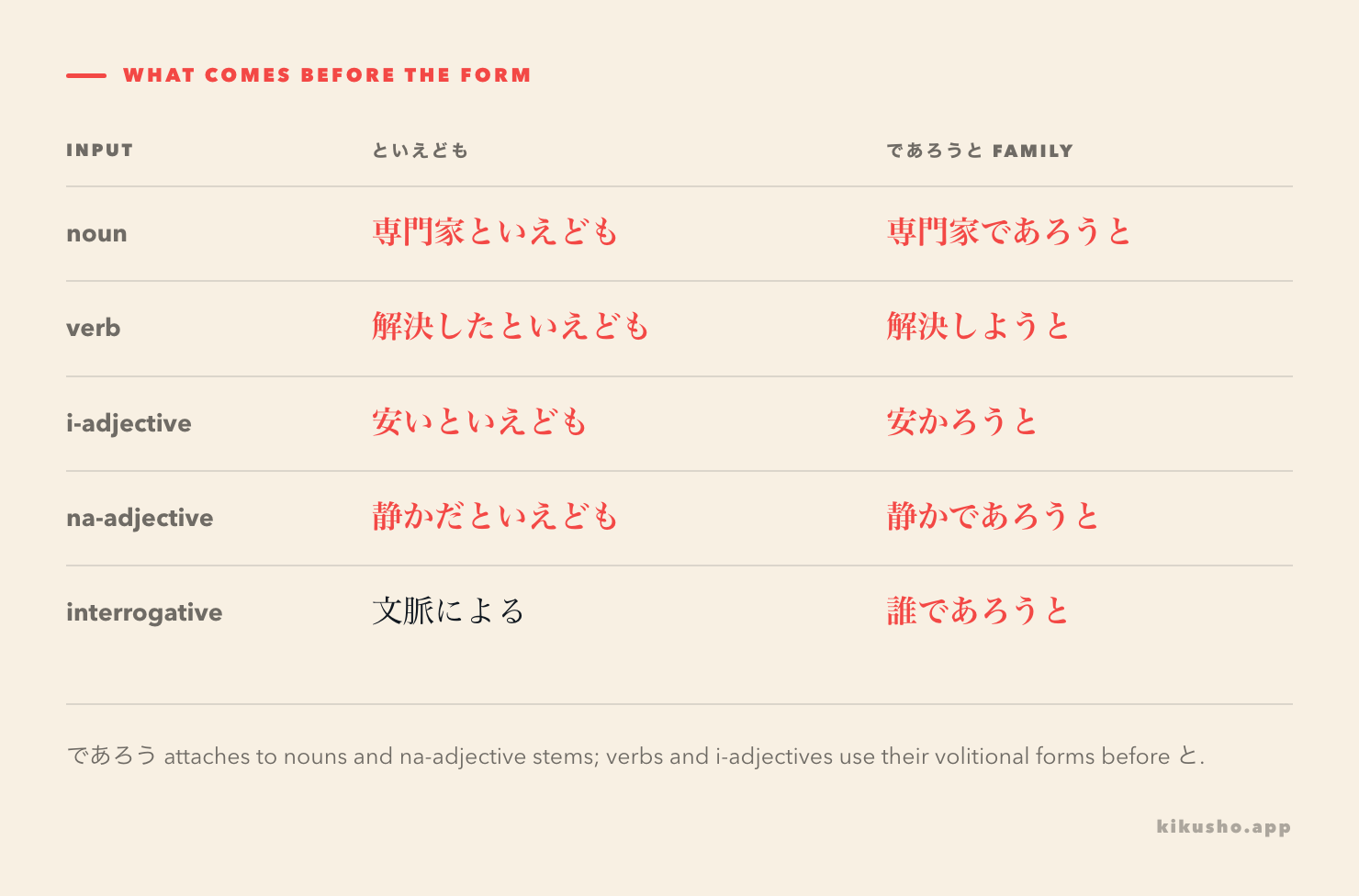
| Before といえども | Form | Example opening |
|---|---|---|
| noun | N + といえども | 初心者といえども |
| verb | plain form + といえども | 解決したといえども |
| i-adjective | plain form + といえども | 安いといえども |
| na-adjective | stem + だ + といえども | 静かだといえども |
問題は解決したといえども、再発を防ぐ対策は必要だ。
もんだいは かいけつした といえども、さいはつを ふせぐ たいさくは ひつようだ。
Although the problem has been solved, measures to prevent a recurrence are necessary.
The solution is acknowledged. What fails is the inference that no further action is needed. Bunpro's といえども entry records the noun, verb, i-adjective and na-adjective + だ attachments and marks the expression as formal. JLPT Sensei and Bunpro both place it at N1. Treat N1 as a practical study placement from those references: the exam authority does not issue a complete grammar catalogue.
であろうと removes a condition from the decision
In this construction, であろう is the formal presumptive form of the copula. The particle と, sometimes followed by も, frames a concession: even under X, the following judgment, rule or intention remains firm.
理由が何であろうと、無断で入ってはいけない。
りゆうが なんで あろうと、むだんで はいっては いけない。
Whatever the reason, you must not enter without permission.
何であろうと ranges over every possible reason. None changes the prohibition. Interrogatives such as 誰, 何, どこ and どんな理由 are natural because they leave the variable open.
参加者が初心者であろうと経験者であろうと、同じ説明を行います。
さんかしゃが しょしんしゃで あろうと けいけんしゃで あろうと、おなじ せつめいを おこないます。
Whether participants are beginners or experienced, we give the same explanation.
The paired frame AであろうとBであろうと names alternatives and states an invariant result. The shorter であれ can perform the same formal test. The existing lesson on であれ and たりとも explains how that family differs from the minimum-unit meaning “not even one.”
For nouns, na-adjectives and interrogative expressions, attach the copula directly:
| Input | であろうと form | Meaning |
|---|---|---|
| 初心者 | 初心者であろうと | even if someone is a beginner |
| 静か | 静かであろうと | even if it is quiet |
| 誰 | 誰であろうと | whoever it is |
| A / B | AであろうとBであろうと | whether A or B |
Do not add で to an ordinary verb or i-adjective. The larger concessive family uses the volitional: 雨が降ろうと (even if it rains), どんなに難しかろうと (however difficult it may be), and 簡単であろうと (however easy it may be). 日本語教師のN1et sets out this attachment contrast, and 日本語教師たのすけ independently shows noun and interrogative uses with であれ/であろうと.
The same noun can support either logic
The word before the form does not settle the choice. Context decides whether the noun is an accepted description or one possibility among several.
責任者といえども、規則を無視することはできない。
せきにんしゃ といえども、きそくを むしする ことは できない。
Even the person in charge cannot ignore the rules.
The person holds that role. Authority might suggest permission to make exceptions, but the second clause denies it.
責任者が誰であろうと、規則は変わらない。
せきにんしゃが だれで あろうと、きそくは かわらない。
Whoever the person in charge is, the rules do not change.
The identity is open. The rule survives every possible answer. A useful editing test is to replace the first half with Xは確かだが for といえども or Xに関係なく for であろうと. If the paraphrase preserves the intended relationship, you have found the right construction.
Both belong to a high, deliberate register
The two forms suit essays, policies, formal speeches and emphatic declarations. といえども can sound literary or old-fashioned in ordinary chat; であろうと can make a personal resolve sound solemn. Their stiffness is useful when the sentence states a principle.
In everyday conversation, 専門家でも間違えることがある is a natural alternative to 専門家といえども間違えることがある. 相手が誰でも態度を変えない or たとえ相手が誰でも can replace 相手が誰であろうと when no formal force is needed. Choose the simpler expression unless the context rewards the deliberate register.
If a passage contains several formal concessions, compare ものの and とはいえ. Those forms normally connect a conceded fact to a contrasting fact. といえども puts stronger pressure on the expectation attached to the first label or proposition, while であろうと is especially suited to an unchanged rule across hypothetical cases.
When saving either form for review, keep the second clause. A card with only 専門家といえども hides the expectation being corrected; a card with only 誰であろうと hides the result that remains fixed. Kikusho can create an editable card from selected or pasted text, so preserve both sides of the concession and check the reading before saving.
Practice: identify the writer's logical move
Question 1: grammar choice
The company really is a major corporation, but size does not remove the risk. Choose the best form.
大企業( )、倒産の可能性はある。
- ① といえども
- ② であろうと
- ③ たりとも
- ④ の末に
Question 2: grammar choice
Complete a rule that applies to either applicant category.
応募者が学生( )社会人( )、審査基準は同じだ。
- ① であろうと/であろうと
- ② といえども/といえども
- ③ たりとも/たりとも
- ④ の末に/の末に
Question 3: meaning
What does the first half of 経験者といえども、確認は必要だ tell you?
- ① The person's experience is only hypothetical.
- ② The person is experienced, but experience does not remove the need to check.
- ③ The writer is comparing two kinds of experience.
- ④ The checking has already failed.
Question 4: sentence composition
Arrange the pieces into a formal sentence meaning “Whether it is a success or a failure, we will publish the results”: 結果を公表する / 成功であろうと / 失敗であろうと.
Question 5: grammar in connected text
Choose the pair that preserves the two different logical moves.
この制度は完成した( )、改善の余地はある。また、担当者が誰( )、同じ基準で判断しなければならない。
- ① といえども/であろうと
- ② であろうと/といえども
- ③ たりとも/ものの
- ④ の末に/といえども
Question 6: attachment
Which sentence uses the attachment correctly?
- ① どんなに難しいであろうと、挑戦する。
- ② どんなに難しかろうと、挑戦する。
- ③ どんなに難しいだといえども、挑戦する。
- ④ どんなに難しさであろうと、挑戦する。
Question 7: rewrite
Rewrite 相手が誰であろうと、態度を変えない in more ordinary Japanese while keeping the meaning that the person's identity does not matter.
Answers and explanations
Answer 1
① といえども. 大企業 is an accepted description, and the second clause rejects the expectation that a large company is safe from failure. 大企業であろうと would require a context treating company size as a possible condition under which a broader rule remains unchanged.
Answer 2
① であろうと/であろうと. 学生 and 社会人 are alternative applicant categories, while the screening standard remains fixed. The matched 学生であろうと社会人であろうと frame states that neither category changes the result.
Answer 3
②. The person is treated as experienced. The sentence then denies the expected inference that an experienced person can skip confirmation. That admitted premise is the core of といえども.
Answer 4
成功であろうと失敗であろうと、結果を公表する。 The paired alternatives vary the outcome, while 結果を公表する remains fixed. Adding も after either と is possible but not necessary here.
Answer 5
① といえども/であろうと. The first sentence accepts that the system is complete and limits what completion implies. The second ranges over every possible person in charge and keeps the decision standard unchanged.
Answer 6
② どんなに難しかろうと、挑戦する. An i-adjective uses its volitional form before と in this concessive family. 難しいであろうと wrongly adds the copula to an i-adjective, and 難しいだといえども has the wrong attachment. 難しさ is a noun meaning difficulty, but the sentence would need a different structure for that noun.
Answer 7
One natural rewrite is 相手が誰でも、態度を変えない。 誰でも keeps the identity irrelevant without the solemn force of 誰であろうと. In a sentence stressing a hypothetical condition, たとえ相手が誰でも、態度を変えない is also possible.
When the English translation gives you “even,” inspect the first clause before choosing. If the writer accepts it and then corrects its implication, use といえども. If the writer ranges across possibilities and protects one result from all of them, use であろうと.
Common questions
What is the difference between といえども and であろうと?
といえども grants a fact, status or label and then blocks the conclusion normally expected from it. であろうと makes a possible condition, identity or alternative irrelevant because the following result holds in every case.
What comes before といえども?
It can follow a noun directly, a plain-form verb or i-adjective, and a na-adjective with だ: 専門家といえども, 解決したといえども, 安いといえども and 静かだといえども.
What comes before であろうと?
In the pattern contrasted here, a noun, na-adjective stem or interrogative expression precedes the formal copula: 初心者であろうと, 静かであろうと and 誰であろうと. Verbs and i-adjectives use related volitional forms such as 行こうと and 難しかろうと.
Are といえども and であろうと common in conversation?
Both are formal and more at home in written argument, rules, speeches and emphatic statements. Everyday alternatives include けれども, ても, でも and たとえ~ても, depending on the intended logic.