

On this page
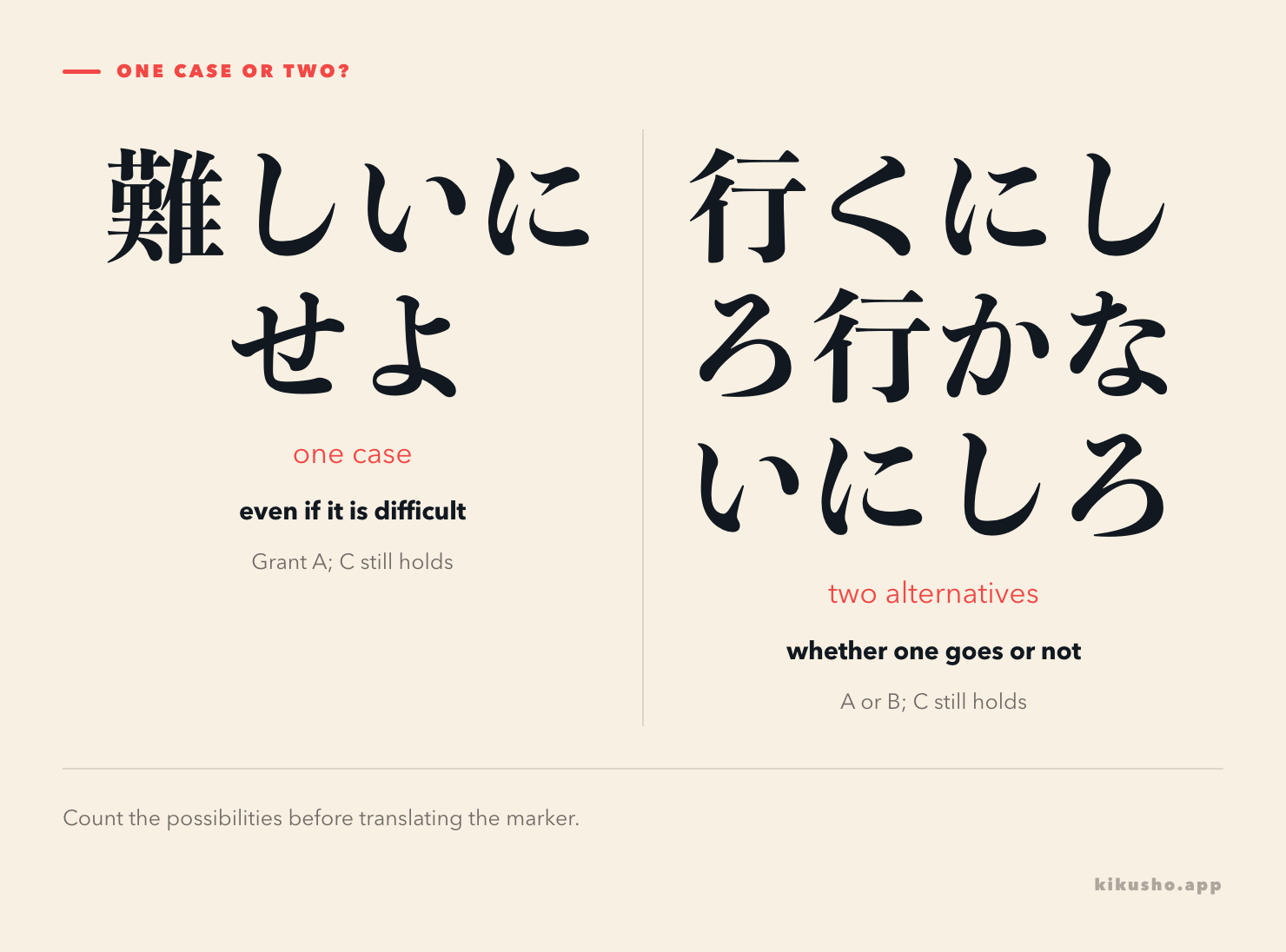
にせよ and にしろ make one case irrelevant to the conclusion: “even if A, C still holds.” Repeat either form around two cases and the reading becomes “whether A or B, C still holds.” The grammar stays stable; the number of cases changes what the sentence is doing.
難しいにせよ、今日中に決める必要がある。
むずかしいにせよ、きょうじゅうに きめる ひつようが ある。
Even if it is difficult, we need to decide today.
賛成するにしろ反対するにしろ、理由を説明してください。
さんせいするにしろ はんたいするにしろ、りゆうを せつめいして ください。
Whether you agree or disagree, please explain your reason.
The first sentence grants one obstacle and maintains a deadline. The second names two positions and applies one request to both.
Count the cases before choosing the reading
The quickest test is structural. Look left of the conclusion and count the alternatives the speaker has put on the table.
| Structure | Work done by the form | Natural English cue |
|---|---|---|
| A にせよ/にしろ、C | grants A without changing C | even if A; granted that A |
| A にせよ B にせよ、C | covers both named cases | whether A or B |
| A にしろ B にしろ、C | covers both named cases | whether A or B |
| A にしても B にしても、C | covers both cases more neutrally | in either case |
The paired form does not always mean that A and B are the only possibilities. 紙にしろデジタルにしろ、記録を残してください names paper and digital records as representative routes; the instruction can still cover another reasonable format.
A single にせよ or にしろ makes a concession
With one case, the speaker temporarily accepts A and then states a judgment, rule, request or decision that survives it.
相手が年下にしろ、礼儀は必要だ。
あいてが とししたにしろ、れいぎは ひつようだ。
Even if the other person is younger, basic courtesy is necessary.
The other person's age could have been offered as an excuse. The sentence admits that case and refuses to let it cancel the rule.
結果が不十分であるにせよ、この調査には価値がある。
けっかが ふじゅうぶんであるにせよ、この ちょうさには かちが ある。
Even if the results are insufficient, this investigation has value.
Here にせよ supports a measured written concession. It does not mean that the speaker is uncertain about every detail. It marks the result as insufficient for overturning the following evaluation.
Bunpro's にせよ・にしろ lesson describes this unchanged-conclusion logic and distinguishes it from a paired list of alternatives. 毎日のんびり日本語教師 independently gives the same plain-form attachments and notes the pattern's tendency to appear with expressions such as いくら and question words.
Question words can leave the case deliberately open:
理由が何にせよ、確認は必要だ。
りゆうが なんにせよ、かくにんは ひつようだ。
Whatever the reason, confirmation is necessary.
Set phrases such as いずれにせよ and いずれにしろ mean “in any case.” They no longer require you to spell out two alternatives because いずれ already points across the possibilities.
Repeating the form removes the choice from C
The paired structure is A にしろ B にしろ、C or A にせよ B にせよ、C. A and B often form opposites, especially a positive and negative version of the same verb.
参加するにせよ参加しないにせよ、金曜日までに返事が必要です。
さんかするにせよ さんかしないにせよ、きんようびまでに へんじが ひつようです。
Whether you participate or not, we need your reply by Friday.
The reply is required before the choice is known. That unchanged consequence is essential. If the second clause changes with the option, use an ordinary conditional instead: 参加するなら席を予約します, “If you are participating, I will reserve a seat.”
The cases may also be two members of the same class:
電話にしろメールにしろ、記録が残る方法で連絡してください。
でんわにしろ メールにしろ、きろくが のこる ほうほうで れんらくして ください。
Whether by phone or email, contact us in a way that leaves a record.
In careful use, repeat the same marker. 電話にしろメールにせよ is understandable, but Bunpro notes that mixing them inside one pair sounds unnatural. Choose にしろ…にしろ or にせよ…にせよ and let the register stay coherent.
Attach the same marker to verbs, adjectives and nouns
Both forms follow plain predicates. Nouns and な-adjectives can attach directly in many sentences; である makes the predication explicit and suits careful writing.
| Before the marker | にしろ example | にせよ example |
|---|---|---|
| verb, non-past | 行くにしろ | 続けるにせよ |
| verb, negative | 行かないにしろ | 続けないにせよ |
| い-adjective | 高いにしろ | 難しいにせよ |
| な-adjective | 静かにしろ / 静かであるにしろ | 必要にせよ / 必要であるにせよ |
| noun | 冗談にしろ / 冗談であるにしろ | 仮定にせよ / 仮定であるにせよ |
Do not insert だ before the marker. 冗談だにしろ is not the target construction; use 冗談にしろ or 冗談であるにしろ. Past forms are possible when the conceded event is complete: 計画が失敗したにせよ、記録は次に役立つ, “Even if the plan failed, the record will help next time.”
Register separates にしろ, にせよ and にしても
The three markers share more meaning than many translations suggest. Their strongest difference is how the statement sounds.
| Form | Typical impression | Useful setting |
|---|---|---|
| にしろ | firm, somewhat formal, available in speech | instructions, arguments, direct judgments |
| にせよ | firmer and more literary | reports, formal claims, careful written reasoning |
| にしても | neutral and reflective | ordinary careful speech and writing |
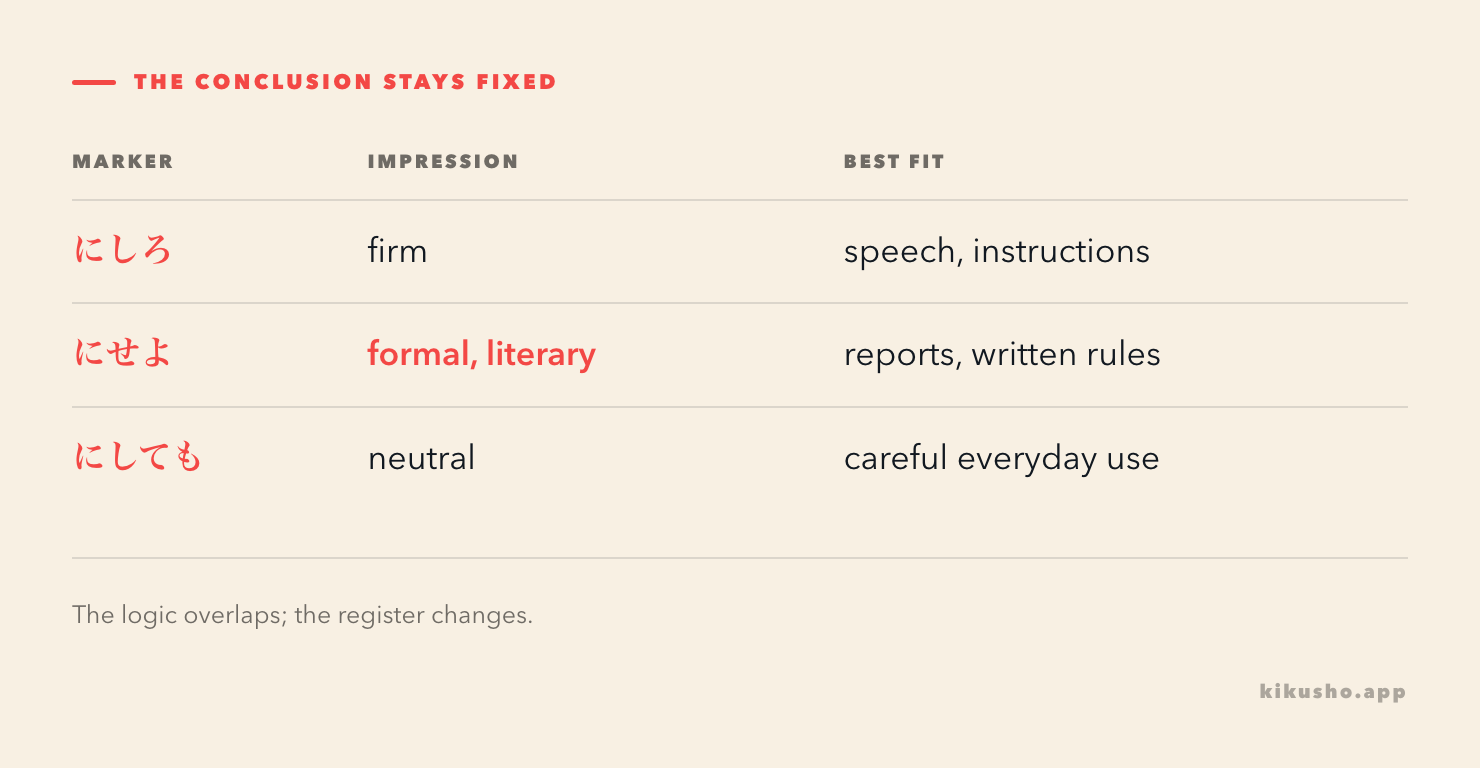
Compare one conclusion across the three:
- 行くにしろ行かないにしろ、連絡してください。 The request sounds firm.
- 行くにせよ行かないにせよ、事前の連絡が必要です。 The rule suits formal writing.
- 行くにしても行かないにしても、早めに教えてね。 The same logic is presented more softly.
These are tendencies, not three sealed boxes. Context, sentence ending and speaker relationship matter. The existing lesson on にしても and は別として shows the softer form in both a single concession and a paired alternative. This lesson adds the stronger にしろ/にせよ contrast and the rule against mixing them inside a pair.
The level labels also disagree. JLPT Sensei and Bunpro classify the target にせよ/にしろ entries as N2. 日本語NET and 毎日のんびり日本語教師 teach the repeated three-form family under N3, while treating the single concession separately at N2. The official test offers no complete grammar catalogue that could settle those publisher labels. A practical study order is clearer: learn the single concession and ordinary にしても first, then control the stronger paired forms and their register.
Do not confuse a concession with an unanswered question
かどうか reports uncertainty: 参加するかどうか分からない, “I do not know whether they will participate.” The paired construction removes that uncertainty from the result: 参加するにしろ参加しないにしろ、返事は必要だ, “Whether they participate or not, a reply is required.”
Likewise, たとえ~ても presents a hypothetical obstacle. A single にしろ can do similar work but often sounds firmer. A pair does something extra: it explicitly spans alternatives and declares that C is invariant.
If you meet one of these structures in a notice, capture the whole sentence in Kikusho. A card containing only にせよ cannot show whether it grants one case or balances two. Keeping both the alternatives and the unchanged instruction makes the register choice visible during review.
Practice: keep the conclusion fixed
Question 1 · single concession
Complete: 相手が新人( )、必要な情報は共有すべきだ。
- A. にしろ
- B. かどうか
- C. にしろ新人
- D. だにせよ
Question 2 · paired alternatives
Complete: 電車で行く( )車で行く( )、出発時刻は同じです。
- A. にしろ / にせよ
- B. にしろ / にしろ
- C. かどうか / にしろ
- D. にしては / にしては
Question 3 · written register
Which sentence best suits a formal written rule meaning “Whether the application is accepted or rejected, the documents will not be returned”?
- A. 申請が受理されるにせよ却下されるにせよ、書類は返却されません。
- B. 申請が受理されるかどうか、書類は返却されません。
- C. 申請が受理されるにしろ却下されるにせよ、書類は返却されません。
- D. 申請が受理されてもいい、書類は返却されません。
Question 4 · attachment
Which phrase correctly means “even if it was a joke”?
- A. 冗談だにしろ
- B. 冗談にしろ
- C. 冗談のにしろ
- D. 冗談でにしろ
Question 5 · unchanged conclusion
Which sentence uses the paired construction naturally?
- A. 雨にしろ雪にしろ、イベントは室内で行います。
- B. 雨にしろ雪が降ったら、イベントを中止します。
- C. 雨かどうか雪にしろ、天気を確認します。
- D. 雨にしろ、雪にせよ、イベントは室内で行います。
Question 6 · build the pair
Compose the Japanese line “Whether you continue or quit, please decide by tomorrow” with 続ける, 辞める, にせよ, 明日までに, and 決めてください.
Answers and explanations
Answer 1
A. にしろ. One possible excuse, the other person's inexperience, is granted without changing the duty to share information. A noun attaches directly; 新人だにせよ uses the wrong copular form.
Answer 2
B. にしろ / にしろ. The two travel choices lead to the same departure time. A paired construction repeats one marker; mixing にしろ with にせよ is avoided.
Answer 3
A. 申請が受理されるにせよ却下されるにせよ、書類は返却されません. The two alternatives share one formal rule, and にせよ is consistent on both sides. C mixes the markers; B merely raises uncertainty and does not cover the rejected case.
Answer 4
B. 冗談にしろ. A noun can attach directly. The target form does not take だ, の or a bare で before にしろ; careful writing can use 冗談であるにしろ.
Answer 5
A. 雨にしろ雪にしろ、イベントは室内で行います. Rain and snow are two representative conditions, and the indoor location remains unchanged. B makes the result depend on the weather, C is malformed, and D mixes にしろ with にせよ.
Answer 6
One natural answer is 続けるにせよ辞めるにせよ、明日までに決めてください。 The two opposite choices use the same marker, and the deadline applies whichever choice is made.
The omitted middle is part of the meaning
When A and B are opposites, the sentence also reaches every position between them. 全面的に賛成するにしろ反対するにしろ does not create a loophole for someone who is undecided; it frames the entire range as irrelevant to the next requirement. That silent coverage is why the pair belongs in rules, deadlines and arguments where no named option should escape C.
Common questions
What is the difference between にせよ and にしろ?
Both can mark a firm concession or appear twice to cover alternatives. にせよ is more characteristic of formal writing, while にしろ is somewhat more available in speech. Keep the same form on both sides of a pair.
What does AにしろBにしろ mean?
It means that the following conclusion holds whether A or B is true. The two cases may be opposites or representative members of a wider range.
How does にしても differ from にしろ and にせよ?
にしても can make the same concession or paired-alternative structure, but it is usually more neutral and less forceful. にしろ and especially にせよ suit firmer instructions and formal claims.


