On this page
N / な-adjective + でも何でもない and い-adjective + くも何ともない reject a description completely. They mean “not X at all,” “nothing like X” or “not X in the slightest,” with more force than an ordinary negative.
あれは勇気でも何でもない。ただ危険を考えなかっただけだ。
あれは ゆうきでも なんでも ない。ただ きけんを かんがえなかった だけだ。
That was not courage at all. They simply failed to consider the danger.
The speaker does not merely place 勇気 on the false side of a yes-or-no question. By adding 何でもない, they reject the label and anything that might be presented as a similar positive description.
This lesson verifies inventory item g-e79e88ec17b0. JLPT Sensei and the Japanese teaching reference おにぎり君の日本語発音教室 independently give the same noun, な-adjective and い-adjective attachment routes and describe a complete, emphatic denial. Marshall's Japanese course additionally notes the form's frequent use in spoken Japanese. All three place it with N1 study material. That level is editorial study guidance: the JLPT FAQ says that exact test-content specifications have not been released since the 2010 revision.
Two attachment routes, one emphatic result
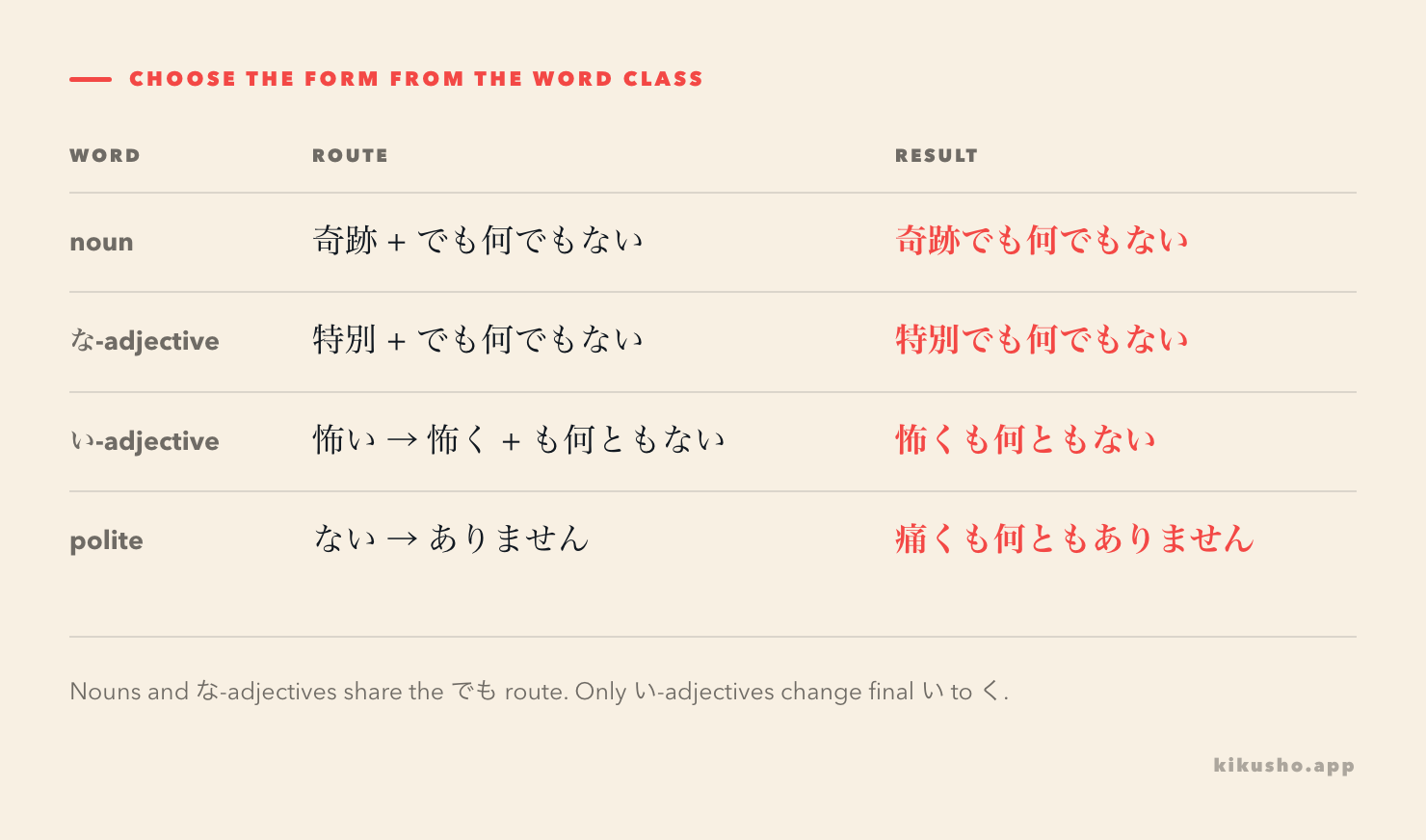
The word before the pattern decides which route to use.
| Word being denied | Formation | Example |
|---|---|---|
| noun | N + でも何でもない | 奇跡でも何でもない |
| な-adjective | stem + でも何でもない | 特別でも何でもない |
| い-adjective | stem without い + くも何ともない | 怖くも何ともない |
With nouns, でも follows the noun directly:
この結果は奇跡でも何でもない。毎日の準備の成果だ。
この けっかは きせきでも なんでも ない。まいにちの じゅんびの せいかだ。
This result is no miracle. It is the product of daily preparation.
A な-adjective uses its stem. Do not retain な or だ:
今日の作業は複雑でも何でもありません。順番どおりに進めれば大丈夫です。
きょうの さぎょうは ふくざつでも なんでも ありません。じゅんばんどおりに すすめれば だいじょうぶです。
Today's task is not complicated at all. It will be fine if you follow the steps.
The correct form is 複雑でも, not 複雑なでも or 複雑だでも. The same route gives 静かでも何でもない, 特別でも何でもない and 安全でも何でもない.
For an い-adjective, remove final い, add く, and then add も何ともない:
初めての発表だったが、不思議と怖くも何ともなかった。
はじめての はっぴょうだったが、ふしぎと こわくも なんとも なかった。
It was my first presentation, but strangely, I was not frightened in the least.
This gives 痛い → 痛くも何ともない, 面白い → 面白くも何ともない and 難しい → 難しくも何ともない. Forms such as 怖いでも何でもない and 怖くでも何ともない mix the two routes and are incorrect.
Reject a label or erase a quality
The two forms reach the same broad meaning through slightly different kinds of description.
でも何でもない often answers an explicit or imagined label. Someone calls an act courageous, a result miraculous or a day special; the speaker refuses that classification.
彼の発言は助言でも何でもない。相手を責めているだけだ。
かれの はつげんは じょげんでも なんでも ない。あいてを せめている だけだ。
His remark was not advice in any sense. It was simply blaming the other person.
昨日は特別でも何でもない、ごく普通の一日だった。
きのうは とくべつでも なんでも ない、ごく ふつうの いちにちだった。
Yesterday was not special at all; it was a perfectly ordinary day.
くも何ともない erases an adjectival quality or sensation. The imagined scale contains no meaningful amount of pain, fear, interest or another quality.
傷はもう痛くも何ともありません。
きずは もう いたくも なんとも ありません。
The injury does not hurt in the slightest anymore.
その説明は長いだけで、分かりやすくも何ともない。
その せつめいは ながい だけで、わかりやすくも なんとも ない。
That explanation is merely long; it is not clear in the least.
A plain negative reports; this pattern pushes back
Compare a neutral correction with a categorical rejection:
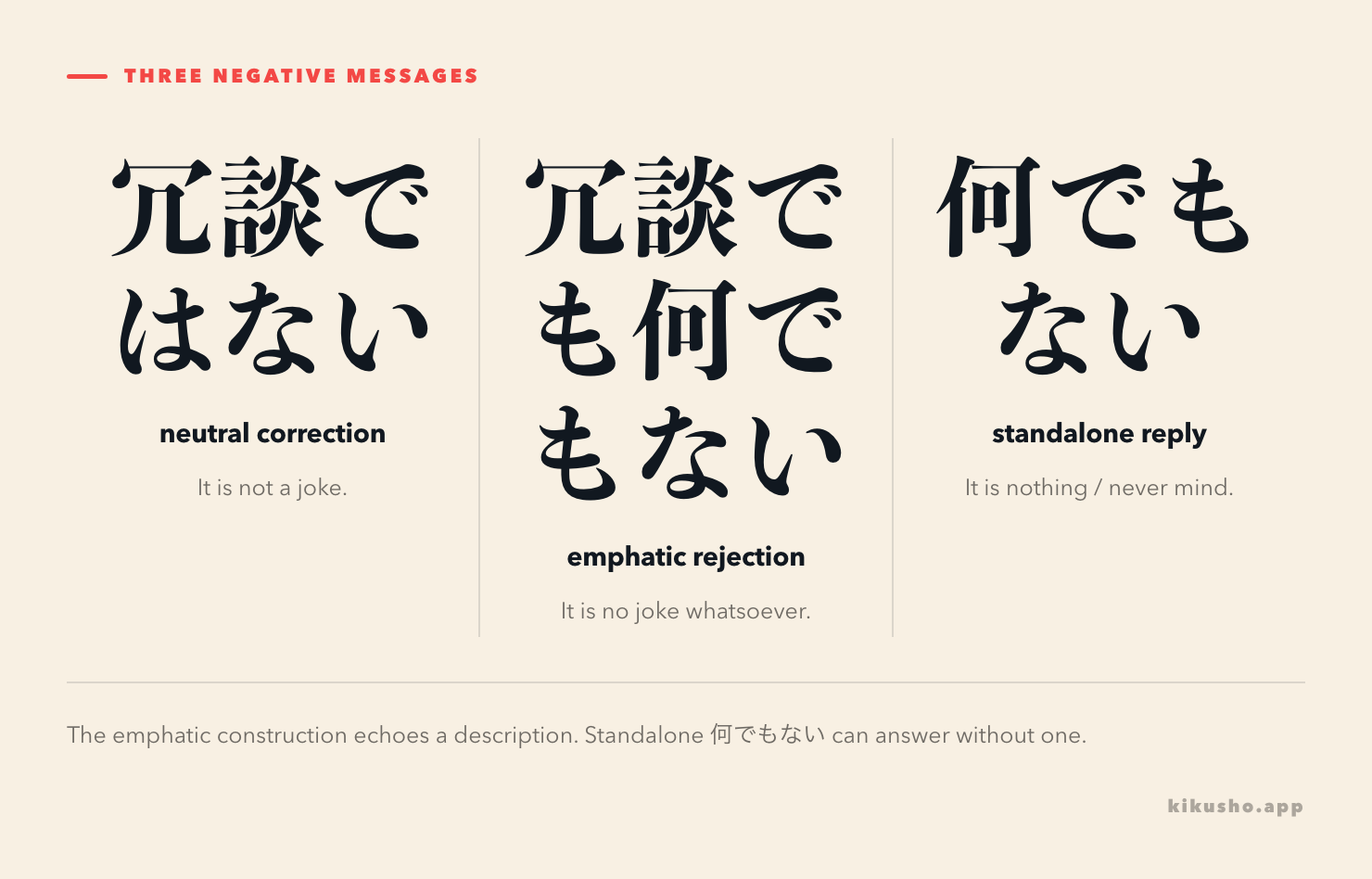
これは冗談ではない。
これは じょうだんでは ない。
This is not a joke.
これは冗談でも何でもない。
これは じょうだんでも なんでも ない。
This is no joke whatsoever.
The first sentence supplies a fact. The second sounds as though “joke” has already entered the conversation and the speaker wants to remove it decisively. A following reclassification is therefore common: 冗談でも何でもない。本気で言っている — “It is no joke; I mean it.”
The same contrast appears with い-adjectives:
この映画は面白くない。
This film is not interesting.
この映画は面白くも何ともない。
This film is not interesting in the slightest.
The second evaluation is sharper. It can communicate criticism, disappointment, defiance or reassurance, depending on the adjective and context. 痛くも何ともないよ can reassure a worried friend, while 面白くも何ともない can dismiss someone's work.
This force makes the construction useful in dialogue, commentary and argumentative prose. It also makes interpersonal judgement risky. 君は特別でも何でもない is structurally correct but sounds harsh because it rejects the person's value as a category. When the goal is a tactful correction, use 特別ではありません, explain the intended category, or state the reason without the emphatic extension.
何でもない alone is a different message
Do not treat every occurrence of 何でもない as this grammar point. Used by itself, 何でもない commonly means “it is nothing,” “never mind” or “nothing special.”
A: どうしたの。
B: ううん、何でもない。
A: What's wrong?
B: Nothing. / Never mind.
No preceding label is being rejected. Speaker B chooses not to name an issue or says there is no important issue.
In Nでも何でもない, by contrast, N provides the label that gets echoed and rejected:
怒っているわけではない。あの言葉は冗談でも何でもないと思っただけだ。
おこっている わけでは ない。あの ことばは じょうだんでも なんでも ないと おもった だけだ。
It is not that I am angry. I just thought those words were no joke at all.
Standalone 何ともない also has an independent use: “nothing is wrong,” “unharmed” or “unaffected.” After a fall, 私は何ともない means “I am fine.” In 痛くも何ともない, however, 痛い is the quality being emphatically denied.
Tense and politeness sit at the end
Change the final ない for tense and politeness. The attachment before it stays intact.
| Meaning | Noun / な-adjective | い-adjective |
|---|---|---|
| plain nonpast | でも何でもない | くも何ともない |
| polite nonpast | でも何でもありません | くも何ともありません |
| plain past | でも何でもなかった | くも何ともなかった |
| polite past | でも何でもありませんでした | くも何ともありませんでした |
その会議は形式的でも何でもありませんでした。全員が自由に意見を出しました。
その かいぎは けいしきてきでも なんでも ありませんでした。ぜんいんが じゆうに いけんを だしました。
That meeting was not perfunctory in the least. Everyone offered opinions freely.
検査のあとも、苦しくも何ともなかった。
けんさの あとも、くるしくも なんとも なかった。
Even after the examination, I did not feel uncomfortable in the least.
Politeness changes how the sentence addresses the listener, but it does not erase the categorical judgement. 失敗でも何でもありません is more polite in form than 失敗でも何でもない, yet both strongly reject “failure.” Add context such as 改善点が見つかった大切な経験です if the relationship calls for encouragement rather than a bare contradiction.
Choose among nearby negative patterns
Several patterns can produce an English “not at all,” but they organize the denial differently.
| Form | What it foregrounds | Example |
|---|---|---|
| Nではない / Aくない | neutral negative judgement | 特別ではない |
| Nでも何でもない | emphatic rejection of a label | 奇跡でも何でもない |
| Aくも何ともない | emphatic absence of a quality | 怖くも何ともない |
| 全く~ない | complete denial of a fact or state | 全く知らない |
| 少しも~ない | not even the smallest amount or degree | 少しも痛くない |
| わけではない | qualified or partial denial | 嫌いなわけではない |
全く and 少しも are adverbs that can modify many kinds of negative predicates. The target construction is more tightly built around a noun, な-adjective or い-adjective and often sounds like a response to the chosen description. The ちっとも, 全く and 少しも~ない comparison develops the difference between speaker attitude, a complete proposition and a minimum point on a scale.
わけではない is usually the wrong replacement when the speaker wants total rejection. 嫌いなわけではない means “it is not that I dislike it,” leaving room for a more qualified account. 好きでも何でもない forcefully denies liking. The わけだ, わけではない and わけがない lesson separates explanation, qualified denial and impossibility.
The surface でも can also point in the opposite semantic direction. 教師でもあり研究者でもある includes both labels, whereas 教師でも何でもない excludes the first label emphatically. The visible ending tells you which operation is taking place; review でもあり~でもある when a sentence assigns two true descriptions to one subject.
Practice: identify what the speaker rejects
Work through prompts 1–7 in order, then open the single explanation panel.
Question 1. Choose the correct form for a noun.
あれは偶然( )。事前に計画されていた。
| Choice | Ending |
|---|---|
| A | でも何でもない |
| B | くも何ともない |
| C | なでも何でもない |
| D | でも何ともある |
Question 2. Build the past い-adjective form.
実際に話してみると、彼は( )。
Intended meaning: “When I actually spoke with him, he was not frightening in the least.”
| Choice | Completed form |
|---|---|
| A | 怖いでも何でもなかった |
| B | 怖くも何ともなかった |
| C | 怖くでも何でもなかった |
| D | 怖さでも何でもなかった |
Keep the two attachment routes separate for the next item.
Question 3. Find the well-formed な-adjective denial.
- この手続きは複雑なでも何でもない。
- この手続きは複雑くも何ともない。
- この手続きは複雑でも何でもない。
- この手続きは複雑だでも何でもない。
The next exchange removes the preceding description altogether.
Question 4. Interpret B's standalone reply.
A: 何かあったの?
B: 何でもないよ。
A. B strongly rejects a noun that A supplied.
B. B says that nothing is wrong or that it is not worth discussing.
C. B says that nothing is interesting.
D. B says that every possibility is correct.
Question 5. Change the sentence to polite past without weakening its emphatic meaning.
あの経験は無駄でも何でもなかった。
Question 6. Choose the form that matches the context.
A: 大勢の前で話すのは怖かったでしょう。
B: 練習していたから、( )。
A. 怖くも何ともありませんでした
B. 怖いわけがありました
C. 怖さでもありました
D. 何でもありませんが怖いです
Question 7. Write two original sentences. First, reject the claim that a success was a miracle and reclassify it as the result of preparation. Second, say that an injury did not hurt in the slightest. Use a different attachment route in each sentence.
Reveal the seven answers and explanations
Question 1: A. 偶然 is a noun, so it takes でも何でもない. The following sentence supplies the replacement account: the event was planned rather than accidental.
Question 2: B. 怖い is an い-adjective. Remove final い and add くも何ともなかった. The past ending matches 話してみると and the realised impression.
Question 3: 3. 複雑 is a な-adjective, so its stem attaches directly to でも何でもない. な and だ do not remain, and the い-adjective く route does not apply.
Question 4: B. There is no explicit noun or adjective before the expression. Standalone 何でもない means “nothing,” “never mind” or “nothing is wrong” in this exchange; it is not automatically the emphatic attachment pattern.
Question 5: あの経験は無駄でも何でもありませんでした。 Replace final なかった with polite past ありませんでした. 無駄でも何でも remains unchanged.
Question 6: A. 怖い takes the い-adjective route, and ありませんでした makes it polite past: “I was not scared in the slightest.” The other choices either use a different meaning or break the attachment.
Question 7 — sample answer: 今回の成功は奇跡でも何でもない。十分に準備した結果だ。傷は浅く、痛くも何ともなかった。 奇跡 uses the noun route, while 痛い becomes 痛くも何ともなかった. Other answers are valid if they preserve the attachment and provide a natural context for the forceful denial.
Use the construction when the conversation calls for a firm pushback, not merely because the English contains “not.” Choose the route from the word class, then check whether the situation supports such a categorical voice.
Common questions
What do でも何でもない and くも何ともない mean?
They emphatically reject a label, state or quality: “not X at all,” “nothing like X” or “not X in the slightest.” They are stronger and more expressive than a plain negative.
How do nouns and adjectives attach to these patterns?
Nouns and な-adjective stems take でも何でもない, as in 冗談でも何でもない and 特別でも何でもない. い-adjectives drop final い and take くも何ともない, as in 怖くも何ともない.
Is 何でもない by itself the same grammar pattern?
No. Standalone 何でもない often means “it is nothing,” “never mind” or “nothing special.” In Xでも何でもない, the speaker echoes X and rejects that label or anything resembling it.
Is でも何でもない rude?
It is not inherently rude, but its categorical force can sound dismissive, critical or defensive. Use a plain negative for a neutral correction, and consider ありません, context-setting or a reason when tact matters.