On this page
AがAなら、BもBだ and AもAなら、BもBだ criticise two related parties or aspects together. The natural message is “A is bad enough, and B is no better,” even though the sentence does not state the particular fault inside the pattern.
親が親なら、子も子だ。
おやが おやなら、こも こだ。
Like parent, like child; neither is any better.
The first 親 and second 親 do not supply two different meanings. Their repetition turns “the parent” into a compressed judgement: given the kind of parent this is, the child's equally poor behaviour is hardly surprising. The second repeated pair, 子も子だ, places the child under the same critical gaze.
This lesson verifies inventory item g-940797560e26. 絵でわかる日本語 documents both AがAなら、BもBだ and AもAなら、BもBだ, describing them as criticism of two closely related people or things. JLPT Sensei independently places the same paired construction in its N1 material. A linguistic comparison of repeated-noun expressions identifies repetition and the speaker's negative evaluation as defining features. The Bunpro N5 matches recorded in the raw inventory point only to elementary uses of が; they do not analyse this larger construction and therefore do not create a genuine level disagreement. As usual, N1 is a publisher study label: the JLPT FAQ says exact test-content specifications are no longer released.
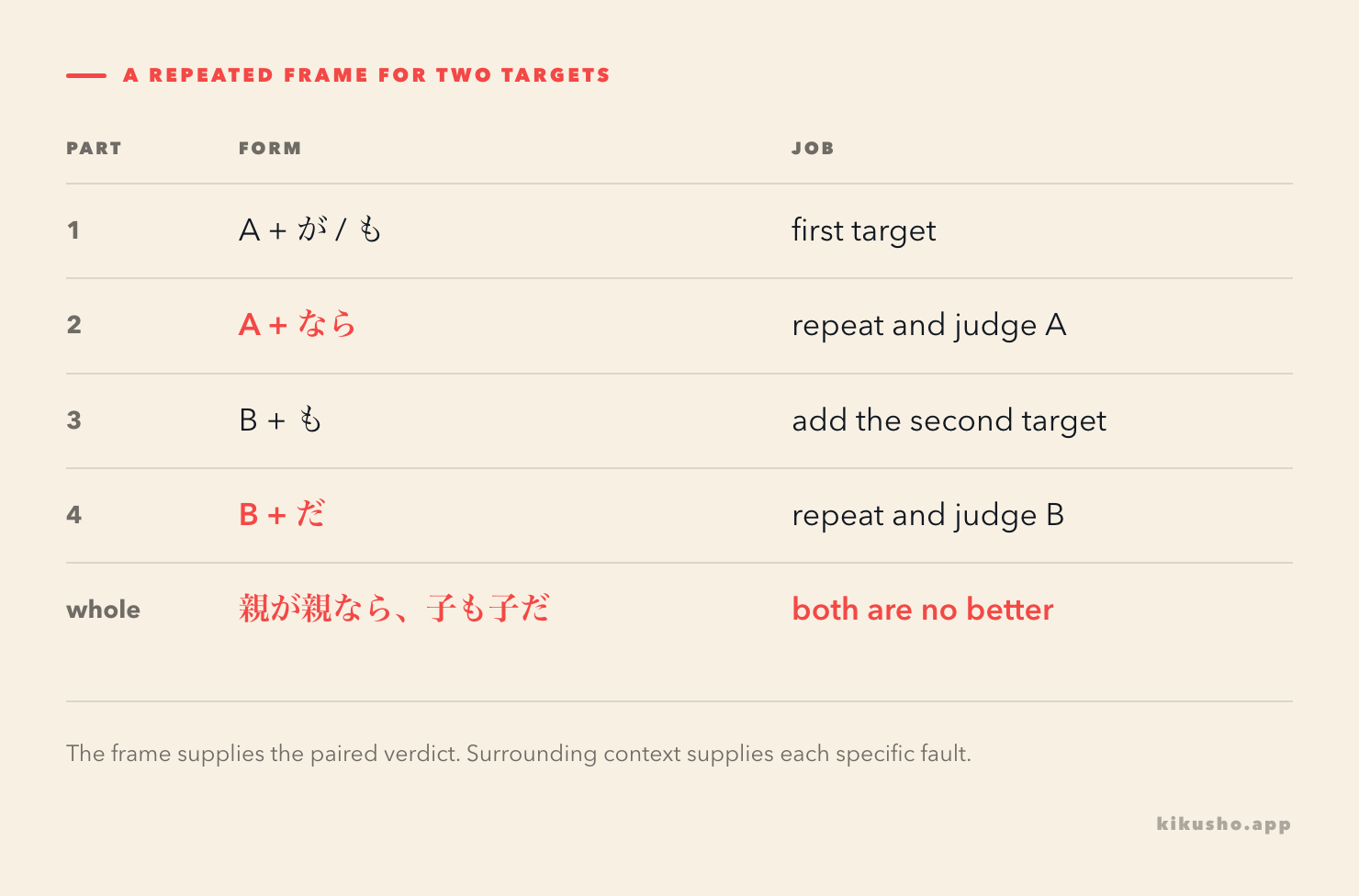
Repeat each noun inside a four-part frame
The canonical structure has two noun pairs:
| Part | Function | 親 / 子 example |
|---|---|---|
| A + が or も | introduces the first target | 親が |
| A + なら | repeats and judges A | 親なら |
| B + も | adds the second target | 子も |
| B + だ | repeats and judges B | 子だ |
Put together, the two common versions are:
AがAなら、BもBだ。
AもAなら、BもBだ。
が presents A as the first target under discussion. も in the variant announces from the beginning that A belongs to a parallel set. The final interpretation is normally the same: both A and B deserve criticism.
学生が学生なら、先生も先生だ。
がくせいが がくせいなら、せんせいも せんせいだ。
The students are bad enough, and the teacher is no better.
This sentence needs a situation in which both sides behaved badly: perhaps the students arrived late and the teacher did too. The nouns alone do not tell us the fault. Context supplies it, and the repeated frame tells us that the speaker condemns both sides.
The second half may use だ, です, である, だね or another context-appropriate copular ending. Changing politeness does not remove the negative assessment:
客も客なら、店も店ですね。
きゃくも きゃくなら、みせも みせですね。
The customer behaved badly, and the shop was no better, was it?
The missing criticism comes from context
Bare nouns normally identify people or things. In this construction, repetition invites an unstated evaluation such as ひどい, 無責任だ, 失礼だ or 困ったものだ.
夫が夫なら、妻も妻だ。二人とも謝ろうとしない。
おっとが おっとなら、つまも つまだ。ふたりとも あやまろうと しない。
The husband is bad enough, and the wife is no better. Neither will apologise.
The follow-up sentence makes the shared problem explicit. Without prior context or a later explanation, 夫が夫なら、妻も妻だ remains grammatical but may sound like a verdict whose evidence the listener has missed.
The two targets need a relationship that lets one judgement illuminate the other. Family roles are common, but the construction is not limited to people:
あの店は、味が味なら、値段も値段だ。
あの みせは、あじが あじなら、ねだんも ねだんだ。
At that restaurant, the food is bad enough and the prices are no better.
計画も計画なら、実行方法も実行方法だ。どちらも現場を無視している。
けいかくも けいかくなら、じっこうほうほうも じっこうほうほうだ。どちらも げんばを むししている。
The plan is bad enough, and the way it is being implemented is no better. Both ignore conditions on the ground.
Restaurant taste and price belong to one experience; a plan and its implementation belong to one project. Random nouns do not become a meaningful pair simply by being repeated.
The construction is openly judgemental
This pattern does more than observe similarity. It conveys blame, exasperation, disappointment or contempt. A speaker may criticise A and B for the same flaw, or for different faults that combine into one bad situation.
部下が報告を怠ったうえに、上司も確認しなかった。部下が部下なら、上司も上司だ。
ぶかが ほうこくを おこたった うえに、じょうしも かくにんしなかった。ぶかが ぶかなら、じょうしも じょうしだ。
The employee failed to report it, and the manager did not check. The employee was at fault, and the manager was no better.
The faults differ, but the speaker distributes responsibility across both sides. This is why “like father, like son” is only one possible English rendering. “They are as bad as each other,” “A is bad enough, and B is no better,” or a full contextual translation may be more accurate.
Positive contexts are a poor fit. To praise a parent and child who are both kind, say 親も親切なら、子も親切だ or use a more natural descriptive sentence. The repeated identity frame carries a conventional negative reading, so trying to force praise into 親が親なら、子も子だ will usually sound ironic.
Because the judgement is strong, avoid using it when you merely want to describe an error neutrally. In a workplace report, 担当者にも管理者にも確認不足があった states that both failed to check without the dismissive tone of 担当者が担当者なら、管理者も管理者だ.
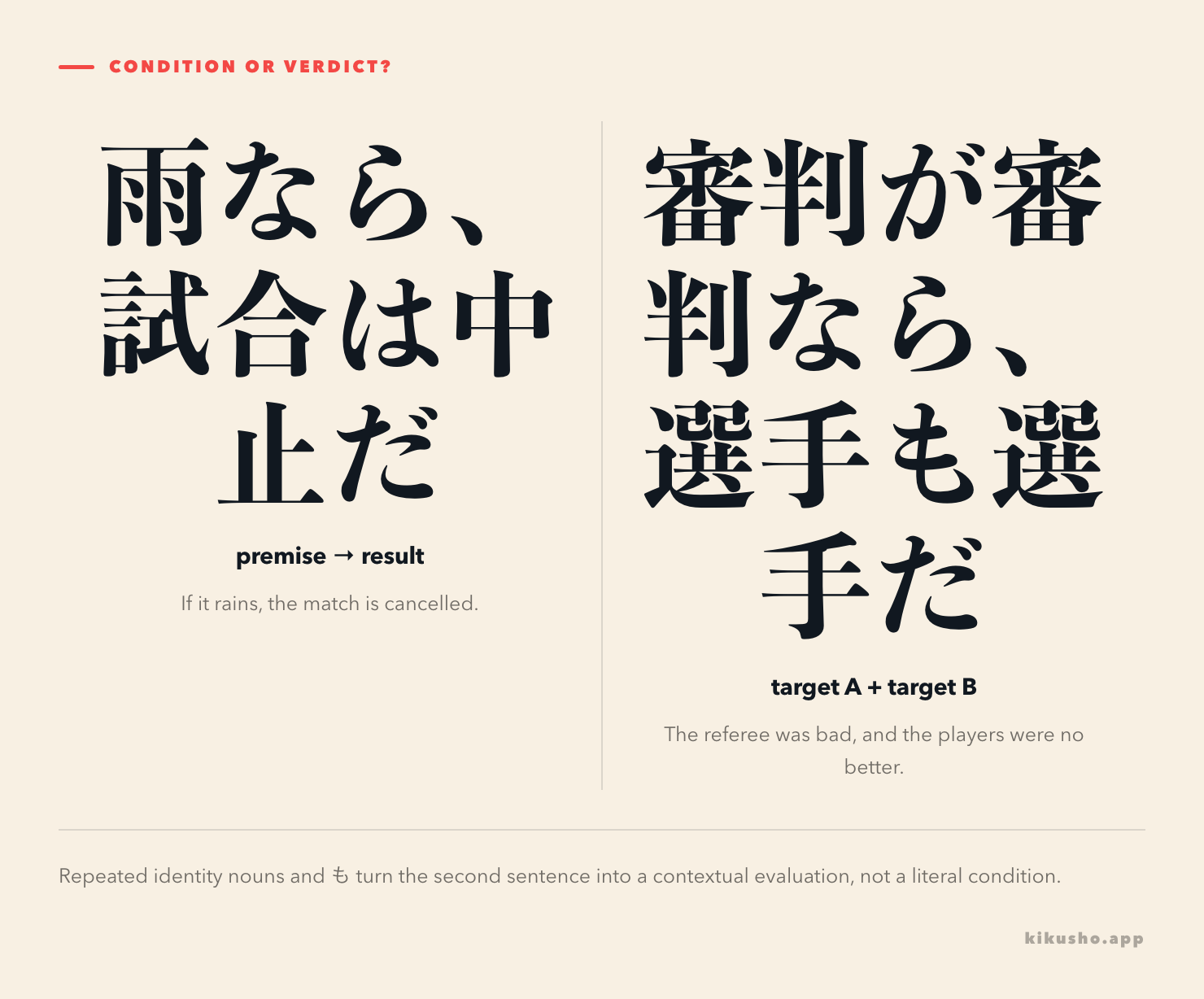
なら does not create an ordinary condition here
An ordinary なら sentence establishes a premise:
雨なら、試合は中止だ。
あめなら、しあいは ちゅうしだ。
If it rains / If it is rain, the match is cancelled.
The cancellation depends on the weather. There is no paired noun repetition and no built-in criticism.
In the target pattern, A and B already exist as objects of evaluation:
審判が審判なら、選手も選手だ。
しんぱんが しんぱんなら、せんしゅも せんしゅだ。
The referee was bad enough, and the players were no better.
The sentence does not mean “if the referee is a referee, the players are players.” なら helps build the fixed evaluative frame; repetition and も determine the reading.
Do not confuse it with neutral も~ば~も
The neutral parallel construction も~ば~も can list two qualities, actions or categories without criticising them:
父も教師なら、母も教師だ。
ちちも きょうしなら、ははも きょうしだ。
Both my father and mother are teachers.
This sentence has two people, 父 and 母, but one unrepeated category, 教師. It simply assigns that category to both.
親も親なら、子も子だ。
おやも おやなら、こも こだ。
The parent is bad enough, and the child is no better.
Here each role noun repeats itself: 親…親, then 子…子. That repetition and the context create the critical verdict. The も~ば~も lesson covers neutral parallel characteristics and group variation in detail.
Another nearby pattern, AといいBといい, selects two salient examples and comments on both. It can praise or criticise:
味といい、盛り付けといい、この店の料理はすばらしい。
Both the taste and the presentation of this restaurant's food are excellent.
The comment すばらしい is explicit, and the nouns are not repeated. In the target construction, the bare repeated nouns themselves carry the contextual negative judgement. The といい~といい comparison explains how selected examples differ from an inclusive list.
どっちもどっちだ also means that neither side is better. It suits a direct comparison of two disputing parties. AがAなら、BもBだ names and repeats the two roles or aspects, often suggesting that their faults are connected within the same situation.
Practice: recover the unstated judgement
Complete all seven tasks before revealing the shared answer panel.
Question 1. Which sentence uses the target pattern?
| Choice | Sentence |
|---|---|
| A | 父も教師なら、母も教師だ。 |
| B | 親が親なら、子も子だ。 |
| C | 雨なら、試合は中止だ。 |
| D | 親なら、子どもを守るべきだ。 |
Question 2. What does 味が味なら、値段も値段だ imply in a restaurant complaint?
- The price changes according to the taste.
- Both the food and the price are unsatisfactory.
- The restaurant has good food despite high prices.
- Only the price is being criticised.
Before the next item, remember that the repeated nouns name the targets rather than their specific faults.
Question 3. Complete the conventional frame.
学生( )学生なら、先生( )先生だ。
| Choice | First / second particle |
|---|---|
| A | を / が |
| B | が / も |
| C | に / は |
| D | で / と |
Question 4. Choose the neutral sentence for “Both my father and mother are doctors,” with no criticism intended.
A. 父が父なら、母も母だ。
B. 父も医者なら、母も医者だ。
C. 父が医者なら、母も母だ。
D. 父も父なら、母が医者だ。
Question 5. Read the context and choose the best conclusion.
店員は注文を忘れ、店長は謝りもしなかった。( )
A. 店員が店員なら、店長も店長だ。
B. 店員なら、店長に報告する。
C. 店員も親切なら、店長も親切だ。
D. 店員といい、店長は謝った。
Question 6. Why does チームがチームなら、監督も監督だ sound incomplete without surrounding context?
A. The pattern requires an い-adjective after every noun.
B. The repeated frame signals criticism, but context must identify what each side did wrong.
C. The final copula must always be polite.
D. チーム and 監督 cannot form a related pair.
Question 7. Write a two-sentence mini-context in which an employee misses an important deadline and the manager never checked the schedule. End with 部下が部下なら、上司も上司だ.
Show how the paired verdict works in all seven tasks
Question 1: B. 親が親なら、子も子だ repeats each role noun and evaluates both negatively. A is the neutral parallel category pattern, while C and D are ordinary uses of なら.
Question 2: 2. The sentence condemns two aspects of the same restaurant experience. Context supplies the exact complaint, but the repeated nouns tell us that neither taste nor price escapes criticism.
Question 3: B. The standard version is 学生が学生なら、先生も先生だ. The first が may also become も, producing 学生も学生なら, but the B half still takes も.
Question 4: B. 父も医者なら、母も医者だ assigns the category “doctor” to both parents. Repeating 父 and 母 would activate the critical identity frame instead.
Question 5: A. The forgotten order and missing apology make both staff member and manager blameworthy. 店員が店員なら、店長も店長だ compresses that paired criticism into one verdict.
Question 6: B. The construction tells the listener that both are unsatisfactory, but it does not encode whether the problem was effort, attitude, judgement or something else. A preceding event or following explanation supplies the evidence.
Question 7 — sample answer: 部下は大切な締め切りを忘れ、上司も予定を一度も確認していなかった。部下が部下なら、上司も上司だ。 The first sentence establishes two connected failures; the target sentence then distributes criticism across both roles.
When you meet this pattern in a reading passage, look backward for two faults. The repeated nouns rarely tell you what went wrong; they tell you that the writer has finished judging both sides.
Common questions
What does が/も~なら、~も~だ mean?
It criticises two related people, groups or aspects together: “A is bad enough, and B is no better.” 親が親なら、子も子だ is often translated as “like parent, like child,” with a negative judgement of both.
Why is each noun repeated in this pattern?
Repetition turns the bare noun into an evaluative judgement whose negative content comes from context. 親が親なら implies that the parent is a poor example; 子も子だ adds that the child is equally open to criticism.
Can the first particle be either が or も?
Yes. Both AがAなら、BもBだ and AもAなら、BもBだ occur. が presents A as the first criticised term, while も makes the parallel framing visible from the start; both versions normally condemn the pair.
Is が/も~なら、~も~だ a normal if-then condition?
No. Although なら appears, the fixed repetition evaluates two existing parties or aspects. An ordinary AならB expresses a premise and consequence; this pattern means that A and B are both unsatisfactory.