On this page
わけだ means something close to "so that's why" or "no wonder." Negate it, and the obvious guess is that わけではない flips the meaning to "that's not why." It doesn't: わけではない never reverses the conclusion わけだ draws, it only refuses part of it. A third form, わけがない, is the one that rules the conclusion out completely. Reach for the wrong one of the two negatives and a soft, hedged claim comes out sounding like a flat denial, or the other way around.
わけ turns something already true into a conclusion
わけ on its own is a noun close to "reason" or "circumstance" (訳 in kanji, though the grammar point is almost always written in kana). Attach it to a clause and that clause stops being a plain statement and becomes a conclusion drawn from something the speaker already has in hand: a fact just mentioned, a situation visible in the room, an assumption already on the table. わけ never supplies that starting fact itself. It only marks that whatever follows is being reasoned to, not reported cold.
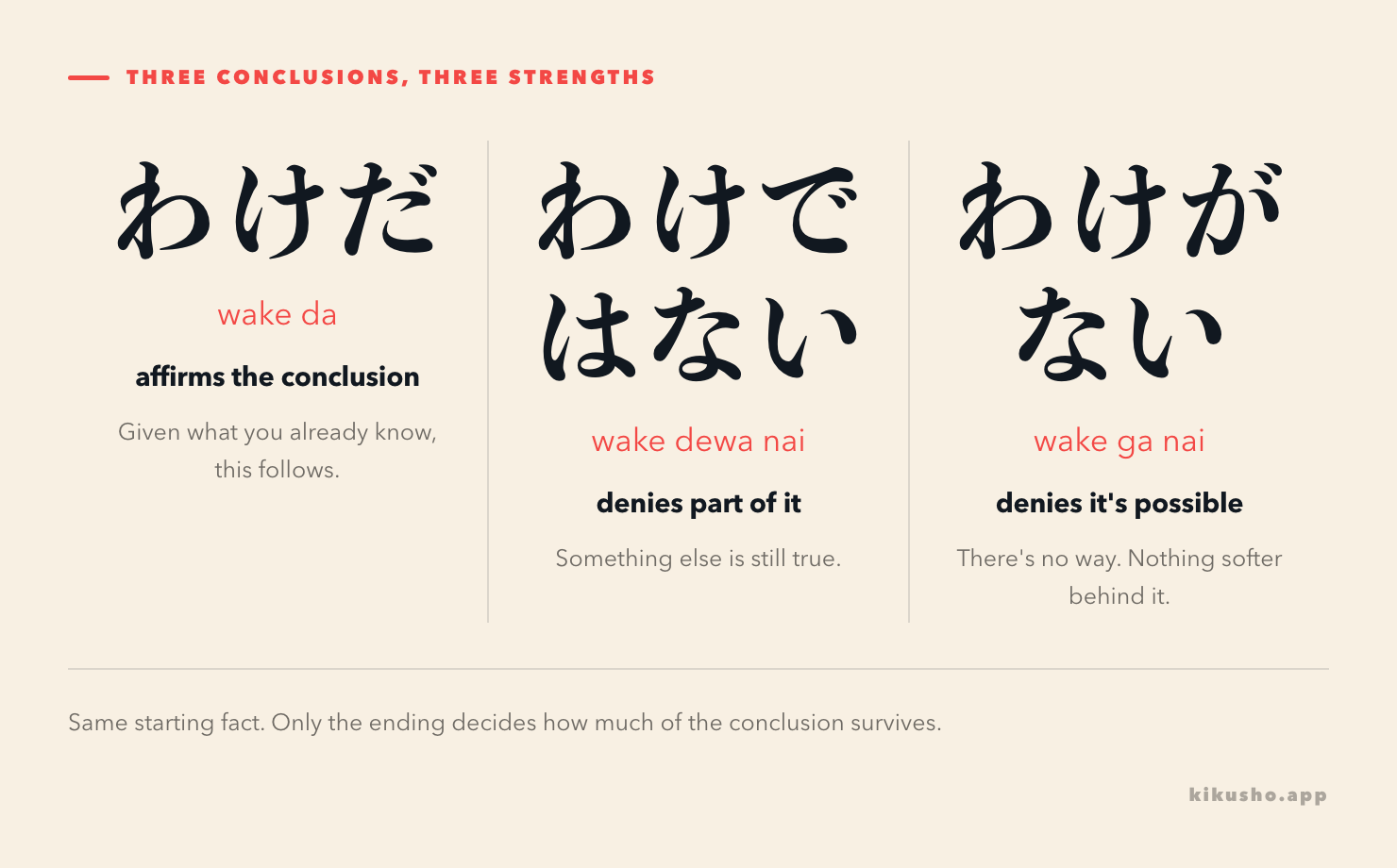
What happens next is entirely down to だ, ではない or がない. だ affirms the conclusion: given what's already known, this follows. ではない denies that the conclusion holds in full, while leaving room for whatever is true instead. がない denies that it could hold at all.
だ, ではない and がない attach the same way, with one exception
All three sit directly on the plain dictionary form of a verb or on an い-adjective. A な-adjective adds な first, the same な it needs before any noun it modifies. A noun is the one place the three diverge: だ and がない both take である, while ではない switches to だという.
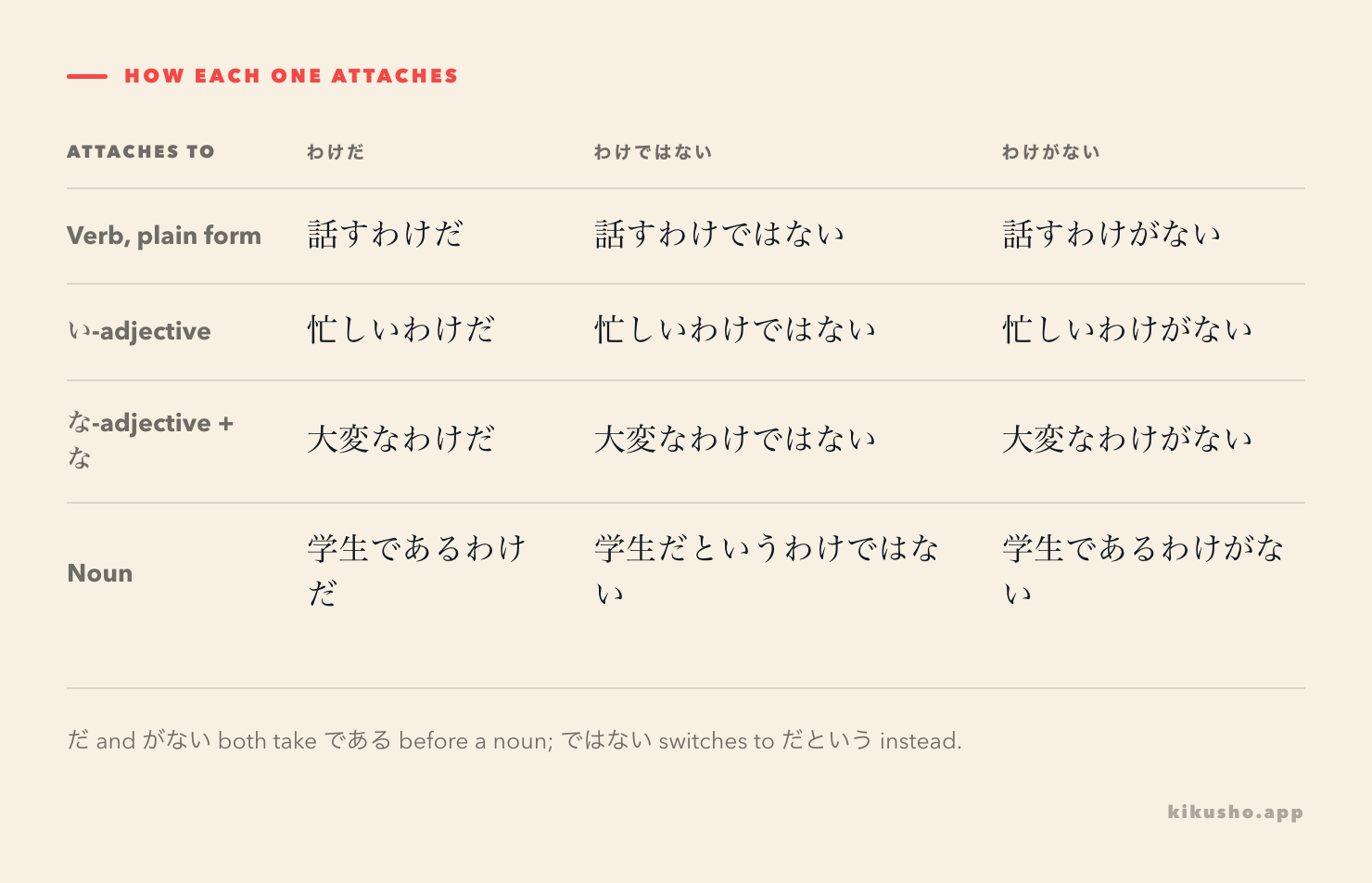
The switch is easy to miss because English doesn't mark it: "so-and-so" doesn't change shape depending on whether you're about to affirm it or deny it. Japanese does, and である versus だという is the tell that a noun is coming before わけ has even arrived.
The same setup produces three different sentences
毎朝5時に起きて走っているから、体が丈夫なわけだ。 He gets up and goes running every morning at five. No wonder he's in good shape. The fact (the running) is already on the table; わけだ just states that the shape follows from it.
日本語が話せるが、いつも敬語が正しく使えるわけではない。 I can speak Japanese, but that doesn't mean I always get the polite forms right. Nobody is denying that this person speaks Japanese. わけではない denies only the stronger claim a listener might otherwise draw from it: that speaking the language means never getting keigo wrong.
あの忙しい先生は今日、休むわけがない。 There's no way that busy teacher is taking today off. Nothing here is being softened. わけがない states that the idea itself doesn't hold up, given what's known about how busy this particular teacher is.
わけではない backs off the conclusion; わけがない rules it out
This is the pair that gets mixed up, because both look like negatives of the same thing and only one of them is total.
わけではない denies the strong reading of a situation while leaving the situation itself untouched. 毎日ラーメンを食べるわけではない doesn't claim you never eat ramen: it denies that "every day" is accurate, and invites whatever the real frequency is. That's deliberately half-open, the same way は leaves room when it negates something on purpose: the sentence marks what it's denying, not everything around it. わけではない sentences are so often followed by が or a second clause spelling out what's really true, because the denial was never meant to be the whole story.
わけがない denies the possibility itself, with nothing left over to add. 彼が今日休むわけがない doesn't invite a follow-up correction, because there isn't a softer truth hiding behind it. The speaker is stating that the whole idea is out of the question.
Swap them and the sentence keeps its grammar and loses its meaning: 彼が休むわけではない, said about a teacher everyone knows never misses a day, reads as leaving room for an exception nobody intends; 彼が休むわけがない, said about someone who might plausibly be sick, sounds far more certain than the speaker has any right to be.
In speech it's わけじゃない and わけない, not the full forms
Formal writing keeps わけではない and わけがない whole. Conversation contracts them the way it contracts most negatives: わけではない becomes わけじゃない, and わけがない drops its が entirely to become わけない. 今日は忙しいわけじゃない。ただ疲れているだけだ。 It's not that I'm busy today. I'm just tired. そんな高いカバンを彼が買うわけない。 There's no way he's buying a bag that expensive.
Neither contraction is slang or sloppy speech; they're the ordinary spoken register, the same way ちゃった is the ordinary spoken register of てしまった. A learner who has only met わけではない and わけがない on a page will hear わけじゃない and わけない constantly and may not connect them to the grammar they studied.
The mistake is reaching for the wrong strength of denial
The learner error here is rarely a broken sentence: both negatives are grammatical almost anywhere the other one fits, which is exactly the problem. It's picking がない when ではない was meant, or the reverse, and ending up with a claim stronger or weaker than intended.
Someone who means "I don't dislike natto, I just haven't gotten used to the smell" and reaches for わけがない has claimed that disliking natto is impossible for them: a much bigger claim than the hedge they meant to make. わけではない is the only one of the two that leaves room for "I haven't gotten used to it yet" as the real explanation.
The reverse mistake undersells a flat impossibility as a mere qualification. 田中さんが嘘をつくわけではない, said about someone whose honesty was never in question, sounds like there's a caveat coming: some situation where Tanaka might, in fact, lie. If that's not what's meant, わけがない says what the speaker means outright: lying, from this particular person, isn't a live possibility at all.
That distinction is worth catching in the sentence it arrived in rather than reconstructing later from a bare gloss like "wake ga nai = no way." A card that keeps 田中さんが嘘をつくわけがない whole, with the context that made がない the right call and not ではない, teaches the choice itself; a card with the ending alone teaches only that わけがない exists. Point the camera at wherever the sentence turns up, or say it into Kikusho, and the card that comes back holds the whole clause and its reading, not the ending in isolation.
Practice: three questions to test which one you'd reach for
Question 1. Complete the sentence with the right form: 「田中さんは毎日8時間、日本語を勉強している。だから、そんなに上手な___。」(Tanaka studies Japanese eight hours a day. So it's no wonder he's this good.)
a) わけだ b) わけではない c) わけがない
Answer 1: わけだ. The first sentence already supplies the fact (eight hours a day), and the second states the conclusion that follows from it, which is exactly わけだ's job. (b) would deny that his skill is total, which nothing here suggests. (c) would claim his skill is impossible, contradicting the very fact that explains it.
Question 2. Put these into a natural sentence meaning "There's no way my mother, who's busy every day, can get a proper rest.": 母が ・ 毎日忙しい ・ ゆっくり休める ・ わけがない
Answer 2: 毎日忙しい母がゆっくり休めるわけがない。 The adjective clause 毎日忙しい has to sit directly before the noun it modifies, 母, and わけがない attaches only once the full predicate ゆっくり休める is complete. No other order keeps both of those in place.
Question 3. Complete the dialogue with the right form: 「A:田中さん、最近元気そうですね。 B:実は、先週から新しい運動を始めたんです。 A:じゃあ、もう毎日ジムに行っているんですか。 B:いえ、毎日___。週に2回ぐらいです。」
a) 行っているわけだ b) 行っているわけではない c) 行っているわけがない
Answer 3: 行っているわけではない. The next line, 週に2回ぐらいです, reveals that B does go, just not every day: exactly the partial denial わけではない makes, and the reason this question can only be answered by reading past the blank, not just at it. (a) would claim daily attendance, which the follow-up contradicts. (c) would claim she never goes at all, which the follow-up also contradicts.
Learn the three together and the sentence that follows any of them stops being a coin flip: だ tells you a conclusion is being confirmed, ではない tells you to expect a "but," and がない tells you there's nothing left to qualify.
Common questions
What's the real difference between わけではない and わけがない?
わけではない denies only part of a claim and leaves room for what's really true instead: 毎日食べるわけではない doesn't deny eating it, only "every day." わけがない denies that the whole idea has any chance of being true, with nothing softer behind it. The test is whether a "but, in fact…" follow-up would make sense: it does for ではない, and it doesn't for がない.
Is わけじゃない the same as わけではない?
Yes, and it's the form you'll hear far more often. わけじゃない is the ordinary spoken contraction of わけではない, the same relationship ちゃった has to てしまった: not slang, just the register people speak in day to day. Written Japanese, and anything formal, keeps わけではない.
Can わけだ attach directly to a noun, the way it does to a verb?
No. A noun needs である first: 学生であるわけだ, not 学生わけだ. わけがない takes the same である; わけではない switches to だという instead: 学生だというわけではない. The connector changes with the polarity, not just the ending.
Does わけにはいかない belong with these three?
It looks like a fourth version of the same pattern, but it isn't marking a conclusion at all: わけにはいかない refuses to do something because of an obligation or what's proper, not because a fact makes it unlikely or impossible. 忙しくて行けない (too busy to go) is a different claim from 忙しくて行くわけにはいかない (busy, and going would be irresponsible given what's expected of me). It earns its own lesson rather than a fourth column here.