On this page
AでもありBでもある says that A and B are both true descriptions of one subject. In この町は観光地でもあり、学生の町でもある, the town does not alternate between two identities: it has both at once.
この町は観光地でもあり、学生の町でもある。
この まちは かんこうちでも あり、がくせいの まちでも ある。
This town is both a tourist destination and a student town.
The repeated も gives the two descriptions balanced weight. The construction is especially useful in profiles, explanations and analytical writing, where a simple list would not show as clearly that both sides matter.
This lesson verifies inventory item g-3744627a1185, でもあり~でもある. 毎日のんびり日本語教師 documents the noun, な-adjective and い-adjective forms and defines the pattern as two qualities holding simultaneously. JLPT Sensei independently gives the same attachment grid and “both A and B” function. A study of the wider ~デモ~デモ construction identifies NでもありNでもある and NaでもありNaでもある as simultaneous co-predication, and notes that the paired descriptions need a coherent semantic relationship. Kikusho's inventory and both teaching references place the target with N1 material. That is a publisher study order rather than an official item boundary; the JLPT FAQ does not publish an exhaustive grammar list.
である becomes でもあり, then でもある
Start from the formal copula である. Insert additive も to make でもある, “also is.” When the first predicate connects forward, ある takes its continuative form あり:
| Position | Form | Job |
|---|---|---|
| first description | Aでもあり | states A and keeps the sentence open |
| final description | Bでもある | adds B and completes the judgement |
彼女は地域の医師でもあり、子どもたちの相談相手でもある。
かのじょは ちいきの いしでも あり、こどもたちの そうだんあいてでも ある。
She is both the local doctor and someone the children turn to for advice.
The first も matters. Compare these two sentences:
彼女は医師であり、研究者でもある。
She is a doctor and also a researcher.
彼女は医師でもあり、研究者でもある。
She is both a doctor and a researcher.
The first sentence states 医師 neutrally, then adds 研究者. The second explicitly includes both roles in one balanced frame. English often translates both naturally, but Japanese makes the information structure visible.
Because the frame is built from である and carefully balances its two predicates, it suits essays, presentations, profiles and deliberate reflections. In relaxed conversation, 教師でもあるし、作家でもある is a lighter way to list the same two roles. The target form is still possible in speech when the speaker wants both sides to sound measured and equally important.
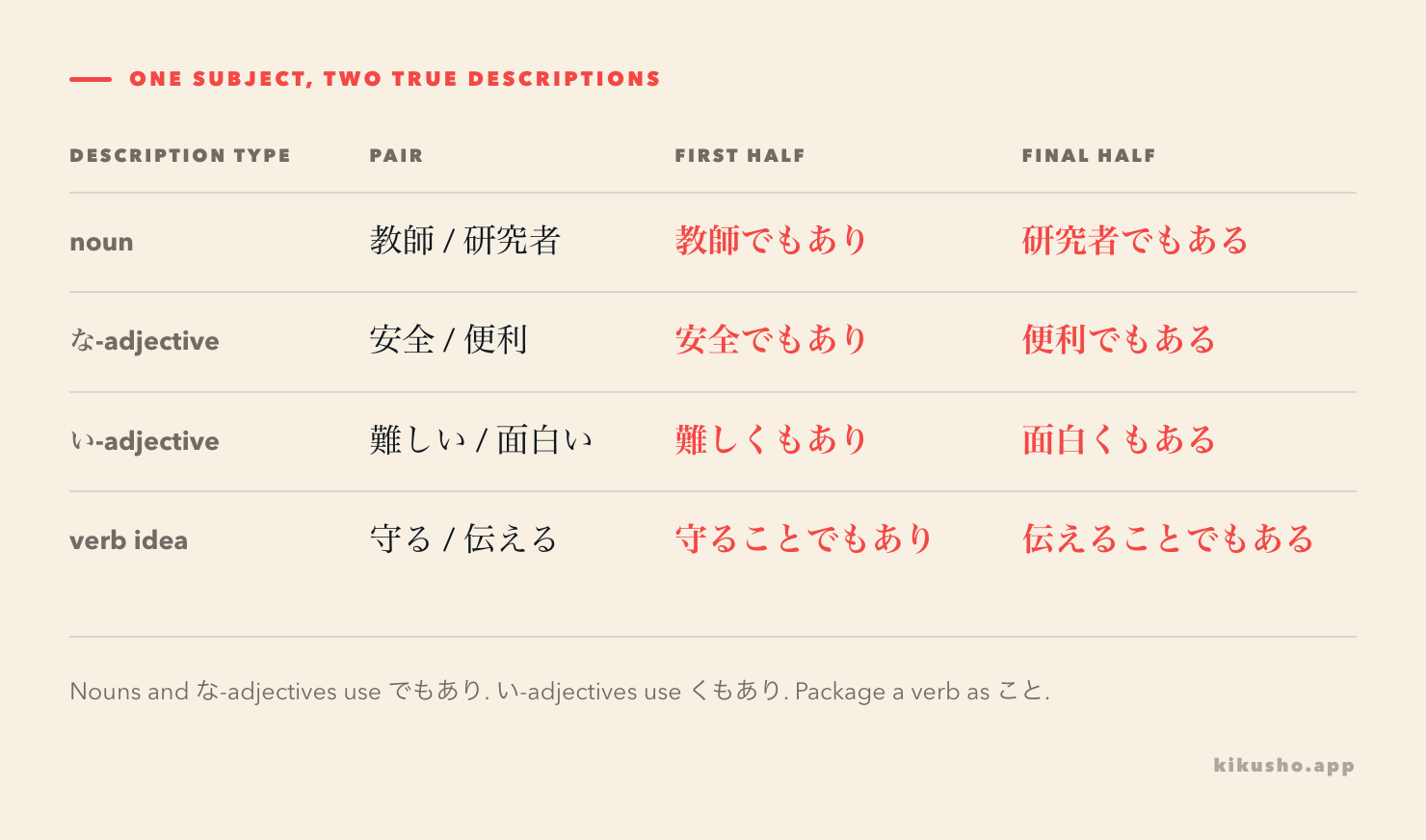
Nouns and な-adjectives use でもあり directly
Nouns attach without another copula:
投票することは権利でもあり、責任でもある。
とうひょうする ことは けんりでも あり、せきにんでも ある。
Voting is both a right and a responsibility.
For a な-adjective, attach the same forms to the stem. Do not keep な:
新しい図書館は静かでもあり、開放的でもある。
あたらしい としょかんは しずかでも あり、かいほうてきでも ある。
The new library is both quiet and open.
The pattern is 静かでもあり, not 静かなでもあり and not 静かだでもあり. な links the adjective to a following noun, as in 静かな図書館; だ is replaced by the である family used here.
い-adjectives change to くもあり~くもある
An い-adjective has no copular で to carry into the pattern. Drop final い, add く, and then add もあり or もある:
海外で働くことは難しくもあり、面白くもある。
かいがいで はたらく ことは むずかしくも あり、おもしろくも ある。
Working abroad is both difficult and interesting.
The full pair is 難しい → 難しくもあり and 面白い → 面白くもある. Forms such as 難しいでもあり and 面白くでもある mix the two attachment routes and are incorrect.
The two sides do not need to belong to the same word class. A mixed pair is natural when the meanings form a coherent evaluation:
この道具は便利でもあり、使いやすくもある。
この どうぐは べんりでも あり、つかいやすくも ある。
This tool is both convenient and easy to use.
Here 便利 is a な-adjective, so it takes でもあり. 使いやすい is an い-adjective, so it takes くもある. Parallel meaning matters more than identical morphology.
Finite verbs do not attach directly to this target frame. Package an action as a noun with こと, or choose two role nouns:
地域の文化を残すことは、記録することでもあり、次の世代に伝えることでもある。
ちいきの ぶんかを のこす ことは、きろくする ことでも あり、つぎの せだいに つたえる ことでも ある。
Preserving local culture is both recording it and passing it on to the next generation.
Both descriptions apply within one frame
The construction asks the reader to assign A and B to the same topic. The pair can express several relationships:
| Relationship | Example pair | What the sentence claims |
|---|---|---|
| two roles | 教師 / 研究者 | one person has both roles |
| two functions | 図書館 / 交流の場 | one place serves both functions |
| two compatible qualities | 安全 / 便利 | both evaluations hold |
| two opposing qualities | 楽しい / 厳しい | both sides belong to one experience |
| two interpretations | 終わり / 始まり | one event can be understood both ways |
卒業は学生生活の終わりでもあり、新しい生活の始まりでもある。
そつぎょうは がくせいせいかつの おわりでも あり、あたらしい せいかつの はじまりでも ある。
Graduation is both the end of student life and the beginning of a new life.
The two labels do not have to be synonyms or opposites. They need a context in which both illuminate the same subject. この建物は図書館でもあり、木曜日でもある has valid morphology but no ordinary relationship between the labels.
Opposite evaluations can coexist without the grammar itself meaning “although”:
チームを率いることは誇らしくもあり、怖くもある。
チームを ひきいる ことは ほこらしくも あり、こわくも ある。
Leading the team is both a source of pride and frightening.
The construction simply validates both feelings. If the argument needs to foreground a benefit and its drawback, 反面 and 一方で make that relationship more explicit.
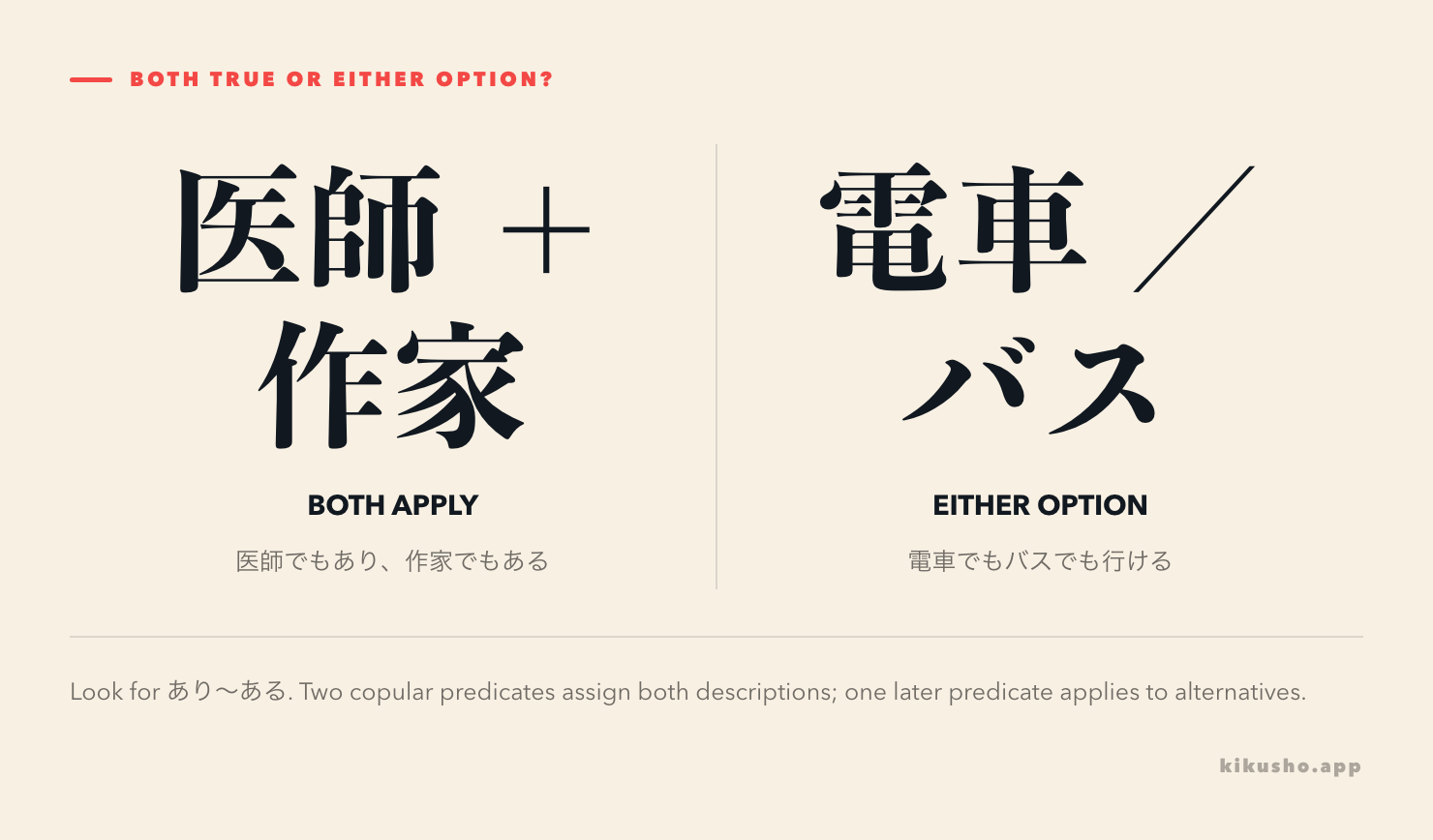
Do not read the pair as “either A or B”
The surface sequence NでもNでも also appears with alternatives:
電車でもバスでも行ける。
でんしゃでも バスでも いける。
You can go by either train or bus.
There is one shared predicate, 行ける, after the alternatives. The sentence allows either means; it does not say that one trip uses both.
In the target construction, each description has its own copular predicate:
この乗り物は観光列車でもあり、地域住民の足でもある。
この のりものは かんこうれっしゃでも あり、ちいきじゅうみんの あしでも ある。
This vehicle is both a tourist train and daily transport for local residents.
The visible あり~ある is the decisive cue. It assigns both descriptions rather than leaving them as choices.
The final ある carries tense and politeness
The first predicate normally remains でもあり or くもあり. The final ある carries the tense and style of the complete sentence:
| Meaning | Noun / な-adjective ending | い-adjective ending |
|---|---|---|
| plain nonpast | でもある | くもある |
| polite nonpast | でもあります | くもあります |
| plain past | でもあった | くもあった |
| polite past | でもありました | くもありました |
その場所は私たちの教室でもあり、実験室でもありました。
その ばしょは わたしたちの きょうしつでも あり、じっけんしつでも ありました。
That place served as both our classroom and our laboratory.
The past ending applies to both descriptions. Repeating past tense in the first half, as in 教室でもあった、実験室でもありました, breaks the standard balanced frame unless the writer deliberately starts a new clause.
More than two descriptions can be chained. Each nonfinal member uses the connecting form, and only the last predicate closes the sentence:
この施設は学びの場でもあり、交流の場でもあり、災害時の避難所でもある。
この しせつは まなびの ばでも あり、こうりゅうの ばでも あり、さいがいじの ひなんじょでも ある。
This facility is a place for learning, a place for exchange and an evacuation shelter during disasters.
The whole chain can modify a noun:
今日は創立記念日でもあり、町の祭りの日でもある特別な一日だ。
きょうは そうりつきねんびでも あり、まちの まつりの ひでも ある とくべつな いちにちだ。
Today is a special day that is both the anniversary of the founding and the day of the town festival.
Choose the pattern by information shape
Several forms can translate as “both” or “also,” but they organize the claim differently.
| Form | Main effect | Example shape |
|---|---|---|
| AでもありBでもある | assigns two balanced descriptions to one subject | 医師でもあり研究者でもある |
| Aであると同時にBでもある | explicitly states coexistence; can also relate timed events | 医師であると同時に研究者でもある |
| Aも~ばBも~ | balances two full facts or characteristics | 知識もあれば経験もある |
| AだけでなくBも | establishes A, then adds B | 知識だけでなく経験もある |
と同時に is useful when simultaneity or double function is the conceptual point. The と同時に lesson also covers event timing, which でもあり~でもある does not.
も~ば~も can coordinate verbs and whole clauses as well as properties. Its visible ば-form may look conditional, so the も~ば~も lesson shows how the paired も markers create a parallel reading.
Use だけでなく when the second fact arrives as an addition beyond the first. Use the target form when the sentence should feel like a balanced account of one subject.
Practice: keep both descriptions in view
Hold the two descriptions together while you solve these seven tasks; reveal the explanations only after the final composition prompt.
Question 1. Choose the correct noun pattern.
田中さんは通訳( )、地域の日本語教師( )。
A. であり/でもいる
B. でもあり/でもある
C. にもあり/にある
D. でもあって/でありもする
Question 2. Complete the い-adjective pair.
この先生の指導は( )、( )。
Intended meaning: “This teacher's guidance is both strict and warm.”
| Candidate | First / final form |
|---|---|
| A | 厳しいでもあり/温かいでもある |
| B | 厳しくでもあり/温かくでもある |
| C | 厳しくもあり/温かくもある |
| D | 厳しいもあり/温かいもある |
Question 3. Which sentence correctly mixes a な-adjective with an い-adjective?
- このアプリは便利でもあり、使いやすくもある。
- このアプリは便利くもあり、使いやすいでもある。
- このアプリは便利なでもあり、使いやすくでもある。
- このアプリは便利だもあり、使いやすいもある。
Question 4. What is the difference between these sentences?
① この建物は学校でもあり、避難所でもある。
② 学校でも公民館でも避難できる。
A. Both sentences say that the same building has two permanent identities.
B. Sentence ① assigns two functions to one building; sentence ② allows either location as an option.
C. Sentence ① offers a choice; sentence ② says every location is both a school and a community center.
D. Both sentences require the speaker to use both places.
Question 5. Choose the ending that makes both descriptions polite and past.
そこは私の職場でもあり、学びの場でも( )。
Candidate A: ありました
Candidate B: ありますでした
Candidate C: あったです
Candidate D: あり
Question 6. Build a three-part chain with one final closing predicate.
この施設は図書館( ① )、交流の場( ② )、災害時の避難所( ③ )。
Path 1: ①でもあり ②でもあり ③でもある
Path 2: ①である ②でもある ③でもあり
Path 3: ①でもある ②でもあった ③でもあり
Path 4: ①にあり ②もあり ③である
Question 7. Write two sentences about a community garden. In the first, use 学びの場でもあり、交流の場でもある. In the second, explain that maintaining it is both a responsibility and a pleasure, using 責任でもあり、楽しみでもある.
Answers and explanations
1. Two noun predicates
B. でもあり/でもある. Both nouns receive the copular predicate with additive も: 田中さんは通訳でもあり、地域の日本語教師でもある。 The first あり connects forward; the final ある completes the sentence.
2. Two い-adjectives
Candidate C: 厳しくもあり/温かくもある. Both い-adjectives drop final い, take く, and then attach to もあり or もある. The sentence presents strictness and warmth as simultaneous qualities of the teacher's guidance.
3. Two attachment routes
Sentence 1. 便利 is a な-adjective stem and takes でもあり. 使いやすい is an い-adjective and changes to 使いやすくもある.
4. Simultaneous truths or alternatives
B. In ①, the two copular predicates でもあり~でもある assign both functions to one building. In ②, 学校でも公民館でも presents two possible locations under the shared predicate 避難できる.
5. Final tense and politeness
Candidate A: ありました. The complete sentence is そこは私の職場でもあり、学びの場でもありました。 The polite past ending on the final predicate places both descriptions in the past.
6. One closing predicate
Path 1. Each nonfinal role uses でもあり, and the third uses でもある to close the chain: 図書館でもあり、交流の場でもあり、災害時の避難所でもある.
7. One possible response
この地域の菜園は、子どもたちの学びの場でもあり、住民の交流の場でもある。
菜園を維持することは、私たちの責任でもあり、季節の変化を味わう楽しみでもある。
The first sentence assigns two functions to the garden. The second keeps one nominal frame on both sides and presents maintenance as both an obligation and a source of enjoyment.
Save the pair, not an isolated でも
An isolated でも has too many possible jobs to make a useful review prompt. Keep the subject, the first description and the final description together: 卒業は終わりでもあり、始まりでもある.
That complete frame makes the decisive question visible on review: are two descriptions simultaneously true, or are two nouns merely alternatives under one later predicate? Once you locate あり~ある, the balanced N1 reading becomes much easier to recover.
Common questions
What does でもあり~でもある mean in Japanese?
AでもありBでもある means that A and B are both true descriptions of the same subject. It can present two roles, qualities, functions or interpretations with balanced emphasis.
How do nouns and な-adjectives attach to でもあり~でもある?
Attach でもあり to the first noun or な-adjective stem and でもある to the second: 教師でもあり研究者でもある; 安全でもあり便利でもある.
How do い-adjectives work with this pattern?
Change each い-adjective to its く-form and add もあり or もある: 難しくもあり面白くもある. Do not add で after an い-adjective.
Is でもあり~でもある the same as でも~でも for alternatives?
No. 教師でもあり作家でもある assigns both roles to one person. 電車でもバスでも行ける presents either train or bus as a possible means; the shared predicate applies to the alternatives.