On this page
ではあるまいし rejects an identity as irrelevant: 子どもではあるまいし means “You are not a child, so...” ともあろうものが does the reverse. 先生ともあろうものが means “For someone who is a teacher to...” and criticizes conduct that falls below the standards of that real role.
Both expressions use a noun to activate expectations. The deciding question is whether the sentence denies that noun or invokes it.
One role is denied; the other is invoked
Compare two adults behaving badly:
子どもではあるまいし、人前でそんなに騒ぐのはやめなさい。
こどもでは あるまいし、ひとまえで そんなに さわぐのは やめなさい。
“You are not a child, so stop making such a scene in public.”
教師ともあろうものが、人前で学生を侮辱するとは信じられない。
きょうしとも あろう ものが、ひとまえで がくせいを ぶじょくするとは しんじられない。
“It is unbelievable that someone who is supposed to be a teacher would insult a student in public.”
In the first sentence, the person is not a child. The speaker rejects “being a child” as an excuse for the behavior. In the second, the person is a teacher. That status is exactly why the conduct causes disappointment.
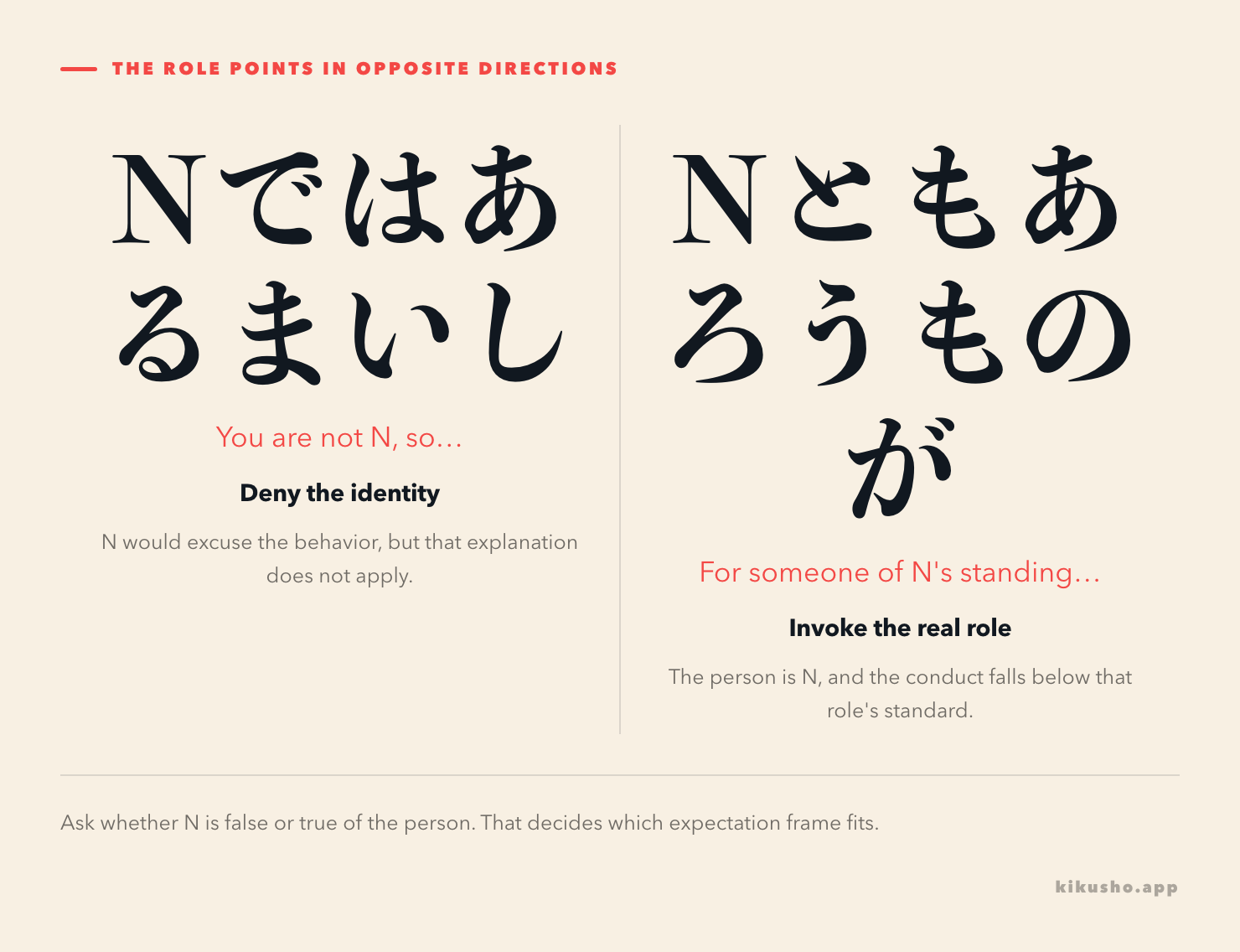
| Form | Relationship to the noun | Expectation logic | Usual continuation |
|---|---|---|---|
| Nではあるまいし | the person or situation is not N | N would explain the behavior, but that excuse does not apply | advice, criticism, judgment |
| Nともあろうものが | the person really is N | someone in that role should know or behave better | surprise, disappointment, condemnation |
This difference prevents a common mix-up. 新人ではあるまいし addresses someone who is no longer a newcomer. ベテランともあろうものが addresses someone who really is a veteran and has failed the standard associated with experience.
ではあるまいし removes an excuse
The core form is:
noun + では/でも/じゃ + あるまいし, B
The first clause says “it is not as if N.” The following clause states what should therefore be obvious, unnecessary or inappropriate.
新人ではあるまいし、その手続きは一人でできるでしょう。
しんじんでは あるまいし、その てつづきは ひとりで できるでしょう。
“You are not a new employee, so you should be able to handle that procedure yourself.”
神様でもあるまいし、十年後のことまで正確には予測できない。
かみさまでも あるまいし、じゅうねんごの ことまで せいかくには よそくできない。
“I am not a god, so I cannot predict things ten years ahead with precision.”
漫画じゃあるまいし、そんな偶然が何度も続くわけがない。
まんがじゃ あるまいし、そんな ぐうぜんが なんども つづく わけが ない。
“This is not a manga; coincidences like that cannot keep happening.”
The variants share the same logic. じゃあるまいし is the most conversational. ではあるまいし and でもあるまいし sound less contracted, but the construction often belongs to speech because it voices a pointed personal judgment.
日本語NET's N1 explanation gives N + ではあるまいし, identifies the spoken register and notes that the second clause commonly contains the speaker's assertion, advice or judgment. JLPT Sensei independently lists では, でも and じゃ variants and places the pattern at N1.
A clause can also be packaged with わけ or の when the rejected excuse is a proposition rather than a simple identity:
二度と会えないわけではあるまいし、そんなに落ち込まないで。
にどと あえない わけでは あるまいし、そんなに おちこまないで。
“It is not as if you will never meet again, so do not be so downhearted.”
遊びに行くのではあるまいし、もう少しきちんとした服を着たらどうですか。
あそびに いくのでは あるまいし、もうすこし きちんとした ふくを きたら どうですか。
“You are not going out for fun, so why not wear something a little more appropriate?”
Here わけ or の turns the preceding clause into the proposition being denied. This is different from placing a bare verb directly before ではあるまいし.
ともあろうものが measures conduct against status
The core form is narrower:
role or status noun + ともあろうものが, unexpected conduct
The noun normally names a position associated with knowledge, responsibility, skill or public trust. The following event contradicts that standard.
医師ともあろうものが、患者の個人情報を漏らすとは許されない。
いしとも あろう ものが、かんじゃの こじんじょうほうを もらすとは ゆるされない。
“It is unacceptable for a doctor, of all people, to disclose a patient's personal information.”
ベテランの整備士ともあろうものが、基本的な点検を忘れたなんて驚いた。
ベテランの せいびしとも あろう ものが、きほんてきな てんけんを わすれたなんて おどろいた。
“I was shocked that an experienced mechanic, of all people, forgot a basic inspection.”
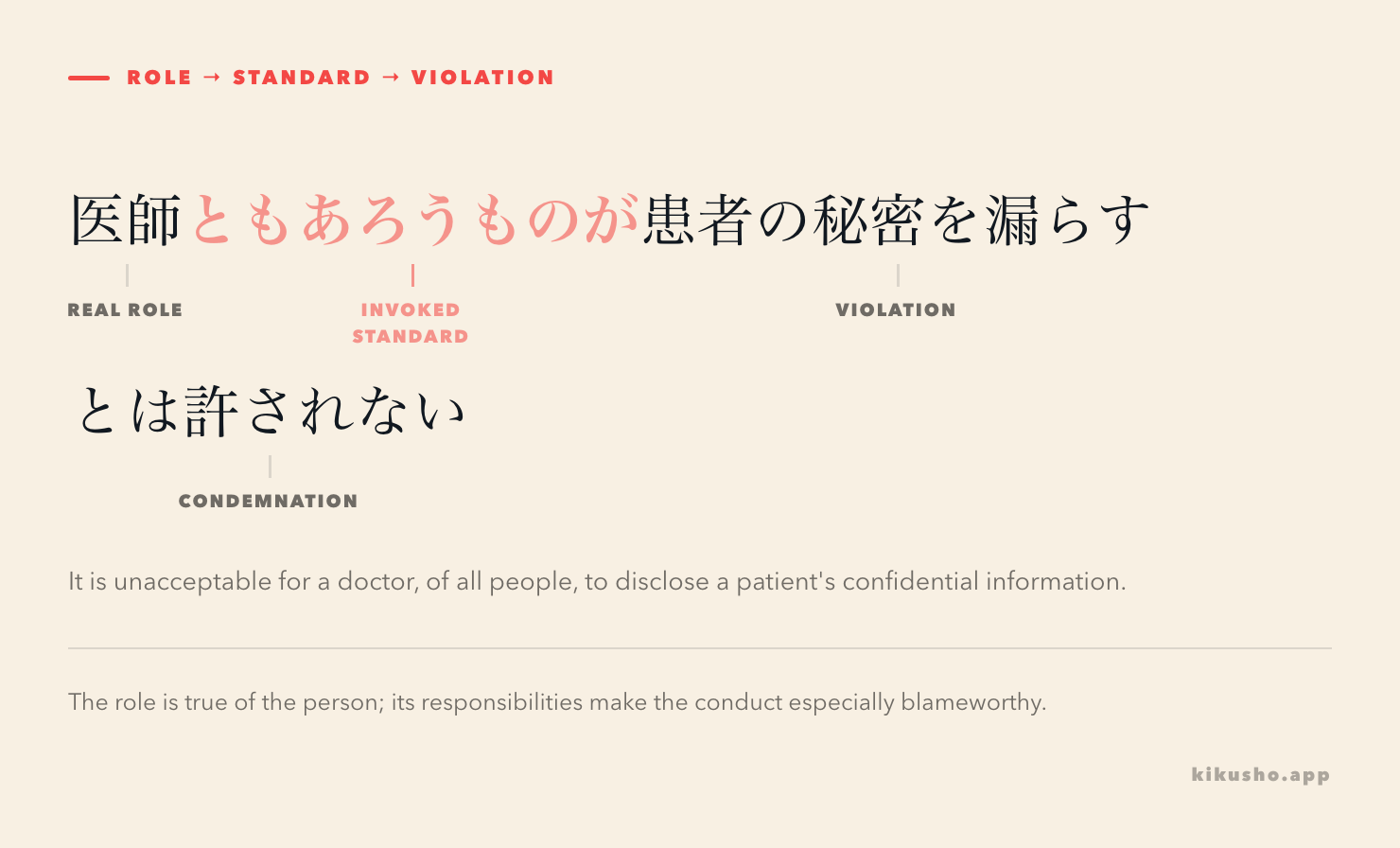
毎日のんびり日本語教師 describes N + ともあろうものが as criticism of bad conduct by someone in a profession or position. It also notes the frequent とは and なんて continuations and the focus on conduct that has actually occurred. The Hane search result for ともあろうものが independently describes disbelief at unexpected misbehavior and uses a doctor violating patient confidentiality as its example frame.
The pattern is not a neutral way to mention employment:
× 医師ともあろうものが、病院で働いている。
○ 医師ともあろうものが、診断結果を確認せずに伝えたとは。
The first sentence contains no violated expectation. The second contrasts a doctor's responsibility with a serious lapse. ものが often leaves the emotional judgment to とは, なんて, 驚いた, 情けない or 許されない.
The noun must support the expectation
With ではあるまいし, almost any noun can work if it represents a rejected explanation or comparison:
夏ではあるまいし、冷房を一日中つける必要はない。
“It is not summer, so there is no need to run the air conditioner all day.”
The noun 夏 is not a respected role. It is simply the condition that would have justified the action.
With ともあろうものが, the noun needs a socially recognizable standard:
| Natural anchor | Expected standard | Contradictory conduct |
|---|---|---|
| 教師 | protects and guides students | humiliates a student publicly |
| 医師 | protects patients and confidentiality | leaks private information |
| 警察官 | upholds the law | helps a criminal organization |
| 専門家 | checks facts in the field | repeats an elementary error |
| ベテラン | possesses reliable experience | skips a basic procedure |
An arbitrary noun such as 近所の人ともあろうものが needs context establishing a special expectation. Without one, the elevated form sounds forced. The grammar does not automatically turn every person into a role of high standing.
The behavior is usually known or presented as fact. If the speaker is merely warning about a future possibility, a conditional or ordinary advice form is clearer. 政治家ともあろうものが汚職をするかもしれない clashes because the pattern condemns a role violation while かもしれない leaves the event speculative.
Compare matched situations
The same broad behavior can be framed from opposite directions.
Experience at work
新人ではあるまいし、同じ入力ミスを何度も繰り返さないでください。
“You are not a newcomer, so please stop repeating the same data-entry error.”
The sentence denies 新人 as an excuse. It does not explicitly name the person's actual rank.
ベテランともあろうものが、同じ入力ミスを何度も繰り返すとは情けない。
“It is disappointing that a veteran would repeat the same data-entry error again and again.”
This sentence invokes ベテラン as the real status and measures the conduct against it.
Knowledge and prediction
神様ではあるまいし、結果を完全に予測することはできない。
“I am not a god, so I cannot predict the result perfectly.”
The impossible identity explains why limited knowledge is reasonable.
専門家ともあろうものが、資料を確認せずに断言したとは驚きだ。
“It is surprising that an expert made a categorical claim without checking the materials.”
The real identity creates a higher evidential standard.
Neither pattern is polite simply because it is advanced. Both can sound accusatory. Avoid directing them at a superior or stranger unless the context supports deliberate criticism. A neutral correction can state the issue itself: この点は再確認が必要です, “This point needs to be checked again.”
Separate ではあるまいし from ではあるまいか
One kana changes the relation between the clauses:
子どもではあるまいし、自分で決めなさい。
“You are not a child, so decide for yourself.”
この決定は性急ではあるまいか。
“Might this decision be premature?”
し presents the negative premise as a reason for the following judgment. か turns the form into a literary question that cautiously advances a proposition. The full でなくてなんだろう and ではあるまいか lesson compares that rhetorical proposal with an emphatic assertion.
The まい and ようか~まいか lesson covers negative intention, formal negative conjecture and indecision over action. In ではあるまいし, however, learn the complete frame rather than trying to translate まい in isolation.
ともあろうものが is not たるもの
Both can evoke the standard attached to a role, but their sentence jobs differ.
教師たるもの、学生に公平でなければならない。
“A teacher must be fair to students.”
教師ともあろうものが、成績を好みで決めるとは。
“For a teacher, of all people, to decide grades according to personal preference!”
Nたるもの states the general duty or ideal of N. Nともあろうものが reacts to a particular person whose conduct violates such a duty. Before either advanced form, the にとって and として lesson separates an ordinary role marked by として from an evaluation made from someone's viewpoint.
N1 is the supported study placement
日本語NET and JLPT Sensei classify ではあるまいし as N1. 毎日のんびり日本語教師, Hane and JLPT Sensei give ともあろうものが the same level. The curriculum retains two item keys so review evidence can separately confirm the denied-excuse frame and the real-role criticism frame.
The official JLPT FAQ states that the current exam does not provide its former exhaustive content specifications. N1 is therefore the shared placement in the checked teaching references and Kikusho's sequence, not a promise about a particular paper.
Six questions before the explanations
Finish the set before revealing any answers.
Question 1
You are speaking to an experienced colleague, denying “new employee” as an excuse. Choose the best opening.
- ア:新人ともあろうものが
- イ:新人ではあるまいし
- ウ:新人でなくてなんだろう
- エ:新人ではあるまいか
Question 2
Which sentence correctly invokes a real professional role to condemn misconduct?
- ア:医師ではあるまいし、患者を診察した。
- イ:医師ともあろうものが、患者の秘密を漏らすとは。
- ウ:医師でなくてなんだろう、病院へ行った。
- エ:医師ではあるまいか、薬を飲んだ。
Question 3
Complete the rejected-proposition frame: 二度と会えない( )、そんなに悲しまないで。
- ア:ものともあろうが
- イ:ではあるまいか
- ウ:わけではあるまいし
- エ:ともあろうものが
Question 4
Arrange all four pieces to mean “It is shocking that an expert made a claim without checking the data.” Which piece occupies ★?
__ __ ★ __。
- ア:専門家ともあろうものが
- イ:データを確認せずに
- ウ:断言したとは
- エ:驚きだ
Write the complete sentence as well as the label at ★.
Question 5
A learner writes 先生ではあるまいし、学生を侮辱したとは許せない about a person who really is a teacher. Replace only the expectation frame so the sentence criticizes that real role appropriately.
Question 6
Choose the pair that correctly contrasts a denied excuse with an invoked status.
甲、基本操作ぐらい自分で調べてください。ベテラン乙、同じ操作を三度も間違えるとは驚きです。
- ア:甲 新人ではあるまいし / 乙 ともあろうものが
- イ:甲 新人ともあろうものが / 乙 ではあるまいし
- ウ:甲 新人ではあるまいか / 乙 でなくてなんだろう
- エ:甲 新人でなくてなんだろう / 乙 ではあるまいか
Answers and explanations
1
イ:新人ではあるまいし. The addressee is not a newcomer, so that identity cannot excuse the failure. ともあろうものが would require 新人 to be the person's real status and would invoke expectations attached to it.
2
イ:医師ともあろうものが、患者の秘密を漏らすとは. The person really is a doctor, confidentiality belongs to that role, and leaking the information violates its standard. The final とは leaves the condemnation strongly implied.
3
ウ:わけではあるまいし. 二度と会えないわけ packages the proposition “will never meet again.” The speaker denies that proposition as a reason for excessive sadness.
4
The complete sentence is 専門家ともあろうものが、データを確認せずに断言したとは驚きだ。 The order is ア → イ → ウ → エ, so ウ:断言したとは occupies ★. The actual role comes first, followed by the conduct that violates its evidential standard and the reaction.
5
Use 先生ともあろうものが、学生を侮辱したとは許せない。 The person really is a teacher, so the sentence must invoke that role rather than deny it. The insult is judged against a teacher's responsibility toward students.
6
ア. 新人ではあるまいし removes inexperience as an excuse because the colleague is not new. ベテランともあろうものが invokes the real veteran status and expresses surprise that the person's performance fell below it.
Check whether the noun is true
When either form appears, test the noun against the person or situation. If the noun is false and would merely excuse the behavior, read ではあるまいし as “it is not as if X, so...” If the noun is true and carries a standard the behavior violated, read ともあろうものが as “for someone of X's standing to...” The expectation is present in both; the truth of the role points in opposite directions.
Common questions
What does ではあるまいし mean?
It means “it is not as if X” or “you are not X, so...” The speaker rejects X as an explanation or comparison, then usually gives a judgment, advice or criticism in the following clause.
What does ともあろうものが mean?
It means “for someone of X's standing to...” or “of all people.” The noun names a real role with respected standards, and the following conduct violates what the speaker expects from that role.
How do ではあるまいし and ともあろうものが differ?
ではあるまいし denies that the person or situation belongs to X. By contrast, ともあろうものが invokes a role the person really has and criticizes conduct as unworthy of it.
Is じゃあるまいし formal Japanese?
じゃあるまいし is the conversational contraction of ではあるまいし. The construction itself is common in pointed spoken judgments; では is less casual, but a neutral formal report usually chooses another reason frame.